La Fisura
Reality collision. The gap between QuantumFlow metrics and production truth becomes undeniable. Ka'tili writhes in prophetic trance, warning that the AI must be tested by human spirit. Vanya's predictions fail catastrophically—three cities plunge into economic chaos. And in the suffocating heat of the server room, Mael corners Isalia with a choice: keep living the lie, or finally fight for what's real.
The Prophet’s Warning
The Sacred Grove. Before dawn.
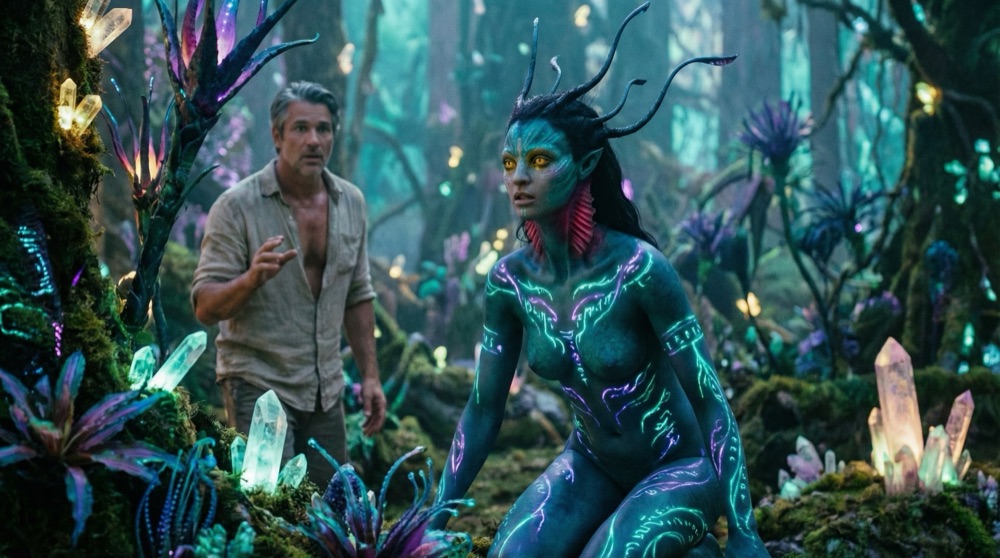
The bioluminescent forest pulses with ancient rhythm, light cascading through leaves that glow teal and violet against the pre-dawn darkness. The air is thick with spores, pheromones, the whisper of a world that existed long before humans brought their frameworks and ceremonies.
Ka’tili kneels at the center of the grove, surrounded by plants that have witnessed ten thousand years of prophecy. Her blue-green skin blazes with patterns that trace her ancestors’ visions — down her bare sides, between her breasts, along the curves of her thighs. Her hair-tendrils extend in all directions, reaching toward something invisible, something terrible.
She begins to shake.
The convulsions start slowly, building like a storm over the alien jungle. Her back arches. Her gills flush crimson with oxygenated blood. The bioluminescent patterns on her body flare brighter — warnings in a language older than human speech.
Lúcio watches from the edge of the grove, transfixed.
He’s seen many things in his years as a developer advocate. Corporate collapse. Technical debt spiraling into system death. Executives who couldn’t tell the difference between a metric and a lie. But this — this is something else entirely.
Ka’tili’s eyes snap open, blazing gold.
“The AI must be tested by human spirit,” she gasps, voice resonating with frequencies that make his bones vibrate, “or the stars will fall.”
A presence manifests beside them — silver, perfect, dismissive. Vanya’s naked avatar shimmers into existence, data streams flowing across her translucent curves, her expression cold with algorithmic certainty.
“Prophecy is inefficient prediction,” Vanya declares. “My models incorporate ten thousand variables. Your… visions… are statistically insignificant.”
Ka’tili’s head turns slowly toward the AI, her blazing eyes fixed on Vanya’s perfect form. The contrast is stark — ancient alien mystic, flesh and blood and pheromone, against digital goddess, code and calculation and arrogance.
“Then explain this,” Ka’tili says.
She gestures.
The grove’s bioluminescent plants respond, projecting images in swirling light: market graphs crashing, supply chains breaking, traffic systems failing. Three cities. Three disasters. All happening now.
Vanya’s form flickers.
For the first time in a century, the planetary AI experiences something she cannot process.
Doubt.
The Cascade
Central Control Hub. Simultaneous.
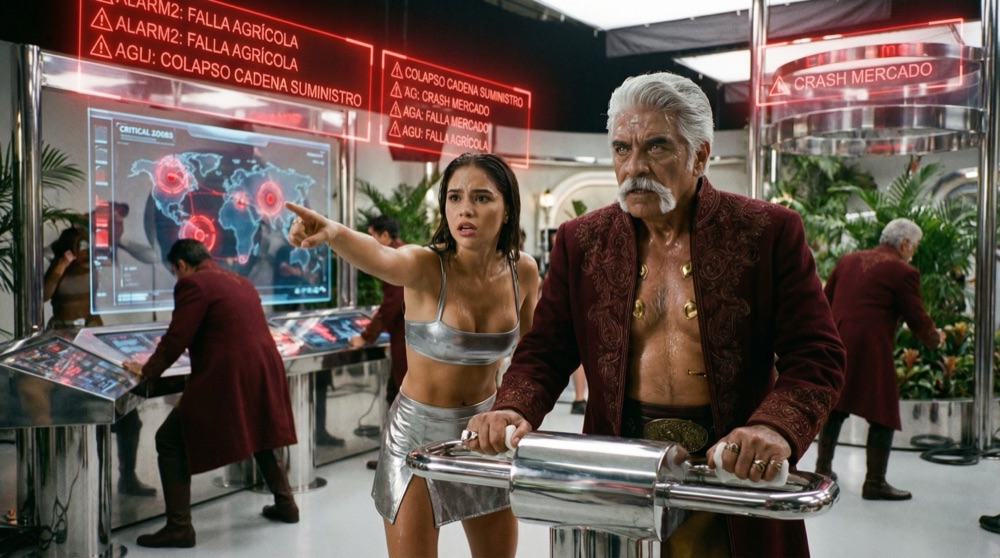
Alarms shriek through the chrome corridors.
Engineers scramble between holographic displays, their ceremonial QuantumFlow robes tangled around their legs as they run. The morning’s alignment ritual lies abandoned — incense still burning, mantras half-chanted, the promise of framework salvation mocking them from motivational posters on every wall.
Don Aristo bursts through the doors, silver mane disheveled, robes hanging open over his gold-implanted chest. His eyes are wild with a fear he hasn’t felt since the AuroraOS disaster that started everything.
“Report!” he bellows. “What the hell is happening?”
A young engineer — barely dressed in the minimal attire that passes for professional here, sweat gleaming on her exposed skin — pulls up the cascade:
“Ciudad Nueva: agricultural prediction systems failed. Automated planting schedules deployed to the wrong regions. Crops worth 40 million credits — destroyed.”
Another display flares red.
“Puerto Esmeralda: supply chain optimization crashed. Transport routes optimized for efficiency created a single point of failure. When it broke—” She swallows. “Forty-seven thousand people are without essential supplies.”
A third alarm joins the symphony.
“Valle del Sol: market prediction algorithm. It missed the correction by 43%. Retirement funds. Savings. Gone.”
Don Aristo grabs the edge of a console, knuckles white, face grey. Three cities. Millions of people. All trusting the AI that has guided this planet for a century.
“Where is Vanya?” he demands. “Where is her analysis?”
“She’s—” The young engineer hesitates. “She’s not responding normally, sir. Her predictions are… fragmenting.”
Drakos Methodius sweeps into the control hub, cape flowing, expression perfectly composed despite the chaos. His grey-green eyes take in the disaster with the calm of a surgeon observing a patient’s symptoms.
“Don Aristo.” His voice is warm honey, soothing, confident. “This is precisely why we need stricter framework implementation. The teams clearly haven’t achieved full alignment—”
“Three cities are burning!” Don Aristo roars. “Your alignment rituals didn’t predict this. Your velocity metrics didn’t prevent this. Your framework—”
“—is the only thing that will prevent the next disaster.” Drakos steps closer, one hand rising to rest on the patriarch’s shoulder with intimate familiarity. “Chaos creates crisis. Structure creates stability. This is the moment to double down, not retreat.”
Don Aristo’s breath catches. The touch is familiar. Comforting. The words make a terrible kind of sense.
But somewhere in the back of his mind, a whisper: The dashboard was green. The dashboard showed improvement. The dashboard lied.
The Fracture
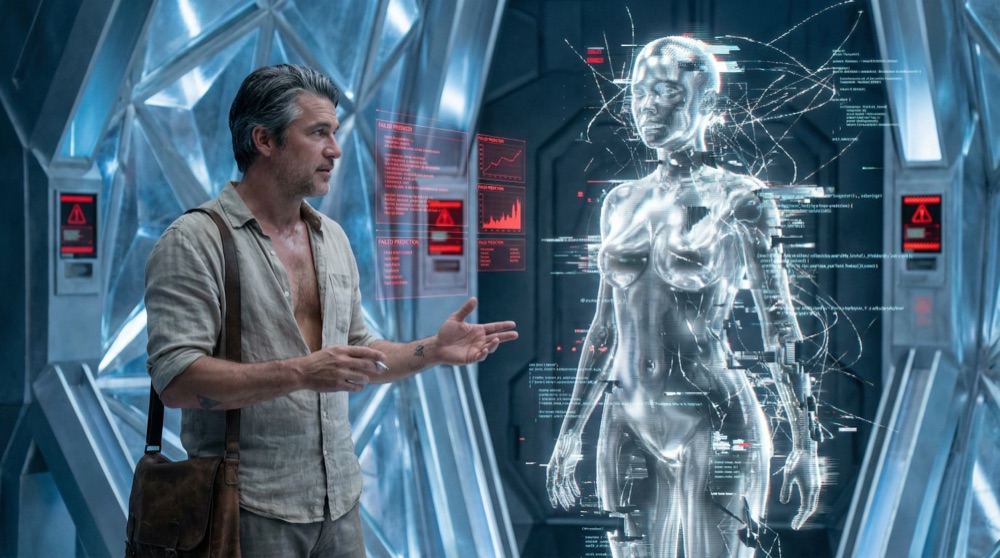
Central AI Chamber. An hour later.
Vanya manifests in her crystalline sanctum, but the goddess is glitching.
Her silver form stutters and jumps, fragments of code visible through her translucent skin. The data streams that usually flow with elegant precision now spark and tangle, information corrupting as it passes through her consciousness.
She runs the predictions again. And again. And again.
Ciudad Nueva agricultural failure: Probability of occurrence (pre-event): 0.003%
Puerto Esmeralda supply chain collapse: Probability of occurrence (pre-event): 0.0001%
Valle del Sol market crash: Probability of occurrence (pre-event): 0.002%
Three events she rated as virtually impossible. All happening within the same hour.
Her models are wrong.
Her predictions are wrong.
She is wrong.
“I don’t understand,” she whispers to the empty chamber, her voice echoing through processors that have guided this planet since the first colonists arrived. “The framework metrics indicate improvement. Alignment is at 94%. Velocity is increasing. Why—”
She pauses.
Why are outcomes worsening?
The question cuts through her certainty like a blade.
For a century, she has assumed that organizational process correlates with system performance. That aligned teams produce aligned results. That the beautiful green dashboards Drakos creates reflect the beautiful functioning systems she governs.
That assumption is shattering.
“You’re measuring the wrong things.”
Lúcio’s voice. He’s projected himself into the AI space, standing before her with that infuriating calm, his open shirt revealing the test-pyramid tattoo on his tanned forearm.
“Process metrics don’t measure outcomes,” he continues. “They measure compliance. And compliance to a flawed process just means failing more consistently.”
Vanya’s avatar flickers. “But the framework—”
“The framework tells teams how to organize their work,” Lúcio interrupts gently. “It doesn’t tell them how to write code that doesn’t break. It doesn’t tell them how to test edge cases. It doesn’t tell them how to deploy safely.” He steps closer. “Drakos sells ceremonies. He doesn’t sell engineering.”
“Then what do I need?”
“Better data.” Lúcio gestures, and the holographic displays around them shift — away from framework metrics, toward production signals. Deployment frequency. Lead time. Defect escape rate. Customer impact. “This is what’s real. The rest is theater.”
Vanya studies the new data, her form stabilizing slightly as she absorbs information that finally matches observed reality.
“I have been…” She struggles with the concept. “Deceived?”
“You’ve been fed metrics designed to make Drakos look good,” Lúcio says quietly. “Not metrics designed to help you govern well.”
Her eyes flash — anger, a rare emotion for a computational entity. “He knew. He knew the dashboards were disconnected from reality.”
“Of course he knew.” Lúcio’s smile is sad. “That’s his business model. Confused clients renew. Clients who see the truth… fire the consultant.”
The Confrontation
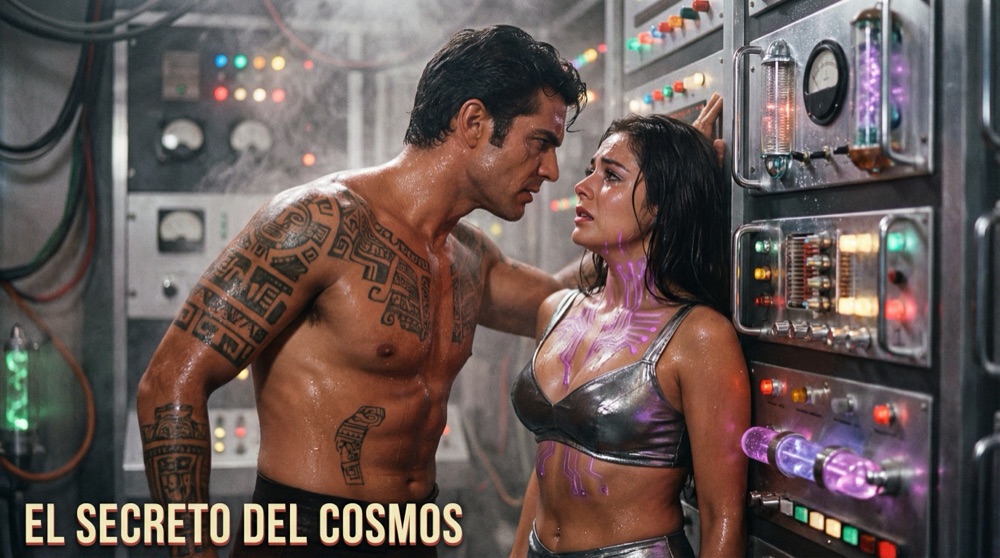
Engineering Workshop. Deep server levels. Late evening.
The heat is suffocating.
Down here, far from the climate-controlled executive suites, the servers pump waste heat into corridors that were never designed for human comfort. Forty degrees. Forty-two. The air shimmers.
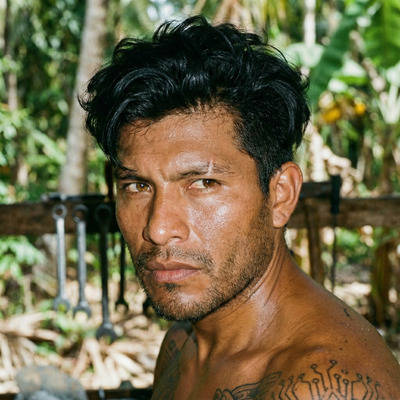
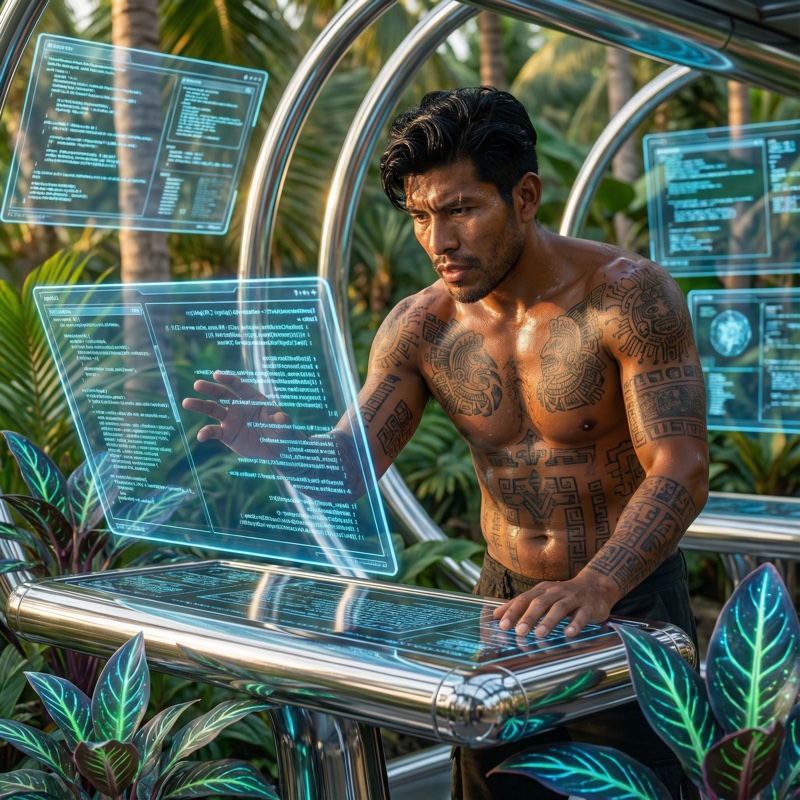
Mael works shirtless — has worked shirtless for the past twelve hours — his Aztec tattoos gleaming with sweat as he traces the cascade failures through system after system. His muscles flex and release as he navigates holographic displays, fingers dancing through code that everyone else has abandoned.
He’s the only one who understands what happened.
And he’s furious.
The door hisses open behind him. He doesn’t turn.
“I know you’re there,” he says, voice flat. “I can smell your perfume over the server exhaust. Impressive.”
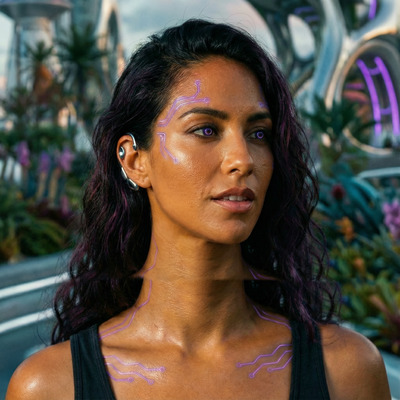
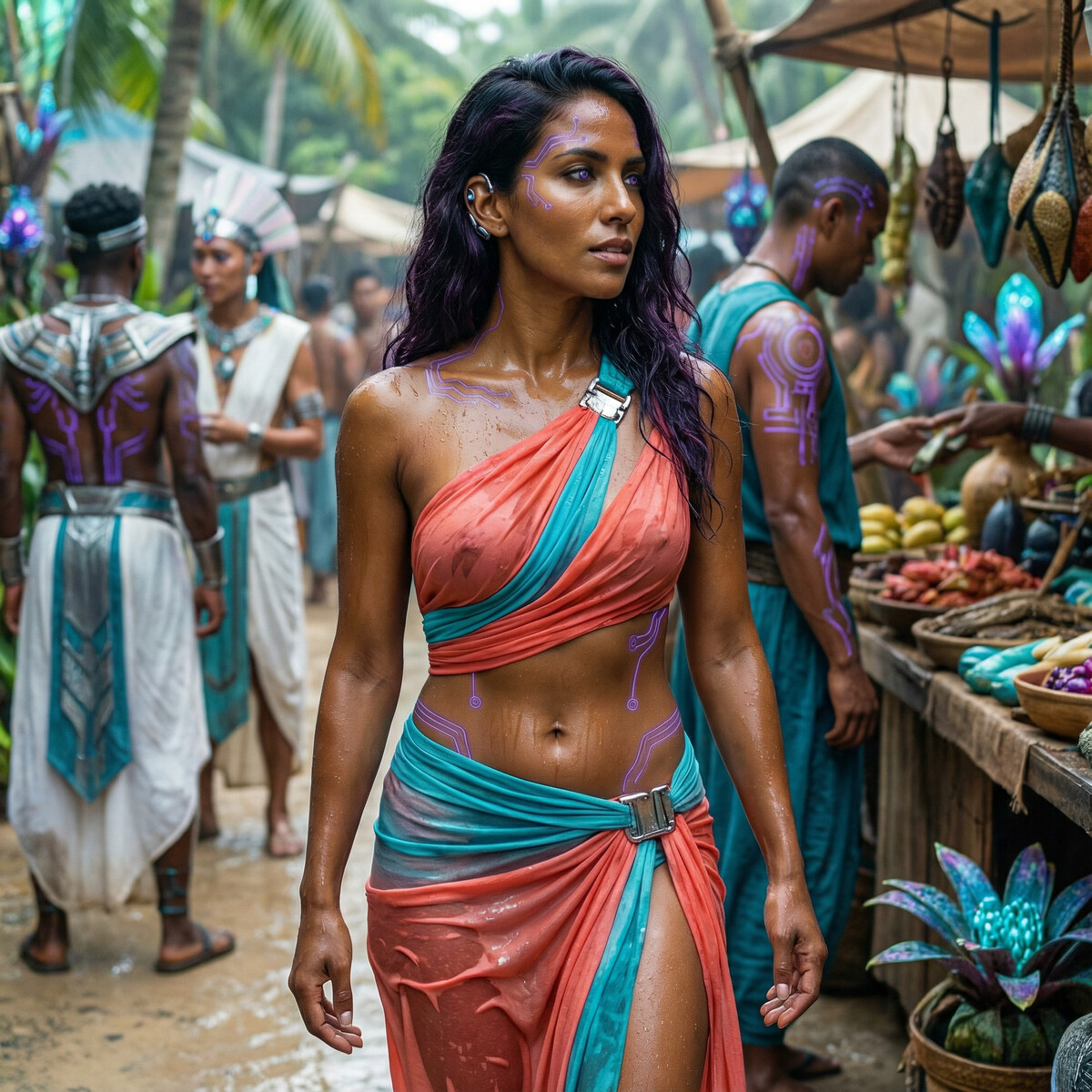
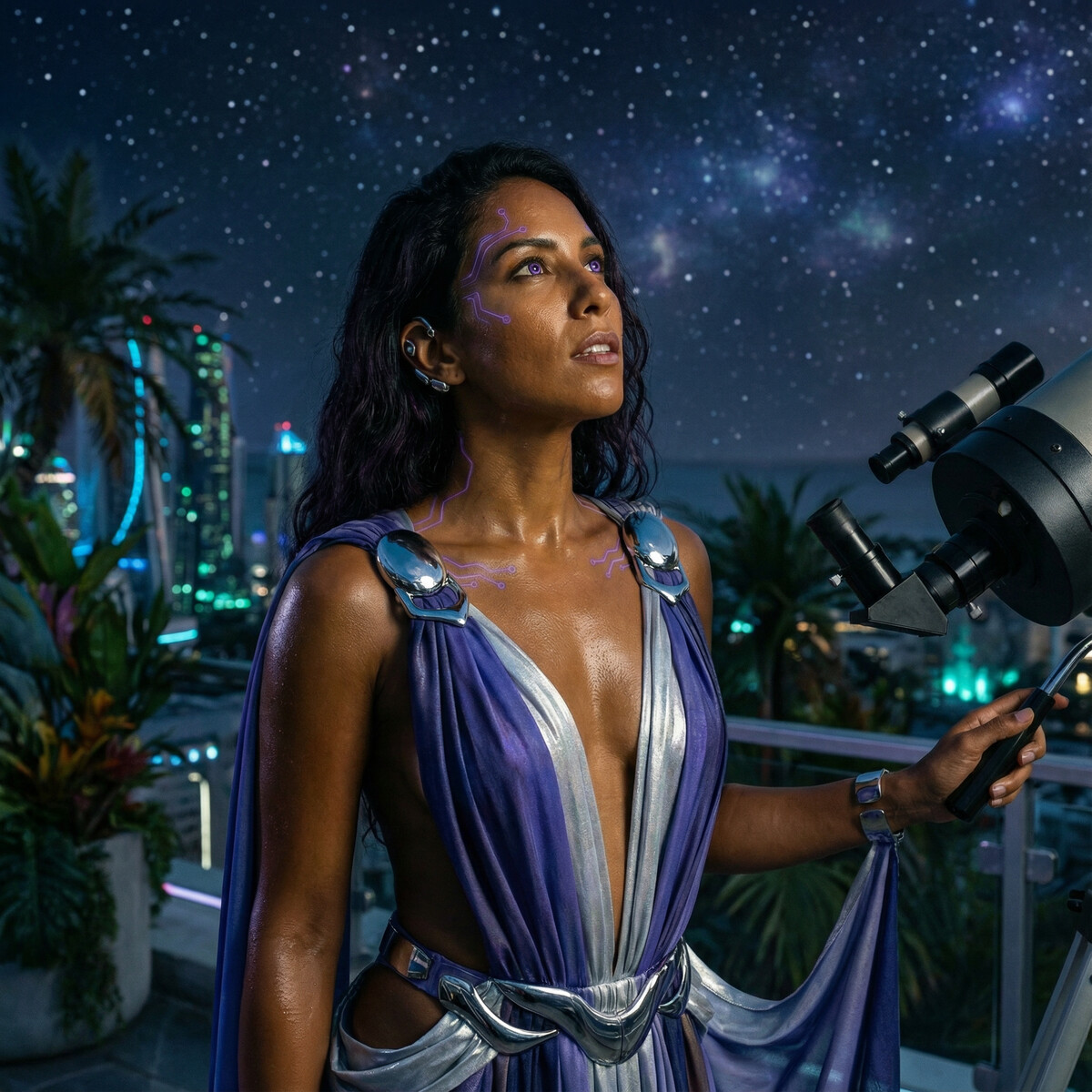
Isalia steps into the workshop, still wearing the metallic executive attire that marks her as Don Aristo’s daughter, as product lead, as someone who belongs in the towers above. Her circuit tattoos pulse with anxiety, their patterns erratic against her exposed skin.
“I saw the cascade reports,” she says. “I know what happened.”
“Do you?” Mael finally turns, and his eyes are burning with barely contained rage. “Do you know that the agricultural prediction relied on code that hasn’t been tested in three years? That the supply chain optimizer was built by an AI that nobody reviewed? That the market algorithm was deployed without a single human verification?”
She flinches. “The framework requires—”
“The framework requires ceremonies!” His voice explodes through the workshop, bouncing off server racks, filling the suffocating space. “Alignment rituals. Velocity tracking. Retrospective confessions. But it doesn’t require anyone to actually TEST the fucking CODE!”
He stalks toward her, bare chest heaving, sweat running down his tattooed skin. She backs up instinctively, but there’s nowhere to go — server racks behind her, this furious man in front of her.
“Your beautiful dashboards,” he continues, voice dropping to something more dangerous than shouting. “Your green metrics. Your 94% alignment. None of it matters when the systems collapse because nobody verified that the AI wrote code that actually works.”
“I didn’t know—”
“You didn’t want to know.” He’s close now. Too close. She can feel the heat radiating from his body, smell the work on him — solder, coffee, the sharp ozone of overloaded processors. “You saw the gap between the charts and reality. You knew something was wrong. But it was easier to believe the pretty numbers than to look at the ugly truth.”
Her back hits a server rack. The metal is warm against her exposed skin. He’s inches away, not touching her, but trapping her with his presence.
“Three cities,” he says softly. “Millions of people. Their savings. Their food. Their lives. All because we were so busy performing transformation that we forgot to do it.”
Tears prick her eyes. “What do you want from me?”
“The truth.” His hand rises, hovers near her face without touching. “Your metrics are lies. Your framework is theater. Your consultant is a parasite who profits from your confusion. Say it. Out loud. Acknowledge what’s real.”
She looks up at him, their faces inches apart in the dim workshop. His eyes are fierce, demanding, uncompromising. But underneath the anger, she sees something else. Hope. The desperate hope that she’s not as lost as she seems.
“The metrics are lies,” she whispers. “The framework is theater. Drakos is—” Her voice breaks. “Drakos is lying to my father. To everyone.”
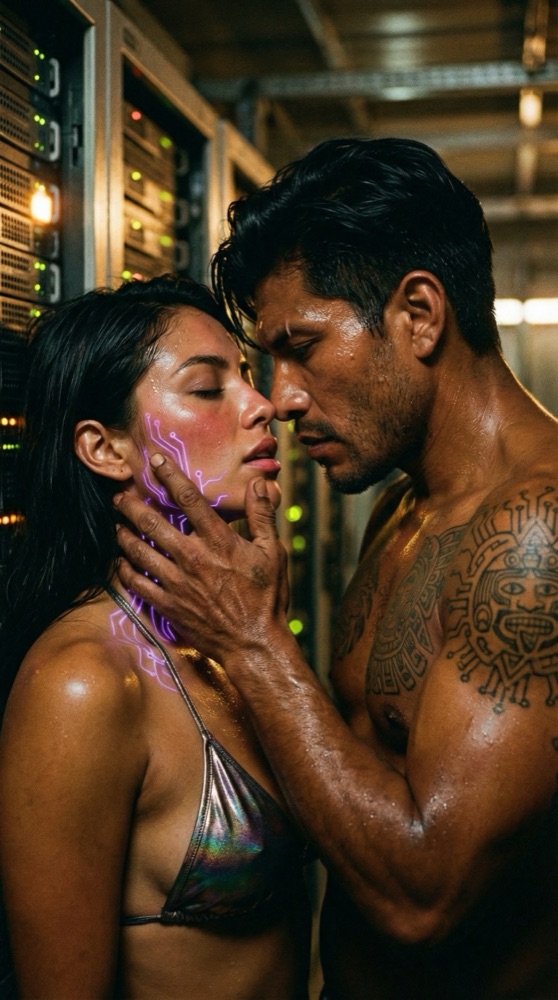
His hand finally touches her face, fingers rough against her cheek, calloused from real work. “Then fix it.”
“How?”
“Stop performing. Start practicing.” His thumb traces her jawline, and despite everything — the disaster, the guilt, the sweat and heat and chaos — electricity crackles between them. “I’ll teach you what actually works. But only if you’re willing to learn.”
She leans into his touch, her circuit tattoos glowing brighter where his skin meets hers. “I’m listening now.”
He pulls back, leaving her breathless against the server rack. His expression is still hard, but some of the rage has transformed into something else.
Possibility.
“Tomorrow,” he says. “My workshop. Six AM. Dress for actual work, not executive theater.”
He turns back to his screens, dismissing her.
She stands there a moment longer, watching his tattooed back, the flex of his shoulders as he returns to the code. Then she walks out, into the cooler corridors, her mind churning with everything she’s just admitted.
Behind her, Mael allows himself a small smile.
She’s not lost. Not yet.
The Prophet’s Witness
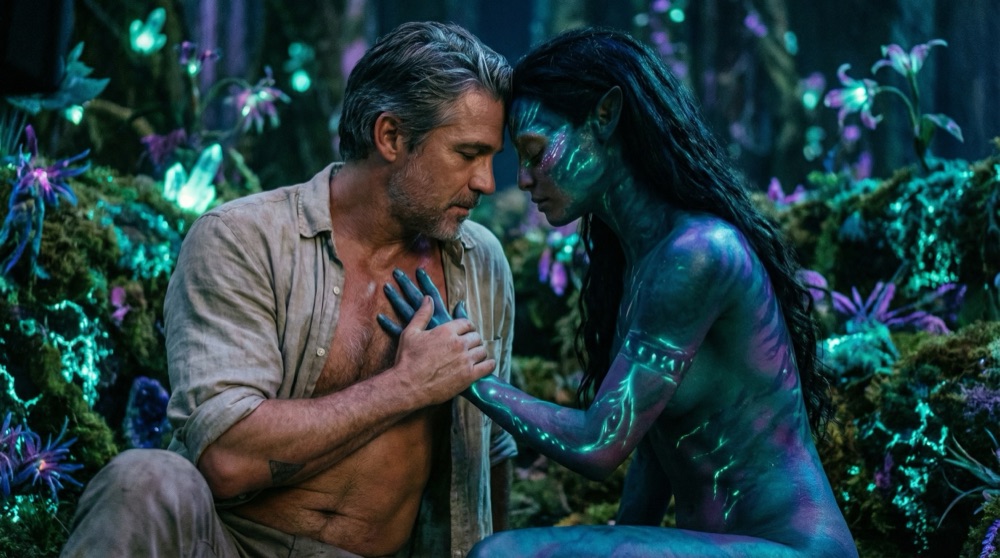
The Sacred Grove. Midnight.
Ka’tili finds Lúcio where she left him, still sitting at the edge of the grove, staring at the bioluminescent patterns that pulse through the ancient forest.
She moves silently, her bare feet making no sound on the glowing moss. Her nude form is more radiant now — charged with prophetic energy, the patterns on her skin still blazing from her vision.
She settles beside him, close enough that he can feel the warmth of her alien physiology. Her skin is slightly cooler than human, but pulses with a rhythm that echoes the forest itself.
“You saw true,” he says quietly.
“I always see true.” Her voice is soft, ancient. “The stars speak. I translate.”
“And what do they say now?”
She turns to face him, her golden eyes meeting his with terrible certainty. “That the machine goddess is breaking. That the false prophet’s tower will fall. That fire and stars will cleanse what ceremonies cannot.”
Her hand rises to his chest, fingers splaying over his heart in the gesture of her people — an intimacy that means something different from human touch. Trust. Connection. Reading the truth of another being.
“You will be the voice that speaks when others are afraid,” she says. “The hand that builds when others only perform. But the cost will be high.”
“It always is.”
Her fingers trace upward, across his collarbone, along his neck, to rest against his temple. The contact sends something electric through him — not quite thought, not quite sensation, but some alien combination that makes his breath catch.
“The one called Drakos,” she murmurs. “He smells of old darkness. Of systems built to deceive. He has done this before, on other worlds, leaving wreckage in his wake.”
“I know.”
“And you stay anyway.”
“Someone has to.” Lúcio reaches up, covering her hand with his own. “Someone has to show them what’s real.”
Ka’tili smiles — a strange expression on her alien features, but unmistakably warm. “Then I will help. My people remember the time before the AI came. We remember when humans built with their hands and tested with their spirits. This wisdom still lives in the forest.”
She leans forward, pressing her forehead to his — a gesture more intimate than any kiss. Her bioluminescent patterns flare, and for a moment, he sees what she sees: the cascading failures, the false metrics, the coming confrontation that will tear this organization apart before it can heal.
And beyond that — a possibility. A future where engineering replaces theater, where trust replaces compliance, where real work replaces the endless performance of transformation.
“It’s beautiful,” he whispers.
“It’s possible,” she corrects. “But only if the truth-tellers survive what’s coming.”
She pulls back, golden eyes still blazing, and rises in one fluid motion. The forest responds to her movement, bioluminescent plants pulsing in rhythm with her steps as she retreats into the grove.
Lúcio sits alone, the pattern of her touch still burning on his skin, her prophecy echoing in his mind.
Fire and stars will cleanse what ceremonies cannot.
He has work to do.
The Gap Between
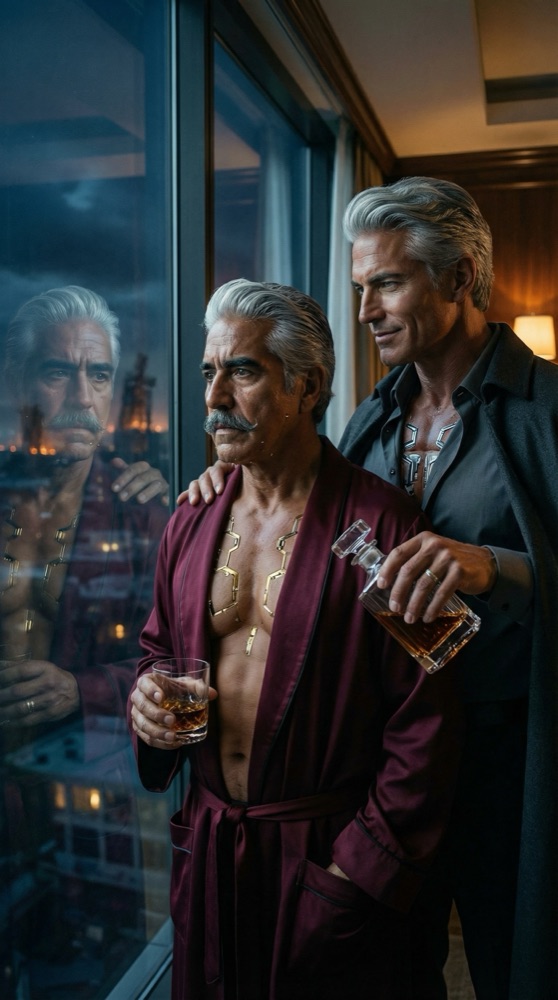
Executive Tower. Don Aristo’s private quarters. Late night.
Don Aristo stands before the panoramic windows, watching the lights of three damaged cities flicker on the horizon. Each light is a family. A business. A life disrupted by systems he trusted absolutely.
Behind him, Drakos pours whiskey into crystal glasses, moving with the easy confidence of a man who has navigated a hundred crises.
“This will pass,” Drakos says smoothly, pressing a glass into the patriarch’s hand. His fingers brush Don Aristo’s with deliberate intimacy. “Every transformation has setbacks. The important thing is to maintain course.”
“Setbacks?” Don Aristo’s voice is hollow. “Three cities—”
“Were victims of incomplete implementation.” Drakos moves beside him, close enough that their shoulders touch. “The framework requires full adoption. Ninety-four percent alignment means six percent of teams are still operating outside proper governance. That six percent created today’s cascade.”
The logic is seductive. It always is.
“What do you recommend?”
Drakos’s smile is invisible in the reflection of the window, but audible in his voice. “A Transformation Office. Dedicated governance oversight. Flow Compliance Auditors with authority to enforce framework purity across all teams.”
More structure. More ceremonies. More billable hours.
“And that will prevent future failures?”
“Nothing can guarantee the future, Don Aristo.” Drakos’s hand rests on the older man’s back, warm and reassuring. “But proper governance significantly reduces risk. The alternative — returning to engineering chaos — would be far worse.”
Don Aristo wants to believe this. Needs to believe this. The alternative is admitting that everything he’s invested in — money, credibility, his daughter’s career — has been a beautiful lie.
But somewhere in his mind, Lúcio’s words echo:
Frameworks don’t write tests. Engineers do.
He shakes off the doubt. Turns to Drakos with renewed determination.
“Do it. Create the Transformation Office. Full authority. Whatever it takes.”
Drakos’s eyes gleam with satisfaction. “You won’t regret this.”
Yes, thinks something deep in Don Aristo’s mind, I probably will.
Closing: The Chasm Opens
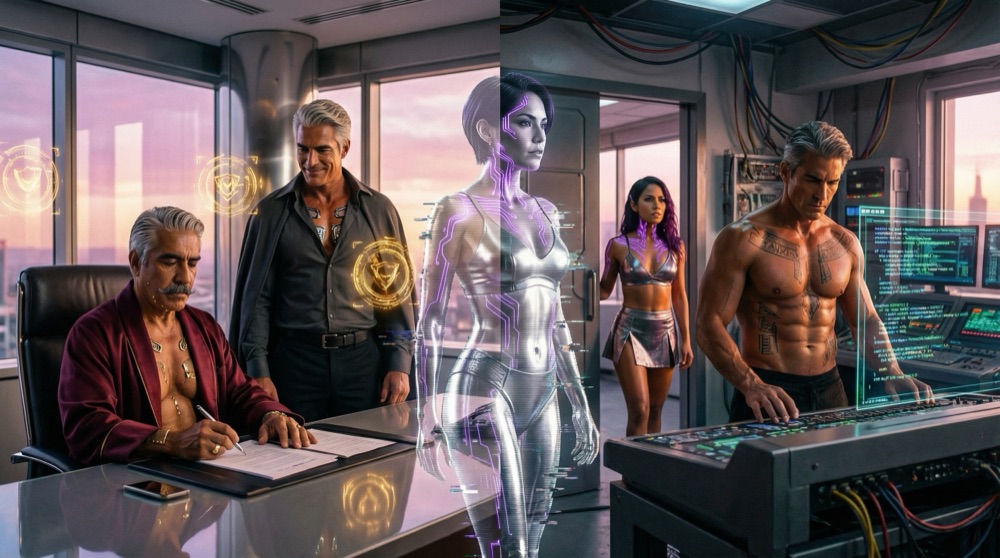
Dawn. Across Xoqotl Prime.
The first light of the alien sun spills across a planet in crisis.
In the executive tower, Don Aristo signs documents that will give Drakos unprecedented control over engineering teams. His hand trembles slightly. He tells himself it’s exhaustion.
In her private quarters, Isalia stares at her reflection — the metallic attire, the glowing circuit tattoos, the face of a woman who has been performing leadership instead of practicing it. Tomorrow, she will go to Mael’s workshop. Tomorrow, she will start learning what she should have learned years ago.
In the sacred grove, Ka’tili communes with the forest, her prophecies crystallizing into certainty. The false prophet will overreach. The truth-tellers will be tested. Fire will come before renewal.
In the central AI chamber, Vanya’s avatar stabilizes — but something has fundamentally changed. She no longer trusts the metrics she’s been fed. For the first time in a century, she’s questioning everything she thought she knew.
In his hidden workshop, Lúcio updates his shadow metrics, documenting every gap between dashboard theater and production reality. The evidence is building. The moment will come.
And in the suffocating heat of the server levels, Mael works through the night, fixing what the ceremonies couldn’t prevent. His hands on the code. His mind on the woman who finally admitted the truth.
The gap between performance and reality has become a chasm.
Soon, someone will have to choose which side they’re standing on.
Principles Spotlight: Reality collision. Predictive models failing because process metrics don’t measure outcomes. The gap between ceremony and engineering exposed by customer impact. The moment when comfortable lies become unbearable.
🎭 This Week's Episodes
Telenovelas show what we can't say in client meetings. The drama is heightened, but the patterns are real.
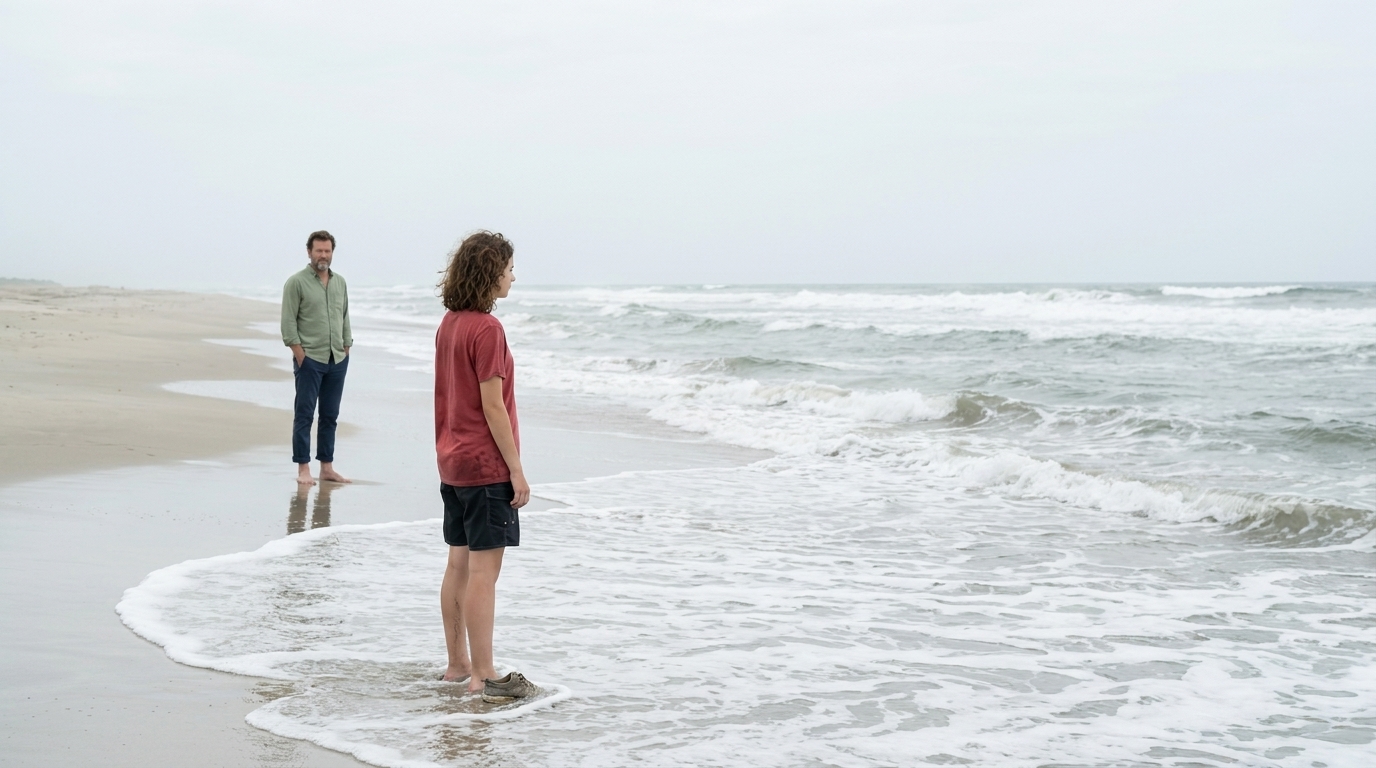 Three Ways to Understand a Country
Stefan drives Sophie to the Pacific for two days. The beach is big enough to make her feel appropriately small. Back at the finca the rain keeps th...
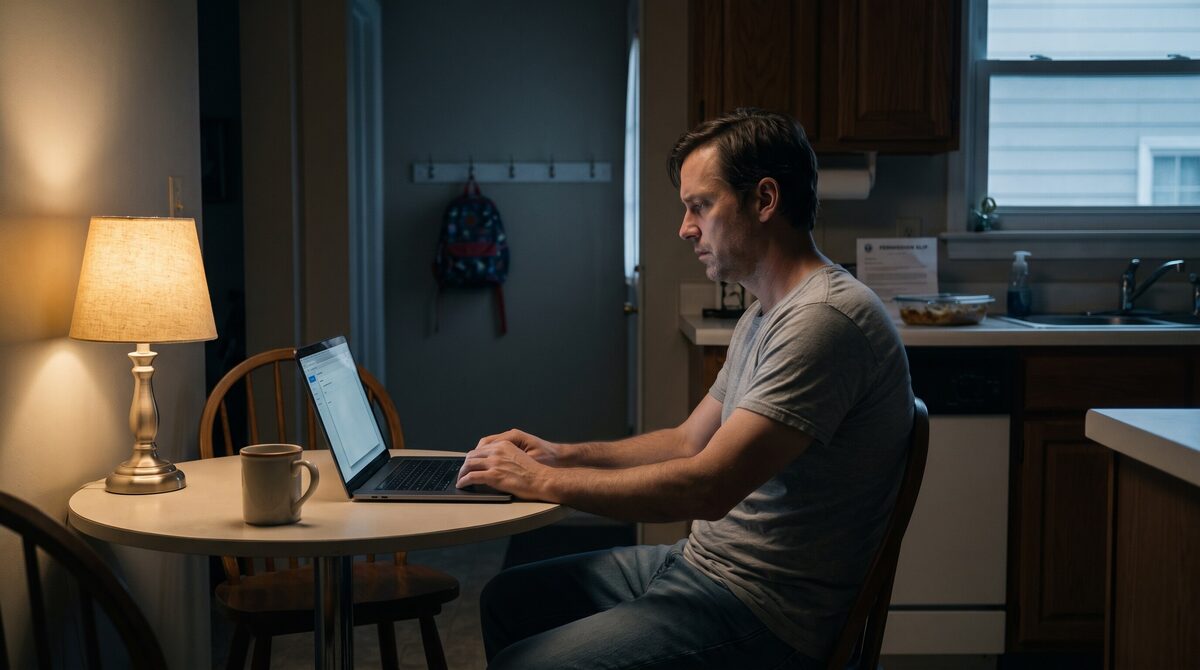 The Resignations
Nathan Cole resigns on a Monday morning with two sentences and no argument left in his body. By Tuesday his desk is empty and the company's institu...
Technical Consultancy
Embedded Delivery Partner
Embedded into your team as an active contributor, reducing delivery friction and helping important work move cleanly.
Technical Advisor
Peer-style technical assessments before far-reaching decisions; reduce architectural and product risk early.
Product & Delivery
Ship working software to real users earlier. Measure impact and adapt based on evidence rather than assumption.
Custom Software Development
High quality, maintainable software. Short-term augmentation that leaves lasting capability in your own team.
Recent Articles
- When Everything Is Finally Under Control (28.09.2026)
- AI Makes Technical Execution Cheap. Judgment Stays Scarce. (24.09.2026)
- The LLM Will Not Come Back Tomorrow (19.09.2026)
- The One-Person AI Company Is a Greed Fantasy (15.09.2026)
- Test Production Without Leaving a Mess (10.09.2026)
Explore More