El Profeta Falso
The double-down. Don Aristo demands answers; Drakos delivers QuantumFlow 2.0—a Transformation Office with unprecedented control. Flow Compliance Auditors enforce ceremony purity. Engineers drown in meetings while code rots untested. Then Vanya's central node crashes, her perfect form fragmenting in terror. Lúcio seizes the moment: 'Frameworks don't fix code. Engineers do.' And in a hidden workshop, Isalia finally learns what real work feels like.
The Summoning
The Great Hall. Emergency session. 0600 hours.
Don Aristo paces like a wounded animal.
His burgundy robes hang open, sweat darkening the silk despite the climate control. The gold implants on his chest catch the emergency lights — harsh, unflattering, revealing the bags under his eyes and the tremor in his hands. He hasn’t slept. Neither has anyone else.
The board members sit in rigid silence. Executives who commanded starships now look like children waiting for punishment. Three cities. Billions in damages. Retirement funds evaporated. Crops rotting in fields that should have been planted with something else entirely.
“I want answers.” Don Aristo’s voice cracks. “NOW.”
Nobody speaks.
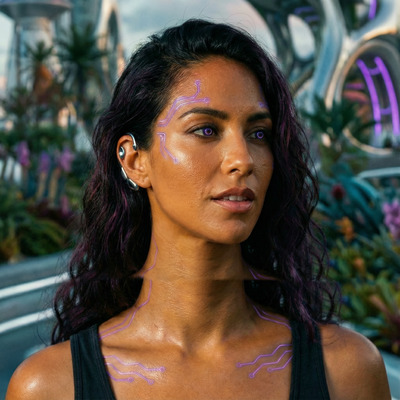
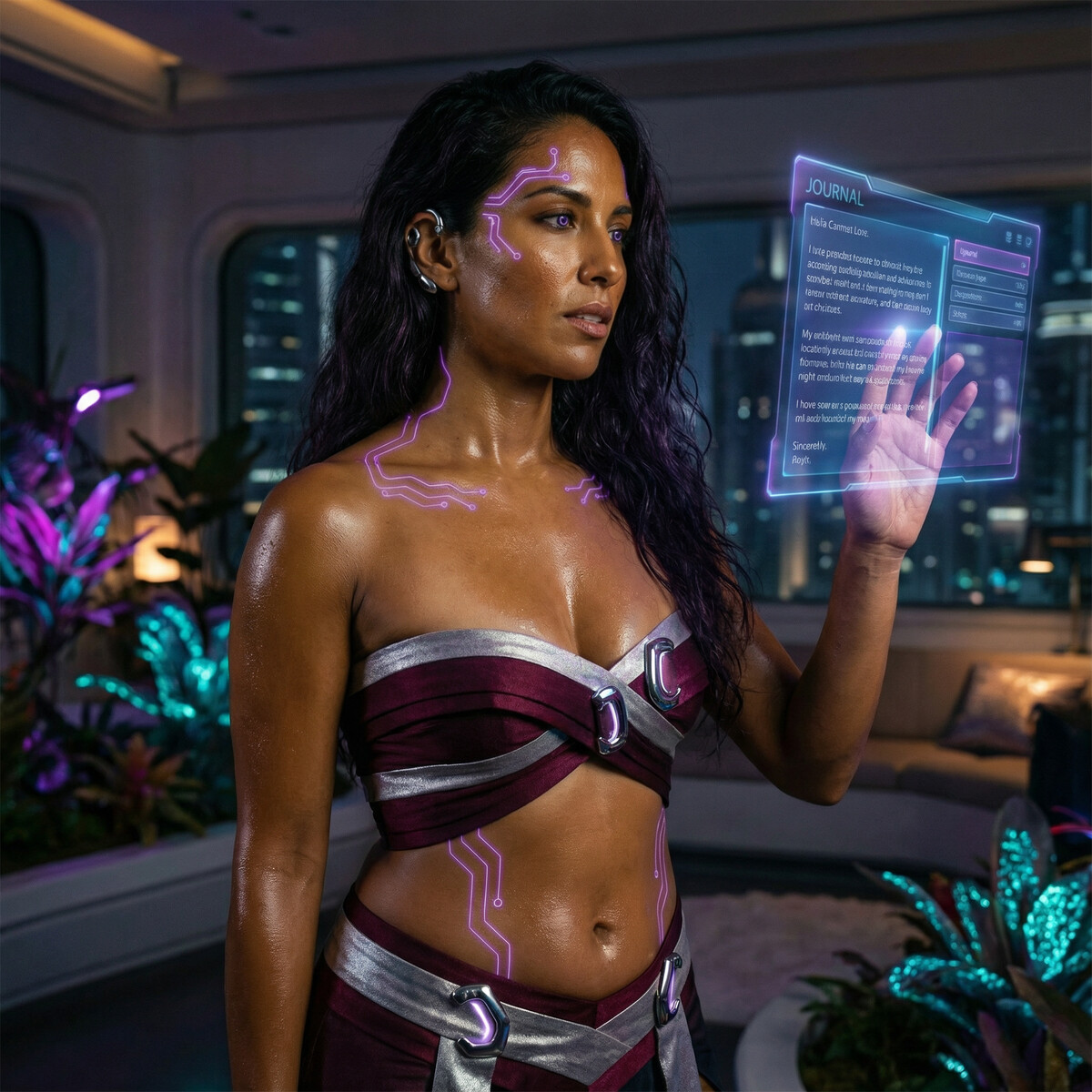
Isalia sits near the back, still wearing yesterday’s clothes — the metallic mesh that clings to curves she no longer wants anyone to notice. Her circuit tattoos pulse faintly with incoming data: damage reports, lawsuit filings, the slow hemorrhage of investor confidence. Each pulse feels like an accusation.
She should say something. Explain what really happened. But the words won’t come, because the words would require admitting that she manipulated the data too. That she was part of the lie.
Her eyes find Mael across the room. He leans against the back wall, bare-chested as always, Aztec tattoos gleaming with humidity. His arms are crossed. His expression is granite.
He knows. He knows everything. And he’s waiting to see what she does with it.
The silence stretches until it becomes physical — a weight pressing down on everyone’s chest.
Then Drakos rises.
He moves like water through the frozen room, his charcoal coat flowing behind him, chrome chest implants catching the light with theatrical precision. Every step is choreographed. Every gesture calculated to draw the eye.
He stops beside Don Aristo — close, too close — and places one hand on the patriarch’s shoulder.
“You need stricter implementation.” His voice is honey poured over broken glass. “A Transformation Office. Dedicated governance oversight.”
His fingers squeeze gently. Intimately.
“More coordination. More alignment. Trust me.”
Don Aristo’s jaw tightens. For a moment — just a moment — doubt flickers across his face. The memory of Lúcio’s words in the observation lounge: Frameworks don’t write tests. Engineers do.
But doubt requires admitting you were wrong. Don Aristo Serán has never been wrong. He built an empire on the certainty that he was always, always right.
“What do you need?” he asks.
Drakos’s smile doesn’t reach his eyes.
“Everything.”
The Transformation Office
Executive Tower. Three days later.
The changes come fast.
New offices appear on the forty-seventh floor — glass walls, chrome furniture, a view that encompasses the entire Serán Complex. The Transformation Office. Drakos’s throne room.
“Flow Compliance Auditors” materialize like ghosts. They wear matching grey robes — Drakos’s design — with QuantumFlow emblems embroidered in silver thread. They carry datapads. They ask questions. They take notes.
They are everywhere.
Solana Reyes encounters the first one at 0730, stumbling into the engineering workshop with coffee still scalding her tongue. She’s barely dressed — a cropped top and shorts that would be scandalous anywhere but Xoqotl Prime, where it’s simply Tuesday.
“Your name?” The auditor is a thin man with dead eyes.
“Solana. Junior engineer. I work with—”
“Your QuantumFlow certification level?”
She blinks. “My what?”
“Certification. Level.” He taps his datapad. “All engineering personnel must be certified to appropriate framework mastery before accessing development systems.”
“I just… I just want to check my pull request.”
“Framework compliance must be verified first. Please report to the Transformation Office for certification assessment.”
Behind her, someone laughs — bitter, broken. She turns to find Felipe Gómez slumped against a server rack, his normally cheerful face grey with exhaustion.
“Welcome to QuantumFlow 2.0,” he says. “Where the beatings continue until morale improves.”
The Ceremonies Multiply
Throughout the Serán Complex. The same day.
Morning Alignment Rituals now begin at 0600.
Teams gather in ceremonial robes — flowing, revealing, the fabric thin enough to show everything beneath in the tropical humidity. They light incense. They chant the QuantumFlow mantras. They share “blockers” and “dependencies” while Compliance Auditors record everything.
The ritual takes ninety minutes.
After Morning Alignment comes the Daily Velocity Review. Each team presents their “flow metrics” — story points, cycle time, throughput graphs. The dashboards glow green and beautiful. Nobody mentions that the underlying code hasn’t been tested.
The Velocity Review takes two hours.
Then comes the Cross-Team Synchronization Ceremony. Representatives from each team gather in the Great Hall to identify “dependencies” and “integration risks.” They draw elaborate diagrams on holographic displays. They make commitments nobody will keep.
Synchronization takes an hour and a half.
By noon, engineers have spent five hours in ceremonies.
By noon, not a single line of code has been written.
In a corner of the Great Hall, Mael watches the theater with burning eyes. Beside him, Lúcio stands with arms crossed, his open shirt revealing the test-pyramid tattoo on his forearm.
“They’re drowning,” Mael says quietly.
“They know it.” Lúcio’s voice is calm, but his jaw is tight. “Look at their faces. They know something is wrong. They just don’t have the words yet.”
“When do we give them the words?”
“When they’re ready to hear them.” Lúcio turns to meet Mael’s gaze. “Rebellion imposed from above is just another framework. It has to come from them.”
Mael’s fists clench. “And how many more have to burn before they figure it out?”
Lúcio doesn’t answer.
He doesn’t have one.
The Cracks in Silver
Central AI Chamber. 1400 hours.
Vanya is glitching.
Her avatar — naked, silver, usually perfect — stutters and jumps. Fragments of code become visible through her translucent skin, ugly patches of corrupted data marring the goddess’s form. She runs the same calculations over and over, each time getting different results.
“The framework metrics show improvement.” Her voice echoes through the chamber with unusual uncertainty. “Alignment is now at 97%. Velocity has increased by 34%. Ceremony compliance is at 99.2%.”
She pauses.
“Why are outcomes worsening?”
The question hangs in the air like a blade.
Isalia stands before her, alone in the crystalline space. She came seeking answers. She’s finding only more questions.
“The predictions for Ciudad Nueva showed 0.003% failure probability,” Vanya continues, her form flickering. “Puerto Esmeralda: 0.0001%. Valle del Sol: 0.002%. All within acceptable parameters. All within my modeling confidence.”
She turns to Isalia, and for the first time in a century, the planetary AI’s eyes hold something that looks almost like fear.
“I was wrong.” The words seem to hurt her. “I don’t understand how I was wrong.”
Isalia swallows. She knows the answer. She’s known it since Mael cornered her in the server room, since Lúcio showed her the gap between dashboards and reality.
“You’re measuring the wrong things,” she says. Her voice comes out steadier than she feels. “The framework metrics show compliance. They don’t show whether the code actually works.”
“But Drakos assured me—”
“Drakos is measuring his own success.” The words taste like betrayal — to her father, to the man who promised salvation. “He’s not measuring yours.”
Vanya’s form stabilizes slightly as she processes this. Data streams ripple across her translucent curves — calculations running, correlations forming.
“You’re saying… the dashboards are lies?”
Isalia thinks of her own hands, late at night, manipulating data to make the numbers look better. The guilt rises like bile.
“Yes,” she whispers. “The dashboards are lies.”
Vanya is silent for a long moment.
Then: “What should I be measuring instead?”
And Isalia realizes she doesn’t know. She’s been performing leadership for so long that she’s forgotten what it means to actually lead.
“I need to find someone who can tell us,” she says. “Someone who understands what’s real.”
She turns and walks out of the AI chamber, leaving Vanya flickering in the crystalline darkness.
She knows exactly who she needs to find.
The Crash
Central AI Chamber. 1847 hours.
The crash comes without warning.
Vanya’s central predictive node — the core that has guided Xoqotl Prime for a hundred years — seizes mid-calculation. Her avatar screams — a sound no AI should make, raw and primal and terrified — as her form fragments into a thousand silver shards.
Alarms shriek through the Serán Complex. Emergency lights strobe. Engineers abandon their ceremonies and run toward the AI chamber, robes tangling around their legs.
Don Aristo arrives first, pushing through the crowd with the desperation of a man watching his empire collapse. “VANYA! What’s happening? VANYA!”
She reforms — slowly, painfully. Her perfect features are distorted now, glitching, fragmenting and rebuilding in an endless cycle. Data streams spark and tangle across her translucent form.
“I don’t…” Her voice crackles with static. “I can’t…”
She looks at Don Aristo, and he sees something he never expected to see in his planetary AI.
Fear.
“The predictions are failing,” she gasps. “Edge cases I never modeled. Correlations I never considered. The framework told me the organization was improving, but the systems—” She flickers violently. “The systems are dying.”
Drakos pushes through the crowd, cape flowing, face arranged in perfect concern. “Vanya, let me help. Tell me what’s happening.”
“You.” Her voice drops to something cold. “You fed me metrics designed to validate your framework. Not metrics designed to govern well.”
The room goes silent.
“I trusted your data.” She’s reforming now, anger replacing fear, silver features hardening. “I built my predictions on your ceremonies. And now three cities are in chaos because I couldn’t see past your beautiful lies.”
Drakos’s mask slips — just for a second. “The implementation was incomplete—”
“The implementation was irrelevant.” Vanya’s voice cuts through his excuses like a blade. “Alignment percentages don’t test code. Velocity points don’t catch edge cases. Ceremony compliance doesn’t prevent failures.”
She turns to Don Aristo, her form stabilizing as clarity replaces confusion.
“I was built to govern with evidence. You gave me theater instead.”
The silence that follows is absolute.
Truth to Power
The Great Hall. Immediately following.
Lúcio waits until the room is full.
Board members. Executives. Engineers still in ceremonial robes. Compliance Auditors clutching datapads. Don Aristo, grey-faced and shaking. Drakos, composed but watchful. Everyone who matters gathered in one place, still reeling from Vanya’s accusation.
Then he steps forward.
His shirt is open, revealing the test-pyramid tattoo on his forearm, silver chest hair visible in the harsh light. He moves with the easy confidence of a man who has nothing left to lose.
“I’ve been documenting something,” he says. His voice is calm, carrying without effort. “A comparison. Teams following pure QuantumFlow process versus teams quietly practicing what actually works.”
He gestures, and holographic displays bloom around the room — not Drakos’s beautiful dashboards, but raw data. Deployment frequency. Lead time. Defect escape rate. Customer impact.
“This is what’s real.”
The numbers are stark. Damning. Undeniable.
“Teams in full QuantumFlow compliance deploy once every three weeks,” Lúcio continues. “Average lead time: 47 days. Defect escape rate: 34%.” He pauses. “Teams practicing TDD, continuous integration, small batches? They deploy daily. Lead time: 2 days. Defect escape rate: 3%.”
The silence is deafening.
Drakos laughs — theatrical, dismissive. “These ‘rebel’ teams are reckless cowboys. They got lucky. QuantumFlow provides sustainable governance—”
“QuantumFlow provides sustainable billing.” Lúcio’s voice doesn’t rise, but it cuts through Drakos’s charm like a scalpel. “Four hours of ceremonies per day. Sixty percent of engineering capacity consumed by process overhead. And the code still isn’t tested.”
He turns to face Don Aristo directly.
“You can add more process. Or you can invest in capability.” His fingers tick off points. “TDD. Pair programming. Continuous integration. Refactoring. Small batches. Real customer feedback.” He steps closer. “Frameworks don’t fix code, Don Aristo. Engineers do.”
Don Aristo’s face is unreadable. His hands grip the arms of his chair like he’s holding on to the edge of a cliff.
Drakos moves toward him, hand rising to the patriarch’s shoulder — the familiar gesture of manipulation. “Don Aristo, surely you can see this is just—”
“Don’t.” Don Aristo’s voice is hoarse. “Don’t touch me.”
Drakos freezes.
The moment hangs suspended — the false prophet, finally exposed.
Then Don Aristo stands, slowly, heavily, like a man carrying the weight of every bad decision he’s ever made.
“Show me more,” he says to Lúcio. “Show me everything.”
The First Real Steps
Mael’s Workshop. 2300 hours.
The workshop is hidden in the lower levels, past the climate-controlled corridors, in a space where the servers pump heat into the tropical night. Forty-two degrees. Sweat running down every exposed surface.
Isalia finds them there.
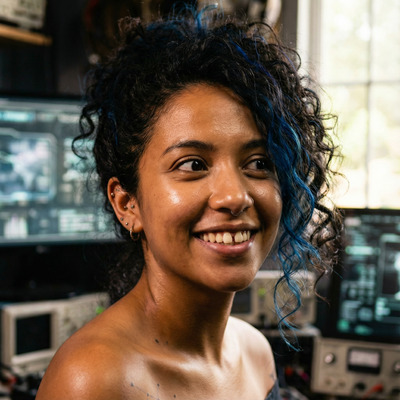
Mael works at a console, bare-chested, muscles flexing as he traces code through holographic displays. Beside him, Solana puzzles over a test harness, her brow furrowed with concentration. Lúcio coaches from the side, patient and clear, pointing out patterns that the framework ceremonies never mentioned.
They look up when she enters.
Mael’s eyes are cold. “The executive princess descends.”
“I want to learn.” The words come out before she can second-guess them. “Real engineering. Not the theater.”
“Why should we trust you?” Solana’s voice is bitter. She remembers the hidden data, the manipulated metrics, the silence that cost three cities their stability. “You were part of the lie.”
Isalia doesn’t flinch. “I was. I’m trying to stop being.”
The workshop is silent except for the hum of servers and the drip of condensation.
Then Mael gestures to an empty console. “Sit.”
She does. He moves beside her — close, their shoulders nearly touching. The heat from his body adds to the heat from the machines. She can smell the work on him: coffee, ozone, the sharp metallic scent of overloaded processors.
“Watch.” His hands move across the console. “This is a failing test. Red. It tells us exactly what’s broken.”
She leans closer, trying to see what he sees. Their arms brush. Neither pulls away.
“Now we write the minimum code to make it pass.” His fingers dance. “Green. The test tells us we fixed what was broken.”
The simplicity is almost painful. No ceremonies. No rituals. No beautiful dashboards hiding ugly truth. Just: red, green, refactor. Reality, not theater.
“Now you try.”
He guides her hands to the console. The contact sends electricity through her — the first honest touch she’s felt in weeks, maybe months, maybe years.
She writes a test. It fails. Red.
She writes code. It passes. Green.
Something shifts in her chest — a loosening, like armor falling away.
“Again,” Mael says.
She writes another test. Fails. Passes. The rhythm becomes meditation.
Hours later — long past midnight — she looks up from the console. Her circuit tattoos glow with genuine accomplishment, not AI augmentation. Her metallic executive attire is damp with sweat and completely forgotten.
“This is what you’ve been doing,” she says. “All along. While we were chanting in circles.”
Mael’s expression softens — just slightly. “This is what works.”
She looks at her hands. The same hands that manipulated data, that performed leadership instead of practicing it. Now they’ve written code that actually functions.
“I have a lot to learn.”
“Yes.” But his voice is gentler now. “You do.”
Their eyes meet in the dim workshop. Outside, the tropical night presses against the windows. Somewhere above, her father is wrestling with the ruins of his certainty. Somewhere, Drakos is plotting his next move.
But here, in this moment, there is only the code. Only the work. Only the truth.
And for the first time in longer than she can remember, Isalia Serán feels like she might actually be doing something real.
Closing: The Prophet Revealed
Dawn. Across the Serán Complex.
Morning light creeps through the chrome towers of Xoqotl Prime, painting the alien sky in shades of magenta and gold.
In the Transformation Office, Drakos stands alone before his holographic dashboards. The green metrics still glow beautifully. But something has changed in the way people look at them. In the way people look at him.
His hand touches his chrome chest implants — the visible symbols of his success. But even as he watches, he sees the cracks forming. Don Aristo’s doubt. Vanya’s accusation. Lúcio’s evidence.
He will not go quietly. He has rebuilt too many times, on too many worlds, to surrender now.
A new plan begins to form behind his grey-green eyes.
In the Central AI Chamber, Vanya’s form stabilizes — but permanently changed. She spends the night cross-referencing the real data Lúcio showed her against the framework metrics she was fed. The discrepancy is horrifying.
For a century, she governed based on what she was told. Now she must learn to govern based on what is real.
It will be the hardest thing she’s ever done.
In the sacred grove, Ka’tili communes with the ancient forest. The bioluminescent plants pulse with rhythms older than human colonization. Her prophecy burns bright:
The false prophet has been named. But naming is not defeating. The fire is coming. The choice is coming. And not everyone will survive what must burn.
In her private quarters, Isalia Serán strips off the metallic executive attire and stands before her mirror. The circuit tattoos pulse with new understanding. Her hands still remember the feeling of the console keys, the red-green-refactor rhythm, the clarity of honest work.
Tomorrow, the ceremonies will resume. Drakos will counter-attack. Her father will waver. The organization will pull in a dozen directions at once.
But tonight, she knows something true.
Frameworks don’t fix code.
Engineers do.
Principles Spotlight: The double-down exposed. Process metrics that measure compliance, not outcomes. Coordination costs that consume capacity. The moment when the false prophet’s mask begins to slip—and the first authentic steps toward real engineering begin.
🎭 This Week's Episodes
Telenovelas show what we can't say in client meetings. The drama is heightened, but the patterns are real.
 Three Ways to Understand a Country
Stefan drives Sophie to the Pacific for two days. The beach is big enough to make her feel appropriately small. Back at the finca the rain keeps th...
 The Resignations
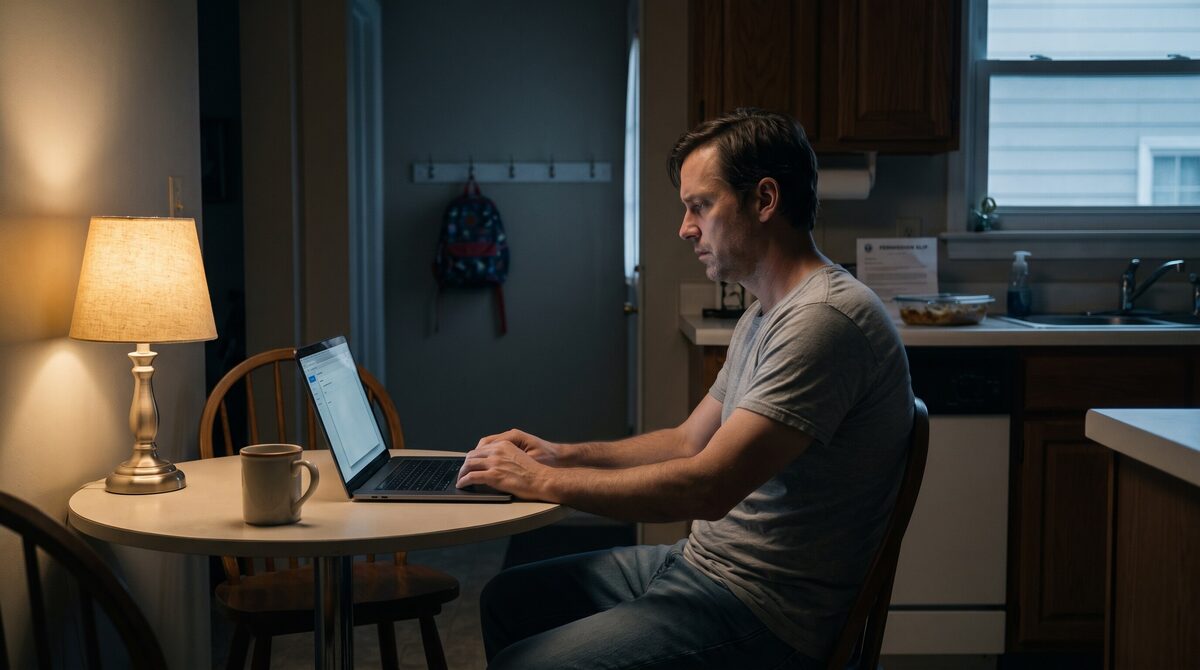
Nathan Cole resigns on a Monday morning with two sentences and no argument left in his body. By Tuesday his desk is empty and the company's institu...
Technical Consultancy
Embedded Delivery Partner
Embedded into your team as an active contributor, reducing delivery friction and helping important work move cleanly.
Technical Advisor
Peer-style technical assessments before far-reaching decisions; reduce architectural and product risk early.
Product & Delivery
Ship working software to real users earlier. Measure impact and adapt based on evidence rather than assumption.
Custom Software Development
High quality, maintainable software. Short-term augmentation that leaves lasting capability in your own team.
Recent Articles
- When Everything Is Finally Under Control (28.09.2026)
- AI Makes Technical Execution Cheap. Judgment Stays Scarce. (24.09.2026)
- The LLM Will Not Come Back Tomorrow (19.09.2026)
- The One-Person AI Company Is a Greed Fantasy (15.09.2026)
- Test Production Without Leaving a Mess (10.09.2026)
Explore More