AI Makes Technical Execution Cheap. Judgment Stays Scarce.
More capacity and AI speed amplify delivery. They do not expose why it remains stuck. That requires judgment with roo...
6 min read
06.04.2026, By Stephan Schwab

Frederick Taylor sold a bargain: trade autonomy for a safer life. In factories, that bargain raised living standards by pulling day labor into predictable wages, routines, and supervision. In software development the bargain breaks, because thinking cannot be separated from doing without crushing motivation. AI makes the old bargain tempting again, and the talk of a post-labor economy misses the real constraint: when production gets cheap, purpose becomes the scarce resource.
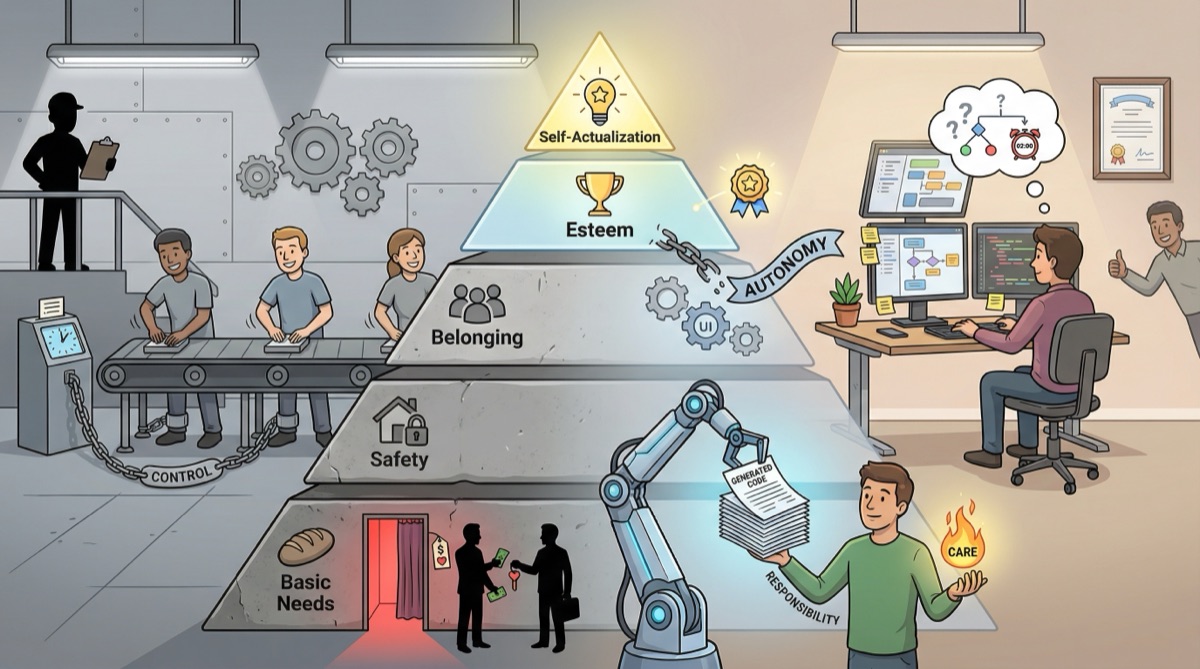
The current AI conversation loves big, clean claims: “Robots will do the work.” “The post-labor economy is inevitable.” “Finally, humans will be free.”
It sounds humane until you notice the blind spot the size of a factory. Humans do not just need income; they need safety, belonging, and dignity, and knowledge work adds another dependency: the need to feel competent at something real.
Automate tasks all you want, but you cannot automate away needs.
Maslow’s hierarchy is usually presented as a cute pyramid with self-actualization at the top, like a motivational poster for executives who have never met a deadline. Read it as constraints and it becomes brutally practical.
Some people reduce the bottom layer to food, sex, and alcohol. Cynical, but not wrong. Humans crave comfort, intoxication, and being wanted. And in most cultures, being wanted is not just biology; it gets tangled up with status signals like “can you provide” and “can you offer a future”. When money gets tight, intimacy turns transactional fast: one side offers it, the other foregoes other needs to buy it. And the identity hit is immediate. In a world where everything has a price, including intimacy, not being able to afford looking desirable makes it hit harder.
Rubén Blades sketched the counterpoint in “Lidia Elena”: a rich daughter who prefers a cramped room with a poor trumpeter over the comfort her family can buy. Romantic, yes, but also a reminder that people are not productivity machines. They trade in belonging, dignity, and meaning, even when the spreadsheet says they shouldn’t.
When someone is worried about rent, attention shrinks. When they fear humiliation, they stop taking risks. When they do not belong, they stop telling the truth.
You can talk about innovation all day, but destabilize the bottom layers and you will get predictable behavior: compliance, risk avoidance, and silence. That is the first connection to Taylor.
Taylor did not show up in an already-stable world; he showed up in the messy transition from craft and day labor to industrial production.
Day laborers had freedom in the most technical sense: they could walk away. They also had insecurity: irregular work, arbitrary pay, and the constant threat that a slow week became a hungry week.
The factory offered a different deal: wages, routines, supervisors, and a sense of predictability that did not depend on luck. That deal helped satisfy the base of Maslow’s hierarchy; for many families it meant fewer catastrophes.
But it came with a condition. The factory separated thinking from doing. Management planned; workers executed.
That split made mass production possible and created a pyramid where authority lived far from reality. You can build bolts like that. You cannot build software like that.
Software development is not typing. It is decision-making under uncertainty, with code as the artifact.
Every meaningful change forces questions nobody wrote down: What is the real constraint? Which failure mode matters? What do we do when the data is wrong? Which shortcut turns into a permanent scar?
If you try to run that work as factory execution, you get what factories are designed to produce: compliance and output. You do not get understanding.
That is why the “manufacturing fantasy” keeps failing in software development. It is not a philosophical mismatch; it is operational, and the work itself fights you.
If you want the short version, it is already written in Intrinsic Motivation and Software Developers and in Why the “Raw Dogging” Team Beats the Factory Method.
The common pattern is simple:
The software still ships. It just ships like fast food.
AI changes the economics of software production. Translation into syntax gets cheaper, repetitive code gets cheaper, and mechanical refactoring gets cheaper.
The management reflex is predictable: “Great. Now we can separate thinking from doing again. The machine will think. The humans will execute.”
It is the same dream with a different costume. We have tried to replace developers every decade since 1969, and the slogan always rhymes.
If you missed the earlier chapters, start with Why We’ve Tried to Replace Developers Every Decade Since 1969.
AI does not make thinking unnecessary. It changes where thinking happens.
The organization still has to decide what it wants, what it will not accept, and what it will do when reality disagrees.
A model can generate code. It cannot accept responsibility.
And the moment you treat developers as replaceable prompt clerks, you have rebuilt the factory pyramid. Same control. Same separation. Same motivational decay.
“Post-labor” talk often assumes that work is only a means to money. That is true for some work, some of the time.
But Taylor’s bargain existed because people also wanted stability, status, and a place in a social fabric, and the factory provided those alongside the paycheck.
Now imagine a future where the paycheck is handled by policy and the work is handled by machines. You still have Maslow. You still have belonging and esteem. You still have the need to feel useful.
In software development, usefulness is not a vibe. It is knowing the system, making it safer, and solving the nasty edge case that breaks at 02:00.
That is why many developers reacted to AI with fear and anger first. They were not protecting keystrokes. They were protecting identity.
If you want the more personal version of that transition, read The Gray Beard and the Machine.
Leaders love strategy slides about the future of work. Here is the practical version.
If AI makes production cheaper, you must treat motivation as an asset with failure modes.
Start with the bottom layers:
Then do the one thing Taylorism cannot do: give developers real authority over the technical “how”. Not endless debates. A clear mandate.
If you want predictable delivery in the AI era, the path is not more control. It is better constraints, tighter feedback loops, and fewer lies.
That is also why visibility matters. Knowledge work is invisible by default: the effort is real, but the signals stay trapped in people’s heads until something breaks.
Daily logbooks and weekly synthesis are not “culture” work. They are self-observation at organizational scale. A short daily note creates shared memory without forcing people into meetings; the weekly synthesis turns those notes into patterns so leadership can remove the frictions that quietly punish care. If you want a concrete example of what that looks like, read Episode 5: The First Synthesis.
AI will not deliver a post-labor paradise. It will amplify whatever system you already run.
Factories get faster factories. Healthy organizations get developers who spend less time typing and more time thinking.
And that, ironically, is the only version of “post-labor” worth building.
Tell me what is happening. I listen, ask a few practical questions, and reflect back what I see: where the risk may sit, what may be blocking delivery, and what looks worth checking next. No pitch, no obligation. Confidential and direct.
Talk it through. Practical reflection, no pitch.
Start a ConversationTelenovelas show what we can't say in client meetings. The drama is heightened, but the patterns are real.
 Three Ways to Understand a Country
Stefan drives Sophie to the Pacific for two days. The beach is big enough to make her feel appropriately small. Back at the finca the rain keeps th...
 The Resignations
Nathan Cole resigns on a Monday morning with two sentences and no argument left in his body. By Tuesday his desk is empty and the company's institu...
Embedded into your team as an active contributor, reducing delivery friction and helping important work move cleanly.
Peer-style technical assessments before far-reaching decisions; reduce architectural and product risk early.
Ship working software to real users earlier. Measure impact and adapt based on evidence rather than assumption.
High quality, maintainable software. Short-term augmentation that leaves lasting capability in your own team.
Visibility and hands-on delivery
Navigator gives your leadership clear insight into patterns, blockers, and capacity. Our Embedded Delivery Partner writes production code with your team and gets delivery moving.