AI Makes Technical Execution Cheap. Judgment Stays Scarce.
More capacity and AI speed amplify delivery. They do not expose why it remains stuck. That requires judgment with roo...
6 min read
23.03.2026, By Stephan Schwab

Product development has fundamentally changed. The gap between having an idea and seeing it work used to be filled with weeks of scaffolding, syntax lookup, and boilerplate. AI collapsed that gap. What remains is the hard part: knowing what to build, how to structure it, and whether it actually works. The bottleneck moved from typing code to making decisions.
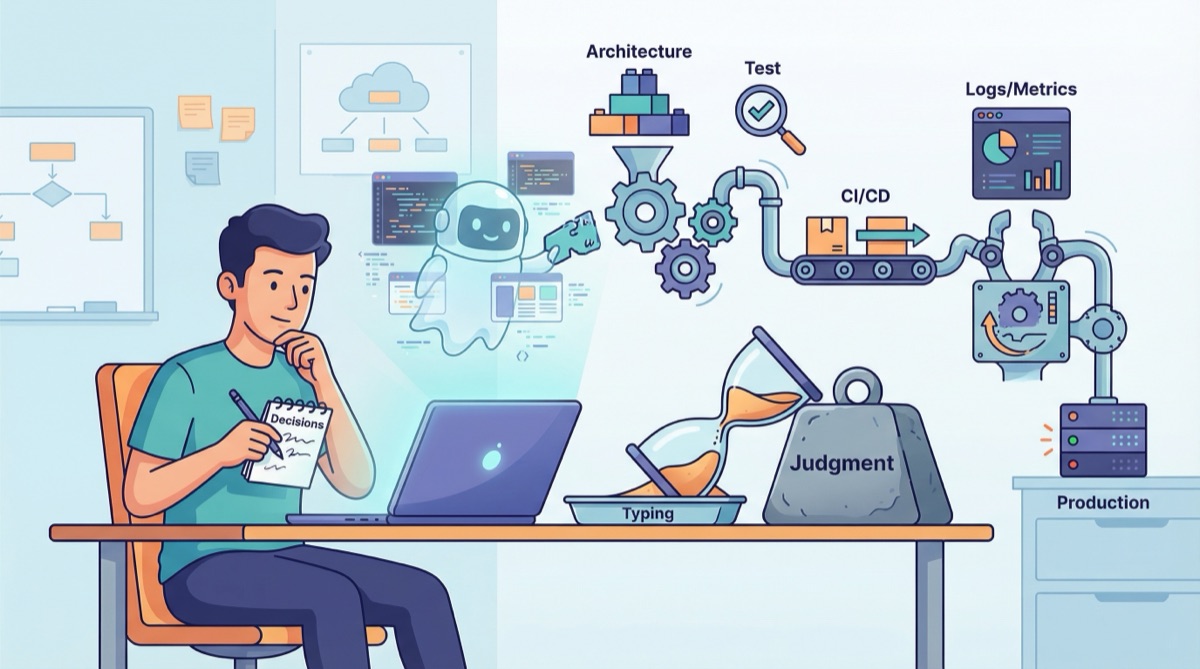
The way I build software has changed. Not gradually, not theoretically. The daily work looks different now.
I describe what a system should do. AI writes it. I review, refine, integrate. The cycle from “I need this” to “this works” shrank dramatically. Capabilities that used to take days now emerge in hours.
That’s not a prediction. That’s my Tuesday.
Not coding speed. Not syntax. The gap between intent and implementation.
Here’s what people miss: the thinking got harder, not easier.
When AI handles the typing, every remaining decision matters more. Architecture choices. Error handling strategies. What to test and why. How to make the system observable.
You can’t hide behind “let me write a spike first” anymore. The spike is instant. Now you have to decide if it’s the right approach.
I used to sketch architecture in diagrams or markdown files, then spend days turning those sketches into code. Now I describe intent and let the AI propose structure.
“I need a service that monitors incoming events, filters duplicates, evaluates which ones require action, and tracks what’s been processed.”
The AI scaffolds it. I critique. We iterate.
What used to take a day of design meetings now takes an hour of focused conversation.
But I still need to know what good architecture looks like. AI doesn’t have opinions about coupling, cohesion, or long-term maintenance burden. It writes what I ask for. The craft parts of software development don’t go away because AI can handle the trade parts. AI becomes a thinking partner, not a replacement.
If my intent is sloppy, the code is sloppy.
Some people think AI makes tests optional. Those people are wrong.
What changed is where I spend my attention. I describe test scenarios in plain language and the AI generates the setup, mocks, assertions. I focus on what should be tested. AI handles how to test it.
“Test that the service skips records it already processed today, even if they arrived through a different channel.”
The AI writes the entity setup, the repository mocks, the date manipulation. I verify the logic is correct.
Tests are still critical. They’re just faster to write.
Here’s what a day looks like now.
Morning: Review what’s running. Check metrics, scan logs, verify behavior matches expectations.
Midday: Describe the next feature. AI generates entity changes, service logic, UI updates. I review the diffs. Adjust. Commit.
Afternoon: Test it. Fix edge cases. Deploy.
Evening: Monitor.
What used to fill a week now fits in a day. Not because I type faster. Because AI removed the latency between thought and code.
Intent. Judgment. Taste.
AI doesn’t know what “good enough” means. It will happily generate perfect code for a bad idea.
I still decide:
And critically: I still review what AI produces. Not by reading every line. By asking questions, probing the parts that feel off, exploring where my intuition, built over decades of building systems, tells me to look closer.
AI is non-deterministic. Ask it the same question twice and you get different answers. It will produce code that looks confident but fails under load, violates security assumptions, or misunderstands the domain. Experience tells you where the traps are. Decades of building systems don’t become worthless. Quite the opposite. You learn to smell the spots that need attention.
This is exactly why tests matter more than ever. Tests are deterministic. They catch what your intuition misses. Done systematically, they drive measurable business results. When the tool generating your code can surprise you on any given run, a solid test suite is the only thing standing between you and silent regressions.
The review step didn’t disappear. It changed shape.
Low-code platforms tried to remove programming by constraining what you could build. AI removes typing by understanding what you want to build.
Huge difference.
I still write code. I still debug. I still think about data models, API contracts, failure modes, observability. The dream of replacing developers is as old as the industry itself. It fails every decade for the same reason.
But I don’t type boilerplate. I don’t look up syntax. I don’t waste time on scaffolding.
I describe systems and they emerge.
The cost of turning an idea into working software dropped dramatically. That changes who can afford to build products. It changes what ideas are viable. It changes the barrier between “interesting concept” and “working system.”
For small teams and solo founders, this opens doors that were previously locked behind hiring budgets.
For large organizations still running process theater and measuring activity instead of outcomes, this is going to hurt. Because the new question isn’t “how many developers do we need?” It’s “do we have someone who knows what to build and can direct AI to build it?”
AI doesn’t kill Agile — it kills Agile theater. The ceremonies that exist to coordinate typing become overhead when typing isn’t the bottleneck.
Small, skilled teams win.
One domain expert who understands the problem. One or two developers who can architect, test, and deploy. AI handles the rest.
No process rituals. No status ceremonies. No coordination theater.
Just: what are we building, why does it matter, how do we know it works?
Code in production every day. Feedback from real users. Iteration based on signals, not opinions.
This is what continuous delivery was supposed to be. AI just removed the last excuse for not doing it. And if you wonder what happens to the traditional role split: it’s dissolving.
Learning to think in systems instead of syntax.
Most developers were trained to think about implementation: loops, conditionals, data structures. AI handles that now.
The new skill is describing intent precisely enough that AI can implement it correctly.
“I need a function that processes payments” is too vague.
“I need a function that accepts a payment intent, validates the amount is within daily limits for this account, charges the card via Stripe, stores the transaction with an idempotency key for replay protection, and publishes a payment.completed event to the message bus.” That works.
Precision of thought matters more than precision of syntax.
I’m not selling AI tools. I’m not affiliated with any LLM provider. I’m a developer who builds systems for clients.
And the way I build products has changed. Not “might change.” Changed.
If you’re still organizing teams around typing velocity, you’re optimizing for a constraint that no longer exists.
The new constraint is decision-making. Understanding what to build. Translating business intent into working systems.
That’s always been the hard part. Now it’s the only part that matters.
Tell me what is happening. I listen, ask a few practical questions, and reflect back what I see: where the risk may sit, what may be blocking delivery, and what looks worth checking next. No pitch, no obligation. Confidential and direct.
Talk it through. Practical reflection, no pitch.
Start a ConversationTelenovelas show what we can't say in client meetings. The drama is heightened, but the patterns are real.
 Three Ways to Understand a Country
Stefan drives Sophie to the Pacific for two days. The beach is big enough to make her feel appropriately small. Back at the finca the rain keeps th...
 The Resignations
Nathan Cole resigns on a Monday morning with two sentences and no argument left in his body. By Tuesday his desk is empty and the company's institu...
Embedded into your team as an active contributor, reducing delivery friction and helping important work move cleanly.
Peer-style technical assessments before far-reaching decisions; reduce architectural and product risk early.
Ship working software to real users earlier. Measure impact and adapt based on evidence rather than assumption.
High quality, maintainable software. Short-term augmentation that leaves lasting capability in your own team.
A senior developer for your team
Our Embedded Delivery Partner writes production code with your team, improves the pipeline, and accelerates delivery. 60-70% coding, 30-40% coaching. A temporary teammate who ships from day one.