The Search for Help
Katja's network responds within the week. Three different people recommend the same name: Stefan Richter. Developer Advocate. Short engagements. Embeds with teams. Focuses on practices, not frameworks. His X account shows posts about TDD and trunk-based development, mixed with photos from a finca somewhere tropical. A recent post catches her eye: 'In Berlin temporarily. Family situation. Available for on-site engagements.' She sends him four weeks of Navigator synthesis. He responds within hours: 'This is solvable.' Friday morning in a Kreuzberg café, she meets a man who doesn't pitch, doesn't promise, doesn't sell. He asks questions. Good ones.
Wednesday, 07:12 — Schönleinstrasse, Kreuzberg
Katja had sent five messages Thursday night. By Wednesday morning, three had come back.
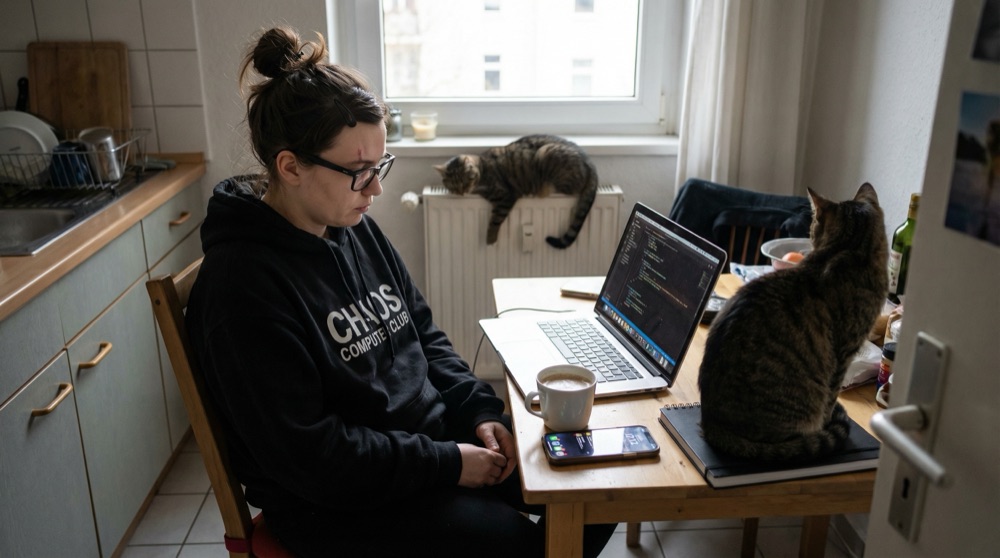
The kitchen window was cracked open for the first time since October. Eleven degrees at seven in the morning, but the air smelled different. Green. Wet soil from the courtyard planters. A blackbird on the fire escape was performing its entire repertoire for nobody. Monday’s drizzle had broken into something warmer overnight, and Berlin was doing that thing it does every April where the city remembers it can be beautiful.
She sat at the kitchen table in underwear and the oversized Chaos Computer Club hoodie she’d stolen from a boyfriend in 2019. Turing was draped across the radiator, which had clicked off sometime during the night and hadn’t come back on. Lovelace had positioned herself precisely on top of the closed notebook Katja needed, because cats understand leverage.
The first reply came from Jens, a former SoundCloud colleague now running platform at a fintech in Hamburg.
Know exactly what you need. Had the same situation in 2023 — team brilliant, codebase rotting, leadership blind. We hired three consultants. Two gave us slide decks. One actually worked. His name is Stefan Richter. Developer Advocate. Does short engagements. Embeds with the team, writes code alongside your people, diagnoses from the inside. Not a framework guy. Not a methodology guy. Practices.
Fair warning: he doesn’t sugarcoat. If your CEO can’t handle directness, don’t bother.
The second response came from the Berlin CTO Slack. A woman named Priska whose name Katja recognized from meetups but had never spoken to directly.
You’re describing a pattern I’ve seen three times. Scaled too fast, promoted your best developer into management, accumulated debt nobody measured, and now the foundation is cracking under the weight of everything you built on top of it.
Talk to Stefan Richter. He did six weeks with us in 2024. Didn’t fix everything. Fixed what mattered first. The order matters more than the effort.
The third reply was from Fabian, the university contact. Shorter.
Stefan Richter. He’s in Berlin right now, visiting family. Usually based somewhere in Latin America. Catch him before he leaves.
Three people. Three separate networks. The same name.
Katja stared at her screen. Coffee going cold. Lovelace purred on the notebook.
She typed the name into her browser.
Wednesday, 09:30 — Katja’s Office

Stefan Richter’s online presence was sparse. No LinkedIn banner shouting “Transformational Leader.” No personal branding. No testimonials carousel. A website with four pages: who he was, what he did, where he’d worked, how to reach him.
She read the “what he does” page twice.
I embed with development teams for four to twelve weeks. I write code alongside your developers. I pair-program, review architecture, and help establish practices that outlast my engagement. I don’t sell frameworks. I don’t run workshops about “agile maturity.” I fix deployment pipelines, introduce test-driven development, and help teams ship safely without depending on heroic individuals.
When I leave, the team owns everything I helped build. No dependency. No subscription. No follow-up retainer.
Katja leaned back in her chair. She’d spent twelve years in Berlin tech. She’d seen consultants arrive with branded slide templates and leave with invoices. She’d sat through transformation kickoffs where everyone clapped and nothing changed. She’d watched process frameworks get installed like operating systems, complete and hermetic and completely disconnected from the actual code running underneath.
This was different. Or it was the same thing wearing better clothes. She couldn’t tell yet.
She opened his X profile. The feed was a mix of technical posts and photographs.
“Trunk-based development isn’t a technique. It’s a trust signal. If your team can’t merge to main daily, something structural is broken.”
Underneath, a photo of horses grazing behind a wooden fence, green pastures stretching toward low hills. Location tag: Chepo, Panamá.
“TDD doesn’t slow you down. It tells you the truth faster than you can discover it any other way. The speed comes from not building the wrong thing.”
Then a photo of a dog sleeping on a terracotta porch. Caption: “Code review partner. Consistently approves all PRs.”
She scrolled further. Technical posts with no jargon inflation. Short. Opinionated. Concrete. Posts about deployment frequency with actual numbers. Posts about pair programming that described what happened in specific teams, not abstract principles. A thread about Conway’s Law that used a real company example without naming it.
Then, three weeks old, the post that stopped her scroll:
“In Berlin temporarily. Family situation. Available for short on-site engagements while I’m here. If your team ships less than once a week and you want to fix that, let’s talk. Practices, not presentations.”
She read it again. Then a third time.
Family situation. In Berlin temporarily. Available.
Through the glass walls of her office, she could see the development floor. Half the desks occupied. Morning sun angled across the open-plan space in a way it hadn’t a month ago, the days stretching longer, catching dust motes and abandoned coffee cups. Someone had opened the big windows along the south wall. Fourteen degrees outside, warm enough for the building to feel stuffy with its winter heating still calibrated for February.
The spring shift was visible in how people dressed. Tomasz at his station in his usual gray hoodie, sleeves pushed up, headphones on, expression blank, already emotionally somewhere else. Hassan’s desk dark again. Mariana had arrived in cut-off denim shorts and a Kreator t-shirt with the sleeves ripped off, bare brown legs crossed under her desk, Docs unlaced. She’d been dressing like it was summer since the temperature hit twelve degrees. Brazilian blood. The German developers were still in hoodies and jeans, clinging to winter layers like the warmth couldn’t be trusted. Mariana typed with the ferocious speed that meant she was angry or caffeinated or both.
Katja opened a new document.
Wednesday, 13:45 — Development Floor

The knowledge drain had already started.
The afternoon sun had turned the development floor warm enough that half the team had stripped down to t-shirts. Mariana stood at Tomasz’s desk holding her laptop like a tray, the deployment configuration file open on screen. Her cut-offs rode high on her thighs. Nobody looked twice. Gaming studio in Kreuzberg, not a consultancy in Frankfurt. A question about container orchestration. Something Hassan would normally handle, but Hassan was out sick for the second day this week. Doctor’s note. Exhaustion.
“Tomasz, do you know why the staging environment uses a different load balancer config than production?”
He looked up. Headphones around his neck. The expression on his face was one she hadn’t seen before. Not the focused intensity of a developer weighing a technical problem. Something flatter. Like someone watching scenery pass from a train window.
“Historical reasons,” he said. “Diego set up staging with a single-endpoint LB when we had twelve developers. Nobody changed it when we scaled. I rewired production in October but never touched staging because I didn’t have time.”
“Is there documentation?”
“No.”
“Where is that knowledge? Your head?”
“Yes.”
Mariana felt something cold settle in her chest. She’d known this intellectually. She’d read the synthesis. Forty-one logs. She’d written her own Slack message to Katja about transition planning. But standing here, asking a simple infrastructure question and hearing “my head” from a man who had seventy-eight working days left, the reality hit different.
“Can you write it down?”
Tomasz pulled his headphones back on. “Add it to the list.”
There was no list. Nobody had started one. Fourteen days and not a single fucking document. Two weeks since his resignation, and the knowledge transfer plan consisted of people wandering to his desk with questions he answered with decreasing patience.
At her own desk, Mariana opened Navigator.
Navigator — Mariana Santos — 22 April 2026, 14:02
Asked Tomasz about staging infrastructure config. Answer: “historical reasons” and “it’s in my head.” No documentation. Hassan is out sick. I can’t deploy to staging without either of them.
We’ve had fourteen days to start a knowledge transfer plan. We haven’t. Tomasz is already checking out. I don’t blame him. But every day we don’t document what he knows is a day of institutional memory walking toward the exit.
Somebody needs to own the transition. Not “everybody.” Somebody specific. Right now it’s nobody, which means it’s not happening. I’m so tired of watching us sleepwalk into a wall we can all see.
Two desks over, Anton was mid-function in Unity when Lars appeared at his shoulder.
“Quick question. The particle effect for the summer event. Can we do volumetric fog on mobile?”
“No.”
“Why not?”
“Because the custom renderer doesn’t support volumetric effects, and I’d need to rebuild the entire particle pipeline to add them, and the particle pipeline is two thousand lines of undocumented code by someone who left eleven months ago.”
Lars blinked. “I used to ask Tomasz these questions.”
“I know.”
“He’d usually give me an alternative.”
Anton took his hands off the keyboard. “The alternative is a gradient overlay faking depth. I can do that in a day. Do you want me to mock it up or do you want to discuss it in the next design review?”
Lars processed this. “Mock it up?”
“Tomorrow.”
Lars left. Anton stared at his screen. He’d just done in forty-five seconds what Tomasz used to do fifty times a week: translate a design wish into a technical reality, offer a compromise, set an expectation, move on. Nobody had listed that skill in any job description. Nobody measured it. Nobody trained for it. Tomasz did it reflexively, the way some people breathe through their mouth without thinking about it.
Now Anton was doing it. One question at a time. The load was shifting.
Wednesday, 22:17 — Schönleinstrasse
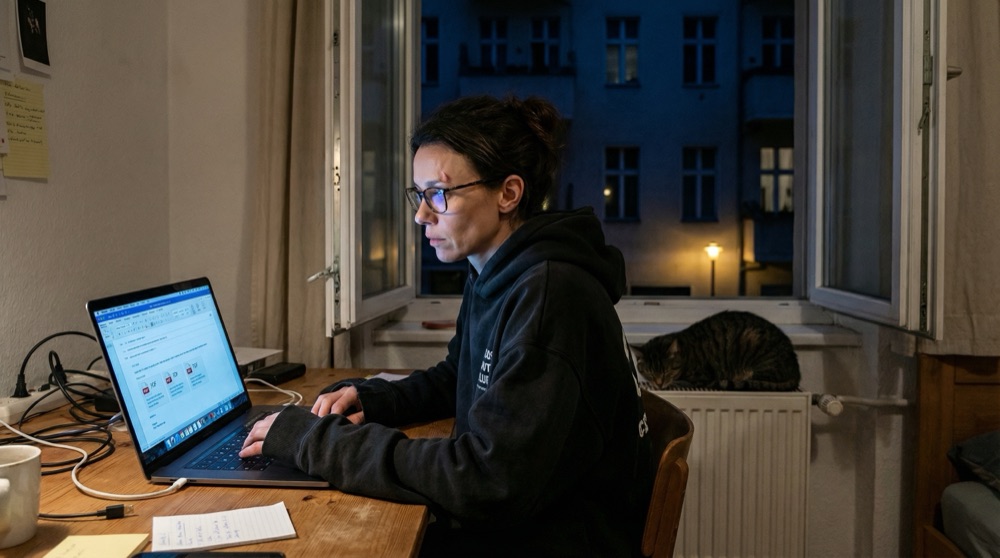
Katja wrote the email in three drafts. Deleted the first because it was too desperate. Deleted the second because it was too formal. The third was honest.
Subject: Broken delivery, brilliant team, no framework will fix this
Sehr geehrter Herr Richter,
my name is Katja Müller, CTO at Pixel Spree, a mobile gaming studio in Berlin. 85 people, post-Series B, eighteen months of growth that outpaced our ability to deliver.
Three people recommended you to me independently this week: Jens Lindqvist in Hamburg, Priska Bauer from the Berlin CTO Slack, and Fabian Hartmann at TU Berlin. All three described the same thing. Someone who embeds with teams, writes code, and fixes practices rather than selling processes.
Our situation, briefly:
Our Head of Engineering resigned two weeks ago. He was our best developer, promoted into management, and hated every day of it. He leaves July 31. His name appears in 41 daily logs across 7 departments. He is not a role. He is connective tissue.
Our DevOps engineer has worked solo for eighteen months. Manual deployments. Infrastructure held together by his personal knowledge. He was out sick twice this month. The doctor wrote “exhaustion.”
Our senior Unity developer mapped the technical debt last week. Fourteen interconnected modules. Two years of accumulated shortcuts. Four of five quarterly priorities are blocked by the same rotting foundation.
We use Caimito Navigator for daily logging and weekly synthesis. Seven weeks of data. The patterns are clear.
I’m attaching the last four weekly synthesis reports. They contain no opinions. Read them. If what you see is a pattern you’ve addressed before, I would like to speak with you.
To be direct: I am not looking for a transformation roadmap or a methodology assessment. I need someone who can sit with my team, read the code, understand why it looks like that, and help us fix what matters first. In the right order. Before the people who can fix it leave.
You mentioned on X that you’re in Berlin temporarily. So is my window.
Mit freundlichen Grüßen, Katja Müller
She attached the four synthesis PDFs. Weeks 8 through 11. Hassan’s burnout trajectory. Anton’s debt assessment. The bus factor analysis. Tomasz’s forty-one mentions. Everything Navigator had surfaced, laid bare.
Her cursor hovered over the send button. Turing shifted on the radiator, one paw dangling. Through the open window, the courtyard smelled like linden buds and someone’s balcony cigarette. Fifteen degrees still, even at ten at night. The neighborhood was quiet. Wednesday night in Kreuzberg, the particular silence that means even the bars have gone conversational.
She clicked send.
Then she closed the laptop, picked up Lovelace from the desk chair, and sat there holding a warm cat and staring at nothing. The email was out. The synthesis reports were now in a stranger’s inbox. Four weeks of her team’s most honest words, the things they typed into Navigator at 02:00 and 14:00 and 22:00 because saying them out loud felt too dangerous or too pointless. She’d just handed all of that to someone she’d never met.
It was either the smartest thing she’d done in months or the most naive. She wouldn’t know until he responded. If he responded.
Thursday, 08:14 — Wilmersdorf

Stefan Richter read the email standing up, phone in one hand, coffee in the other. He’d been awake since 06:30. Old habit from years in Panama where dawn came at 05:45 and the finca was loudest before the heat settled.
He’d been in Berlin eight days. Sophie had called him in Mexico City on a Wednesday evening, her voice cracking through the phone in a way that cut through two thousand kilometers of distance like it was nothing. Her mother had collapsed at home. Ambulance. Hospital. Diagnosis pending. “Papa, I don’t have anyone else. Can you come home?”
He’d been on a flight from Mexico City by Thursday morning. Left the LogiMex engagement mid-sprint. Diego Ramírez had said, “Go be with your family. You’ve given us everything we need.” Stefan had been too focused on Sophie to argue.
The ex-wife’s apartment in Wilmersdorf was the only version of home that still existed for him in Berlin. Guest room. Single bed. Sophie’s drawings from Grundschule still on the hallway wall because nobody had gotten around to taking them down. The kitchen smelled like the Brötchen he’d walked to the bakery to buy at seven, because doing something useful with his hands felt better than sitting with the dread. The walk had taken him past Ludwigkirchplatz, where the cherry trees were erupting in pink along the paths. Thirteen degrees at seven in the morning, a light jacket over his t-shirt. Berlin spring felt fragile after years of tropical heat. In Chepo the temperature never dropped below twenty-five. Here, April could give you sixteen degrees and sunshine at noon and seven degrees and drizzle by evening. He’d forgotten that about this city.
Sophie appeared in the kitchen doorway. Sixteen. A denim jacket over a band t-shirt he didn’t recognize, jeans ripped at one knee. Backpack trailing from one shoulder. She’d stopped wearing the heavy parka sometime last week. Spring was doing its work on the wardrobe. She looked at him the way she’d been looking at him since he arrived: with the guarded relief of someone who expected him to leave again but hadn’t stopped hoping he wouldn’t.
“Frühstück?”
“Hab schon.” She grabbed a Brötchen from the counter and took a bite standing. “Mama’s awake. She texted. They’re doing more tests today.”
“I’ll go after lunch.”
Sophie nodded. Then, quieter: “You’re staying, right? For a while?”
“I’m staying.”
She left for school. The apartment door clicked shut. The apartment felt empty in the particular way that single-parent homes do when the child leaves: too quiet, too clean, too full of evidence of a life being lived by someone else.
He opened his laptop and downloaded the four PDF attachments. Navigator synthesis reports. He knew the tool. Knew the approach. Daily logs from practitioners, weekly AI synthesis surfacing patterns. He’d recommended it to the team in Bogotá. The data was always more honest than the meetings.
He opened Week 8. The onboarding disaster. Four juniors arriving with no plan, no documentation, no mentorship capacity. New hires mentioned zero times in production logs. Invisible headcount.
Week 9. The backlog explosion. 147 items, 89 high priority. Developers abandoning the backlog entirely. A CEO who confused motion with direction.
Week 10. Technical debt assessment. Fourteen modules. Custom renderers written by departed developers. Undocumented. Untested. Two years of shortcuts hardening into geology.
Week 11. The departure. Forty-one logs. Seven departments. One person. Bus factor table showing four individuals carrying the entire technical organization. One of them already leaving.
Stefan closed the reports. Sat down at the kitchen table. Picked up his Brötchen. Butter, strawberry jam, the good Gouda from the Turkish deli three blocks over.
He ate slowly, thinking.
The pattern was familiar. He’d seen it in Bogotá at a fintech where the lead developer vanished and the codebase collapsed. He’d seen it in Hamburg where scaling-without-practices turned a competent team into permanent firefighters. He’d seen it in Mexico City just three weeks ago, where a twenty-five-year-old AS/400 system needed modernization and a veteran developer was terrified of being made obsolete by the very transformation he was asked to deliver.
The shape was always the same. Growth without discipline. Pressure without visibility. Talented people ground down by systems that rewarded output over sustainability. The individual symptoms varied. The structural causes didn’t.
This one had something the others hadn’t: seven weeks of Navigator data. Seven weeks of developers writing truth because the tool asked and the synthesis listened and the patterns emerged whether leadership wanted to see them or not. That data was a map. Most companies he walked into didn’t have a map. They had slide decks and opinions and status meetings where everyone agreed things were roughly fine.
This company already knew what was wrong. They could see it. They just couldn’t fix it from inside.
The apartment was quiet. Sophie’s school bag was gone. Her coffee cup sat in the sink, unwashed. The small evidence of a teenager’s morning. He’d been in Berlin eight days and already the rhythm was forming: bakery, breakfast, hospital visit, evening with Sophie, the particular ache of watching his daughter navigate something no sixteen-year-old should navigate while her father tried to be present after years of choosing work.
A Berlin engagement would let him stay. Be here for Sophie. Visit the hospital. Not disappear back to Latin America while his daughter held everything together alone.
He opened a reply.
Thursday, 10:47 — The Reply

Katja was between meetings when her phone buzzed. She was standing in the hallway outside Conference Room “Neukölln” where Daniel Schmidt was presenting QA metrics to nobody who’d asked. The development floor buzzed with its midweek rhythm. Someone was microwaving soup. The espresso machine hissed.
She looked at her phone.
Subject: Re: Broken delivery, brilliant team, no framework will fix this
Guten Tag Frau Müller,
I read all four synthesis reports. Twice.
This is solvable.
A few observations, based solely on the data:
Your team isn’t weak. Your team is good. The synthesis makes that clear. Developers who log honestly at 02:00 after a fifteen-hour shift care about the work. People who identify structural problems and document them precisely have diagnostic ability. What they lack is time, sequencing, and the structural support to use their own insights.
The forty-one mentions in Week 11 aren’t a personnel risk. They’re an architectural one. You didn’t lose a manager. You lost an integration layer. The human routes disappeared, and now every cross-team interaction has to find a new path. That’s fixable, but not through a replacement hire. The role wasn’t one role. It was seven roles that one person absorbed because nobody built the systems that should have handled them.
Infrastructure is your first constraint. Everything starts with deployment. If Hassan is the only person who can ship code to production, then Hassan is a manual deployment pipeline, and every priority you set is gated by one exhausted human being. Fix that first.
I’m in Berlin for the foreseeable future. Family situation. I could start within a week if we agree on scope.
But before we talk scope: Come have coffee. Bring questions, not a brief. I’ll bring the synthesis reports with my annotations. Let’s see if working together makes sense. Sometimes it doesn’t. I’d rather both of us know that over coffee than discover it three weeks into an engagement.
Friday, 11:00? I know a place on Paul-Lincke-Ufer. Let me know.
Stefan
Katja read it standing in the hallway. Read it again. Her hands were steady but her pulse wasn’t.
Your team isn’t weak. Your team is good.
Nobody had said that. Not in eight weeks of crisis. Not in the all-hands. Not in the board prep meetings. Not in the Monday standups where everyone stared at their shoes. Eight weeks of reports and arguments and the slow grinding recognition that everything was breaking, and not once had anyone said: the team is good. The system around them isn’t.
The forty-one mentions aren’t a personnel risk. They’re an architectural one.
She leaned against the hallway wall. Conference Room “Neukölln” emitted the drone of slides being advanced. Someone walked past carrying a laptop and a defeated expression.
She typed a reply.
Friday, 11:00. Paul-Lincke-Ufer works. I’ll be the one with the laptop and the dark circles.
Sent.
She stood in the hallway for another thirty seconds, phone in her hand, the echo of this is solvable sitting in her chest like the first warm day after a long winter. Not quite warm enough to trust. But warm.
Thursday, 15:22 — Navigator Weekly Synthesis

The synthesis arrived at its usual time. Katja opened it at her desk, afternoon coffee untouched beside her keyboard.
Navigator Weekly Synthesis — Week 12 (19–23 April)
Critical Pattern: Knowledge Drain Velocity
Two weeks since Tomasz Kowalski’s resignation. The organizational impact is accelerating.
This week’s logs reveal a shift from shock to operational friction. Developers are encountering daily gaps where Tomasz’s knowledge was previously the bridge. Five specific knowledge domains have generated repeated “nobody knows” or “Tomasz would know” entries:
- Staging environment configuration — 3 developers blocked, no documentation
- Deployment approval workflow — Process depended on Tomasz’s judgment, no written criteria
- Cross-team technical arbitration — Design and QA teams report decisions stalling without a neutral technical authority
- Architecture decision history — 2 developers reversed decisions this week that Tomasz had made for undocumented but valid technical reasons
- New hire mentorship — Junior developers report decreased access to senior guidance
Knowledge Transfer Status: NOT STARTED
No formal transition plan exists. Knowledge transfer is occurring ad hoc through desk-side questions. Developer logs indicate Tomasz’s responsiveness to these queries is declining. This is consistent with emotional disengagement patterns observed in departing employees.
Estimated knowledge at risk: Tomasz logs indicate approximately 200+ architectural decisions, deployment configurations, and cross-team agreements stored as personal institutional memory. Current transfer rate at ad hoc pace: 2-3 items per week. Required transfer time at current rate: 18+ months. Available time: 10 weeks.
Katja stared at the numbers. Eighteen months. Ten weeks. She said “Shit” out loud to her empty office. The math was obscene.
Emerging Pattern: Load Redistribution Without Capacity
Tomasz’s departure has redistributed his informal responsibilities across three individuals:
| Responsibility | Previous | Current (unofficial) | Capacity Available |
|---|---|---|---|
| Technical arbitration | Tomasz | Anton Petrov | None — already at capacity with Q2 priority work |
| Infrastructure decisions | Tomasz | Hassan Al-Rashid | None — out sick 2 days this week |
| Cross-team translation | Tomasz | Mariana Santos | Limited — absorbed 40% of Tomasz’s Slack traffic |
None of these redistributions were planned or acknowledged. None include workload relief in the recipient’s existing responsibilities.
Burnout Indicators: Elevated
Hassan Al-Rashid was absent two days this week (medical — exhaustion). This is his first sick leave in fourteen months of employment. Log analysis shows his weekly hours exceeded 50 in nine of the past eleven weeks.
Developer sentiment across all logs this week: resignation and frustration exceeding previous weeks. Three entries explicitly mention recruiter contact. One entry mentions updating a CV.
Recommendation:
The knowledge drain from Tomasz’s departure is proceeding faster than the organization’s ability to capture it. Without a structured transition plan, the majority of his institutional knowledge will be lost. The recommendation from Week 11 remains urgent: external technical support is needed to help sequence interventions, absorb transition complexity, and prevent the remaining senior developers from reaching their own breaking points.
Katja read the recommendation and, for the first time, didn’t feel the weight of it alone.
Friday. 11:00. Paul-Lincke-Ufer.
Someone was coming who’d read the same data and said: This is solvable.
She opened Navigator.
Navigator — Katja Müller — 23 April 2026, 15:48
Synthesis confirms what the hallways show: knowledge drain is accelerating. No transition plan. Tomasz disengaging. Load shifting to Anton, Hassan, and Mariana without anyone acknowledging it or reducing their existing work.
I contacted an external developer advocate this week. Stefan Richter. Three independent recommendations. He read four weeks of synthesis reports and responded within hours. Practical observations. No buzzwords. He identified the infrastructure constraint and the architectural nature of Tomasz’s role from the data alone.
Meeting him tomorrow. Coffee. Kreuzberg. Not a sales pitch. A conversation. If he’s what the recommendations describe, he could start within a week.
I haven’t told Lukas yet. I want to have the conversation first. Bring something concrete. Lukas responds to proposals, not possibilities.
Friday, 11:04 — Paul-Lincke-Ufer, Kreuzberg
She arrived ten minutes early. Force of habit from twelve years of German corporate life, plus the specific anxiety of meeting a stranger you’ve already told everything to.
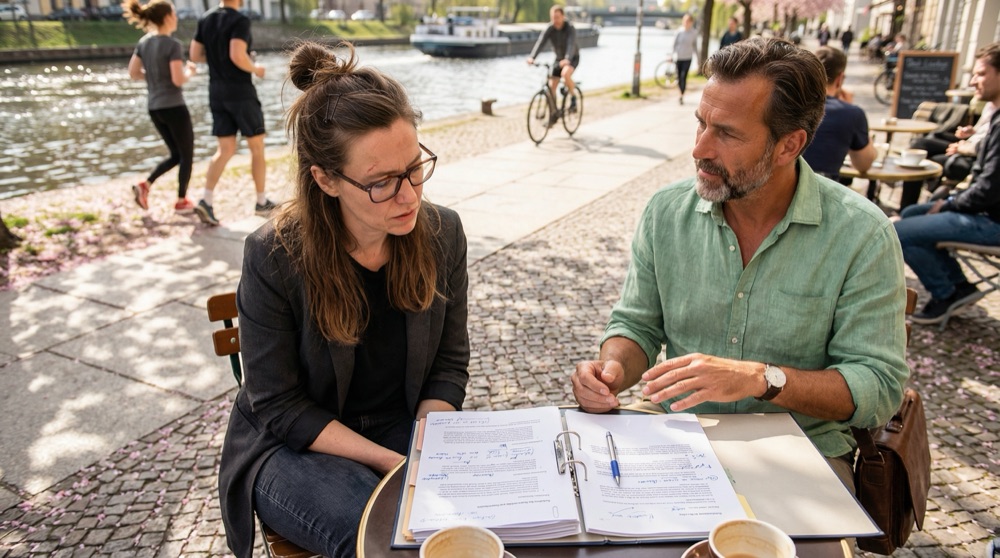
The café on Paul-Lincke-Ufer had the same tables outside as last spring, same view of the Landwehrkanal, same dog walkers and joggers on the towpath below. Cherry blossoms along the water, petals drifting onto the canal surface in slow pink spirals. Sixteen degrees and climbing. She’d worn the charcoal blazer over a black t-shirt because she wanted to look like a CTO, then regretted it walking from the U-Bahn because the sun was already warm enough for shirt sleeves.
She recognized him from the X profile photo. Taller than expected. Late forties. Linen shirt, sleeves rolled above the forearms, tanned in a way that said years outdoors and not two weeks in Mallorca. Leather bag over one shoulder. He walked toward the café with the unhurried pace of someone who’d spent years in places where nobody rushed anywhere before noon.
He spotted her and nodded. Laptop, dark circles, charcoal blazer. As advertised.
“Frau Müller?”
“Katja.”
“Stefan.” He sat down. Pulled a folder from the bag. Four printed synthesis reports, every page covered in handwritten annotations. Marginal notes in blue ink. Sections underlined. Arrows connecting passages across pages.
She stared at the folder. He’d printed them. He’d annotated them by hand. In the age of AI-powered summary tools and automated insight dashboards, this man had printed eighty pages of developer logs and gone through them with a pen.
“I have three questions,” he said. “Then I want to hear yours.”
No introduction. No credentials recitation. No description of his methodology or his approach or his values or his proprietary four-phase engagement model. Three questions.
“OK.”
“First.” He opened the Week 10 synthesis to a page near the middle. Anton’s technical debt assessment. “Your developer Anton Petrov identified fourteen interconnected modules that constitute the foundation of your technical debt. He mapped them. He knows where the problems are. He has the diagnostic ability to do the remediation work. Why isn’t he leading it?”
Katja opened her mouth. Closed it. The honest answer formed before the diplomatic one could intervene.
“Because he’s fully committed to the Q2 feature priorities that Lukas set in March. Nobody moved anything off his plate.”
Stefan wrote something in the margin. One word. She couldn’t read it upside down.
“Second.” He flipped to Week 11. The bus factor table. “Hassan Al-Rashid has been your sole infrastructure person for eighteen months. He’s out sick with exhaustion. Nobody can deploy without him. When did you first know this was a single point of failure, and what prevented you from acting on it?”
The question stung because it was fair.
“I raised it in September. Lukas said we’d hire a second person in Q1. Q1 came and the headcount went to game development instead. I raised it again in January. Same answer. Q2. Then Hassan started breaking.”
Stefan nodded. Not sympathetically. Not judgmentally. The nod of a diagnostician confirming a pattern.
“Third.” He found Week 8. The onboarding failure. “Four junior developers arrived in February with no mentorship structure, no documentation, and no one assigned to guide them. They’ve been invisible ever since. Whose decision was it to hire four juniors simultaneously into a team that was already at capacity?”
“Lukas’s. He wanted to grow fast. The board expected headcount growth as a Series B signal.”
“Growth as metric instead of capacity outcome.”
“Yes.”
Stefan closed the folder. Put his hands flat on the table. The canal glinted behind him, a cyclist bell ringing somewhere on the towpath below.
“All three questions have the same answer,” he said. “Priority is set by someone who doesn’t understand the constraints. Your CEO decides what gets built. Your developers know what needs fixing. The two groups don’t share a language, don’t share data, and don’t share authority. Every problem you described flows from that gap.”
Something shifted in Katja’s chest. Not relief exactly. Something closer to the feeling of hearing your own thoughts spoken by someone who had no reason to soften them.
“You already have the data,” Stefan continued. “Navigator gives you something most companies never have: honest signals from the people doing the work. Seven weeks of it. The patterns are obvious to anyone who reads them. The sequencing is the part that matters now.”
“Sequencing.”
“Infrastructure first. If Hassan is the only person who can deploy, nothing else moves. Automate the pipeline. Get two more people who can push code to production. That’s week one. Not next quarter. Week one.”
He ticked it on his fingers.
“Knowledge capture second. Tomasz has ten weeks left. Most of what he knows is undocumented architecture decisions and cross-team tribal knowledge. Pair me with him four hours a day. I’ll extract, document, and transfer as much as possible. Not all of it. Enough to prevent catastrophe.”
Second finger.
“Technical debt triage third. Not all fourteen modules. The three that block everything else. Anton already knows which three. Ask him. Then let him work on them. Move the Q2 feature work to someone else or push the deadline. The foundation has to hold before you can build on it.”
He stopped. Picked up his coffee for the first time. Drank. Set it down.
“Infrastructure, knowledge, foundation. In that order. Everything else is noise until those three are addressed.”
Forty-five minutes. That was how long it took. Forty-five minutes of direct questions, direct answers, and a sequence that made the chaos feel like something with handles she could grab.
He didn’t promise transformation. Didn’t mention agile or scrum or SAFe or any of the branded frameworks consultants deploy like Christmas decorations. Didn’t use the word “journey.” Didn’t offer a slide deck. He read the data, asked the right questions, and told her what to fix first.
“What do you need from me to start?” she asked.
“Access to the codebase. A desk on the development floor. Introduction to Hassan and Tomasz. I’ll pair with your developers, not manage them. I write code. I don’t run workshops.”
“When can you start?”
“Monday.”
They sat with that for a moment. The canal sparkled. A long barge moved slowly under the bridge. Cherry blossom petals collected in the eddies along the stone walls.
“I need to present this to Lukas,” Katja said. “He’ll want to know costs, timeline, deliverables.”
“Send me his questions. I’ll answer them with data from your own synthesis reports. If he can read his own company’s truth and still say no, you have a bigger problem than technical debt.”
She almost smiled. Almost.
She walked back through Kreuzberg’s Friday streets. Cherry blossom petals drifting along Paul-Lincke-Ufer like pink static. The bakeries and bike shops and Turkish grocers and all the ordinary machinery of a city that kept running because someone, somewhere, maintained the systems that made it work.
She didn’t go to her office. She went straight upstairs.
Friday, 14:22 — Lukas’s Office
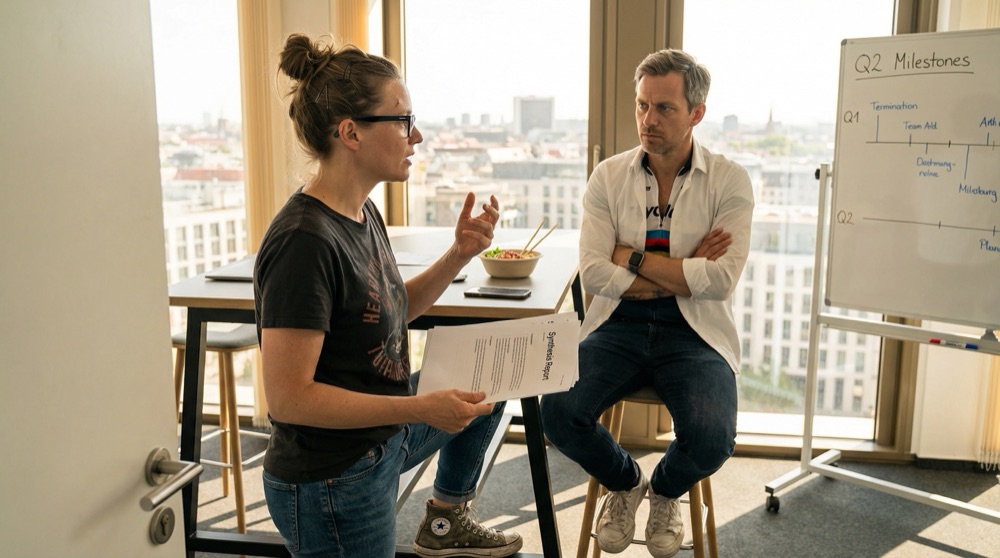
Lukas was eating lunch at his desk. A bowl of poke from the place around the corner. Chopsticks in one hand, phone in the other, scrolling through something with the half-attention of a man who never fully stopped working but never fully started either.
He looked up when Katja knocked on the open door.
“Got ten minutes?”
“Five.” He set the chopsticks across the bowl. Leaned back on the desk stool. Arms crossed. The posture she knew well: ready to listen, ready to deflect.
Katja didn’t sit down.
“I met someone this morning. A developer advocate named Stefan Richter. Three people recommended him independently this week. He does short engagements, four to twelve weeks, embeds with the team, writes code. Not a methodology consultant. Not a framework seller. He fixes deployment pipelines and development practices.”
Lukas’s expression didn’t change. She’d seen him listen to a hundred pitches. The face was the same for all of them: polite, patient, already composing the question that would find the weakness.
“I sent him four weeks of Navigator synthesis reports. He read them. All of them. Annotated them by hand. Then he asked me three questions that cut straight to the root of every problem we’ve been circling.”
“What questions?”
“Why isn’t Anton leading the debt remediation he already mapped? Why did we let Hassan run solo on infrastructure for eighteen months after I flagged it? And whose decision was it to hire four juniors simultaneously into a team at capacity?”
Something flickered across Lukas’s face. Not quite discomfort. Recognition.
“All three answers pointed to the same thing,” Katja continued. “Priority is set without understanding constraints. The developers know what’s broken. The people setting priorities don’t see the constraints. The two groups don’t share data and don’t share authority.”
Lukas uncrossed his arms. Put his hands flat on the desk.
“And his solution?”
“Three things. In order. First: automate the deployment pipeline. Get Hassan out of the critical path. If he’s the only person who can ship code, everything is gated by one exhausted person. That’s week one.”
Lukas opened his mouth. Katja didn’t stop.
“Second: pair with Tomasz four hours a day. Extract and document the architecture decisions, the cross-team knowledge, the infrastructure reasoning that lives in his head. We have ten weeks. At the current ad-hoc rate, Navigator estimates we’d need eighteen months to transfer what he knows. We don’t have eighteen months.”
“And third?”
“Technical debt triage. Not all fourteen modules. The three that block everything else. Anton already knows which three. Let him work on them instead of the Q2 feature list. The foundation has to hold before anything we build on top of it matters.”
Silence. Lukas stared at the whiteboard behind her. Q2 milestones. Revenue targets. The board update in two weeks. She could see him running the numbers.
“What does he cost?”
“I don’t have a number yet. He said to send him your questions and he’d answer them using our own data. But Lukas, think about what Tomasz’s departure costs. What Hassan’s burnout costs. What every week without a deployment pipeline costs in developer hours, in blocked features, in retention risk.”
“I’m not arguing costs.” He said it quietly. “I’m asking.”
She exhaled. Right. He was asking. Not deflecting. That was new.
“He can start Monday.”
Lukas picked up a chopstick. Turned it between his fingers. A fidget gesture she’d seen a thousand times. Processing.
“No slide deck? No transformation roadmap? He just shows up and writes code?”
“He shows up, sits on the development floor, pairs with our people, and fixes what’s broken. Starting with infrastructure. He doesn’t run workshops. He doesn’t give presentations. He reads code and makes it better.”
“And when he leaves?”
“The team owns everything he helped build. No dependency. No subscription. That’s his model.”
Lukas set the chopstick down. Looked at her directly for the first time since she’d walked in.
“You trust him?”
The question landed harder than it should have. Trust. She’d spent forty-five minutes with the man. She’d read his sparse website. She’d looked at his X feed. She’d heard three independent recommendations. She’d watched him annotate eighty pages of her team’s most honest writing with a blue pen.
“I trust the data,” she said. “And he’s the first person who read it and didn’t try to sell me something. He told me what to fix first. In what order. Based on what our own people wrote.”
Lukas was quiet for five seconds. Six. Seven.
“Monday,” he said.
“Monday.”
“Set it up. Get me a scope and a day rate by end of day. I’ll approve it tonight.”
Katja nodded. Turned to leave.
“Katja.”
She stopped at the door.
“The three questions he asked. The ones about priority and constraints.” Lukas picked up his chopsticks again. Stared at his poke bowl. “He was describing me, wasn’t he.”
It wasn’t really a question.
“He was describing the gap,” Katja said. “The gap is fixable too.”
She left before either of them had to say more.
Navigator — Katja Müller — 24 April 2026, 14:51
Lukas said yes.
Didn’t argue. Didn’t deflect. Asked the right questions and approved Stefan for Monday.
When I told him Stefan’s three questions all pointed to the same structural root, he went quiet. Then he asked if Stefan was describing him. I said it was the gap. I meant it.
Stefan starts Monday. Infrastructure first. Knowledge capture. Debt triage.
Ten weeks. A team that’s brilliant and exhausted and honest enough to document their own collapse. Seven weeks of data that tells the truth whether anyone likes it or not. And now someone who read that truth and said: this is solvable.
For the first time in weeks, I don’t feel like I’m pushing the boulder alone.
🎭 This Week's Episodes
Telenovelas show what we can't say in client meetings. The drama is heightened, but the patterns are real.
 La Verdad
The emergency board meeting Don Hernando demanded has arrived. Mariana and the Vulcano Capital team want answers. Alejo has one final card to play....
 When Players Revolt
They fixed the validation bug properly — six hours, no corners cut. But the database migration script Anton wrote Monday night to handle legacy NUL...
Technical Consultancy
Senior Developer Advocate
Embedded into your team as an active contributor, increasing effectiveness and elevating engineering clarity.
Technical Advisor
Peer-style technical assessments before far-reaching decisions; reduce architectural and product risk early.
Product & Delivery
Ship working software to real users earlier. Measure impact and adapt based on evidence rather than assumption.
Custom Software Development
High quality, maintainable software. Short-term augmentation that leaves lasting capability in your own team.
Recent Articles
- When Labor Becomes Cheap, Motivation Becomes Everything (06.04.2026)
- Authentication Methods That Work in 2026 (03.04.2026)
- Developer, Not Engineer. And Why It Matters (30.03.2026)
- The Product Manager Is Dead. Long Live the Product Developer. (27.03.2026)
- Building Products in the Age of AI (23.03.2026)