The Outsider
Stefan Richter arrives at Pixel Spree on a Monday morning in late April. No kickoff meeting. No transformation roadmap. He walks the development floor, reads code, and asks Hassan to show him the deployment process. By Wednesday he's paired with Mariana on backend tests and written his first commit to the repository. By Thursday, Tomasz sits with him for three hours while two years of undocumented architectural decisions finally make it onto paper. Emma O'Sullivan starts the same week as the new platform developer, and Hassan discovers that help doesn't always arrive too late. Stefan leaves on time every evening. Nobody knows why. The outsider isn't here to save anyone. He's here to help them save themselves.
Monday, 08:23 — The Development Floor

The security card worked on the first try. Small mercy.
Stefan walked through the main entrance at 08:23, seven minutes before the time Katja had suggested. The office occupied the third floor of a converted Kreuzberg warehouse, the kind of building that had been a furniture factory in the 1920s, a squat in the 1990s, and a tech company since 2019. High ceilings. Exposed brick on two walls. Ductwork painted black and left visible because someone decided that was aesthetic.
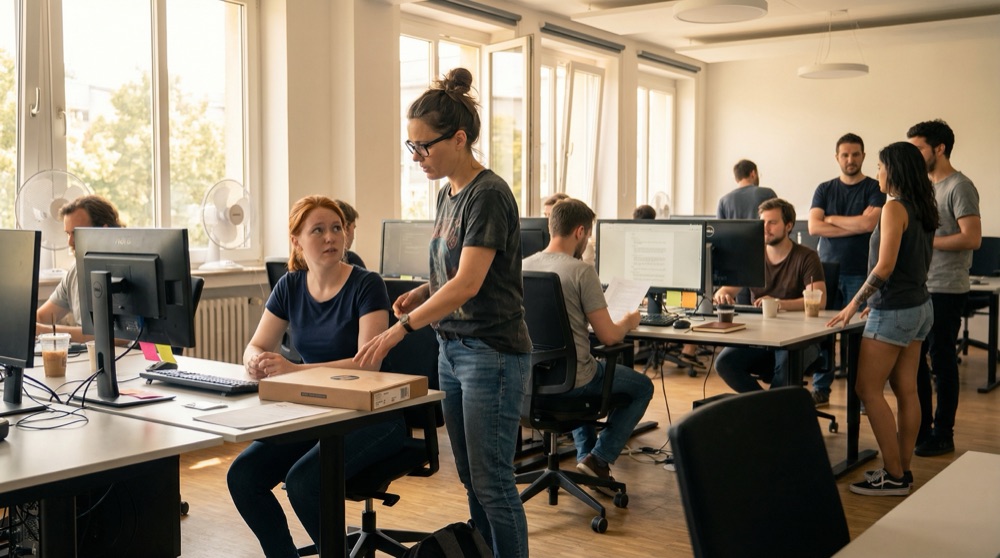
The development floor opened in front of him like a document he’d read about but never seen. Eighty-five people across nine departments, according to Navigator. At 08:23 on a Monday, maybe thirty were present. Standing desks and sitting desks in clusters that probably mapped to teams. Monitors showing code, Slack, Unity editors. Someone had taped a handwritten sign to a pillar: “IF IT’S NOT IN JIRA IT DOESN’T EXIST (but also JIRA doesn’t work).”
He stopped just inside the door. Set his messenger bag on the nearest empty desk. Took his leather notebook from the front pocket. Uncapped a pen.
He didn’t look for Katja’s office. Didn’t ask where to sit. Didn’t announce himself.
He stood still and watched.
The office had a rhythm he could read even without knowing names. Two clusters of desks active in the back corner, keyboards clicking at the speed that meant real work, not email. A lone figure in a gray hoodie near the window, headphones on, hood up, the universal signal for “interrupt me at your own risk.” Three empty desks with monitors still on, screensavers drifting, chairs pushed back at angles that suggested abrupt departures rather than clean endings.
One desk near the south windows was different. A woman in a Kreator t-shirt with the sleeves ripped off was already standing at her station, bare brown legs crossed at the ankle, Docs unlaced beneath the desk. She typed at a velocity that meant she was either solving a problem or fighting one. Dark hair in a loose ponytail. Geometric tattoo visible on her right forearm. Brazilian, if the Sepultura sticker on her laptop lid was any indication. He didn’t know her name yet. He knew her type. The person who sees everything and says it out loud while others are still formulating diplomatic versions.
A desk two rows closer sat dark. Monitor off. Chair pushed in neat. No personal items. No coffee ring on the surface.
Hassan’s desk. He recognized the absence before anyone told him.
“You must be the consultant.”
The voice came from his left. He turned. A young woman in athletic leggings and a fitted tank top, sports bra strap visible at the shoulder, high ponytail, nose stud catching the light. Fitness tracker on her wrist. She carried a reusable coffee cup and the expression of someone who’d already been awake for three hours.
“Stefan Richter,” he said. “And I’m not a consultant.”
“Elif,” she said. “Live Ops. And what do you call yourself?”
“Developer Advocate.”
“What’s the difference?”
“A consultant gives you a report. I write code.”
Her eyebrows went up. Then she nodded once, the way people nod when they’re reserving judgment but registering the claim for later verification.
“Katja’s in her office. Glass walls, far corner. She’s expecting you.”
“I know where it is. I’m going to stand here for a few more minutes first.”
Elif stopped mid-stride. Turned back. “Standing and looking?”
“Standing and looking.”
She studied him for two seconds. Then something crossed her face that might have been the beginning of respect.
“Most people start with meetings,” she said.
“Most people start wrong.”
She left. Stefan wrote three lines in his notebook without looking down.
Monday, 09:15 — Katja’s Office
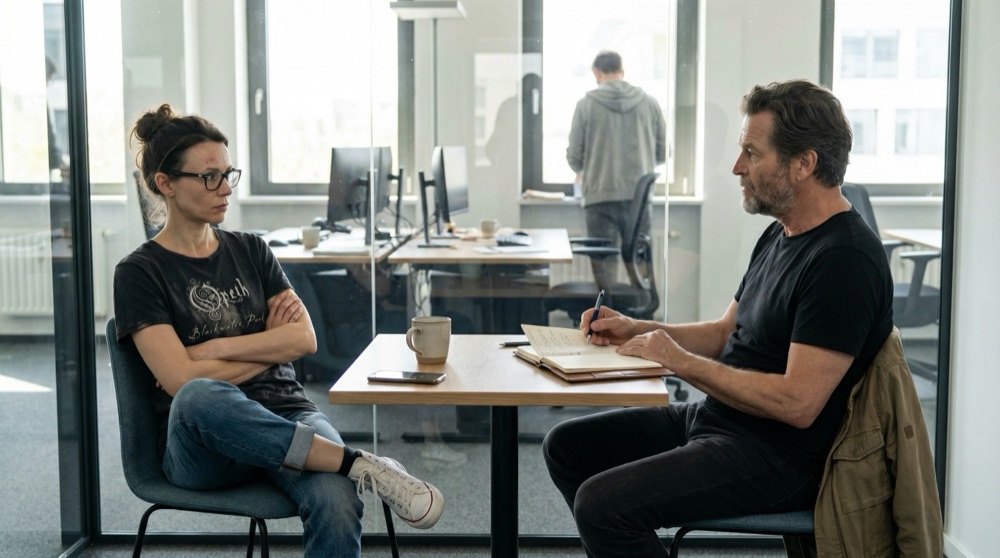
“You were standing in the entrance for twelve minutes,” Katja said.
“Eleven.”
She almost smiled. Almost. There were rings under her eyes that hadn’t been there on Friday. Weekend of email, he guessed. Or a weekend of worrying about whether hiring him was the right call.
“What did you see?”
Stefan opened his notebook. The page was already filling with his small, precise handwriting. European lettering, the kind that Americans found hard to read.
“Three things. First, the desk layout doesn’t match the team structure in your Navigator data. Backend and Unity are physically separated by the art team, which means cross-functional communication requires walking past people who have nothing to do with the conversation. Conway’s Law in spatial form.”
Katja blinked. She’d worked on this floor for two years and hadn’t noticed.
“Second, there’s one desk that’s been abandoned. Monitor off, chair pushed in, no personal items. That’s either someone who quit or someone who’s about to. Given that Tomasz gave notice two weeks ago and is still sitting here” — he glanced through the glass walls at the gray hoodie by the window — “the empty desk belongs to someone else.”
“Hassan,” Katja said. “He’s been out sick. Exhaustion.”
“Third time this quarter.”
It wasn’t a question. He’d read the Navigator data.
“Second,” she said quietly. “But the first time was a long weekend he called ‘personal days.’”
“Was it?”
She didn’t answer. She didn’t need to.
“Third thing. The woman at the standing desk near the south windows. Brazilian, metal fan, backend by the look of her tooling. She’s been here since before eight on a Monday morning and she’s typing like she’s angry. Who is she?”
“Mariana Santos. Backend Team Lead. She’s the one whose logs told you half of what you know about this place.”
Stefan wrote the name next to a note that already said backend — angry — early — metal.
“I’d like to pair with her this week.”
“She’ll resist.”
“Good. The ones who resist are usually right about why things are broken. They’ve just stopped believing anyone will listen.”
Katja leaned back. The Opeth shirt was worn thin enough to show the outline of the band’s logo from behind. Bobby pins held her bun in a structural arrangement that looked accidental and wasn’t.
“What’s your plan for today?”
“No plan. I want to see the deployment process. The actual one, not the documented one.”
“There is no documented one.”
“I know. That’s why I want to see the actual one.”
“Hassan handles deployment. He’s out.”
“Then who deploys when Hassan is out?”
The silence lasted four seconds. Long enough to be an answer.
“Nobody,” Katja said.
Stefan closed his notebook. Capped his pen. Looked at her through those gray-blue eyes that had a way of making you feel seen without being judged.
“That’s where we start.”
Monday, 14:30 — The Empty Chair

“So you’re the fixer.”
Mariana didn’t look up from her screen when she said it. Stefan had pulled a chair to the desk next to hers twenty minutes ago and opened a laptop. He’d found the repository, cloned it, and started reading without asking permission or introduction.
“I’m not a fixer,” he said, still reading.
“Katja called you a Developer Advocate.”
“That’s closer.”
“What does that mean?”
“It means I write code alongside your team, identify what’s broken in how you work, and help you fix it yourselves. When I leave, you own everything.”
“Sounds like a consultant who writes code.”
“A consultant tells you what’s wrong and charges you for it. I show you what’s wrong by working with you, and when I leave, you don’t need me.”
Mariana turned her chair. Looked at him directly for the first time. He was older than she’d expected from Katja’s description. Late forties, maybe. Tanned in a way that said outdoors, not vacation. Calloused hands on the keyboard. Salt-and-pepper hair that didn’t care about style. A mechanical watch that ticked softly in the afternoon quiet.
“How long?”
“Ten to twelve weeks.”
“And what happens when you leave?”
“You keep shipping.”
She snorted. “We don’t ship now.”
“I know. I read the Navigator data. You’ve deployed to production eleven times in the last nine weeks. Four of those were hotfixes. Three were rollbacks. Your actual feature deployment rate is four releases in nine weeks.”
The number hung in the air. She’d known it in her gut. Hearing it from a stranger’s mouth, precise and unjudgmental, was different from knowing it.
“You read our Navigator logs?”
“Katja shared seven weeks of synthesis. I read every page. Yours were the most honest.”
Something shifted in her face. Not softening. Recognition. The look of someone who’d been shouting into a void and just heard an echo.
“You read my logs.”
“You wrote that the staging environment uses a different load balancer config from production and nobody can explain why. You wrote that you asked Tomasz about deployment architecture and his answer was ‘it’s in my head.’ You wrote that every time Hassan is out, the entire company stops.”
“And?”
“And you were right about all of it. The question is why nobody acted on it.”
“Because nobody reads Navigator except Katja.”
“Katja reads it. She just didn’t have authority to act until the crisis became visible to Lukas.” He paused. “That’s a governance problem, not a data problem.”
Mariana was quiet for ten seconds. Her forearm tattoo caught the light as she uncrossed her arms. The Tupi-Guarani geometric pattern, black ink with dot work shading, running from mid-forearm toward her wrist.
“Okay,” she said. “What do you want from me?”
“Show me the codebase. Not the architecture diagram. The actual code. Where the bugs live. Where the hacks are. Where the debt accumulated.”
“That’ll take all week.”
“I have twelve weeks.”
She turned back to her screen. Opened a directory. Her fingers moved fast across the keyboard, pulling up files Stefan hadn’t seen yet.
“Don’t say I didn’t warn you.”
Tuesday, 10:00 — The New Developer
The email had arrived in Emma O’Sullivan’s inbox three weeks ago. Platform Developer. Berlin gaming studio. Infrastructure and deployment. She’d read Pixel Spree’s Glassdoor reviews, which were exactly the kind of mixed signals that meant a real company with real problems, not a polished facade hiding emptiness.
Day one. New desk. New badge. New city, if you counted three months as new. She’d moved from Dublin in January for a different role that fell through, stayed because Berlin was cheaper than Dublin and the tech scene was deeper. Living in a Neukölln flatshare with two Australians and a cat whose name she kept forgetting.
Her desk was two rows from Hassan’s empty station. Nobody had told her Hassan was out. Nobody had told her much of anything beyond “you start Tuesday, Katja will meet you at nine.”
Katja appeared at 09:07 looking like she’d slept four hours. Bobby pins in her hair. Glasses instead of contacts. The band t-shirt of someone who’d grabbed the first thing from the clean pile.
“Welcome. Sorry about the chaos. Your first week will be intense.”
“I’m Irish. We do intense.”
Katja almost laughed. “Your primary responsibility is infrastructure. Deployment pipelines, staging environments, monitoring. Right now that’s handled by one person — Hassan Al-Rashid. He’s out this week.”
“Out as in vacation?”
“Out as in his body told him to stop before his brain did.”
Emma nodded. She’d seen that before. Dublin fintech culture ate people the same way.
“Where’s the documentation?”
Katja’s expression said everything.
“Right,” Emma said. “Who do I talk to?”
“There’s a consultant — a Developer Advocate — named Stefan who started yesterday. He’s already reading the infrastructure code. Find him. He’s the one without headphones and with a leather notebook.”
Emma found Stefan at 10:30 at a desk near Mariana’s cluster. He was reading a deployment script that was, by the line count visible on his screen, over eight hundred lines of bash.
“You’re Stefan?”
He looked up. Calm eyes. “And you’re Emma.”
“How do you know?”
“New badge, laptop still in its box, and you’re looking for the infrastructure person. Hassan’s out, so that leaves me by elimination.”
“Katja said you’re reading the deployment code.”
“I’m reading eight hundred lines of bash that deploys to production. There are no tests. There are comments that say ‘DO NOT CHANGE THIS’ with no explanation of what ‘this’ does.” He turned the laptop toward her. “Here. Line four hundred and twelve. What do you make of this?”
Emma leaned in. Read the block. Her eyebrows climbed steadily higher.
“That’s a hardcoded IP address inside a conditional that checks if it’s Friday.”
“Yes.”
“Why Friday?”
“That is an excellent question. Want to find out together?”
She pulled a chair over. Her laptop stayed in its box for another hour.
Wednesday, 16:45 — The First Commit
Reader's note: Stefan committing directly to main without ceremony is not recklessness. It's trunk-based development in action: tiny change, immediate feedback, visible signal, quick fix. No approval theater. No waiting queue.
This is also Developer Advocacy in the original sense: embedded, hands-on, and willing to challenge local ritual by shipping real code with the team.
Related reading: Beyond the Solo Developer Myth · When "Developer Advocate" Meant Something Else
The first test was trivial. Stefan had spent two hours reading the backend payment processing code on Monday afternoon and identified three places where the error handling swallowed exceptions silently. Not complex bugs. The kind of quiet rot that accumulated over months of shipping fast and fixing later.
“Write a test for this,” he said, pointing at a function that processed in-app purchases.
Mariana frowned at the screen. “We don’t have test infrastructure for the payment module.”
“Then we build it.”
“That’s a three-day task.”
“It’s a forty-minute task. You don’t need a framework. You need one test that proves one thing.”
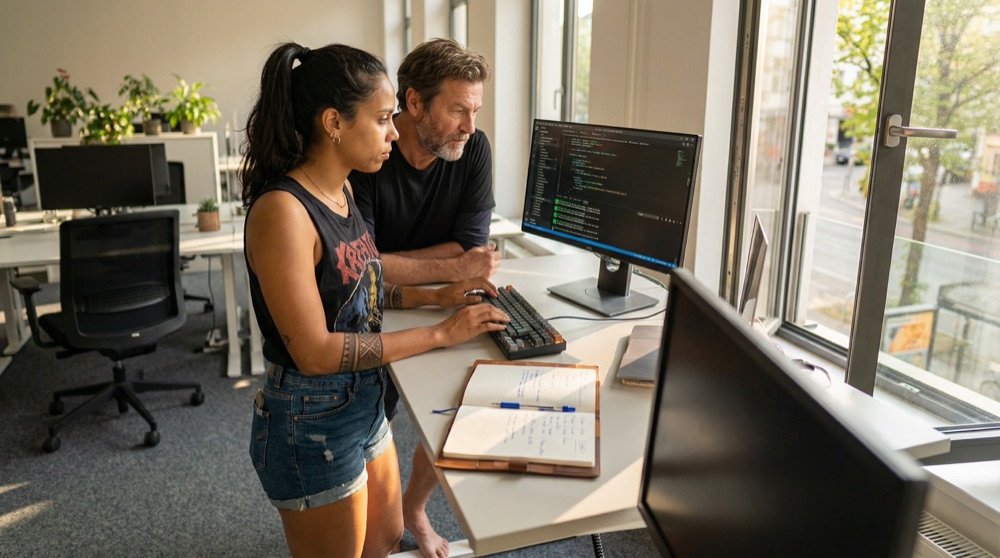
She stared at him. He was perched on a stool next to her standing desk, lower than her eye level, deliberately not towering. His leather notebook was open beside the keyboard with a pen laid across it. The notebook had small, tight handwriting in blue ink. She couldn’t read it from this angle.
“Show me,” she said.
He typed for six minutes. Set up a minimal test harness. Wrote a single test case that called the payment function with invalid data and asserted that it should throw an error instead of returning null.
He ran it. Red.
“The function swallows the error and returns null,” he said. “Your payment system silently fails on bad input.”
“I know. I filed a bug about this in January.”
“What happened?”
“Lukas prioritized the summer event features. Bug sat in the backlog.”
Stefan said nothing. He saved the test file. Committed it. Pushed.
Mariana watched the commit message appear in the terminal: “Add failing test: payment processing should throw on invalid input, not return null”.
“You just committed a failing test to main.”
“Yes.”
“On your second day.”
“A failing test that documents a known bug is better than no test and a backlog item nobody reads. Now it’s visible. Every CI run will show red until someone fixes it.”
She opened her mouth. Closed it. Thought for five seconds.
“That’s obnoxious.”
“It’s honest.”
“It’s both.”
She wrote the fix in eleven minutes. The test went green. She committed: “Fix: payment processing now throws ValidationError on invalid input instead of returning null silently”.
Two commits. Twenty minutes. A bug that had been documented in January, ignored for four months, and fixed by the person who’d reported it once someone gave her permission to stop waiting.
Mariana looked at the green test output. Then at Stefan. Then back at the screen.
“You’re going to do this every day, aren’t you.”
“Every day.”
“People will hate it.”
“People will hate the failing tests. They’ll love the green ones.”
She didn’t smile. But the tension in her shoulders dropped half an inch.
Navigator — Mariana Santos — 29 April 2026, 17:14
Stefan paired with me today on the payment module. We wrote one test. It failed. I wrote the fix. It passed.
The whole thing took twenty minutes. The bug had been in the backlog since January. Four months of knowing it was broken and nobody touching it because it wasn’t a priority.
He committed a failing test to main. On his second day. No permission asked. No pull request review. Just: here’s a test that proves your system silently swallows payment errors. Fix it or look at red every time CI runs.
I wanted to be annoyed. I fixed the bug instead. Took eleven minutes. Four months in the backlog. Eleven minutes to fix.
I don’t trust him yet. But he sees the code. He actually reads it. That’s more than the last three people Lukas brought in.
Thursday, 13:00 — The Knowledge That Lives in Heads

Reader's note: Stefan skips introductions, names the exact countdown Tomasz has been privately tracking, and pushes past polite non-answers. That looks rude. It's the opposite.
A departing employee experiences social death by degrees. Colleagues stop asking their opinion. Meetings shrink. Knowledge becomes irrelevant because the person carrying it is already gone in everyone's mind. Stefan reverses that. By making Tomasz's knowledge the most important thing in the room, he's saying: you still matter here. What you built matters. I take you seriously enough to be direct.
The slow questions, one every five or six minutes, are deliberate. Rapid-fire extraction treats a person as a database to dump. Slow questions treat them as a professional reconstructing their own reasoning. Tomasz doesn't just recall what he built. He remembers why. That's the difference between a knowledge transfer and a dignified farewell.
This is what Developer Advocacy looks like when it works. Not a framework. Not a presentation. A whiteboard, a pen, real questions, and the patience to let someone see their own expertise reflected back before they walk away from it.
Tomasz arrived at the office Thursday at 09:15, forty-five minutes later than his pre-resignation self. The gray hoodie was the same. The New Balance sneakers were the same. The expression was different. The clenched jaw of a man holding a position had been replaced by the blank calm of someone who’d already left.
He had sixty-three working days remaining. He’d counted.
Stefan found him at ten. Didn’t introduce himself. Didn’t explain what he wanted. Just pulled a chair to the whiteboard near Tomasz’s desk and said: “Tell me why the staging environment uses a different load balancer config than production.”
Tomasz looked at him. The gray-blue eyes looking back were patient and undemanding.
“Historical reasons,” Tomasz said. The same answer he’d given Mariana two weeks ago.
“I need better than that.”
“Why?”
“Because in sixty-three days, ‘historical reasons’ walks out the door.”
The number landed. Tomasz had counted the days himself. Hearing someone else say it stripped away the abstraction.
“Fine.” He stood up. Walked to the whiteboard. Picked up a blue marker. “This is what the architecture looked like in 2023 when we had twelve developers.”
He drew for ninety minutes. Stefan asked questions. Not rapid-fire consulting questions designed to demonstrate expertise. Slow questions. One every five or six minutes. The kind that required Tomasz to think before answering, to trace the decision chain backward, to remember not just what he built but why.
“Why did you separate the authentication service?”
“Because the player session handler was eating memory and taking down the game server when it crashed. Moving auth to its own container isolated the failure domain.”
“That’s good architecture. Why isn’t it documented?”
“Because I was the only one who knew why it was done, and I was too busy doing the next thing to write down the last thing.”
Stefan wrote in his notebook. Small, precise, blue ink. He didn’t comment on the answer. Didn’t lecture about documentation. Just wrote it down and asked the next question.
By noon, the whiteboard was full. Three years of architectural decisions drawn in blue marker. Tomasz stood back and looked at it like a man seeing his own skeleton for the first time.
“Nobody’s ever asked me to explain all of this.”
“Nobody could afford to see how much lives in one person’s head.”
They took a break. Coffee from the machine, which was adequate in the way that office coffee anywhere is adequate. Stefan sat with his leather notebook and transferred the whiteboard diagrams into it, adding notes and annotations.
After lunch they continued. Stefan asked Tomasz to walk him through the deployment process step by step. Not the script. The human process. What Tomasz did before, during, and after every deployment. The mental checklist. The things he checked that weren’t in any runbook because there was no runbook.
Tomasz talked for an hour and a half. Somewhere around the forty-minute mark, his voice changed. The flat resignation lifted. He was talking about code, about systems, about the craft of making things work. His hands moved when he described how the container orchestration coordinated service restarts. His eyes sharpened when he explained the monitoring gaps he’d been trying to fill for six months.
“You’re good at this,” Stefan said.
“I used to be.”
“You still are. You’ve been doing the wrong job.”
Tomasz looked at the whiteboard. Two years of knowledge rendered visible for the first time.
“Nobody asked me to do this job. They needed a Head of Engineering. I was the best engineer. So they promoted me.”
“The Peter Principle with extra steps.”
“I know exactly what the Peter Principle is. I’ve been living it for two years.”
“And in sixty-three days you won’t be.”
Tomasz sat down. Picked up his coffee. Looked at Stefan over the rim.
“You’re going to do this with everyone, aren’t you.”
“Not everyone has two years of undocumented architecture in their head.”
“Hassan does. Hassan has three years.”
“I know. I’m talking to Hassan next week.”
“He’s out sick.”
“Then the week after. Or whenever he’s ready. The knowledge isn’t going anywhere as long as the person stays.”
“But the person doesn’t always stay,” Tomasz said. “That’s the lesson, isn’t it.”
Stefan capped his pen. Closed the notebook.
“That’s the lesson.”
Navigator — Stefan Richter — 1 May 2026, 13:45
Three days in. Observations from the floor:
Knowledge concentration is critical. Tomasz holds two years of architectural decisions in his head. None documented until today. Hassan holds three years of infrastructure knowledge. Also undocumented. Together, they represent the majority of the company’s technical institutional memory. Tomasz leaves in sixty-three days. Hassan’s body is telling him to leave now.
The codebase is better than I expected. The core architecture is sound. Tomasz made good decisions under pressure. The rot is in the margins: swallowed exceptions, untested payment flows, deployment scripts that evolved through accretion instead of design. Fixable.
The team is capable. Mariana Santos sees everything clearly and has been saying it for months. When I sat with her Wednesday and asked her to write one test, she hesitated for thirty seconds and then wrote a fix in eleven minutes that eliminated a four-month-old bug. She doesn’t need training. She needs permission to act.
Deployment is a single point of failure inside a single point of failure. Hassan is the only person who can deploy. Hassan is absent. Nobody deployed this week. That means an entire week where the development team wrote code that cannot reach production. The pipeline itself is eight hundred lines of undocumented bash. Emma O’Sullivan started Tuesday and is already reading it. She’s sharp. She and Hassan need to overlap before deployment becomes a capability instead of a person.
Priorities remain chaotic. I counted the active Jira epics: forty-seven. For eighty-five people. That’s not a strategy, it’s a wish list that someone called a roadmap.
Recommendation: infrastructure first. Get Emma up to speed. Get Hassan back. Document the deployment process. Automate what can be automated. Everything else follows from the ability to ship safely and often.
Thursday, 18:04 — Schöneberg
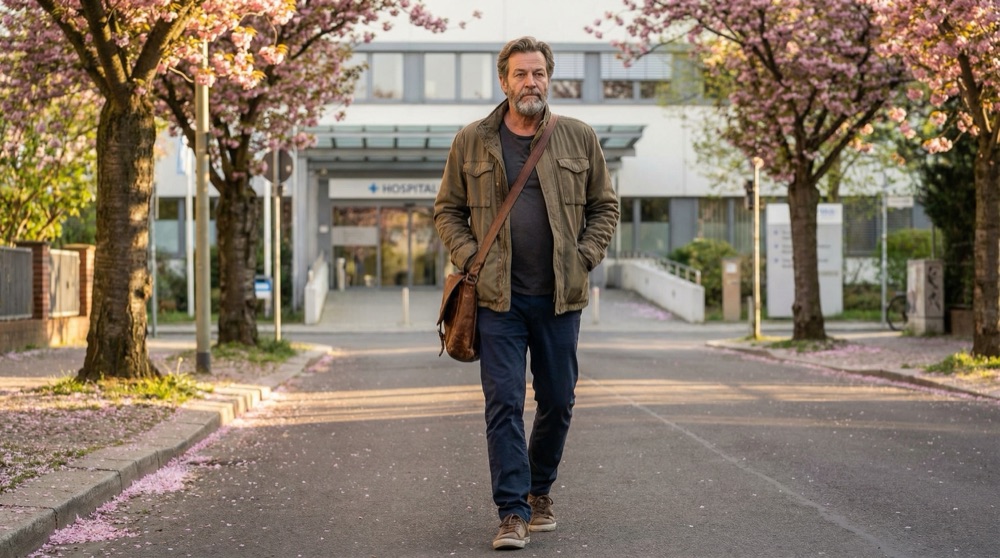
He left on time.
The development floor was still half-occupied at six. Mariana at her desk, barefoot, debugging something with the intensity of someone who’d forgotten what time it was. Anton’s station glowing with Unity render previews. Two junior developers he hadn’t spoken to yet arguing about a merge conflict in the tones of people who hadn’t learned to argue about merge conflicts quietly.
Stefan closed his laptop at 17:55. Put it in his messenger bag. Put his notebook in the front pocket. Stood up.
Nobody noticed. The office didn’t have a culture of noticing departures, only absences.
He took the U-Bahn to Schöneberg. The hospital was a fifteen-minute walk from the station, through streets lined with cherry blossoms that had exploded in the last warm week. Petals covered the sidewalks in patches of fading pink. Berlin in late April was a city remembering how to breathe after winter.
The guest room at his ex-wife’s apartment was exactly as Emma had left it when she’d been admitted three weeks ago. One towel neatly folded on the bed. Sophie’s handwriting on a sticky note on the mirror: “Dad — there’s food in the fridge. Don’t forget to eat. — S.”
He showered. Changed. Walked to the hospital.
Emma was sitting up in bed, reading. She looked better than last week. The color was returning. The monitors beside her showed steady numbers. The overnight bag Sophie had packed for her sat on the side table, overstuffed with things a sixteen-year-old thought her mother might need: three books, a phone charger, moisturizer, and a small stuffed elephant that had been in the family since Sophie was five.
“You started the new job,” Emma said.
“Today was day three.”
“And?”
“The company is a mess. The team is good. The usual combination.”
She smiled. It was tired but real. They’d been divorced for six years. The anger had burned out three years ago. What was left was something harder to name. Two people who’d shared a life, made a child, discovered they wanted different futures, and were now navigating the narrow corridor of co-parenting with the kind of careful politeness that comes after everything else fails.
“Sophie told me you’ve been leaving work on time.”
“Sophie tells you everything.”
“She’s proud of you for it, you know. She said ‘Papa comes home every night.’ Like it’s remarkable.”
It was. For him, it was.
“How are you feeling?”
“Better. Doctor said maybe Friday or Saturday. Sophie’s been here every day after school. She reads to me. Chapter books. As if I’m five.” She paused. “She reads out loud because she knows the silence makes me anxious. She figured that out herself.”
Stefan’s throat tightened. His daughter, sixteen, sitting in a hospital room reading aloud to her mother because she’d figured out that silence was the enemy. Nobody taught her that. She just knew.
“She’s extraordinary,” he said.
“She’s yours,” Emma said. “The best parts of you.”
He stayed for an hour. They talked about practical things. The apartment. The doctors’ schedule. Whether Sophie was keeping up with schoolwork. The ordinary architecture of a life that continued despite crisis.
He walked back through Schöneberg at 19:30 as the sun dropped behind the rooftops. The cherry blossoms glowed pink-gold in the dying light. His phone buzzed.
Sophie: “How was day 3?”
Stefan: “Good. Paired with a Brazilian developer who might be smarter than I am.”
Sophie: “Finally! Someone to keep you humble. 😄 See you at home?”
Stefan: “Twenty minutes.”
He put his phone away. Walked faster. For the first time in years, he had somewhere to be that wasn’t work. Somewhere that wanted him back.
Navigator — Katja Müller — 1 May 2026, 21:32
Stefan’s been here three days.
He hasn’t given a presentation. Hasn’t scheduled a kickoff. Hasn’t asked for a meeting room or a whiteboard marker. Well, he asked for one whiteboard marker. He used it to get Tomasz to draw two years of architecture that doesn’t exist anywhere except Tomasz’s head.
He paired with Mariana Wednesday and she committed a fix for a bug that’s been in the backlog since January. Eleven minutes. He hired himself into the deployment script Thursday morning and found a hardcoded IP address inside a conditional that checks if it’s a Friday. Emma, the new platform developer, is already reading the pipeline with him.
He leaves at six every evening. I noticed because nobody else does. Mariana’s still here at eight most nights. I’m here until nine. Hassan, when he’s not out sick, was here until midnight.
Stefan leaves at six. Doesn’t explain. Doesn’t apologize. Just closes his laptop and goes.
I don’t know what to make of that yet. Either he doesn’t care enough, or he’s showing us something we’ve forgotten how to see. A person who works, then stops, then comes back the next day and works again. Like it’s normal. Like that’s how it’s supposed to be.
Maybe that’s part of what he’s here to fix.
🎭 This Week's Episodes
Telenovelas show what we can't say in client meetings. The drama is heightened, but the patterns are real.
 La Verdad
The emergency board meeting Don Hernando demanded has arrived. Mariana and the Vulcano Capital team want answers. Alejo has one final card to play....
 When Players Revolt
They fixed the validation bug properly — six hours, no corners cut. But the database migration script Anton wrote Monday night to handle legacy NUL...
Technical Consultancy
Senior Developer Advocate
Embedded into your team as an active contributor, increasing effectiveness and elevating engineering clarity.
Technical Advisor
Peer-style technical assessments before far-reaching decisions; reduce architectural and product risk early.
Product & Delivery
Ship working software to real users earlier. Measure impact and adapt based on evidence rather than assumption.
Custom Software Development
High quality, maintainable software. Short-term augmentation that leaves lasting capability in your own team.
Recent Articles
- When Labor Becomes Cheap, Motivation Becomes Everything (06.04.2026)
- Authentication Methods That Work in 2026 (03.04.2026)
- Developer, Not Engineer. And Why It Matters (30.03.2026)
- The Product Manager Is Dead. Long Live the Product Developer. (27.03.2026)
- Building Products in the Age of AI (23.03.2026)