The Breaking Point
Tomasz walks into Katja's office Monday morning and doesn't sit down. Eleven minutes later, everything has changed. He's leaving for a fifteen-person studio at thirty percent less pay because he'd rather code than manage. The news ripples through the development floor in Slack DMs and hallway silences. At home in Lichtenberg, his wife Agnieszka cries from relief. On Tuesday, people who never thought about Tomasz as a dependency start showing up at Katja's door. Thursday's synthesis reveals the full picture: Tomasz appeared in forty-one daily logs across seven departments. Decision authority. Knowledge source. Translation layer. Conflict mediator. The best developer was promoted into a role that killed him. Katja sits in her Kreuzberg apartment with her cats and begins searching for someone who can help from outside.
Monday, 08:47 — Eleven Minutes
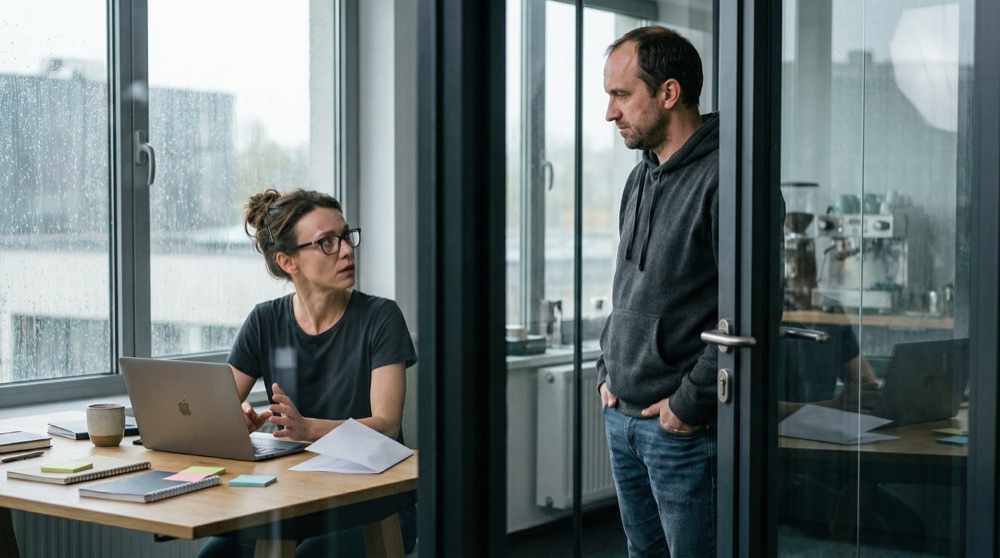
Tomasz stood in the doorway. He didn’t sit down.
Katja knew what this was before he spoke. People sit when they have problems. They stand when they’ve already decided.
“I’m giving notice.”
Three words. Her office hummed with server fans two floors below and the espresso machine grinding in the kitchen. Outside, April drizzle streaked the window. Her stomach dropped. The coffee she’d been holding went cold in her hand without her noticing.
She started to say something. He held up his hand. Gentle.
“I want to explain. You deserve that.”
He explained. Eleven minutes. She timed it later, looking at the calendar block she’d created afterward to process. Eleven minutes to dismantle two years of assumptions about his role, his commitment, his future at this company.
“I was hired to solve technical problems.” His voice was steady. Rehearsed, probably. Or the calm that comes after months of arguing with yourself and finally arriving at an answer you can live with. “The first year was good. Complex work. Interesting architecture. Hard problems with elegant solutions.”
He paused.
“Then I got promoted. Because I was the best developer. That’s what companies do, right? Reward technical excellence with management. Take somebody who’s brilliant at building things and make them spend their days approving time-off requests and sitting in planning meetings and mediating disagreements between people who don’t want to be mediated.”
Katja opened her mouth. Closed it.
“I don’t code anymore, Katja. I haven’t written a meaningful line of production code in seven months. I review pull requests when I squeeze twenty minutes between meetings. I spend my evenings catching up on technical decisions I should have been part of during the day. My kids are five and seven. They go to bed at eight. I get home at nine. On good days.”
He set a folded sheet of paper on her desk. White A4. Single paragraph.
“I found a job. Fifteen-person studio in Friedrichshain. Thirty percent less money. I’m going to Lukas after this to hand in the formal Kündigung. Three months to end of month. My last day is July 31.”
He paused. Then, quieter:
“I wanted to tell you first. You deserved that.”
“Tomasz — “
“I just want to code again.”
The words arrived like something falling from a great height. Not because they were dramatic. Because they were small. A man who’d spent two years building the technical architecture of an eighty-five-person company, who knew where every wire connected, who carried the institutional memory of three hundred deployment decisions and two thousand architectural trade-offs in his head. And all he wanted was to sit at a desk and write code again.
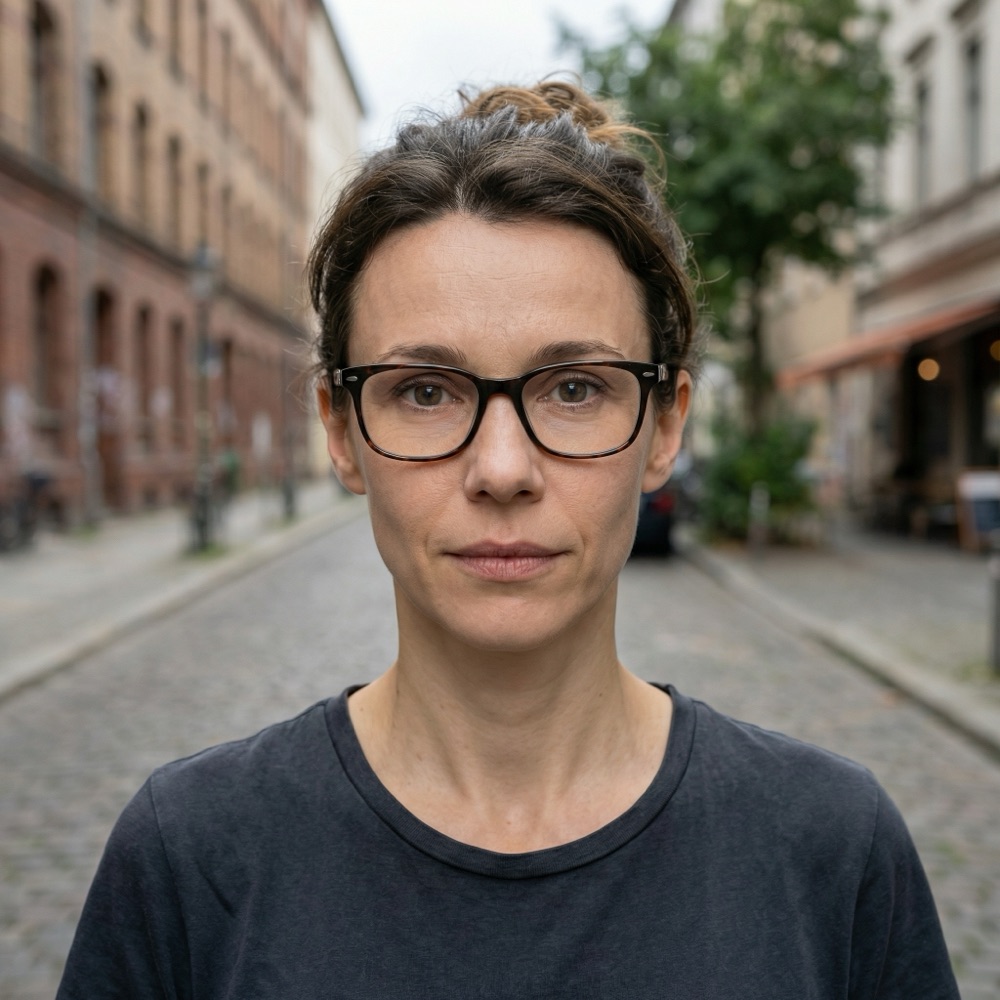
She looked at him. Green eyes, bags under them. Receding hairline he was sensitive about. Gray hoodie, the same one he wore every other day. Five o’clock shadow at eight in the morning.
“Is there anything I can do?”
“No.” He said it without hesitation. “It’s about what the role requires. You need a Head of Engineering who wants to manage. I’m not that person. I never was. You promoted me because I was the best developer, and now you don’t have your best developer and you don’t have a good manager either. You have someone who’s bad at both because he’s trying to do both.”
Eleven minutes. He nodded once, turned, and walked out. The door clicked shut behind him.
Monday, 09:01 — The Note on the Desk

Katja stared at the folded paper. Not the Kündigung. That was for Lukas. This was something else. Something personal.
Her hands were shaking. She pressed them flat on the desk. The tremor ran through the wood grain, or maybe that was just her pulse, hammering in her temples, her wrists, behind her knees.
Through the glass walls she could see the development floor. Tomasz’s desk was empty. He’d gone upstairs. To Lukas. To make it official.
She opened Navigator on autopilot. Fingers finding the keyboard before her thoughts organized.
Navigator — Katja Müller — 13 April 2026, 09:04
Tomasz just told me he’s resigning. He came to me first, before going to Lukas with the formal Kündigung. Three months’ notice, last day July 31. Taking a job at a fifteen-person studio for thirty percent less pay.
His reason: “I just want to code again.”
We promoted our best developer into a management role he never wanted. He stopped coding seven months ago. He reviews pull requests in twenty-minute fragments between meetings. He gets home after his children are asleep.
I should have seen this. His logs have said it for weeks. The frustration about meetings. The resentment about interviews eating his days. The slow withdrawal from technical discussions. The signs were there. I read them. I noted them. I didn’t act.
He holds two years of architectural knowledge that exists nowhere except his head. No documentation. No runbooks. No recorded decisions. When he walks out at the end of July, that knowledge walks with him. Three months sounds like time. It isn’t. Not for this.
She saved the entry and closed her laptop. The note sat on the desk, white against the dark surface. She picked it up and unfolded it.
One paragraph. His handwriting was careful, the letters small and precise. He’d written it before coming in. Planned the whole thing. The door, the standing, the eleven minutes, the note. She read it twice. By the second time her vision had blurred and she had to set it down and press the heels of her hands against her eyes until the pressure pushed the tears back.
She folded the note and put it in her desk drawer. Under the stack of quarterly reports nobody read.
Monday, 10:15 — How You Lose What You Can’t Replace
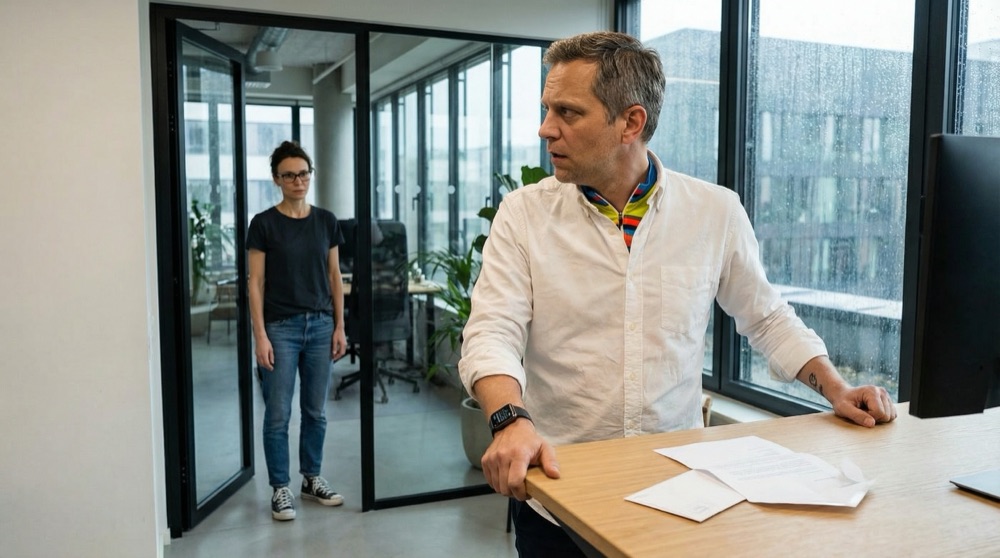
Lukas was at his standing desk when she came in. Cycling jersey under his button-down, collar slightly askew. He’d biked in despite the rain. Apple Watch on his wrist, the screen showing a calendar so packed the blocks had merged into a single colored mass.
A white envelope sat on his desk, opened. She recognized the format. Standard Kündigung. One page. Tomasz had been here already.
Lukas turned before she spoke. His face told her he knew why she was here.
“You talked to him?”
“He came to me first,” Katja said. “Before bringing you the letter.”
Lukas picked up the envelope, held it between two fingers like something contaminated. “Fifteen-person studio. Friedrichshain. Thirty percent less money. He told me the same thing he told you. Three months to end of month. July 31.”
“He told you why?”
“He wants to code.” Lukas said it like someone repeating a phrase in a language he didn’t speak. He set the envelope down. She could see the calculation happening behind his eyes: board questions, replacement timelines, Q2 commitments already made to investors on the assumption that the current team was stable.
“I offered him fifteen percent more. Then twenty. A different title. Principal Engineer, no reports, pure architecture.” He counted the offers on his fingers, each one a rung on the only ladder he understood. “He wasn’t interested in any of it. I don’t get it. Twenty percent more money, a title most developers would kill for, and he’d rather go to some garage studio in Friedrichshain?”
Katja watched him cycle through it. Lukas solved problems with incentives. Bonuses, equity, titles, team leads. The currency of ambition. It had never occurred to him that someone might not be motivated by the things that motivated Lukas.
Lukas lowered himself onto his desk stool, slowly, like someone settling into cold water. His hands gripped the edge of the desk. White knuckles.
“We promoted our best developer into a role he hated.” He said it to the wall. “I signed off on that promotion. I thought we were rewarding him.”
Katja’s throat tightened. Because she remembered pushing for that promotion. She’d gone to Lukas eighteen months ago and argued that Tomasz deserved it. That the company had hired a Head of Marketing, a Head of Product, a Head of People, but the person holding the entire technical architecture together was still “Senior Developer” on the org chart. That if they didn’t promote him, they’d lose him. The irony sat in her stomach like something spoiled.
She’d been so proud of herself. Finally, a technical person getting recognized. Finally, the company treating deep expertise as something worth rewarding instead of something to exploit quietly. She’d told Tomasz herself, in this building, on the development floor, in front of the team. His face had done something complicated that she’d read as humility. She now recognized it as dread.
“We were punishing him. We just called it a reward.” She heard herself say it and felt the weight of her own role in it. She’d fought for his promotion like it was a victory for every developer who’d ever been overlooked. She never asked Tomasz what he actually wanted.
Lukas rubbed his face. The stubble rasped against his palms. “Maybe in a few weeks he’ll reconsider. People make emotional decisions. Once it sinks in what he’s walking away from…”
“He’s not being emotional, Lukas. He’s being rational. For the first time in months, maybe.” She paused. “He doesn’t want more money. He doesn’t want a bigger title. He wants to sit at a desk and solve hard problems with code. That’s what drives him. It’s what always drove him. We took that away and gave him a calendar full of meetings and a Slack full of interruptions and called it a career.”
Lukas stared at her. She could see him trying to fit this into his model of the world, a model where people climbed and wanted to keep climbing. Where stepping down was failure. Where thirty percent less money was a defeat, not a liberation.
“He holds everything,” Lukas said, pivoting to the problem he could frame in business terms. “He’s the only one who understands how the deployment pipeline actually works. The only one who can explain the architecture to new hires. The only one Hassan goes to when infrastructure decisions need someone with context. I have a board update in three weeks. What do I tell them?”
“I know.”
“Three months. Can we use that for a proper handoff?”
“We can try. But two years of undocumented architectural knowledge doesn’t transfer in three months. Not when the person leaving has already checked out emotionally.”
“What happens when he’s gone?”
The question hung in the air. They both knew the answer. They’d seen it in Anton’s technical debt assessment four days ago. They’d read it in Navigator’s synthesis every week for six weeks. They hadn’t connected those signals to the specific human being who was holding all the pieces together.
“I don’t know,” Katja said. And for the first time in weeks, the honesty didn’t feel strategic. It felt like standing at the edge of something without a railing.
Monday, 14:30 — The Afternoon the Hallways Went Quiet
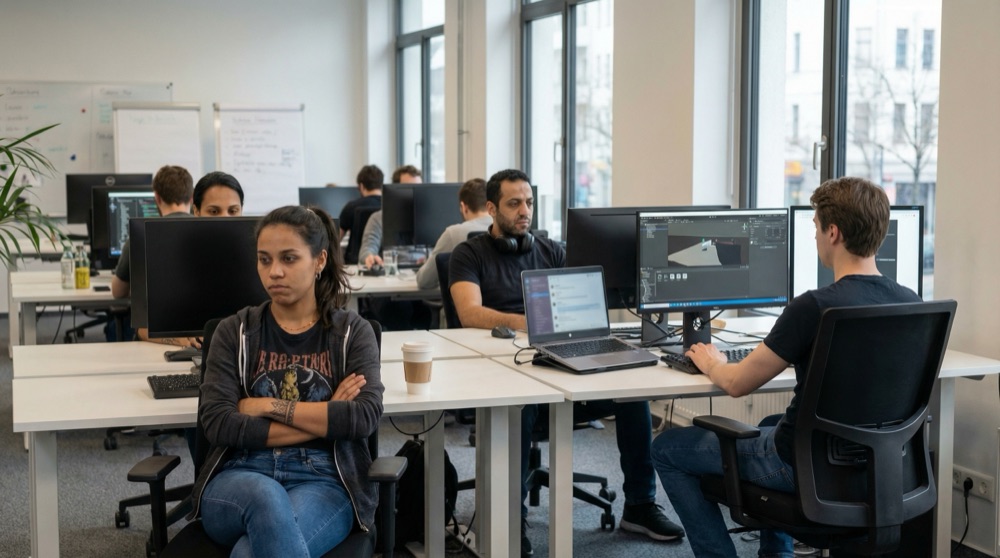
News didn’t travel through official channels at Pixel Spree. It never did.
Mariana heard Katja’s voice through the glass before lunch, saw the body language through the conference room windows: Katja rigid, Lukas with his head in his hands. She texted Anton: Something happened. Katja looks wrecked.
Anton replied: Tomasz gave notice.
How do you know?
He told me. On the way to coffee. Just now. Said it like he was telling me about the weather.
By 14:00, every developer on the floor knew. Nobody talked about it openly. That wasn’t how it worked. Instead, the development floor developed a particular quality of silence. The sound of people processing something privately while their screens stayed lit and their cursors blinked and nobody committed any code for the better part of an hour.
Hassan found out last. He’d been troubleshooting a container orchestration issue in the server room since morning, headphones on, isolated from the floor’s emotional weather. He came back to his desk at 14:30 to find a Slack DM from Mariana.
Hassan. Tomasz is leaving. Gave his Kündigung today. Last day end of July.
He read it twice. Set his coffee down. Stared at the message.
Tomasz was the person who approved his infrastructure changes. Not because of process. Because Tomasz understood the system well enough to catch the things Hassan missed when he was exhausted, which was always. Tomasz was the one who’d looked at Hassan’s deployment scripts six months ago and said, “These are holding the company together. Nobody else knows that. We need to fix this.” They never fixed it.
He opened Navigator.
Navigator — Hassan Al-Rashid — 13 April 2026, 14:37
Tomasz is leaving. Three months’ notice. Last day end of July. I found out from Slack.
He was the only person who understood my infrastructure changes well enough to review them properly. The only one who pushed back when I cut corners because I was tired. The only one who said “we need to fix the deployment scripts” even though we never did.
I’m now the most senior technical person who touches the full stack. I don’t want that responsibility. I can barely keep the infrastructure alive. Now I’m supposed to hold the architectural knowledge Tomasz carried?
Nobody asked me how this affects infrastructure. Nobody will. They never do.
At the next desk over, Anton stared at his Unity project. His cursor blinked in the middle of a function call he’d started twenty minutes ago. He hadn’t typed a character since.
Navigator — Anton Petrov — 13 April 2026, 14:51
Tomasz resigned today. He told me on the way to get coffee, casually, like it was already done and he’d moved past it. Maybe he has.
He said he wants to code again. I understand that. I understand it completely.
Irina asked me last week if I was happy here. I said yes. I lied. I’m good at this work and I care about the game and I respect the people I work with. But happy is something else. Happy is the thing that got crowded out by fourteen-module dependency diagrams and Easter Sunday debugging sessions.
Tomasz leaving makes this worse for everyone who stays. It also makes something visible that was invisible before: he was carrying weight that nobody measured. When load-bearing structures fail, you find out what they were holding up.
Mariana didn’t log. She went to the rooftop, lit a cigarette she didn’t usually smoke, and stood in the April drizzle staring at the Fernsehturm until her hands were numb. When she came back inside, her Sepultura t-shirt was damp and her jaw was set.
She sat at her desk and opened a Slack DM to Katja.
We need to talk about transition. Today. Not tomorrow. Hassan can’t absorb Tomasz’s architecture knowledge. Neither can I. We need a plan before he walks out and takes it all with him.
Katja replied in under a minute: I know. Give me until tonight.
Monday, 19:45 — Lichtenberg
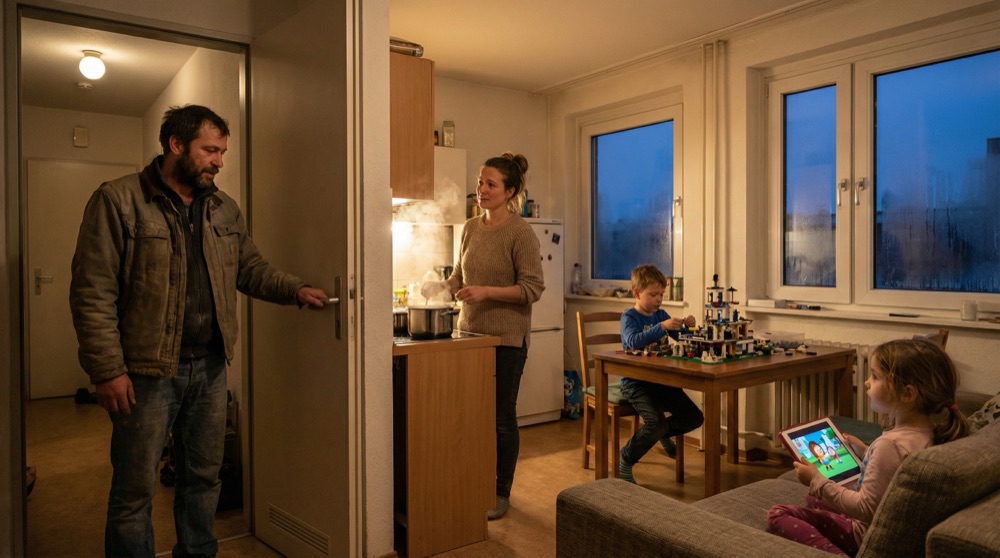
Tomasz’s apartment was on the fourth floor of a Plattenbau on Rüdigerstrasse. Prefab concrete, built in the seventies, renovated in 2019 with windows that never quite sealed right. The elevator smelled like cleaning fluid and stale cigarette smoke. The hallway lights buzzed.
He opened the door. The apartment was warm. Agnieszka had cooked. He could smell rosół from the kitchen. Chicken broth. His mother’s recipe, the one Agnieszka had learned from her own mother in Kraków because some recipes travel the same routes regardless of the family.
The kids were still up. Kacper, seven, was building something elaborate with Lego at the kitchen table. Zosia, five, sat on the couch watching Peppa Pig in Polish on the iPad. She looked up when he came in.
“Tata! Tata, chodź tu!” She held up the iPad. He kissed the top of her head and went to the kitchen.
Agnieszka was at the stove, stirring. She turned. Looked at him. Her eyes searched his face in that way she had, reading the answer before the question was asked.
“Złożyłem wypowiedzenie,” he said. I handed in my notice.
She set the spoon down. Her hand moved slowly to the counter, finding it by feel, like she needed something solid under her fingers. Her eyes filled.
“Nareszcie.” Finally. “Nareszcie to zrobiłeś, Tomasz.”
She wasn’t crying from sadness. Her face was open, the lines of months of worry dissolving into something raw and grateful. She’d been watching him come home at nine, ten, eleven at night. Watching him fall asleep on the couch with his laptop still warm. Watching Kacper ask “Dlaczego tata jest zawsze zmęczony?” Why is Dad always tired? She’d said it twenty times: Odejdź z tej pracy. Niszczy cię. Leave this job. It’s destroying you.
He’d argued every time. Responsibility. Stock options. The team needs me. All the things people say when they’re not ready to admit the machine has broken them.
Now he stood in his kitchen, in a warm apartment that smelled like rosół, his wife crying from relief and his daughter shouting about a cartoon pig, and the knot that had lived in his chest since October loosened. Not gone. But looser than it had been in six months.
He opened a beer. Sat on the couch. Zosia climbed into his lap. Kacper brought his Lego creation over: a spaceship, apparently. It looked like a brick with wings.
“Cool,” Tomasz said. “Does it fly?”
“Not yet. I need more pieces.”
“We can get more on Saturday.”
Agnieszka leaned in the kitchen doorway, watching them. Her expression contained months of stored fear finally releasing. Later, after the kids were in bed, she’d sit next to him on the couch and put her head on his shoulder and say nothing for a long time. That silence would carry more than any conversation they’d had in a year.
Later still, after Agnieszka fell asleep, Tomasz opened his laptop. The Dota 2 loading screen appeared. He hadn’t played in four months. He clicked “Find Match.”
Queue time: twenty-three seconds. Everything else in his life had required months of deliberation. This took twenty-three seconds and felt more like freedom than anything he’d experienced since he’d stopped being a developer and started being a manager.
Tuesday — What Nobody Logged Before

Tuesday brought Navigator entries from people who had never logged about Tomasz before. People who hadn’t thought of him as a dependency. People who realized what he carried only when he announced he was setting it down.
Navigator — Elif Yılmaz — 14 April 2026, 09:23
Tomasz is leaving. I didn’t know he was unhappy. He never showed it in meetings. He was always the calm one, the person who explained technical constraints without making you feel stupid for not knowing them.
I go to Tomasz for every decision involving development capacity. Not Katja. Tomasz. Because he actually knows what the team can deliver. Without him, I’m estimating blindly.
Navigator — Claudia Rossi — 14 April 2026, 10:47
Marketing depends on development timelines for campaign planning. Tomasz was the only person who gave me dates I could trust. Not optimistic dates. Not political dates. Real dates. Who gives me those now?
Navigator — Lars Pedersen — 14 April 2026, 11:15
Fuck. Tomasz was the one person who told me when my designs were technically impossible without making it a fight. He’d just say “that won’t work because X, but you could do Y instead.” Who does that now?
Navigator — Daniel Schmidt — 14 April 2026, 14:02
Tomasz understood why testing matters. He didn’t always follow the process, but he understood the reasoning. I fear his successor will bypass QA entirely.
Navigator — Priya Sharma — 14 April 2026, 16:30
I ran the numbers. Tomasz’s name appears in my own logs eleven times in the past six weeks. Not as a blocker. As a facilitator. He was the person who translated my analytics findings into development action items. Without that translation layer, my data goes back to being ignored.
By Tuesday evening, Katja had lost count of the people who stopped by her office or pinged her on Slack to talk about Tomasz. She sat at her desk with her third coffee, the screen light harsh against the darkening office. Everyone processing the same departure. Dependencies she’d never mapped becoming visible only because the node announced its removal.
She closed the laptop. Her neck was stiff. Her jaw ached from clenching. She didn’t need the weekly synthesis to see the pattern. It had been walking through her door all day.
Thursday, 15:22 — Navigator Weekly Synthesis

The synthesis email arrived at 15:22. Katja opened it standing, coffee in one hand, phone in the other. By the second paragraph she’d sat down. By the bus factor table her hand was pressed against her mouth.
Navigator Weekly Synthesis — Week 11 (12–16 April)
Critical Pattern: Load-Bearing Departure
Tomasz Kowalski (Head of Engineering) submitted his resignation Monday, April 13. Three months’ notice per contract. Departure date: July 31.
This week’s logs reveal the organizational impact: Tomasz’s name appeared in 41 different daily logs across 7 departments. This is the highest single-person mention count in seven weeks of Navigator data. By comparison, the next highest individual mention count this week was Hassan Al-Rashid at 23.
How 41 logs referenced his name:
- Decision authority: 14 logs mention Tomasz as the person who approved or informed development decisions
- Knowledge source: 11 logs reference him as the only person who understands specific systems or historical decisions
- Translation layer: 9 logs describe him as the bridge between technical and non-technical departments
- Conflict mediator: 4 logs mention him as the person who resolved cross-team disagreements
- Capacity estimator: 3 logs identify him as the source of reliable delivery timelines
Bus Factor Analysis:
The departure confirms a critical organizational risk pattern. Four individuals carry disproportionate system knowledge:
| Person | Role | Unique Knowledge Domain | Replacement Timeline |
|---|---|---|---|
| Tomasz Kowalski (departing) | Head of Engineering | Architecture, deployment decisions, cross-team technical coordination | 6+ months |
| Hassan Al-Rashid | DevOps | Infrastructure, deployment pipeline, server architecture | 4-6 months |
| Anton Petrov | Senior Unity | Client-side architecture, rendering pipeline, Unity systems | 3-4 months |
| Amélie Dubois | Senior Designer | Game design systems, feature interaction logic | 3-4 months |
Systemic Pattern: The Promotion Trap
Tomasz’s logs over seven weeks show a consistent trajectory:
- Week 4: “Spent 15 hours interviewing, zero hours coding”
- Week 6: “Hired to solve technical problems, spending week managing instead”
- Week 8: “Haven’t written production code in months”
- Week 11: “I just want to code again”
This is not an individual failure. This is an organizational incentive structure that rewards technical excellence by removing it from technical work. The promotion punishes the very skill that earned it.
Combined Risk Assessment:
The technical debt crisis (Week 10) and this departure (Week 11) are compounding events. The organization simultaneously faces:
- Accumulated technical debt blocking all Q2 priorities
- Loss of the person with deepest understanding of that debt’s architecture
- Elevated burnout and attrition risk among remaining senior technical staff
- No internal capacity to simultaneously diagnose systemic issues and deliver product
Recommendation:
The organization has reached a complexity threshold that exceeds internal diagnostic capacity. The team is too close to the problem and too exhausted to simultaneously identify root causes and implement solutions. External technical expertise, specifically someone who can embed within the team, understand the codebase, and sequence interventions based on evidence, should be considered before the remaining knowledge holders reach their own breaking points.
Katja read the recommendation twice. Her throat was tight.
Forty-one logs. Seven departments. One person.
She’d known Tomasz was important. Everyone knew that. What she hadn’t known, what the synthesis made impossible to deny, was the specific shape of his importance. He wasn’t just a developer or a manager. He was connective tissue. The thing that held the organs in place. Remove it and everything that used to work in coordination starts drifting, grinding against itself, failing in ways that look like individual mistakes but are actually structural collapse.
The recommendation sat at the bottom of the screen like a verdict. External technical expertise. Not another hire. Not a promotion. Not a process change. Someone from outside who could see what they couldn’t see, because they were inside the thing that was failing.
Thursday, 22:30 — Kreuzberg
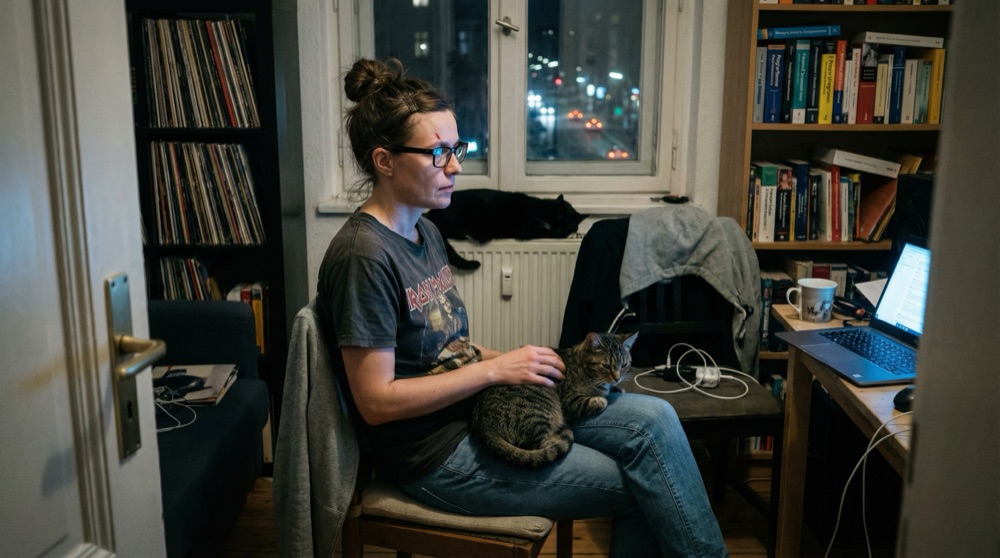
Katja’s apartment on Schönleinstrasse. Thirty-eight square meters of vinyl records, programming books, and two cats who understood that an open laptop meant the human was unavailable.
Turing slept on the radiator. Lovelace had claimed the desk chair until Katja displaced her. The apartment was quiet except for traffic on Kottbusser Damm and faint bass from the bar two floors below.
She opened Navigator.
Navigator — Katja Müller — 16 April 2026, 22:37
Tomasz leaving. Fourteen modules rotting. Hassan exhausted. Anton lying to his wife about being happy. Three seniors getting recruiter pings. Synthesis says get outside help.
It’s right. We can’t see this clearly anymore. We’re inside the thing that’s failing.
I don’t want a consulting firm. I’ve seen what they do. They run workshops, produce slide decks, bill by the hour, and leave you with a transformation roadmap nobody follows. I don’t want someone who talks about process. Our process isn’t the problem. Our codebase is the problem. Our deployment pipeline is the problem. The fact that two years of architectural decisions live in one man’s head is the problem.
I need someone who writes code. Who can pair with Hassan and read the deployment scripts and understand why they look like that. Who can sit with Anton and see what’s actually broken in those fourteen modules.
Starting to search. I’m too tired to think straight but if I wait until I’m rested I’ll never start.
She saved the entry. Closed Navigator. Opened her browser.
She started with her network. LinkedIn messages to three former colleagues at SoundCloud who’d dealt with similar crises. A signal in a private Slack community for Berlin CTOs. An email to a university contact who consulted for startups.
The same question to each: Who do you call when delivery is broken but the team is talented? Not a recruiter. Not a framework vendor. Someone who embeds, works alongside developers, fixes root causes.
She sent the messages. Closed her laptop. Turing climbed onto the desk, sat on the closed lid, and looked at her with the serene indifference of a creature whose systems had never been complex enough to fail.
Almost midnight. Two floors below, the bar’s music shifted to something slower. Kreuzberg settling into its late-night rhythm, the particular calm that Berlin develops after the trains stop running and the city belongs to the people still awake.
Katja picked up Turing, set him on her lap, and sat in the dark. Fourteen modules of rotting code. Forty-one logs naming one departing man. Three months until Tomasz walked out the door and took two years of undocumented knowledge with him. Three months that would evaporate into meetings about transition plans that nobody would follow.
Somewhere out there was someone who could help. She just had to find them in time.
🎭 This Week's Episodes
Telenovelas show what we can't say in client meetings. The drama is heightened, but the patterns are real.
 La Verdad
The emergency board meeting Don Hernando demanded has arrived. Mariana and the Vulcano Capital team want answers. Alejo has one final card to play....
 When Players Revolt
They fixed the validation bug properly — six hours, no corners cut. But the database migration script Anton wrote Monday night to handle legacy NUL...
Technical Consultancy
Senior Developer Advocate
Embedded into your team as an active contributor, increasing effectiveness and elevating engineering clarity.
Technical Advisor
Peer-style technical assessments before far-reaching decisions; reduce architectural and product risk early.
Product & Delivery
Ship working software to real users earlier. Measure impact and adapt based on evidence rather than assumption.
Custom Software Development
High quality, maintainable software. Short-term augmentation that leaves lasting capability in your own team.
Recent Articles
- When Labor Becomes Cheap, Motivation Becomes Everything (06.04.2026)
- Authentication Methods That Work in 2026 (03.04.2026)
- Developer, Not Engineer. And Why It Matters (30.03.2026)
- The Product Manager Is Dead. Long Live the Product Developer. (27.03.2026)
- Building Products in the Age of AI (23.03.2026)