The Technical Debt Reckoning
Easter weekend crushes the remaining team while half the studio is on approved vacation. Anton works Easter Sunday while his daughter hunts eggs in the courtyard below. Hassan pulls an eighteen-hour shift alone. Mariana vents on social media. When work resumes, Anton begins the first Q2 priority: performance optimization. Three days in, he discovers layers of accumulated technical debt blocking every path forward. Estimates triple overnight. And the debt isn't isolated to performance. It's in infrastructure, in backend modules, in deployment scripts. Choosing what to build has revealed what was never maintained.
Easter Sunday, 10:14 — Anton’s Apartment, Prenzlauer Berg
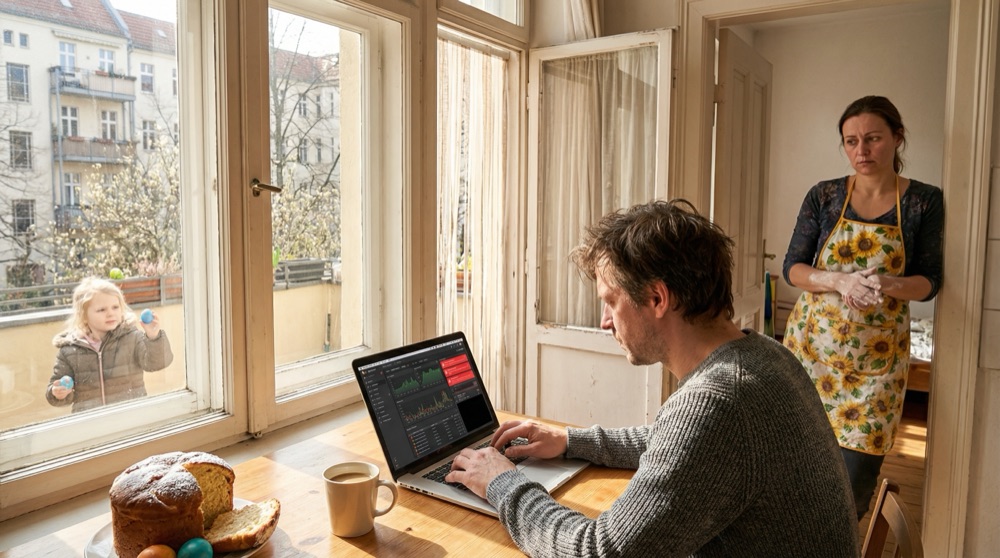
Anton Petrov’s daughter found the blue egg behind the flower pot at 10:07. She shrieked and held it up toward the kitchen window with both hands, waving it in the April sunlight.
He saw her through the glass. Third floor. Sunday morning light catching her blonde hair. Her mouth wide open, laughing. He couldn’t hear her through the double-glazed windows, but he knew the sound by heart.
His laptop pinged. Another alert.
The Easter in-game event had launched at 08:00 and pulled three times the expected concurrent players. Backend response times were spiking. 4,200 milliseconds average. Hassan had been messaging since before dawn.
Anton’s coffee sat untouched on the kitchen table. Cold. The kulich Irina had baked that morning filled the apartment with vanilla and cardamom. A proper Easter. Painted eggs. Family. Church bells from the Gethsemanekirche down the street, their rhythm slow and insistent.
Except he was staring at Unity telemetry while his wife handled their daughter alone in the courtyard below.
He pushed the balcony door open. Cold April air rushed in, carrying church bells and traffic noise from Turmstraße.
“Papa! Papa, come! Blue egg!”
Masha’s voice carried up through the open balcony door. He glanced at the error rates. Climbing. He opened the client-side cache configuration and started scanning for the concurrency bottleneck.
Irina appeared in the kitchen doorway. Flour on her wrists. Her apron from Petersburg, the one with the sunflowers, the one she’d packed in the suitcase when they left Russia because it was the one thing from her mother’s kitchen she couldn’t leave behind.
“It’s Easter, Anton.”
“I know. The servers are—”
“Stop.”
He stopped.
“Our daughter is three years old. She is in the courtyard looking for eggs I hid at six this morning while you were already working. She has asked me four times where you are.” Irina’s voice cracked. Her jaw tightened. She pushed through it. “The last time, she said: ‘Does Papa not live here anymore?’”
The words hit like cold water poured down his spine. His hands went still on the keyboard.
“She’s three, Irina. She doesn’t mean—”
“She means exactly what she said. You sit at this table every morning before she wakes up. You’re still here when she goes to bed. She sees the back of your head more than your face.”
Silence. The church bells rang ten-thirty. Below, Masha found another egg and squealed.
“Thirty minutes,” he said. “Let me stabilize this one thing. Then I’ll come down.”
Irina stared at him. The expression on her face wasn’t anger. Anger would have been easier. This was something heavy and tired and final. She turned and walked out of the kitchen.
The apartment door closed. Through the window he watched her cross the courtyard, pick up Masha, and point at the window boxes on the neighbor’s balcony where more eggs were hidden.
Masha looked up at his window. Waved.
He waved back.
Then turned to his laptop. The cache layer was misconfigured for high-concurrency scenarios. Someone had hardcoded a connection pool limit of 50 that worked fine during normal play but choked during events. He started typing a fix. Below, his daughter moved on to the next egg without looking up again.
Easter Sunday, 19:38 — Hassan’s Apartment, Kreuzberg
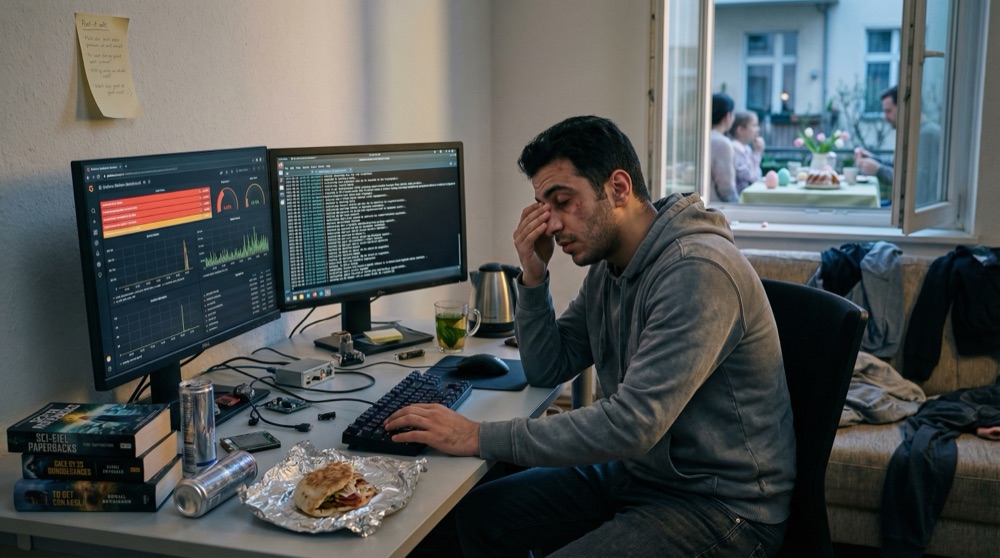
Hassan Al-Rashid had been awake since 04:47. Fifteen hours of keeping the infrastructure alive while three times the normal player count hammered the Easter event.
His studio near Schönleinstrasse hadn’t changed much since he’d moved in. Thirty square meters of cables, hardware, and sci-fi paperbacks stacked on every surface. The couch still doubled as a laundry basket. Two monitors on the desk, three terminal windows, Grafana dashboard on the left screen, deployment logs scrolling on the right.
The error rates had stabilized around 16:00. He’d rebalanced the load across four container instances, patched the auto-scaling configuration that had been on his to-do list for three months, and manually restarted the message queue twice when it choked on event reward payloads. Nobody else had been online to help. Elif had messaged that morning asking whether the event was stable. He’d told her it was fine.
It wasn’t fine. But “fine” was shorter than explaining the fifteen individual fires he’d put out since dawn.
He made himself tea. Mint. His mother’s recipe, the one from Damascus that she’d dictated over a video call two years ago and he’d scrawled on a Post-it now curling at the edges above the kettle.
The döner he’d ordered at 15:00 sat half-eaten on the desk. Cold. He couldn’t remember the last time he’d had a proper meal that didn’t come in foil wrapping.
From outside, through the open window, he could hear families in the courtyard. Children laughing. Someone had set up a table with painted eggs and cake. Church bells drifted in from somewhere across Kreuzberg, faint and unhurried.
He rubbed his eyes. They burned. His vision blurred when he blinked.
“Anton helped with the client-side cache this morning,” he muttered to nobody. “But the backend, the infrastructure…” He let the sentence trail off. There was nobody to finish it for.
Easter Sunday. A public holiday. The courtyard full of families, and he was alone in a studio apartment watching container logs scroll.
His mother had called that morning. He’d let it go to voicemail. She’d asked why he didn’t come home for Easter, why he worked so much, whether he was eating properly. The same questions every call. He sent money every month. Worked sixty hours a week. Seventy during crunch. He hadn’t been to the mosque in two months. He’d skipped Eid last year because of a deployment.
He opened Navigator. His fingers felt heavy.
Navigator — Hassan Al-Rashid — April 5, 2026, 19:44
Easter Sunday. Worked since 05:00. Fifteen hours keeping the game alive during the Easter event.
Three times normal player concurrency. Auto-scaling configuration was broken. Load balancer rules were wrong. Message queue choked twice. Fixed everything manually.
Total Easter weekend hours: 22 (Saturday monitoring + Sunday active firefighting).
Nobody asked me to work today. Nobody had to. If I don’t do it, the servers go down. If the servers go down, the event fails. If the event fails, revenue drops. So I work.
My mother asked why I don’t come home. I didn’t have an answer.
This isn’t sustainable. Everyone says that. Nothing changes.
He saved the log and closed Navigator. The tea was lukewarm. He drank it anyway. It tasted like Damascus.
Easter Sunday, 23:41 — Kreuzberg
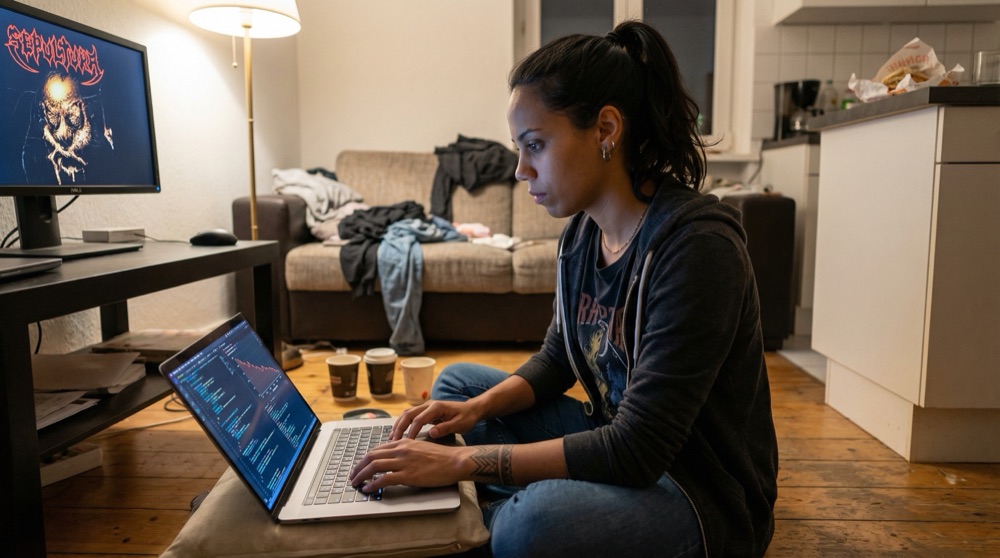
Mariana Silva Santos sat cross-legged on her apartment floor, laptop balanced on a cushion, Sepultura’s “Arise” rattling the windows at a volume her neighbors would regret in the morning.
She’d been debugging since 14:00. The authentication refactor was done but the Easter event had surfaced three edge cases in the session management layer. Players getting logged out mid-purchase. Support tickets stacking up. Marcus had pinged her twice.
Her apartment was chaos. Clothes on the couch. Three coffee cups on the floor beside her. The remains of a döner on the kitchen counter. Sunday night in Berlin. Sunday night in Berlin when you’re Brazilian, single, far from home, and the game you built is breaking under its own weight.
She pushed a fix to staging. Ran the test suite. Waited.
While the tests ran, she opened her phone. Scrolled X. The usual Easter posts. Families. Egg hunts. Brunch photos. Church. Normal people doing normal Sunday things.
Her tests passed. She deployed to production and watched the error rates for the session management endpoint drop. Flattening. Good.
She took a photo of her screen: the error graph trending down, Sepultura’s album art glowing on her second monitor. Typed a post.
Debugging on Easter Sunday while blasting Sepultura. Six weeks of crunch and no end in sight. Something has to break. 🤘
She hit post. Closed the app. Turned up the volume.
Three hours later, the post had 240 likes. Twelve retweets. Nine comments from developers at other companies sharing their own holiday work stories. Two comments from recruiters offering DMs.
Mariana was already asleep on the couch, laptop still warm on the cushion beside her, Sepultura long since looped back to track one.
Tuesday, 08:52 — Pixel Spree Office
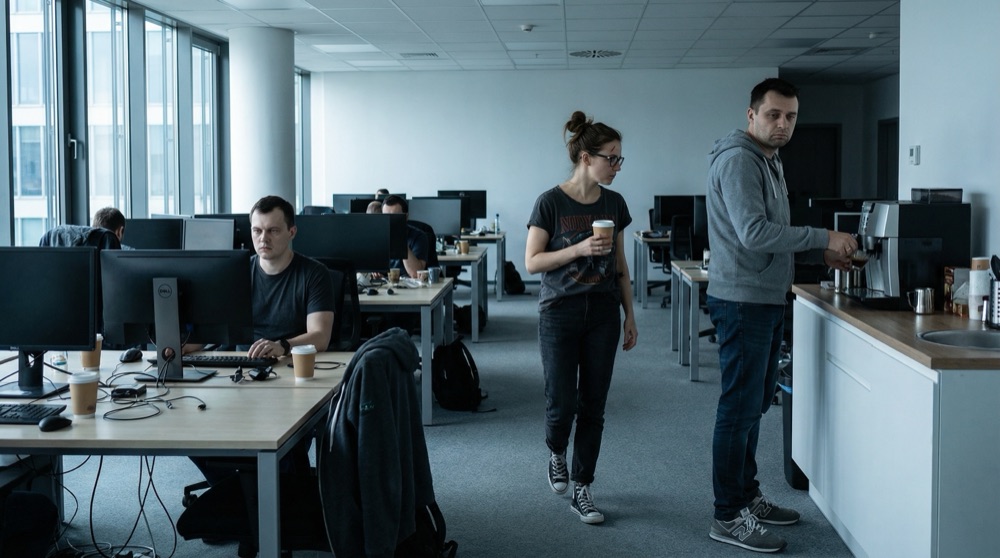
Tuesday morning. The elevator doors opened on the fourth floor and Katja stepped into a building that felt half-empty and fully broken.
Easter Monday was a public holiday. Some of the team had taken the whole week as annual leave, approved months ago. The development floor held maybe half its usual population. Those who were present moved slowly, like people recovering from something. Anton sat at his desk staring at his screen, which wasn’t even on yet. Hassan hadn’t arrived. His desk was dark.
Katja walked past the coffee machine. Tomasz was there, pouring espresso.
“How was Easter?” she asked.
“I worked Saturday.” His voice was flat. “Not because anyone asked me to. Because nobody else was going to review the deployment patches Hassan needed.”
“I know. I saw your Navigator log.”
He nodded.
At her desk, Katja opened Navigator’s weekly synthesis. The report was blunt. Three developers had logged entries over Easter Sunday. In a company of eighty-five people, three had kept the game alive.
Hassan: fifteen hours on Sunday alone. Twenty-two across the weekend. Anton: six hours, including time spent while his daughter hunted Easter eggs one floor below. Mariana: nine hours debugging session management bugs.
Three people. Easter Sunday. A public holiday. And the live ops Easter event generating revenue that would show up on Lukas’s board slide next week as proof the company was growing.
She opened X on her phone and searched for the studio. Mariana’s post appeared near the top. 240 likes. Climbing.
Debugging on Easter Sunday while blasting Sepultura. Six weeks of crunch and no end in sight. Something has to break. 🤘
Katja read it twice. The tone wasn’t angry. It was tired. The sound of someone stating facts because they’ve given up expecting facts to change anything.
The replies were worse. Developers at other companies sharing solidarity. “Same here.” “Three years of crunch, then I quit.” A recruiter: “We value work-life balance. DM me.”
When internal channels fail, people go external. That wasn’t disloyalty. That was desperation with nowhere else to go.
She opened her own log.
Navigator — Katja Müller — April 7, 2026, 09:18
Easter postmortem. Three developers worked Sunday. Hassan worked 22 hours across the weekend maintaining infrastructure solo. Anton worked from home while his three-year-old hunted Easter eggs without him. Mariana fixed critical session management bugs for nine hours alone.
Nobody assigned this work. They did it because the game would have failed without them. That’s not commitment. That’s a system where three individuals carry everything and everyone else assumes someone is handling it.
Mariana posted on X about burning out. 240 likes. Recruiters in her replies. Our best backend developer is being headhunted while we sleep.
The Easter in-game event was Elif’s initiative. Good idea. Strong revenue. But nobody checked engineering capacity against the vacation calendar. Half the team was off. The other half carried the load without being asked.
Friday’s prioritization meeting was progress. Five Q2 priorities. Clear commitments. But we still haven’t addressed the underlying pace. We’re destroying people and calling it startup culture.
She closed Navigator. Picked up her coffee. Drank it. The office hummed with the particular quiet of a team that was present in body and absent in everything else.
Tuesday, 14:10 — Anton’s Workstation

Anton opened the Unity project at 14:10 with the specific clarity that comes from finally knowing what you’re supposed to work on.
Performance optimization. Priority number one from Friday’s meeting. Player experience and revenue impact. The words from the whiteboard, written in Lukas’s blue marker, voted on by every department head.
He’d been thinking about this for months. Frame rate drops during peak events. Inventory loading times that turned a three-second interaction into twelve. Particle effects that spiked memory on older devices and crashed the game on anything below an iPhone 12.
He knew where the problems were. He’d filed bug reports in November. December. January. All marked for “future sprint.” Never scheduled. Never touched. Gathering digital dust in the backlog that had hit 147 items before last week’s purge.
Now they were scheduled. Now they were the priority. His priority.
He opened the rendering pipeline module. Scrolled through the code.
And stopped.
The particle system didn’t use Unity’s native particle renderer. Someone had written a custom rendering pipeline eighteen months ago. No documentation. No comments explaining why. No design document, no ADR, no scribbled note in a wiki. The custom system bypassed Unity’s built-in draw call batching and rendered particles one at a time through a hand-rolled shader pipeline that looked like it had been written by someone brilliant who never expected anyone else to read it.
Anton scrolled through the shader code. Two thousand lines of C# wrapping hand-written HLSL. The code was clever. Too clever. It solved a problem Anton couldn’t identify because nobody had written down what that problem was.
He opened git blame. The author: Diego Fernandez. A developer who’d left the company eleven months ago. No exit documentation. No handover notes. No knowledge transfer session. Just a Slack farewell message and an empty desk.
“Shit,” Anton muttered.
He started reading the custom renderer from the top. Line by line. Optimization tricks that assumed a specific GPU architecture no longer dominant on current devices. Memory management patterns that leaked on Android but not iOS. Thread synchronization that worked beautifully on four cores and fell apart on two.
This wasn’t performance optimization. This was archaeology.
Wednesday, 16:33 — The Layers Beneath
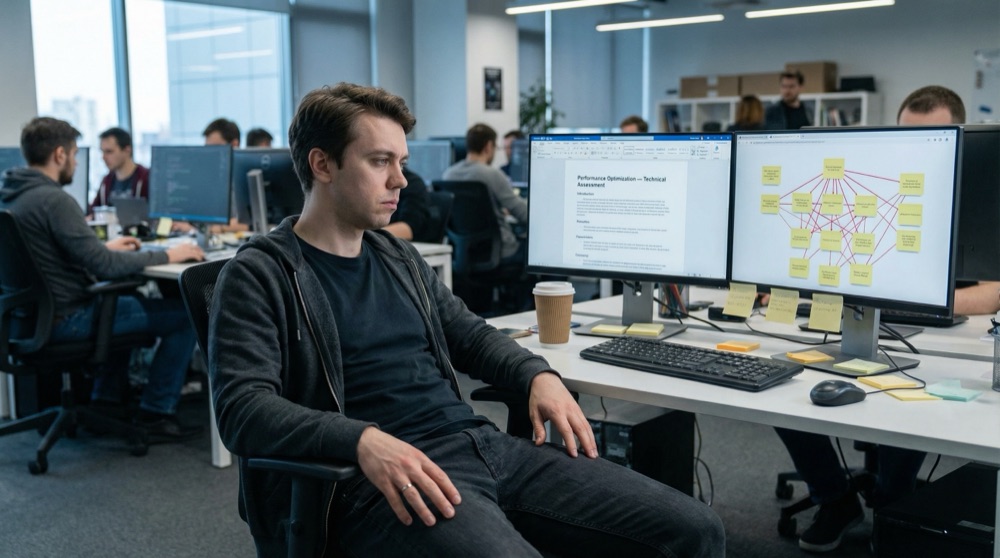
By Wednesday afternoon, Anton had stopped looking for problems and started mapping them.
His second monitor displayed a dependency diagram he’d been building since Tuesday evening. Yellow sticky notes on a digital whiteboard. Each note was a component. Each red line was a dependency that was broken, undocumented, or built on assumptions that were no longer true.
The particle rendering system connected to the inventory display system through a shared texture atlas. The texture atlas was generated at build time by a Python script nobody maintained. The script referenced asset paths that had been reorganized six months ago, so it silently failed on 30% of textures and fell back to placeholder images. Players had been reporting “missing item graphics” for months. Support had logged 47 tickets. QA had flagged it. Nobody had traced it to the build script.
That was one thread. He pulled another.
Frame rate drops during peak events weren’t just particle rendering. Memory allocation. The game allocated and deallocated objects in tight loops during event processing. No object pooling. No pre-allocation. The garbage collector fired every few seconds during peak load, freezing the game for 50 to 200 milliseconds each time. Players saw it as stutter. Support called it “lag.” It wasn’t lag. It was the runtime choking on its own waste.
Standard fix: implement object pooling. Estimated time: two days.
Actual time: unknown. The allocation patterns were woven through fourteen different modules, each written by a different developer over two years, each with its own conventions, none documented. Changing the allocation pattern in one module without changing all fourteen would introduce crashes that would only surface under load. Under production load. With real players.
He pulled a third thread.
Inventory loading performance depended on a database query that joined six tables. The query had been optimized once, a year ago, by a backend developer who’d since left. The optimization used a MySQL-specific feature that had been deprecated in MySQL 8.0. They’d upgraded in January. Nobody checked the inventory query afterward. It was running unoptimized and nobody had noticed because the baseline was already slow. What used to take 800 milliseconds now took 3,200.
Every thread led to more threads. Every fix required understanding three other systems first. Every system had been built under deadline pressure with the implicit promise that someone would clean it up later.
Nobody ever had.
Anton opened a fresh document. Typed a title: Performance Optimization — Technical Assessment.
Original estimate: 2 sprints (4 weeks) Revised estimate: 6+ sprints (12+ weeks)
Root cause: accumulated technical debt across 14 interconnected modules. No documentation. No tests. No single developer who understands all dependencies. Each module built under deadline pressure by developers who have since left or been reassigned.
Attempting performance optimization without addressing underlying debt will produce temporary improvements that degrade within weeks as new features interact with the same rotten foundation.
He sat back. Stared at what he’d written.
Six sprints. Three times the original estimate. Four days after Lukas committed to five Q2 priorities, the very first one had blown up.
Wednesday, 22:15 — Prenzlauer Berg
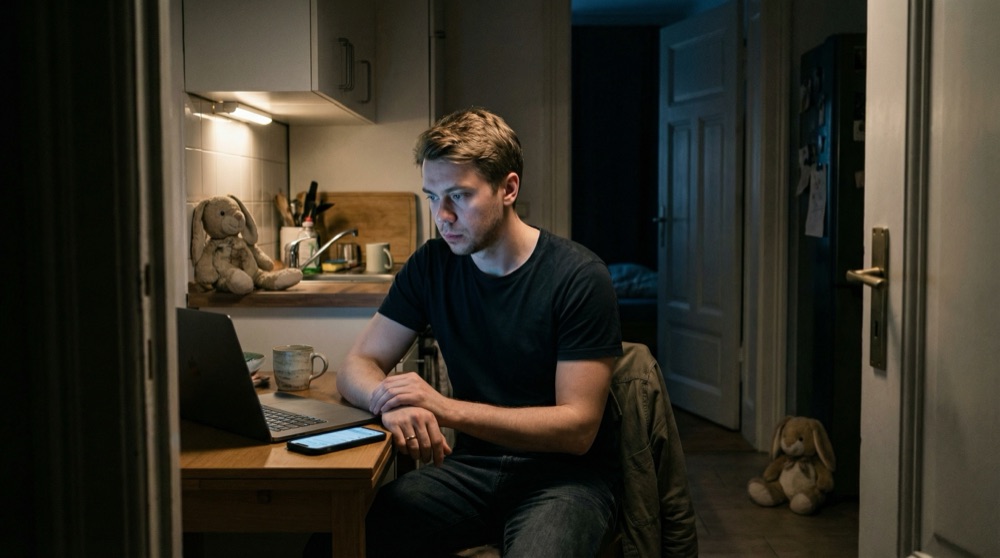
Anton got home at 21:30. Irina and Masha were already asleep. He sat at the kitchen table, the same table where he’d worked Easter Sunday, and opened Navigator on his phone.
Navigator — Anton Petrov — April 8, 2026, 22:19
Spent two days mapping the performance optimization scope. Original estimate was two sprints. Real estimate is six. At minimum.
The codebase has two years of accumulated technical debt. Custom rendering system built by Diego Fernandez, who left eleven months ago. No documentation. No tests. Memory allocation patterns woven through fourteen modules by developers who have mostly left. Database queries running deprecated optimizations nobody checked after the MySQL upgrade in January.
Every fix I attempt requires understanding three other systems first. Every system was built during crunch with the assumption someone would clean it up later. Nobody did.
This isn’t a performance problem. This is a structural problem. The code is rotting from the inside. Performance optimization is just the place where the rot became visible.
I need to tell Lukas tomorrow. He’s going to want to cut performance from Q2 to protect the other four priorities. But the debt doesn’t stop at performance. It touches everything.
He put his phone on the table. In the bedroom, Irina turned over in her sleep. Masha’s stuffed rabbit sat on the kitchen counter where she’d left it before bed.
He picked up the rabbit and placed it outside the bedroom door so she’d find it in the morning. Then he went back to the table and sat in the dark for a long time.
Twelve weeks. At minimum. They had four.
Thursday, 09:15 — Conference Room “Kreuzberg”
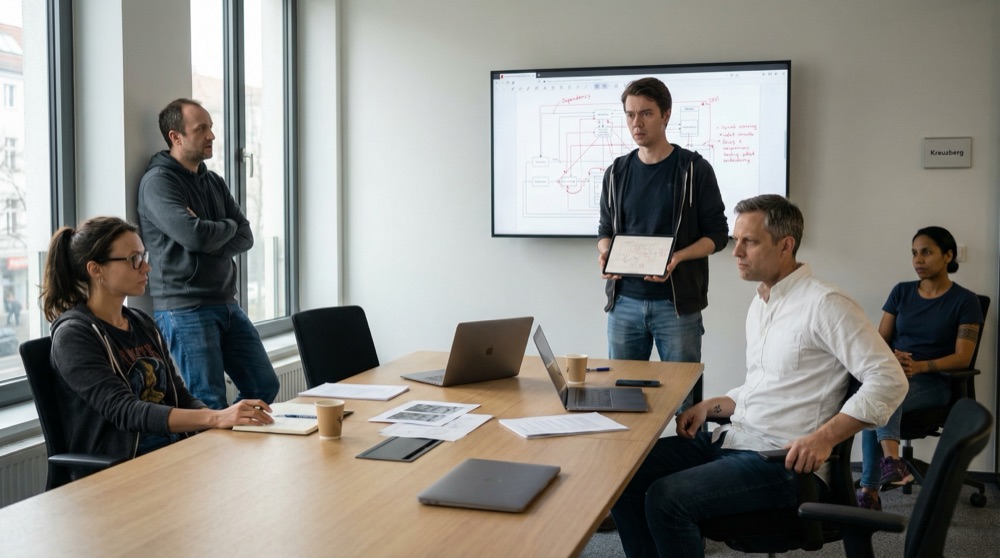
Anton’s assessment document filled the wall screen. Six pages. Fourteen annotated dependency diagrams. Every red line a piece of debt. Every yellow flag a missing test. Every gray node a module written by someone who no longer worked here.
Katja sat on one side of the table. Lukas on the other. Tomasz leaned against the window, arms crossed. Mariana had pulled a chair into the corner.
“Walk us through it,” Katja said.
Anton started with the particle renderer. Two thousand lines of undocumented custom code by a developer who left without a handover. He showed the dependency chain: rendering to texture atlas to build script to asset pipeline. Each link had its own fractures.
Then the memory allocation. Fourteen modules. No pooling. Garbage collector freezing the game multiple times per second during peak load.
Then the database query. Deprecated optimization. MySQL upgrade that nobody checked.
Lukas listened in silence for twelve minutes. His fingers drummed on the table. The drumming got faster as the numbers got worse.
“So the two-sprint estimate…” Lukas started.
“Is six sprints. Minimum. And that’s with help. Alone, I can’t hold fourteen modules in my head at once.”
“Six sprints.” Lukas said the words slowly, like tasting something bitter. “We agreed on five Q2 priorities four days ago. Performance was number one. Now you’re telling me number one alone will consume three times the entire quarter.”
“Yes.”
Silence. Lukas looked at Katja. She didn’t flinch.
“Cut it,” Lukas said. “Move performance to Q3. Protect the other four priorities. We agreed on five, we’ll deliver four.”
“You can’t cut it.” Anton’s voice was quiet but steady. “The debt isn’t just in the performance path. It’s everywhere.”
“What do you mean, everywhere?”
Tomasz pushed off the window. “He means the same technical debt that blocks performance optimization also blocks the other four priorities. Different symptoms. Same disease.”
Lukas’s jaw tightened. “Explain.”
Thursday, 09:47 — The Domino Effect
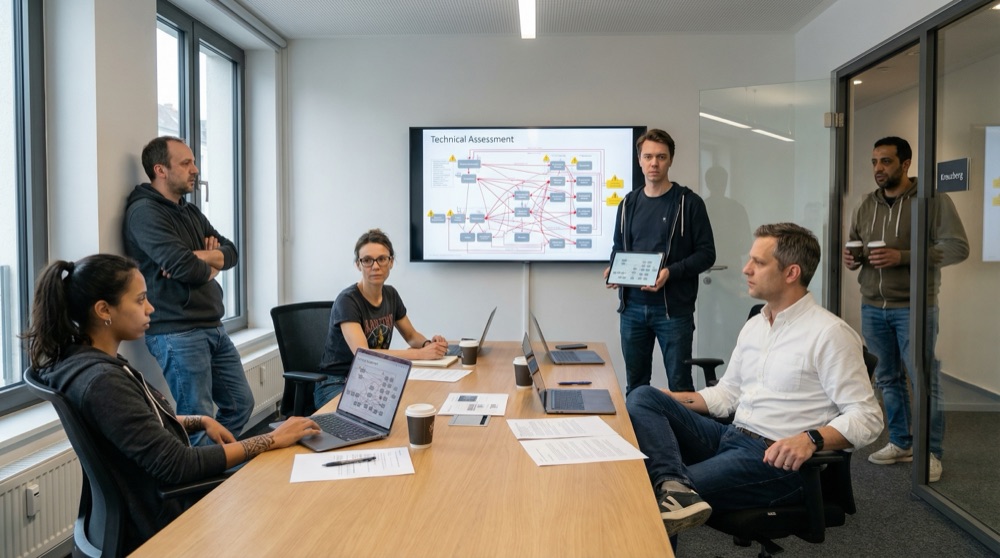
Mariana leaned forward in her corner chair. “Can I?”
Katja nodded.
“I started scoping the character customization MVP yesterday. Priority number five.” Mariana pulled up a diagram on her laptop. “It requires changes to the inventory system. The inventory system uses the same module that has the deprecated MySQL query Anton found. Same tangled dependencies. Same missing tests.”
She paused to let that settle.
“Adding new item types to the inventory without automated tests means I’ll break existing behavior and we won’t catch it until players report it. Like last time.”
Last time. The inventory bug. 4,847 players with empty arrays. App Store rating crashing to 2.1 stars. Nobody in that room had forgotten.
“Custom reporting,” Katja said, looking at the whiteboard where the five priorities still stood in blue marker. “Priority number two. Marcus needs it for churn analysis.”
“Custom reporting requires the analytics data pipeline,” Mariana said. “Priya’s team maintains the front end, but the pipeline runs on infrastructure Hassan manages. The data transformation layer was written as a ‘temporary solution’ eighteen months ago.”
“I can speak to that.” Hassan’s voice came from the doorway. He’d arrived late, dark circles carved under his eyes, carrying a coffee he needed more than wanted. He looked like he hadn’t slept properly in a week. Because he hadn’t.
“The data pipeline runs on infrastructure I patched together during a crunch weekend last year. It works. Barely. If Priya’s team tries to scale it for custom reporting, it’ll collapse. Rebuilding it means touching the deployment scripts, which means—”
“Deployment automation,” Katja finished. “Priority number three.”
“Right.” Hassan sat down. “Deployment automation was supposed to be straightforward. Replace my manual scripts with proper CI/CD. But the manual scripts are hardcoded to the current infrastructure layout, which is…” He paused, searching for the right word. “It’s not what anyone would design on purpose. Automating a bad design just automates the badness. Faster.”
Four of five Q2 priorities. All blocked by the same rot. Two years of shortcuts stacked on top of each other like geological layers: each crunch cycle depositing another stratum of debt, each deadline burying the previous mess under new mess, each departing developer taking undocumented knowledge with them.
“Player analytics?” Lukas asked. His voice was flat now. He was gripping the armrest with both hands. White knuckles. “Priority number four. Claudia’s board dashboard.”
“Analytics is the one priority that might be achievable in isolation,” Mariana said carefully. “It’s mostly frontend. New dashboard views over existing data. But the data it displays comes from the same pipeline Hassan just described. If the underlying numbers are wrong because the pipeline is unreliable, the dashboard is worse than useless. It’s confidently wrong.”
Lukas stared at the whiteboard. Five priorities in blue marker. Each one now had invisible chains connecting it to a foundation made of duct tape and promises.
“So what are you telling me?” His voice was tight. “That we can’t do any of them?”
“We can do all of them,” Anton said. “But not in four weeks. Not built on this.”
“Then what? What’s the actual plan?”
Tomasz pushed off the window again. “We spend the first four sprints on foundation work. Technical debt cleanup. Automated tests for the critical modules. Documentation. Infrastructure rebuild so Hassan isn’t the only person who can deploy. Then in Q3 we build the features on solid ground. They’ll go three times faster because we’re not fighting the codebase the whole way.”
“Four sprints of cleanup.” Lukas’s voice was strained. “That’s two months of zero features. Zero visible progress. The board will—”
“The board will get nothing either way.” Katja’s voice cut through, sharp and final. “We either spend two months fixing the foundation and deliver features on schedule in Q3. Or we spend four months fighting the debt while trying to ship features, deliver everything late and broken, and explain to the board why Q3 and Q4 are also a disaster.”
Lukas sat in silence for a long time. The conference room glass exposed them all to the development floor outside. Developers at their desks, pretending not to watch. Pretending not to know what was being discussed in the room with fourteen red lines on the screen.
“I need to think about this,” Lukas said. He stood up and walked out.
Nobody else moved for a while.
“He’ll come around,” Katja said. Her voice carried more hope than certainty.
“Will he?” Mariana asked.
Nobody answered. On the wall screen, Anton’s dependency diagram blinked patiently. Fourteen modules. Six sprints. Two years of debt. The same number whether anyone looked at it or not.
Thursday, 15:22 — Navigator Weekly Synthesis

The synthesis email arrived at 15:22.
Navigator Weekly Synthesis — Week 10 (Apr 5 – Apr 9)
Key Patterns Detected:
1. Easter Weekend Crunch (Critical — Human Cost)
Three developers worked Easter Sunday. Hassan Al-Rashid logged 22 hours across Saturday and Sunday maintaining infrastructure solo. Anton Petrov worked six hours from home while his family celebrated without him. Mariana Santos debugged session management bugs for nine hours alone.
No manager assigned this work. No expectation was formally communicated. These developers worked because the systems would have failed without their individual intervention. This is a systemic single-person dependency pattern, not voluntary commitment.
External visibility: one developer posted publicly on social media about six consecutive weeks of burnout. The post received significant engagement and recruiter outreach. Internal frustration is becoming externally visible.
2. Technical Debt Blocking All Q2 Priorities (Critical — Delivery Risk)
Anton Petrov’s performance optimization assessment reveals accumulated technical debt across fourteen interconnected modules. The original two-sprint estimate has tripled to six or more sprints.
Root causes: undocumented custom code from departed developers, zero automated tests in critical modules, deprecated database optimizations not checked after platform upgrades, manual infrastructure built under sustained crunch conditions.
Critical finding: the technical debt is not isolated to performance. Four of five Q2 priorities depend on the same compromised foundation. Deployment automation is blocked by hardcoded infrastructure scripts. Custom reporting depends on an unstable data pipeline. Character customization requires changes to untested inventory modules.
Pattern: Two years of sustained crunch created a speed-debt cycle. Deadlines eliminated maintenance time. Skipped maintenance created technical debt. Technical debt slowed delivery. Slower delivery created pressure for more crunch. The cycle has reached a terminal phase where accumulated debt blocks forward progress entirely.
3. Burnout at Historic Levels
Combined Easter crunch and technical debt discovery have pushed developer morale to its lowest recorded level across seven weeks of Navigator data. Log sentiment shows exhaustion and resignation significantly exceeding any previous measurement period.
Notable entries:
- Hassan Al-Rashid: “This isn’t sustainable. Everyone says that. Nothing changes.”
- Anton Petrov: “This isn’t a performance problem. This is a structural problem. The code is rotting from the inside.”
- A developer posted publicly about burnout; recruiters responded immediately.
- Three senior developers have received unsolicited recruiter contact in the past week.
4. Prioritization Progress Under Threat (Mixed)
Last week’s prioritization exercise (reducing 94 high-priority items to five Q2 must-haves) was a significant organizational achievement. However, the immediate discovery that four of five priorities are blocked by technical debt has created a secondary crisis: the organization now has clear priorities but lacks the technical foundation to execute them.
The team faces a choice between two paths: (a) attempt features on a compromised foundation and accept delayed, fragile delivery, or (b) invest in foundation repair first and accept a period of zero visible feature output. Neither path is comfortable. Only one is sustainable.
Recommendations:
- Foundation sprint: Dedicate focused time to technical debt cleanup before attempting feature delivery. Current feature estimates are unreliable because they exclude the hidden cost of working around accumulated debt.
- Bus factor reduction: Three developers (Hassan, Anton, Mariana) carry disproportionate system knowledge. Any single departure would create a critical capacity gap.
- External perspective: The organization may benefit from an external technical assessment. Internal teams are too close to the problem and too exhausted to diagnose and remedy it simultaneously.
- Pace reset: Current working hours are unsustainable. Easter weekend was symptom, not outlier. The team has been in crunch mode for at least six consecutive weeks with no recovery period.
Risk Assessment:
Retention risk is elevated. Multiple developers are receiving recruiter attention. The combination of sustained crunch, technical frustration, and visible burnout creates conditions where experienced developers leave for organizations that value sustainable pace. Given the critical knowledge concentration in Hassan (infrastructure), Anton (Unity), and Tomasz (architecture and institutional knowledge), even one departure would substantially reduce delivery capacity.
Katja read it twice. Her hand was over her mouth.
The synthesis had said what she’d been circling for weeks. The thing she didn’t want to name because naming it made it impossible to ignore.
They were too broken to fix themselves. Too deep in the mess to see the edges of it. Too exhausted to do the work that needed doing while also keeping the game alive. The debt was structural. The burnout was systemic. And the people who understood the problem most clearly were the same people being destroyed by it.
She opened her log.
Navigator — Katja Müller — April 9, 2026, 15:41
The synthesis confirms what the meeting revealed this morning. Four of five Q2 priorities are blocked by the same technical debt. Our best people are burned out. Recruiters are circling.
We need external help. Not a consulting firm selling frameworks. Not someone who writes reports and leaves. Someone who can embed with the team, read the code, and fix what’s actually broken. Someone who understands that this is a practice problem, not a process problem.
I’ll start searching tonight.
Thursday, 18:30 — Rooftop
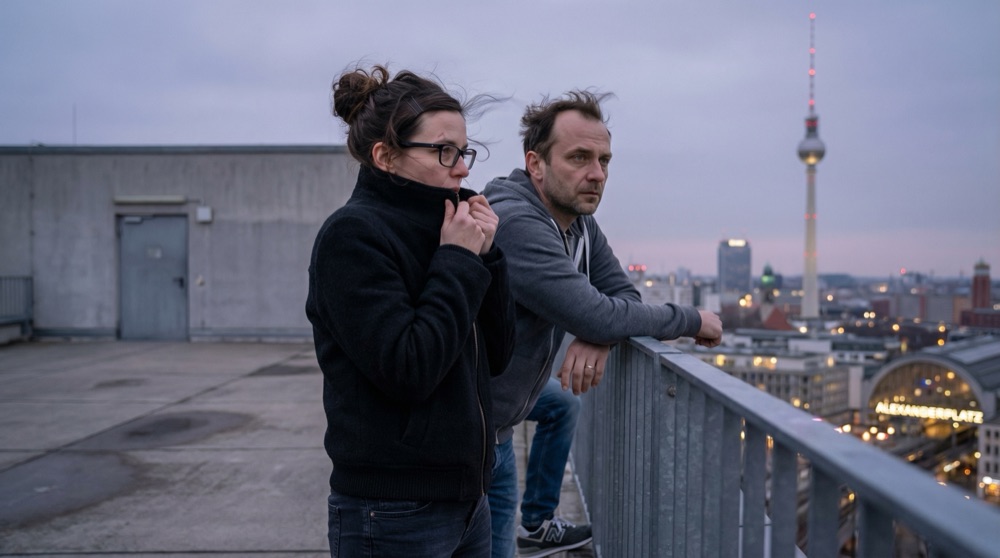
The rooftop terrace was empty. April evening, still cold enough to keep most people in the warm lobby downstairs. Katja stood at the railing with her wool jacket zipped to her chin, watching the Fernsehturm blink against the darkening sky.
Tomasz appeared beside her. No jacket. Didn’t seem to notice the cold.
“You read the synthesis,” she said.
“Yeah.”
They stood in silence. Below, the U-Bahn rumbled into Alexanderplatz station. A cyclist pedaled down Prenzlauer Allee trailing a Bluetooth speaker playing something with heavy bass that faded as they passed.
“The recommendation about external help,” Tomasz said. “Navigator’s right. We’re too deep in it.”
“I know.”
“We need someone who’s fixed this pattern before. Someone who walks into a codebase, looks at the team, and says, ‘Here’s what’s actually wrong and here’s the order to fix it.’”
Katja nodded. “Not a consultant selling methodology.”
“God, no.” Tomasz almost smiled. Almost. “Someone who writes code. Someone who’s rebuilt infrastructure that was held together with cron jobs and prayer. Someone who can pair with Anton and Hassan and actually help, not just observe and make slides.”
The wind picked up. She pulled her collar tighter.
“There’s something else,” Tomasz said.
She looked at him. His face was outlined against the city lights. The tiredness wasn’t new. But something in his expression was. A stillness she hadn’t seen before.
“Lukas promoted me because I was the best developer on the team. I said yes because I thought leading engineering meant engineering.” He paused. “It doesn’t. It means meetings. Slack messages. Defending decisions I didn’t make to people who don’t understand the constraints. Managing humans when all I want is to solve problems.”
A long breath. The Fernsehturm blinked. Red. Pause. Red.
“I’m burning out, Katja. I’ve been burning out for months. My logs show it. The synthesis shows it. Anybody paying attention can see it.”
“I know,” she said softly. “I read your logs.”
“Then you know I can’t keep doing this much longer.”
The city hummed below them. Ten thousand things happening simultaneously, none of them visible from up here. The conference room on the fourth floor still had Anton’s dependency diagram on the wall screen. Fourteen modules. All connected. All rotting.
“What are you saying?” Katja asked.
Tomasz looked at the skyline. “I’m saying the synthesis is right about retention risk. And I’m saying you should take it seriously.”
He didn’t add anything else. The meaning sat in the cold April air between them, heavy and clear.
“Let’s get through this week,” Katja said. “I’ll talk to Lukas about the external help. And about the pace.”
“Sure.”
They went back inside. The rooftop door closed behind them with a metallic click that echoed across the empty terrace.
Below, on the development floor, most of the team had already gone home. Anton’s workstation was dark. Hassan’s desk was dark for the second time that week, though this time because he’d left at 17:00 for the first time in months. His mother had called again at 16:30. This time he’d picked up.
He’d closed his laptop and gone.
Two years of technical debt sat waiting in the codebase. Patient. Indifferent to holidays and arguments and burnout. It would be there tomorrow, and the day after, and the day after that. The only question was whether the people who could fix it would still be around when the organization finally decided to let them.
🎭 This Week's Episodes
Telenovelas show what we can't say in client meetings. The drama is heightened, but the patterns are real.
 La Verdad
The emergency board meeting Don Hernando demanded has arrived. Mariana and the Vulcano Capital team want answers. Alejo has one final card to play....
 When Players Revolt
They fixed the validation bug properly — six hours, no corners cut. But the database migration script Anton wrote Monday night to handle legacy NUL...
Technical Consultancy
Senior Developer Advocate
Embedded into your team as an active contributor, increasing effectiveness and elevating engineering clarity.
Technical Advisor
Peer-style technical assessments before far-reaching decisions; reduce architectural and product risk early.
Product & Delivery
Ship working software to real users earlier. Measure impact and adapt based on evidence rather than assumption.
Custom Software Development
High quality, maintainable software. Short-term augmentation that leaves lasting capability in your own team.
Recent Articles
- When Labor Becomes Cheap, Motivation Becomes Everything (06.04.2026)
- Authentication Methods That Work in 2026 (03.04.2026)
- Developer, Not Engineer. And Why It Matters (30.03.2026)
- The Product Manager Is Dead. Long Live the Product Developer. (27.03.2026)
- Building Products in the Age of AI (23.03.2026)