The Infrastructure Crisis
Friday afternoon, 15:47. The deployment pipeline fails during a critical hotfix. Hassan works alone until 03:00. Mariana arrives Saturday morning and discovers the CI infrastructure hasn't been maintained in six months — every patch, every workaround held together by Hassan's knowledge alone. They spend the weekend fixing it together. Monday's synthesis will reveal what leadership refused to see: Hassan mentioned as blocker in nine different department logs.
The Friday Hotfix
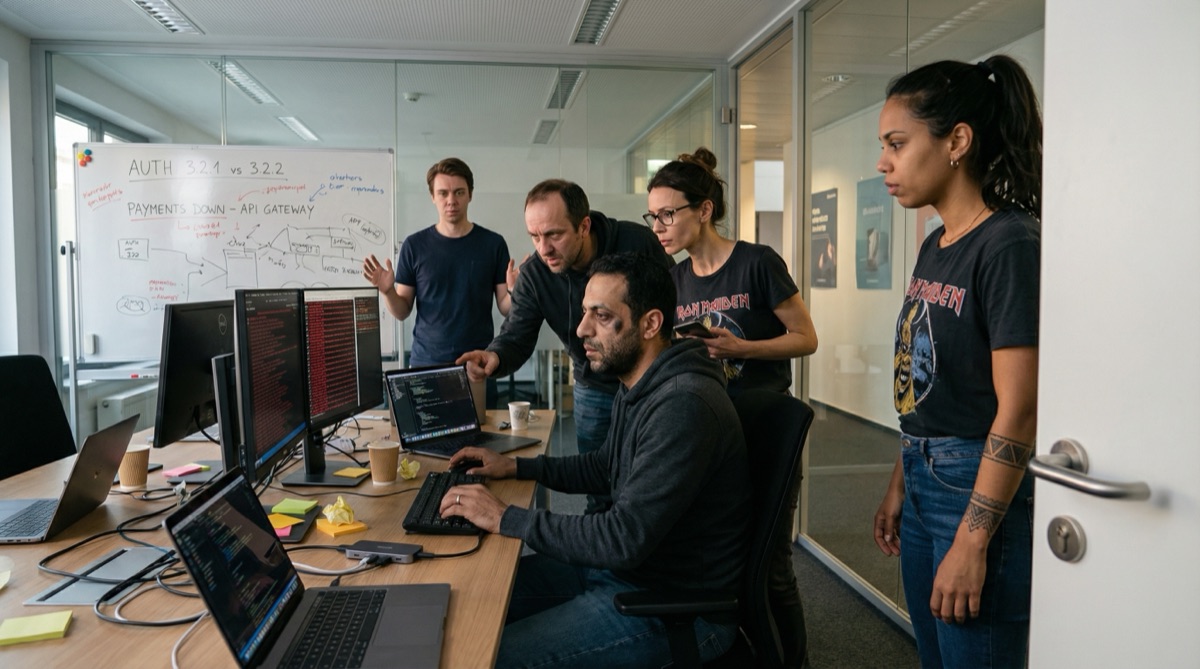
Friday, 15:47. The development floor had that end-of-week energy — people wrapping up, planning weekend escapes, mentally checked out. Mariana was reviewing a PR when the Slack notification exploded across three channels.
 Marcus Thompson (Player Support) @channel CRITICAL — Payment processing is completely cooked. Players can't buy gems. Getting absolutely flooded with tickets.
 Priya Sharma (Analytics) Confirmed. Zero successful transactions in the last 12 minutes. Revenue dashboard showing flatline. We're so fucked.
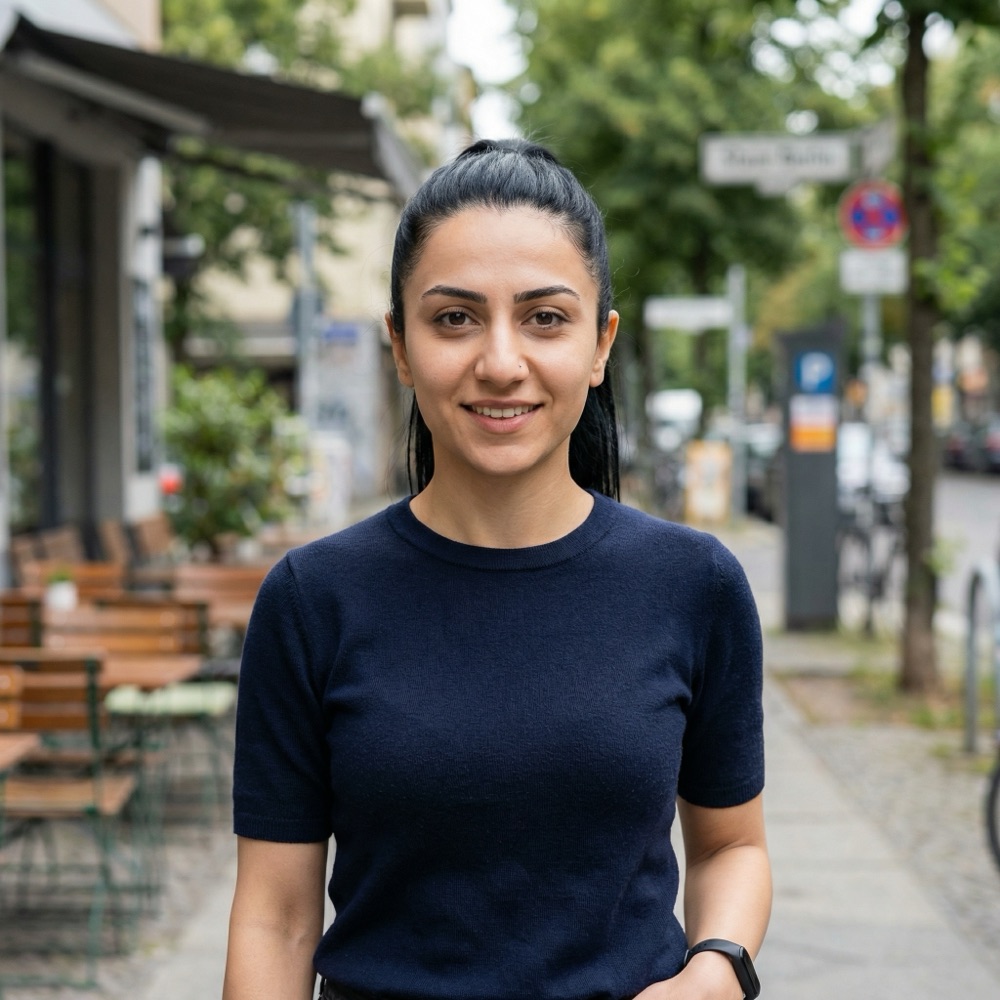 Elif Yılmaz (Live Ops) Shit. We have a weekend sale starting in three hours. If payments are down we lose the entire revenue spike.
Tomasz’s response came thirty seconds later:
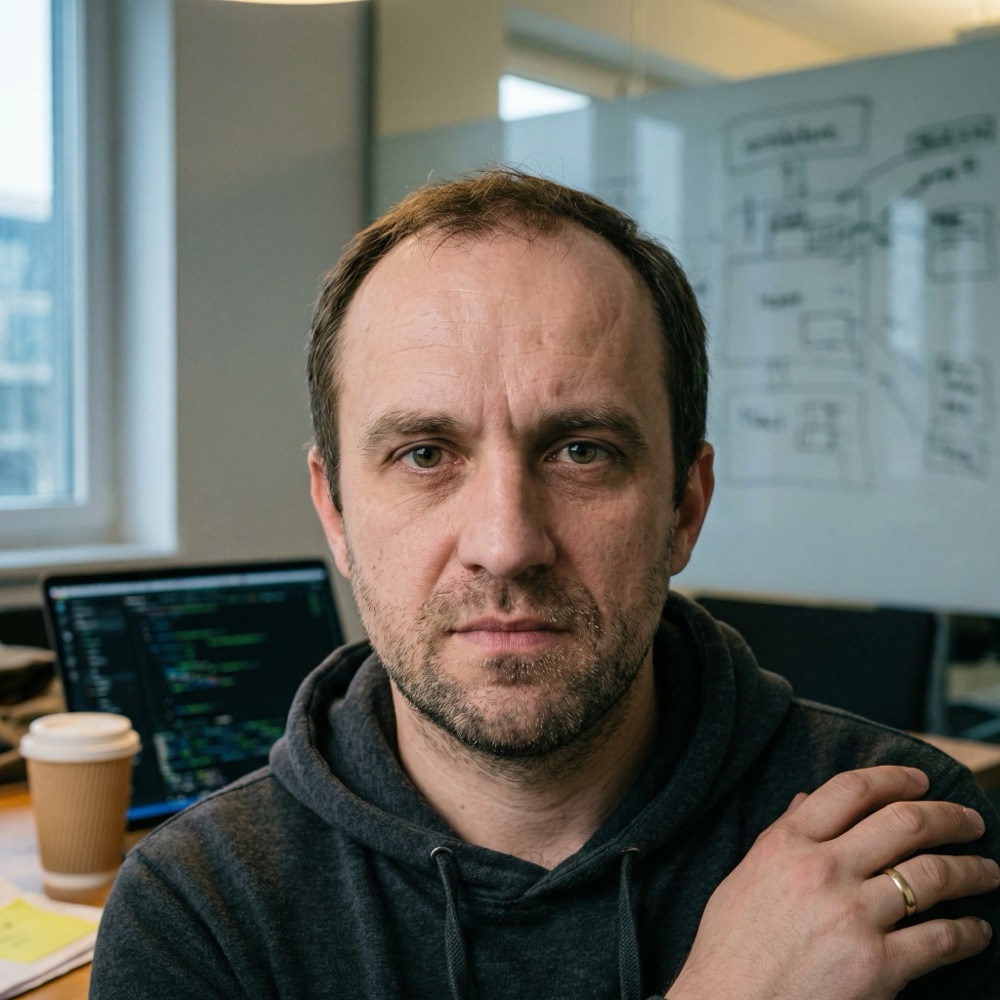 Tomasz Kowalski Development war room. Now. Hassan, Mariana, Anton — drop everything.
Mariana was already moving. She grabbed her laptop and headed to Conference Room A, the designated war room. Hassan Al-Rashid was already there, his laptop open, terminal windows cascading across two external monitors.
Hassan didn’t look up. “Payment gateway logs?”
“Clean. Gateway’s fine. The problem is our backend API. Version mismatch between staging and production. Someone deployed without running the full test suite.”
Anton Petrov arrived, looking panicked. “I deployed the inventory fix this morning. Could that—”
“Wasn’t you,” Hassan said, typing rapidly. “This is the authentication service. Different repo.”
Tomasz arrived with Katja right behind him. “How bad?”
“Bad,” Hassan said. “Authentication service in production is running version 3.2.1. The payment gateway expects 3.2.2. They’re incompatible. Need to roll back or push forward.”
“Roll back,” Katja said immediately. “Safest option.”
“Can’t,” Hassan said. “The rollback script requires the CI pipeline to rebuild the old version. The pipeline’s been throwing errors all week. I’ve been manually deploying as a workaround. It’s fucked.”
Silence.
Tomasz leaned over Hassan’s shoulder to look at the error logs. “How long to fix the pipeline?”
Hassan’s jaw tightened. “Three hours. Maybe six if I hit the usual infrastructure bullshit.”
Mariana checked her watch. 16:02. “The weekend sale starts at 19:00.”
“I know,” Hassan said.
Katja pulled out her phone. “I’ll tell Lukas we’re down. Elif, push the sale start time to tomorrow morning.”
Elif Yılmaz That costs us Friday night revenue. We're talking €50K minimum.
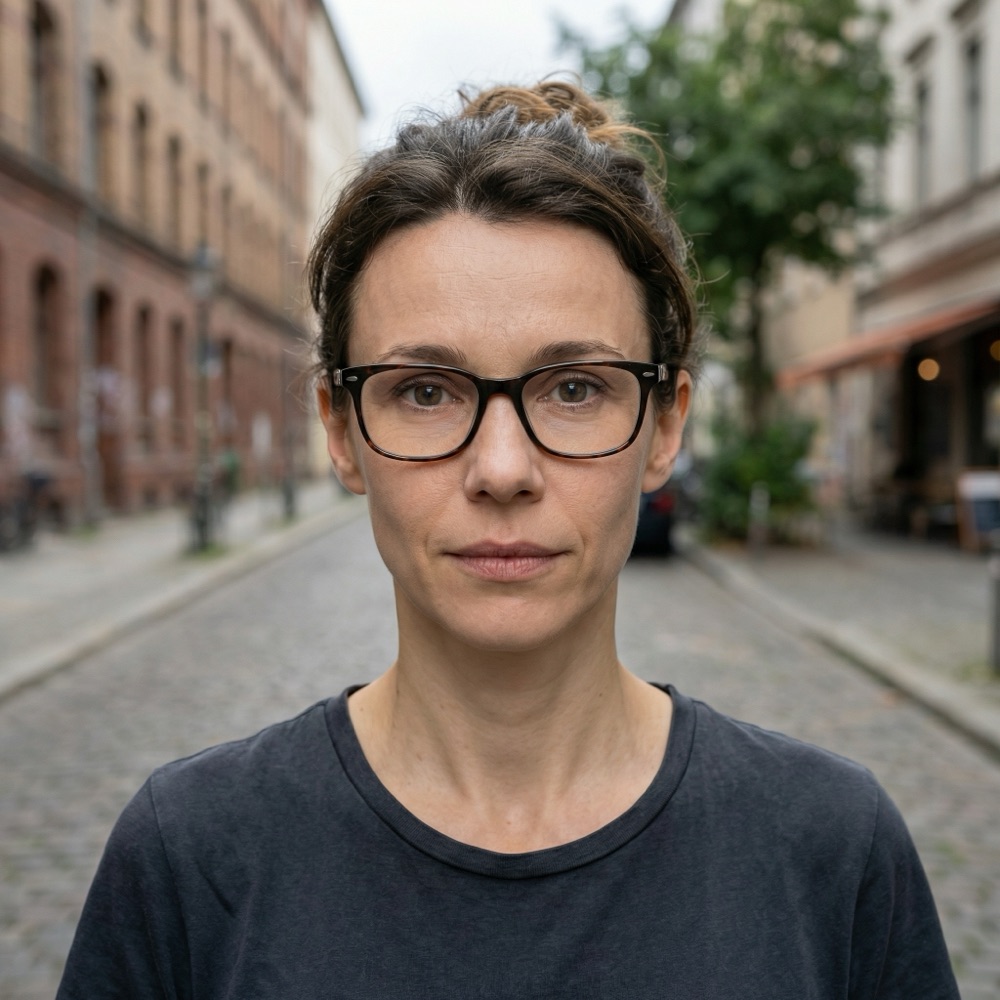 Katja Müller Noted. Do it anyway. Hassan, what do you need?"
Hassan was already deep in configuration files. “Space. Time. Coffee.”
“You’ve got it,” Katja said. “Everyone else out. Let him work.”
They filed out of the war room. Mariana hesitated at the door. “Hassan, if you need—”
“I’ll ping you if I need help,” Hassan said without looking up. “Right now I just need to focus.”
Mariana closed the door.
The Long Night
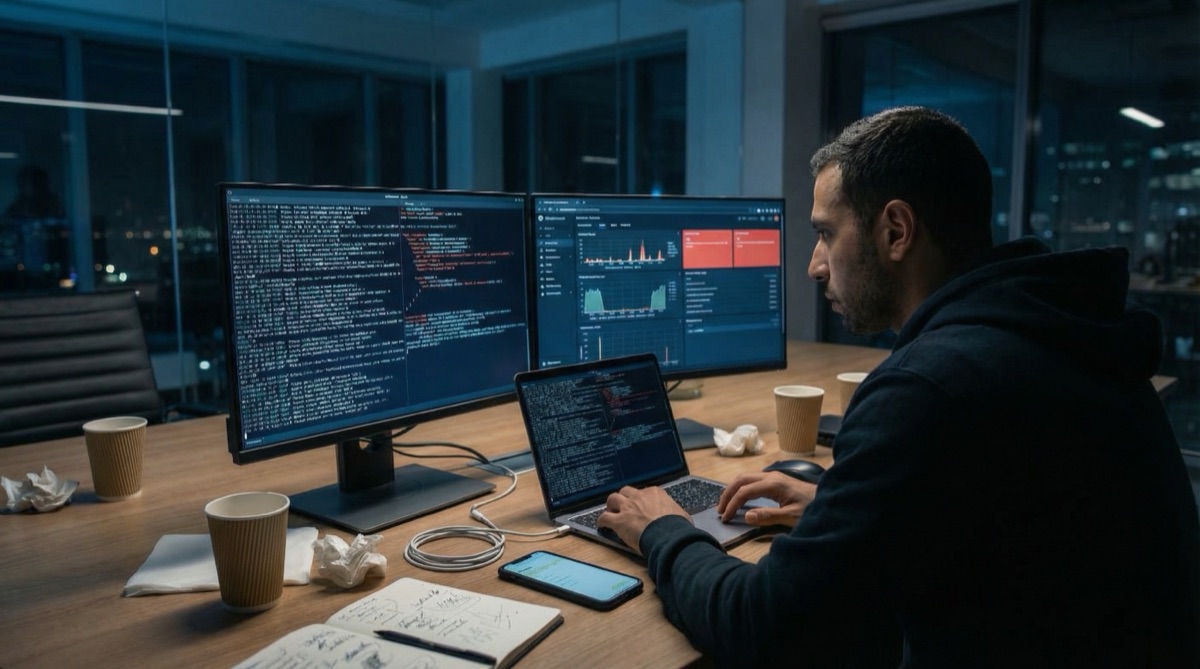
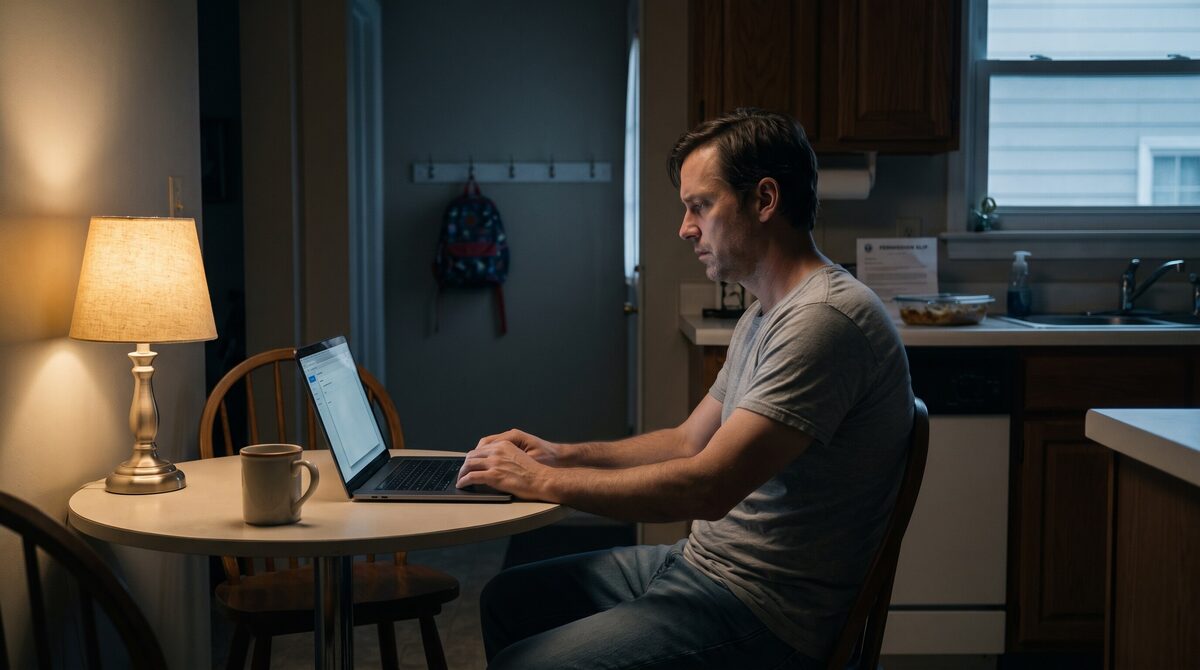
23:17. The office was dark except for Conference Room A, where Hassan sat surrounded by empty coffee cups and the blue glow of terminal windows.
The CI pipeline rebuild revealed layers of rot. Dependencies outdated by six months. Configuration drift between environments. Hardcoded credentials that had expired. Every fix exposed two more problems.
His phone buzzed. Tomasz.
Tomasz Kowalski Still there?
 Hassan Al-Rashid Yeah. Making progress. Pipeline's rebuilding now. Should have deployment ready in an hour.
Tomasz Kowalski You need help?
Hassan Al-Rashid Honestly? No. Too deep in the weeds. Would take longer to explain than to just finish.
Tomasz Kowalski Alright. But seriously — if you're still there at 01:00, I'm calling it and we'll resume tomorrow.
Hassan Al-Rashid Deal.
But when 01:00 came, Hassan was still there. The deployment had worked, but only after manually patching three different configuration files. The authentication service was running again. Payments were processing.
He opened Navigator on his phone and typed his daily log entry:
March 14, 2026 — Friday
Deployment pipeline failed during critical payment hotfix. Spent 6 hours rebuilding CI infrastructure. Discovered: dependencies outdated since September, config drift across all environments, expired credentials hardcoded in four places. This shit is completely fucked.
Got payments working again. But this is unsustainable. Every deployment is a minefield. Every hotfix reveals more infrastructure debt. I’m the only person who knows how this works.
Alone in the office at 01:37. Team thinks this is heroic. It’s not. It’s a single point of failure waiting to explode.
He hit Submit, closed his laptop, and went home.
The Weekend Discovery
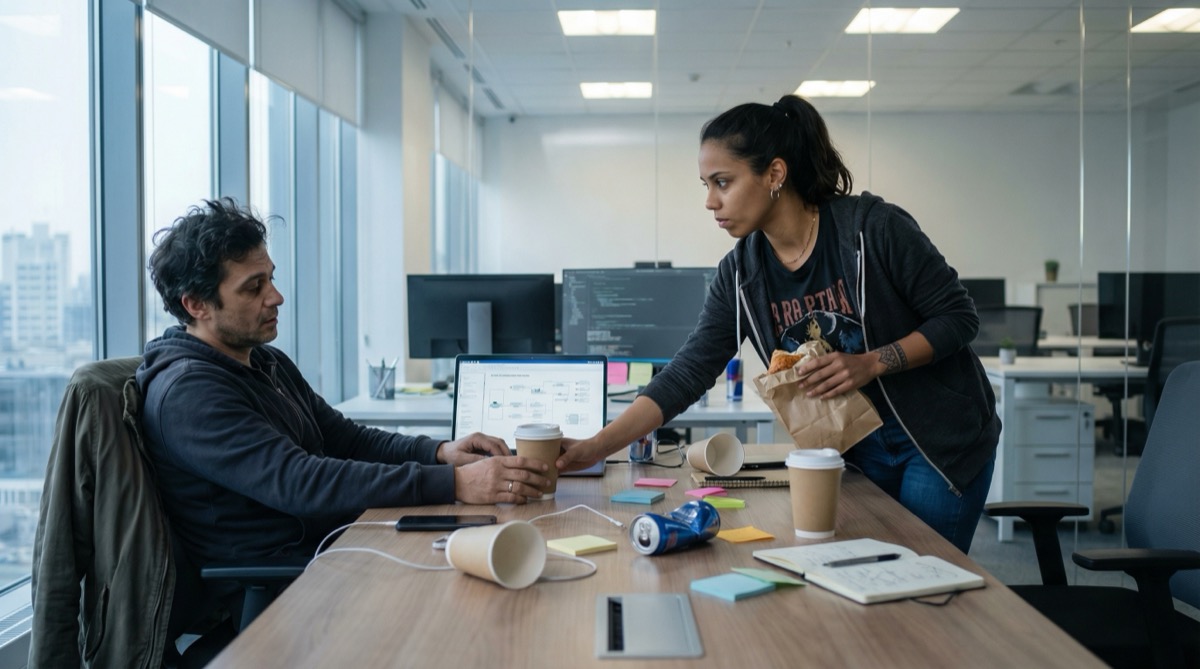
Saturday, 09:34. Mariana arrived at the office with two large coffees and a bag of pastries from the bakery downstairs. She found Hassan at his desk, looking like he’d slept there.
“You came back?” she said.
Hassan looked up, bleary-eyed. “Deployment’s working but it’s fragile. Wanted to document what I fixed before I forget.”
Mariana set a coffee in front of him. “Okay. Show me.”
“Show you what?”
“Everything you fixed last night. The infrastructure debt. All of it.”
Hassan hesitated. “It’s … a lot.”
“I’ve got all day,” Mariana said, pulling up a chair. “And if this is as bad as I think it is, you need someone else who understands it. Walk me through it.”
Hassan took a long drink of coffee, then opened his documentation notes. “Alright. So. The CI pipeline hasn’t been properly maintained since September.”
“Six months,” Mariana said quietly.
“Yeah. Every time something broke, I patched it manually. Workarounds on top of workarounds. Last night I had to rebuild the entire dependency tree from scratch because the whole thing was held together with duct tape and prayers.”
He pulled up a diagram showing the pipeline architecture. Mariana’s eyes widened. “Holy shit. This is … how the fuck is this even running?”
“Because I know where all the bodies are buried,” Hassan said. “Every manual patch. Every hardcoded credential. Every environment-specific config override. It’s all in my head. The entire fucking thing.”
“That’s not sustainable.”
“I know.”
Mariana leaned back in her chair. “Okay. Let’s fix it properly. Not patches. Actual infrastructure modernization. This weekend, while everything’s quiet.”
Hassan laughed, sharp and bitter. “With what time? I’m already underwater. Every department needs infrastructure support. Every deployment needs manual babysitting. I’m mentioned as a blocker in every fucking standup because I’m one person trying to cover an entire infrastructure layer.”
“Which is exactly why we need to fix this,” Mariana said. “Right now, this weekend, while everything’s quiet. Document everything, automate what we can, make it maintainable. This isn’t sustainable and you know it.”
Hassan stared at his coffee cup. “You’re serious.”
“Dead serious. You’ve been carrying this shit alone for six months. That ends today.”
Something in Hassan’s expression shifted. Not relief — not yet. But maybe the first hint that the weight might be shareable.
“Alright,” he said. “Let’s fucking do it.”
They spent the next two hours documenting the CI pipeline configuration. Every manual step. Every workaround. Every assumption baked into the infrastructure that only Hassan knew about.
By noon they had a plan. By 15:00 they’d automated the dependency updates. By 18:00 they’d removed the hardcoded credentials and set up proper secrets management.
“Okay,” Mariana said, stretching. “This is starting to look maintainable.”
Hassan nodded, exhausted but lighter. “Yeah. First time in months I’m not terrified of the next deployment.”
“Get some sleep tonight,” Mariana said, packing up her laptop. “You look like absolute shit.”
“Thanks,” Hassan said drily. “You’re a real inspiration.”
She grinned. “Anytime.”
Hassan logged in Navigator:
March 15, 2026 — Saturday
Mariana showed up this morning with coffee and refused to leave. We spent the entire day modernizing the CI pipeline. Documented every manual workaround. Automated dependency management. Fixed credential handling.
First time in six months someone else understands how this infrastructure works. First time I’m not alone with it.
Mariana logged her entry:
March 15, 2026 — Saturday
Spent Saturday working with Hassan on CI infrastructure. Discovered he’s been manually patching the pipeline for six months. Every deployment dependent on his knowledge. Every hotfix revealing more debt.
We fixed it together. Documented everything. Automated what should never have been manual.
This isn’t heroic overtime. This is organizational failure made visible. Hassan shouldn’t have been carrying this alone.
The Metal Show
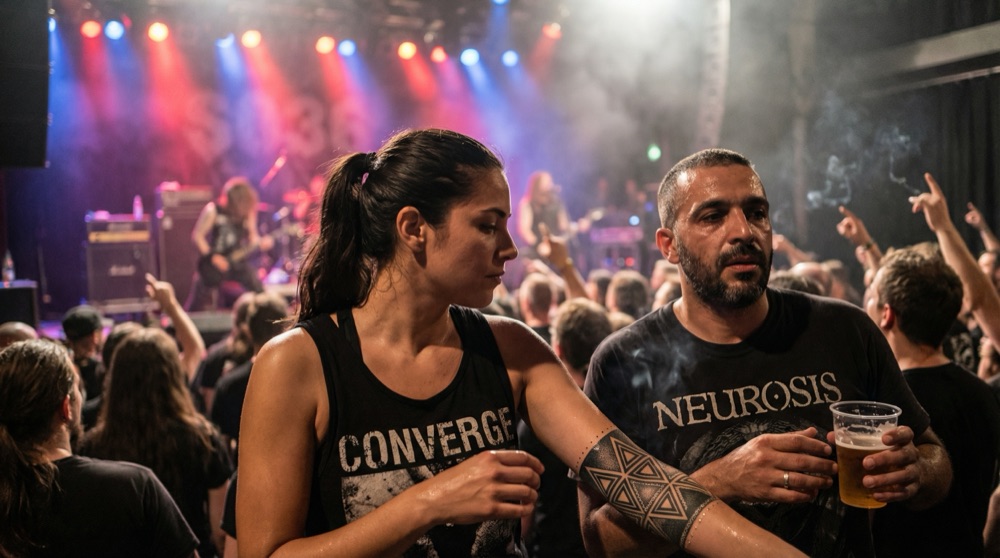
Sunday, 21:34. SO36 in Kreuzberg was packed — Wolves in the Throne Room touring through Berlin. The venue smelled like beer, sweat, and cigarette smoke drifting in from the courtyard. Red stage lights cut through the haze. Bodies pressed together in the darkness, black shirts and raised fists.
Hassan hadn’t planned to come. He’d spent Saturday fixing infrastructure, slept twelve hours straight, woke up Sunday afternoon feeling wired and restless. The kind of exhausted where your body is done but your brain won’t shut up.
So he’d showered, put on his old Neurosis shirt — faded gray, holes in the collar from a decade of wear — and taken the U1 to Kreuzberg.
The opening band finished, feedback screaming through the PA as they unplugged. Hassan was near the back, nursing a Pilsner in a plastic cup, when he spotted Mariana in the crowd. She was near the stage, wearing a Converge tank top and cut-off denim shorts, dark hair pulled back in a ponytail, lost in the music. Sweat glistened on her bare shoulders under the stage lights.
Their eyes met across the room. She grinned, surprised, and threaded her way through the crowd toward him — slipping between bodies, ducking under arms, moving with the easy confidence of someone who’d spent years navigating mosh pits.
“You like metal?” she shouted over the noise, close enough that he could smell her shampoo mixed with sweat.
“Used to tour with a doom band in uni,” Hassan said, leaning in so she could hear. “You?”
“Brazilian hardcore scene,” Mariana said. “Grew up on Sepultura and Ratos de Porão.”
The headliner started. The first note hit like a physical force — a wall of distortion so thick it made Hassan’s chest vibrate. The crowd surged forward. Drums thundered, slow and crushing, each hit resonating in the floor beneath their feet. The vocalist’s screams tore through the mix, raw and primal.
Stage lights strobed white, then plunged into darkness. Green fog rolled across the stage. The guitarists stood motionless, heads down, hair hanging over their faces, letting the feedback build and build until it became unbearable — then dropped into a riff so heavy it felt like the floor might collapse.
Hassan and Mariana didn’t try to talk — just stood together, shoulders touching, letting the music drown out everything else. The pipeline. The crisis. The fucking exhaustion. Around them, bodies moved in slow, deliberate headbanging, a synchronized pulse of motion. Someone’s elbow caught Hassan’s ribs. He didn’t care. The air was thick, humid with breath and sweat. His ears would ring for days.
After the show they ended up at a dive bar near Kottbusser Tor. The place had no name on the door, just a faded neon sign showing a beer mug. Inside: sticky floors that grabbed at their shoes, cheap beer in smudged glasses, a bartender with bleached hair and sleeve tattoos who looked like she’d seen everything twice. The walls were covered in band stickers and graffiti — layers upon layers, a decade of punk and metal history compressed into peeling paper.
They grabbed a table in the back, tucked into a corner booth with cracked vinyl seats. The air smelled like stale beer and disinfectant. A speaker overhead played Motörhead at low volume.
“So,” Mariana said, third beer in, leaning back against the booth. Sweat had dried on her skin, leaving salt streaks down her neck. “You always work until you collapse, or is that a new thing?”
Hassan laughed. “New. Started maybe six months ago when I realized nobody else was going to fix the infrastructure.”
“That’s fucked up,” Mariana said flatly. She traced a finger through the condensation ring her glass left on the scarred wooden table.
“Yeah.” Hassan traced condensation on his glass. “It is.”
They talked about music. About Brazil and Egypt. About how they’d both ended up in Berlin tech. Hassan mentioned his family was back in Cairo. He’d come to Berlin alone. Mariana mentioned her last relationship had imploded over her refusing to quit coding to “focus on family.”
“Fuck that noise,” Hassan said.
“Exactly,” Mariana said. She smiled — not polite, genuinely amused.
2:17 AM. The bar was closing. Fluorescent lights came on, harsh and unforgiving, revealing the full extent of the grime. They were standing outside on Kottbusser Strasse, slightly drunk, wired, the night still warm. The air smelled like kebab grease from the late-night shops and something vaguely chemical from the canal. A night bus hissed past, nearly empty.
Mariana looked at Hassan. Streetlight caught in her eyes. Her tank top was damp with sweat, clinging to her skin. She was close enough that he could see the small scar above her left eyebrow.
“Want to get out of here?” Mariana asked. Direct. No game.
Hassan looked at her. Adult decision. No performance. Just honest interest. His pulse quickened.
“Yeah,” he said.
They took the U8 to Kreuzberg. The train car was mostly empty — a couple of drunk students, a woman in scrubs heading home from a night shift, someone sleeping against the window. Fluorescent lights flickered. The doors chimed at each stop. Mariana’s flat in Neukölln would’ve been closer, but Hassan’s place was a ten-minute walk from Schönleinstrasse.
They walked through empty streets, past closed döner shops and dark storefronts. Their footsteps echoed off the buildings. Somewhere nearby, glass shattered — laughter, then silence.
Small apartment, third floor walkup. Narrow stairwell, walls painted institutional beige, the smell of someone’s dinner still lingering. Hassan unlocked the door. “It’s a mess.”
“Don’t care,” Mariana said.
Inside: a studio apartment, maybe thirty square meters. Unmade bed against one wall, couch piled with laundry, desk covered in cables and hardware. Books stacked everywhere — technical manuals mixed with sci-fi paperbacks. The window was open, curtain fluttering in the night breeze.
They fucked on his couch — urgent at first, fumbling with clothes, her shorts hitting the floor, his belt buckle clanging against the frame. Then slower. Good sex. Stress relief and genuine attraction. Her nails dug into his shoulders. He tasted salt on her neck. The couch springs creaked. Outside, someone’s car alarm went off, then stopped.
They moved to the bed. Sheets tangled around their legs. Sweat cooled on their skin. The city hummed beyond the window — traffic on the distant autobahn, a siren fading into the distance.
No complications, no performance, just two exhausted adults choosing this.
Afterward, they lay in the dark, windows open to let in the night air. A breeze carried the scent of linden trees from the street below. Mariana’s breathing slowed, deepened. Hassan stared at the ceiling, feeling his muscles finally, finally relax.
“This was —” Hassan started.
“Casual,” Mariana finished. “We’re adults. This doesn’t have to be complicated.”
“Good,” Hassan said. “Because work is complicated enough.”
She laughed. “No fucking kidding.”
They fell asleep around 04:00.
The Morning After
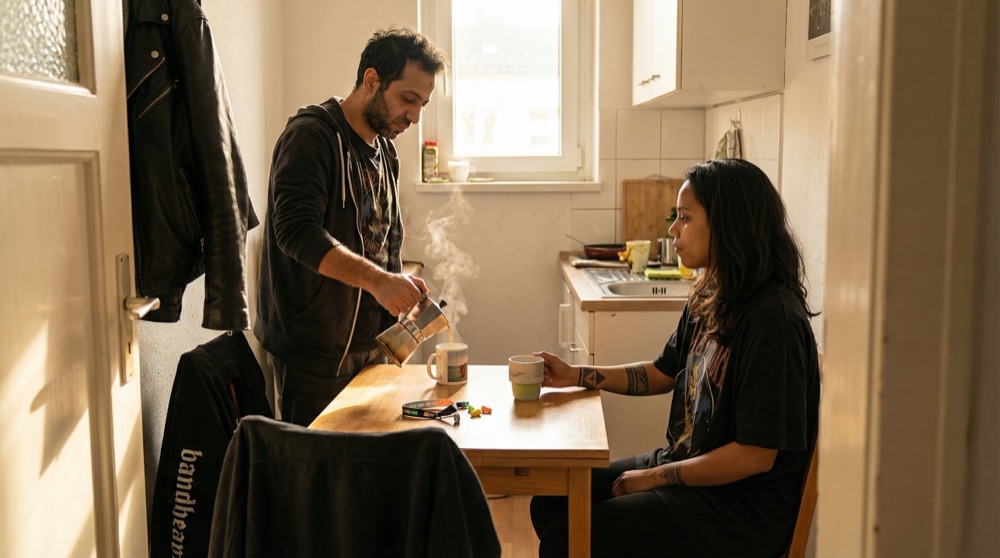
Monday morning, 09:47. Mariana woke to sunlight and the smell of coffee. Hassan was in the kitchen, making espresso in a moka pot.
“Morning,” he said. “Coffee?”
“Please,” Mariana said, pulling on her shirt from last night.
They sat at his small kitchen table, drinking coffee, comfortable. No awkwardness. No regret.
“So,” Hassan said. “We good?”
“Yeah,” Mariana said. “We’re good. This was fun. Doesn’t have to be more than that.”
“Cool,” Hassan said.
“Cool,” Mariana echoed.
She finished her coffee around 10:30 and headed home to shower before work.
Monday at the office, they saw each other in the kitchen around 11:00. Slight smile. Back to work.
Adults. Casual. No drama.
Navigator logged nothing about it — because it wasn’t work, and some things stay private.
The Monday Synthesis
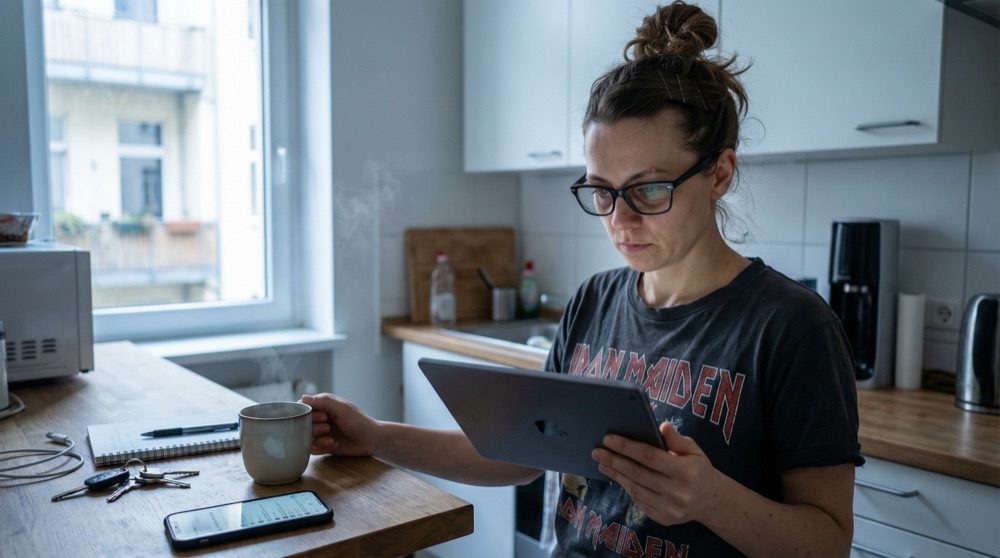
Monday, 08:12. Katja’s phone buzzed with the Navigator weekly synthesis notification. March 12-18, 2026. She poured coffee and opened it on her iPad.
The adoption numbers had grown: 14 people logging consistently. Three department heads (Katja, Elif, Priya). Two development leads (Tomasz, Mariana). Hassan. Seven individual contributors who’d quietly started logging after Mariana’s invitation.
The Observed Actions section hit her immediately:
Infrastructure dependency patterns: Hassan Al-Rashid mentioned in entries from nine different individuals across four departments. Common contexts: deployment access requests, environment configuration needs, pipeline troubleshooting, infrastructure support.
Friday crisis response: Multiple entries describe payment processing outage March 14. Hassan logged solo resolution effort lasting past midnight. Mariana’s weekend entries describe discovering six months of unmaintained CI infrastructure, stating: “Every deployment dependent on Hassan’s knowledge. Every hotfix revealing more debt.”
Individual contributor adoption: Seven developers not officially mandated to use Navigator began logging this week. Entries describe blockers consistent with department lead observations: unclear requirements, infrastructure dependencies, waiting for decisions.
Katja scrolled to Recommendations:
• Immediate infrastructure backup: Pair Mariana with Hassan on all infrastructure work. Document tribal knowledge. Cross-train at minimum one additional developer on DevOps responsibilities.
• Infrastructure maintenance sprint: Allocate dedicated time to address accumulated technical debt in CI/CD pipeline. Friday’s crisis exposed systemic fragility.
• Expand Navigator adoption organization-wide: Individual contributors are self-organizing to adopt Navigator without mandate. Patterns from their logs align with leadership observations, providing ground-truth validation.
The Conclusions section made her stomach tighten:
The Hassan Al-Rashid single point of failure is not a perception problem — it’s a documented organizational reality. Nine different people blocked by infrastructure dependencies in a single week. Friday’s payment crisis resolved by solo effort lasting past midnight because one person possesses the knowledge to fix the pipeline.
This pattern is unsustainable and high-risk. If Hassan leaves, becomes unavailable, or burns out, the organization loses deployment capability entirely.
Weekend recovery effort (Hassan + Mariana) suggests viable path: knowledge transfer through documentation and pairing. But this requires protected time and organizational commitment to infrastructure investment.
Katja sat in silence, coffee cooling in her hand.
She’d known Hassan was overloaded. Everyone knew. But “overloaded” was abstract. This was evidence. Nine people. One week. A Friday night crisis that nearly cost them €50K in revenue.
And Hassan’s log entry from 01:37 Friday night: Team thinks this is heroic. It’s not. It’s a single point of failure waiting to explode.
She opened Slack and created a new channel: #infrastructure-recovery. Added Hassan, Mariana, Tomasz.
Katja Müller Read the synthesis. We're allocating a full sprint to infrastructure work. Hassan, you're not doing this alone anymore. Mariana's pairing with you full-time. Tomasz, cancel Hassan's participation in the next three interviews. He's got more important shit to do.
Hassan Al-Rashid Seriously?
Katja Müller Seriously. The synthesis doesn't lie. You're mentioned as a blocker in nine different logs. That's not a you problem. That's an us problem. We fix it properly, starting today.
Hassan stared at his phone. Tomasz sent a private DM:
Tomasz Kowalski You good?
Hassan Al-Rashid Yeah. Just ... didn't expect anyone to notice. Thought I was just taking Ls forever.
Tomasz Kowalski We noticed. We just couldn't see the full picture until the data showed us. You've been carrying this whole thing and nobody saw it.
The Pattern Becomes Visible
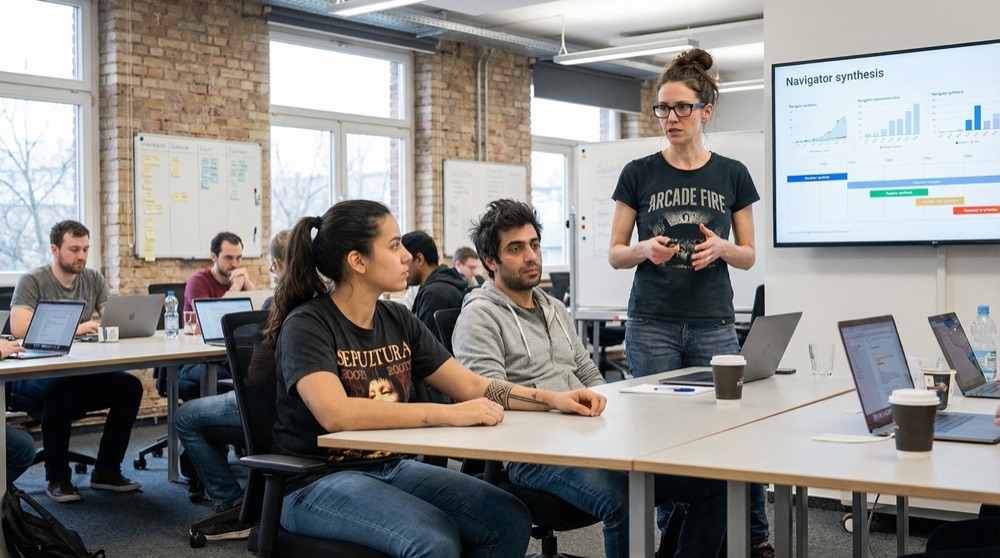
Monday, 15:00. The development all-hands meeting. Normally these were status theater — everyone reporting “on track” while reality burned around them. Today felt different.
Katja projected the Navigator synthesis summary on the screen. Not the full report — just the clearest recurring themes and the Hassan-as-blocker pattern.
“This is what’s happening,” she said. “Nine people blocked by infrastructure dependencies in one week. Hassan working solo until past midnight on Friday to fix a crisis caused by six months of deferred maintenance.”
Lars Pedersen wasn’t at this meeting — it was development-only. But Carmen Vega was there as art director, since her team interfaced with development constantly. She leaned forward. “So what changes?”
“Three things,” Katja said. “One: Hassan and Mariana are doing infrastructure recovery for the next two weeks. Full-time. No interruptions for other requests. Two: We’re documenting every piece of tribal knowledge Hassan’s been carrying. Three: Anyone who wants to learn infrastructure work can pair with them. We’re building redundancy.”
Anton Petrov raised his hand. “What about the feature work for next sprint?”
“Delayed,” Tomasz said. “Infrastructure comes first. We can’t keep building on a foundation held together by Hassan’s after-hours heroics.”
Silence. Then Sofia, one of the junior developers who’d started logging after Mariana’s invitation, spoke up: “Can we keep using Navigator? Even though we’re not department leads?”
Katja looked surprised. “You’re already using it?”
“Mariana invited Rafael and me last week,” Sofia said. “It’s … helpful. Writing down what happened makes the patterns visible. I logged about waiting for environment access three days in a row. Seeing it written down made me realize it wasn’t just bad luck — it’s a systemic issue.”
“Keep using it,” Katja said. “In fact, I’m opening Navigator adoption to anyone who wants to log. No mandate. But if you’re experiencing blockers, dependencies, or patterns that leadership can’t see — write them down. The synthesis will surface them.”
Mariana glanced at Hassan. He was staring at the synthesis on the screen, the line about him being mentioned in nine different logs. His expression was unreadable.
After the meeting, Mariana found him at his desk. “You good?”
Hassan exhaled slowly. “I spent six months thinking I was the problem. Like I wasn’t fast enough, wasn’t good enough, should be able to handle all of this. The synthesis showed me I wasn’t failing — the system was.”
“The system was failing,” Mariana said. “Past tense. We’re fixing it now.”
Hassan nodded. “Yeah. We are.”
He opened Navigator and logged:
March 17, 2026 — Monday
Synthesis showed I was mentioned as blocker in nine different logs. Nine people. One week.
Leadership response: infrastructure recovery sprint. Mariana pairing full-time. No more solo crisis response.
First time in six months someone acknowledged this isn’t sustainable. First time I’m not carrying it alone.
Signal through noise works both ways — it showed them the problem, and it showed me I wasn’t imagining it.
🎭 This Week's Episodes
Telenovelas show what we can't say in client meetings. The drama is heightened, but the patterns are real.
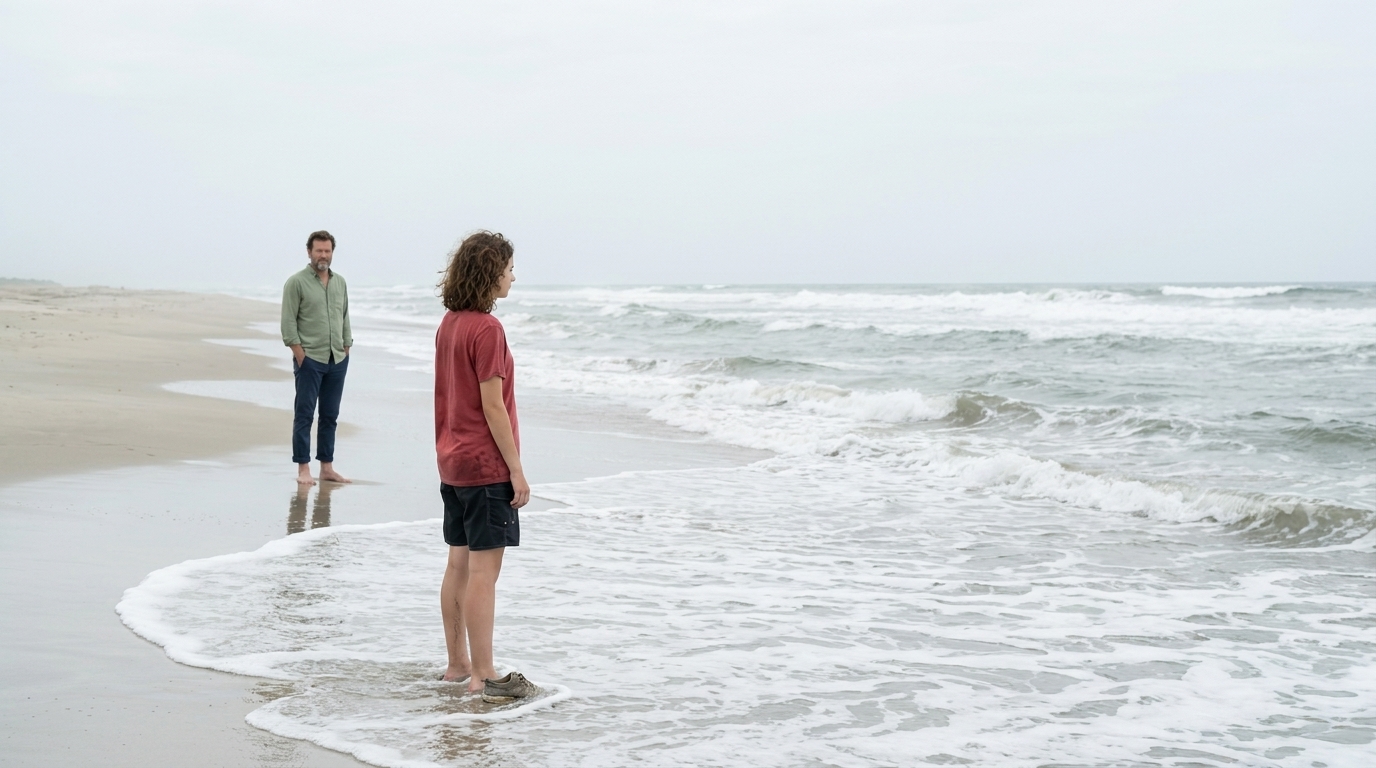 Three Ways to Understand a Country
Stefan drives Sophie to the Pacific for two days. The beach is big enough to make her feel appropriately small. Back at the finca the rain keeps th...
 The Resignations
Nathan Cole resigns on a Monday morning with two sentences and no argument left in his body. By Tuesday his desk is empty and the company's institu...
Technical Consultancy
Embedded Delivery Partner
Embedded into your team as an active contributor, reducing delivery friction and helping important work move cleanly.
Technical Advisor
Peer-style technical assessments before far-reaching decisions; reduce architectural and product risk early.
Product & Delivery
Ship working software to real users earlier. Measure impact and adapt based on evidence rather than assumption.
Custom Software Development
High quality, maintainable software. Short-term augmentation that leaves lasting capability in your own team.
Recent Articles
- When Everything Is Finally Under Control (28.09.2026)
- AI Makes Technical Execution Cheap. Judgment Stays Scarce. (24.09.2026)
- The LLM Will Not Come Back Tomorrow (19.09.2026)
- The One-Person AI Company Is a Greed Fantasy (15.09.2026)
- Test Production Without Leaving a Mess (10.09.2026)