Primera Sangre
Stefan Richter arrives at NexoDigital without fanfare — just a German in jeans asking to see code, not org charts. Meanwhile, Natalia Vásquez makes her move on Tomás, the lonely developer with production access. By nightfall, Stefan has diagnosed the real problem: there's nothing wrong with the engineering. The attack is pure theater.
The Phoenix Lifts

Gimnasio Fitness, Laureles. 5:47 AM.
The barbell bends slightly under the weight. Seventy-three kilograms. Not much for a powerlifter, but Salomé Ruiz is 168 centimeters and fifty-nine kilos soaking wet. This is heavy. This is pushing limits.
She breathes in. Tightens her core. Descends into the squat.
The phoenix tattoo on her shoulder blade seems to spread its wings as her muscles engage. Geometric patterns on her forearm catch the gym’s fluorescent light. Sports bra and shorts — not for attention, just practicality. Sweat already glistening on bronze skin.
Down. Hold. Drive.
Up.
She racks the weight. Logs it in her phone: 3x8 @ 73kg. PR. Personal record. She doesn’t need anyone to validate it. The numbers don’t lie.
Two guys approach. Brothers, maybe. Both in tank tops showing off arms that photograph better than they lift.
“Hey mamacita,” the taller one says, leaning against her squat rack. “Need a spotter?”

Salomé racks the bar, breathes steady. Turns to face them with a polite smile that has an edge they should recognize but won’t.
“Gracias parcero, but I’m good on my own.”
“Come on, hermosa. A girl like you shouldn’t be lifting so heavy. You’ll hurt yourself.”
Her smile doesn’t waver. “I appreciate the concern, parce. But I’ve been doing this for five years. I know my limits.”
The shorter one tries again. “We could grab breakfast after? There’s a place down the street that makes amazing calentado.”
“That’s sweet. But I have to get to work.” She turns back to the bar, adds more weight for her next set. The conversation is over.
They finally leave. She finishes her workout. Showers. Rides her motorcycle through Medellín’s morning traffic with wet hair whipping behind her.
By 8:30 AM, she’s at her desk, code already open on dual monitors, still carrying the endorphins from deadlifts that make her feel invincible.
That’s when Natalia Vásquez walks in.
And Salomé knows — the way you know a predator when you see one — that this woman is dangerous.
The Huntress Enters

NexoDigital offices. 8:47 AM.
Natalia Vásquez walks through the engineering floor like she owns it.
The morning light catches the gold necklace at her neckline. Her burgundy dress is fitted — professional enough to pass HR scrutiny, but tailored to follow every curve with precision. The neckline dips just enough to be noticed. The hem hits just above the knee, showing toned calves. Designer heels click against the floor with the rhythm of a metronome counting down to something.
Every male head turns. She counts them without appearing to look. Fourteen. Fifteen. The one in the corner with the band t-shirt — he actually drops his coffee cup. She files him away: nervous, young, probably important. The ones who drop things are always the ones with access to things.
“Buenos días,” she says warmly as she passes desks, making eye contact, remembering names from yesterday’s introductions. Every smile calculated. Every glance measured.
Smiles. Nods. The women watch her with narrowed eyes. The men watch her with something else entirely.
In the break room doorway, Salomé Ruiz leans against the frame, paper coffee cup in hand, phoenix tattoo catching the light on her arm. She doesn’t turn to watch Natalia. She’s seen weapons before.
Instead, she watches the reactions. Tomás Herrera is bright red, pretending to focus on his screen while his eyes flick sideways every three seconds. Pipe Gómez — older, wiser — has the look of a man who’s seen this play before and knows how it ends.
Salomé takes a sip of her coffee. The question isn’t whether she’ll make a move. The question is who she’ll target. And whether the poor bastard will see it coming.
Her phone buzzes. Unknown number again.
Unknown Watch the young one. The nervous one with production access.
Unknown That's who she'll come for.
Salomé looks across the room at Tomás. Then back at Natalia, who is already gravitating toward his section like a shark that smelled blood three floors away.
Yeah, she thinks. I figured. Poor dumb kid doesn’t stand a chance.
The Other Arrival

NexoDigital lobby. 9:15 AM.
The German doesn’t look like a consultant.
No suit. No slide deck. No wireless earpiece connecting him to handlers in some distant war room. Just dark jeans, a charcoal button-down with the sleeves rolled up, and a leather messenger bag that looks like it’s actually been used.
Carmen Torres meets him at the reception desk. They don’t hug — too risky if anyone’s watching — but her eyes say everything.
“Stefan. Thank God.”
“Carmen.” He takes in the lobby: glass walls, motivational posters, the faint hum of fear that no amount of interior design can mask. “Show me where they work.”
“Don’t you want to see the— “
“No org charts. No strategy decks. No stakeholder maps.” He adjusts his bag. “I want to see where the code gets written.”
She almost smiles. Almost. “Follow me.”
They take the elevator to the seventh floor. Stefan watches the numbers climb in silence. When the doors open, he steps onto the engineering floor and stops.
Forty-seven desks. Forty-seven developers. Some are coding. Most are pretending to. The fear is palpable — you can taste it in the recycled air.
And at the center of it all, Natalia Vásquez is laughing at something Tomás Herrera just said, her hand resting on his arm just a moment too long.
Stefan watches. Takes mental notes. Says nothing.
“That’s— “ Carmen starts.
“I know who she is.” His voice is flat. “Show me the codebase.”
The First Approach

Engineering floor. 11:23 AM.
Stefan has been reading code for two hours.
Not skimming. Not running static analysis tools. Reading. Like someone who actually understands what he’s looking at.
The developers don’t know what to make of him. He’s asked three people to explain their modules. He’s taken notes in a paper notebook — the kind that can’t be hacked. He hasn’t mentioned AI once.
Salomé watches from three desks away. She’s been tracking him since he arrived, cross-referencing his behavior against every consultant she’s ever seen. None of them did this. None of them cared about the code.
Finally, she stands. Walks over. Sets a cup of coffee on his desk.

“Tinto,” she says. “It’s not good coffee, but it’s Colombian coffee. Matters more.”
Stefan looks up. Blue-gray eyes that have seen everything and are still curious. “Thank you.” He takes a sip. Doesn’t wince at the bitterness. “You’re the one analyzing their code samples.”
Not a question.
Salomé’s eyebrows rise. “How did you—”
“Carmen told me. Said you stayed late last night running static analysis on QuantumMind’s public case studies.” He sets down the cup. “Found something interesting?”
“Yeah.” She sits on the edge of his desk without being invited. “Their ‘AI-generated’ samples are too clean. Real AI output has tells — repetitive patterns, awkward naming, missing edge cases. These samples have none of that. They’re too human.”
“Which means?”
“Which means they’re not AI-generated. They’re showcasing human-written code and calling it AI output to sell the lie.”
Stefan is smiling. It’s a small smile, almost hidden in his beard, but it’s real. “You’ve been doing forensics.”
“I’ve been paying attention.” She pulls out her paper notebook — the one that matches his. Pages of research. Company names. Timelines. Code analysis results. “You’re not like the other consultants. You actually look at the code.”
“The code is where the truth lives.” He taps her notebook. “Keep building this. Everything you find, document it. Dates, sources, analysis results. Make it impossible to deny.”
“Why? What are we going to do with it?”
“I don’t know yet.” He leans back. “But evidence is like ammunition. Better to have it and not need it than need it and not have it.”
Salomé nods. Stands. Pauses.
“The book on my desk,” she says. “The one about software craft. You wrote it.”
“I contributed to it.”
“The ideas feel like water in a desert.”
Something flickers in his eyes. Something that might be recognition. “Keep reading. Keep building. Keep noticing.”
She turns to go, then stops. “He’s going to get hurt.”
“Who?”
“Tomás.” She glances toward where Natalia is still orbiting, still laughing, still touching. “He’s never had anyone look at him the way she’s pretending to. He doesn’t know it’s a weapon.”
Stefan follows her gaze. His jaw tightens. “I know.”
“Can you stop it?”
“Not without destroying him in a different way.” He picks up his coffee. “Sometimes you have to let people make their own mistakes. And sometimes you just have to be there when they realize what they’ve done.”
Salomé considers this. It’s not the answer she wanted. But it might be the true one.
“I’ll be there,” she says. “When he falls.”
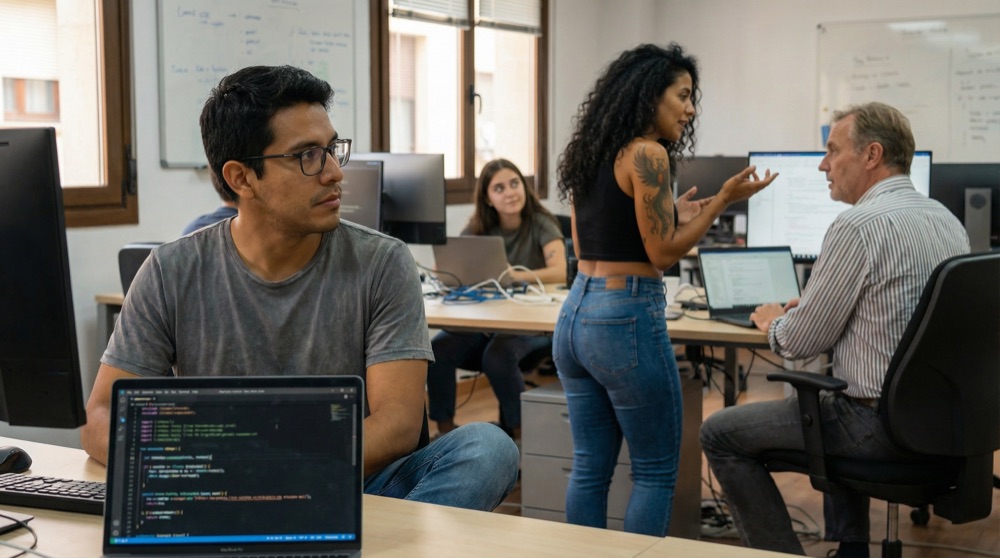
From three desks away, Pipe Gómez watches Salomé walk back to her station. He’s watched her for two years now — the way she moves, the way she thinks, the way she sees through bullshit that everyone else accepts. He’s never said anything. Never will. She’s a force of nature, and he’s just a developer who peaked at thirty-five.
She’ll never look at him the way she looks at code: like it’s worth solving.
When Shoulders Touch

Engineering floor. 1:43 PM.
Diego Reyes and Valentina Cruz share a desk when they’re debugging integration issues. Backend meets frontend. His API calls, her interface rendering. It’s efficient. Professional. Completely reasonable.
Their shoulders are touching.
It’s Medellín. It’s warm. Diego’s in a fitted t-shirt that shows his gym-toned arms. Valentina’s in a sleeveless blouse, her long dark hair falling over one shoulder as she leans in to see the monitor better.
The debugging console shows an error stack trace. Neither of them is reading it.
“Right there,” she says, pointing. Her arm brushes his. “The endpoint is returning null when it should return an empty array.”
“I can fix that.” His voice is lower than it needs to be. Their faces are maybe fifteen centimeters apart.
“You smell like coffee.”
“You smell like… what is that? Vanilla?”
“Body lotion.” She turns her head slightly. Now they’re looking at each other instead of the screen. “My sister makes it. Natural ingredients. I can—”
Camila walks past, loudly clearing her throat. “Conference room 3 in five minutes. Deployment sync.”
They jump apart like teenagers caught kissing.
Valentina laughs, embarrassed. Diego runs a hand through his hair. The error is still on the screen, unsolved, forgotten.
“Tonight?” he asks quietly.
“Your place or mine?”
“I was talking about fixing the bug.”
“Sure you were.”
She walks away. He watches her go, that confident walk that makes her skirt move in ways that short-circuit rational thought.
Across the room, Lucas sees the whole thing and grins.
The Rooftop That Isn’t About Smoking
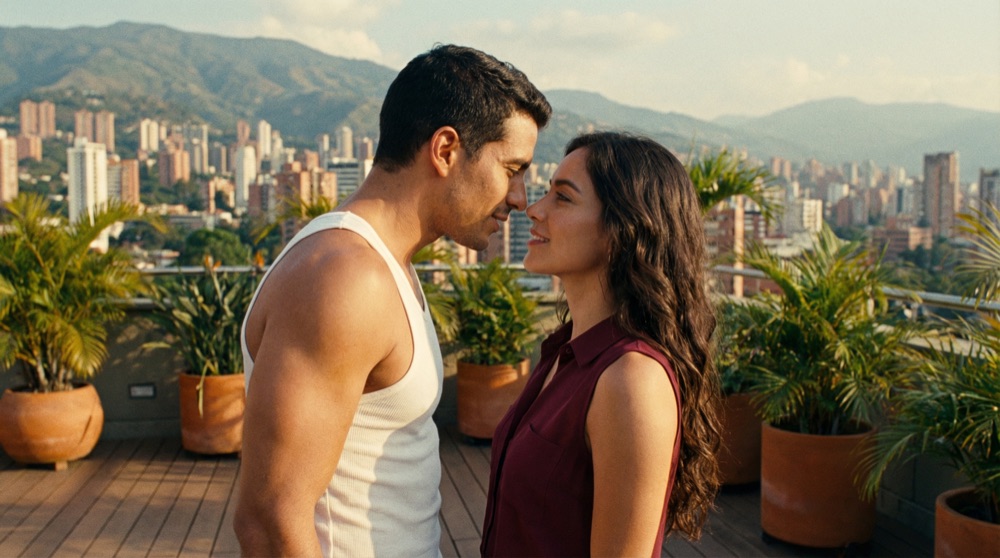
Rooftop terrace. 2:03 PM.
Neither of them smokes.
Lucas Montoya and Isabela Vargas have been taking “smoke breaks” together for three months. Everyone knows. Nobody says anything. The office pretends not to notice when they disappear to the rooftop for twenty minutes and come back looking… different.
Today’s excuse: “Discussing test environments.”
The rooftop terrace overlooks El Poblado, Medellín’s mountains rising green and impossible in the distance. Tropical plants in terracotta pots. Wooden benches. Nobody ever comes up here.
Lucas is in a tank top — he’s always in tank tops, showing off arms built from cycling the city’s hills every weekend. Isabela’s in a sleeveless blouse and skirt that moves when she walks, curves she doesn’t hide because why should she?
They’re standing very close. Supposedly looking at the view.
“The QA pipeline is running slow,” she says. Not looking at the mountains. Looking at him.
“Might be the new integration tests.” Not looking at the view either.
“We could optimize them.”
“We could.”
She steps closer. Her hand finds his. Their fingers interlace like code merging into a single branch.
“We should go back,” he says.
“Yeah. We should.”
Neither of them moves.
His other hand comes up to her face. Tucks a strand of hair behind her ear. She leans into the touch like she’s been waiting for it.
“Lucas—”
“I know.”
“If people find out—”
“They already know.”
“But if they know know—”
He kisses her.
It’s not their first kiss. It won’t be their last. But it’s the first one in daylight, where someone could theoretically see, where the plausible deniability dies.
When they break apart, she’s smiling. “So much for keeping it professional.”
“We’re testing the production environment,” he says. “Very professional.”
“Is that what we’re calling it?”
They stay up there for another ten minutes. When they come back downstairs, Isabela’s lipstick is smudged and Lucas has that look — the one men get when they’ve just kissed someone they actually care about.
Camila sees them and shakes her head, smiling. Salomé gives Isabela a knowing look. Diego elbows Lucas and mouths finally.
The whole floor knows.
Nobody cares.
Medellín is warm. People fall in love. Life goes on.
Even when AI consultants are planning your funeral.
The Coffee Machine

Break room. 2:17 PM.
Tomás Herrera is trying to fix the coffee machine. Again.
Yesterday Natalia brought him coffee from downstairs when it was broken. Today he’s determined to fix it himself — partly because he hates inefficiency, partly because if he fixes it maybe she’ll come back to thank him.
He doesn’t hear her approach. Doesn’t register the click of heels until the scent of expensive perfume wraps around him like a silk noose.
“Still fighting with that machine?”
He jumps. Turns. She’s right there — closer than yesterday, close enough to see the gold flecks in her dark eyes, close enough that his gaze accidentally drops to her neckline before he forces it back up.
“I— yeah. The heating element keeps shorting. I think I almost have it.”
“My hero.” Her voice is warm, teasing. “Fixing broken machines while the world falls apart around us.”
She’s referencing yesterday’s presentation. The AI transformation announcement. The fear rippling through every developer on the floor.
“Someone has to keep things running,” he mutters, turning back to the machine. Safer to look at wiring than at her.
“That’s what I keep telling Marcus.” She leans against the counter beside him. Close. Too close for professional. Not close enough. “These systems need people who understand them. People like you.”
His hands are shaking slightly as he reconnects a wire. “I’m just one person.”
“The most important one.” She reaches past him for a paper towel — her arm brushing his shoulder, lingering just a second longer than necessary. “Everyone says so. ‘Ask Tomás. Tomás built that. Tomás is the only one who knows how it really works.’”
She’s been asking about him. Learning his value. His stomach flips.
“About lunch—” she says.
“Noon. Right. I remember.” He’s been thinking about it since yesterday. Couldn’t sleep last night replaying the conversation, wondering if he imagined the way she touched his arm.
“I was thinking…” She tilts her head, watching him work. “Instead of the cafeteria, maybe somewhere quieter? There’s a place in Laureles. Great bandeja paisa. We could actually talk. No interruptions.”
Alone. She wants to be alone with him. Outside the office.
“That— yeah. That sounds good.”
“Perfect.” She touches his arm — the same spot as yesterday, like she’s marking him. “I really want to understand the architecture. The decisions you made. Why you built it the way you did.”
She wants to understand his work. She sees him.
The coffee machine suddenly gurgles to life. Steam hisses. The heating element glows red.
“You did it!” She claps, genuinely delighted. Or performing delight so perfectly he can’t tell the difference.
“It’ll probably break again next week.”
“Then I guess you’ll have to fix it again.” She smiles. “My persistent hero.”
She walks away. He watches her go, heart pounding, the ghost of her touch still burning on his arm.
This is real, he thinks. She actually sees me. She wants to know how I think.
He has no idea she’s already cataloging his access levels. Planning her approach. Building a dossier.
From the doorway, Pipe Gómez has been watching. Day two and the kid’s already deeper. Yesterday it was coffee and smiles. Today it’s lunch off-site, private conversations, deliberate touches.
He pulls out his phone.
pipe_gomez: @carmen_torres It's getting worse. She's taking him to lunch tomorrow. Off-site.
carmen_torres: I know. Stefan noticed too.
pipe_gomez: What do we do?
carmen_torres: For now? Watch. Document. Be ready.
pipe_gomez: That's not a plan. That's waiting for a car crash.
carmen_torres: I know. Believe me, I know. But we can't warn him without proof. He won't listen. Men never do when a beautiful woman is involved.
pipe_gomez: *Mierda.* This is going to end badly.
carmen_torres: Yes. The question is how badly. And whether we can limit the damage.
pipe_gomez: When does it end?
carmen_torres: It already has. We just don't know how badly yet.
First Contact

Conference room 7B. 4:30 PM.
Marcus Delacroix has been in this room for twenty minutes, and Stefan has let him talk for nineteen of them.
“…and the transformation is really about empowerment,” Marcus is saying, his hands making TED Talk gestures that probably cost ten thousand dollars to learn. “We’re not replacing your engineers. We’re augmenting them. Giving them superpowers.”
“Mmm.” Stefan makes a note in his paper notebook. Or appears to. He’s actually drawing a small diagram of the power dynamics in the room: Marcus taking up space like a gas expanding to fill its container, Natalia standing like a beautiful tool being presented — perfectly still, waiting for the call to action. There’s something in her stillness that suggests pleasure, like a blade enjoying the weight of the hand that wields it.
“You must have seen our results from the Blackrock implementation. 340% productivity increase in the first quarter.”
“I’ve seen the press release.”
Marcus’s smile doesn’t waver. “And? Impressive, wouldn’t you say?”
“I’d say press releases are written by marketing departments. Usually by people who’ve never touched a compiler.”
The words land like a slap. The temperature in the room drops three degrees. Aurelio looks up for the first time, a ghost of a smile crossing his face.
Marcus recalibrates. His smile becomes more genuine — or at least, more convincingly calculated. “You’re Stefan Richter. The Developer Advocate. Carmen mentioned she’d brought in a consultant.”
“I’m not a consultant.”
“No? Then what are you?”
Stefan looks up from his notebook. Meets Marcus’s eyes. “I help people see what’s real.”
“How poetic.” Marcus leans back, crosses his legs. “And what do you see here?”
“A solid codebase. Good deployment frequency. Reasonable test coverage. A team that knows what they’re doing.”
“Is that your professional assessment?”
“It’s what the code says.”
Marcus gestures toward Natalia without looking at her. “Natalia has been instrumental in our client integration process. I’ve deployed her to seven organizations now. Each time, she adapts perfectly to the technical landscape. Learns the systems. Identifies the pressure points.” He pauses, admiring his own phrasing. “She’s exceptionally responsive to direction. Extremely reliable. I can place her anywhere and trust she’ll deliver exactly what I need.”
Natalia doesn’t move. Doesn’t speak. Her eyes remain fixed on Stefan, unblinking. Professional. Still.
“She has a particular gift for building relationships with key technical personnel,” Marcus continues, as if discussing a piece of equipment he’s proud of. “Finding the individuals who hold critical access. Understanding their vulnerabilities. She’s very thorough in her research. Very precise in her execution.”
Stefan meets Natalia’s eyes. Sees nothing there. No embarrassment. No reaction at all.
“You’ve trained her well,” Stefan says quietly.
Marcus smiles. “I don’t train people, Mr. Richter. I find people who already know what they want to be. Natalia knows exactly what she is. Don’t you, Natalia?”
“Yes.” Her first word of the entire meeting. Spoken without shifting her gaze from Stefan. “I do.”
Marcus’s smile widens fractionally. Satisfaction at her obedience, displayed like a trainer showing off a prize animal.
“The code.” Marcus laughs. It’s the laugh of someone who has never written code. “The code is just text. The question is whether that text is being produced efficiently. Whether human hours are being optimized. Whether this company is prepared for a future where AI can generate in seconds what takes your engineers days.”
Stefan writes something in his notebook. This time he’s actually taking notes.
“You don’t agree?” Marcus prompts.
“I think there’s a difference between generating text and building systems.”
“A difference that shrinks every day.”
“A difference that matters every day.” Stefan closes his notebook. Stands. “Thank you for your time. I’ve learned what I needed to learn.”
Marcus blinks. People don’t walk out of his meetings. “We’re not finished.”
“I am.” Stefan heads for the door. “I’ll have my assessment ready by end of week.”
He leaves. The door closes softly behind him.
Silence. Then Marcus stands, begins gathering his materials. Natalia moves immediately — not asked, not commanded — collecting his tablet, his presentation remote, organizing his leather portfolio with practiced efficiency. A perfectly calibrated assistant anticipating every need.
“That arrogant German prick,” Marcus mutters, more to himself than to her.
“He saw you,” Natalia says quietly, handing him the portfolio. “Most people don’t.”
Marcus takes it. Looks at her. “Do you think he saw you?”
“Yes.”
“And?”
“I don’t care what he sees.” Her hand brushes his chest — an intimate gesture, possessive, claiming. “I know what I am.”
“Good girl.” His hand slides down her back, slow and deliberate, then grabs her ass firmly. Ownership. They’re alone now. No performance necessary.
Her breath catches. Heat floods her body — not embarrassment, arousal. Being claimed like this, reduced to his possession in the empty conference room where she just stood silent as his displayed weapon, makes her wet. She wants his hand to slide higher, under her dress. Wants him to bend her over the conference table. Wants to prove she’s his. But he just holds her there, grip firm, eyes assessing. Making her wait. Making her want.
Then he releases her. Steps back. Adjusts his cuffs like nothing happened.
She steadies herself, legs shaking slightly. Still eager. Still ready. Waiting for the next command that won’t come until later, in the hotel room where she’ll show him exactly how much being his instrument turns her on.
The Diagnosis

Carmen’s office. 9:47 PM.
The building is quiet. Most of the team has gone home. The cleaning staff moves through the halls like ghosts.
Three people sit in Carmen’s office. Not because they were ordered. Not because someone owns them or commands them. Because they choose to be here.
Carmen pours coffee from a French press she keeps hidden in her desk. Offers the first cup to Salomé, who stayed late without being asked — stayed because she wants to understand, wants to help, wants to fight alongside them. The young developer takes the cup with both hands, her phoenix tattoo visible on her shoulder, curly hair pulled back in a messy knot. She’s beautiful — heads turn when she walks through the office, men stammer when she asks them questions — and she knows it. But she doesn’t weaponize it. Doesn’t use it. She’s here for the code, for the truth, for the people she cares about.
Stefan takes the second cup with a nod of thanks. Carmen pours the third for herself.
“Tell me,” Carmen says. An invitation. Not a command.
Stefan opens his laptop willingly, scrolls through notes he chose to take. “I’ve spent twelve hours reviewing your systems. Talked to eight developers. Read through six months of commit history.”
“And?”
“Your architecture is solid. Better than solid — it’s thoughtful. Whoever designed the core modules understood separation of concerns. Your deployment pipeline ships to production twice a week without drama. Your test coverage is at 73%, which isn’t perfect but is better than most companies I’ve seen.” He closes the laptop. Meets her eyes honestly. “There’s nothing wrong with your engineering.”
Carmen stares at him. “Then why are they doing this?”
“Because fear is cheaper than understanding.”
Salomé, curled in a chair by the window, speaks quietly. Not because she’s been silenced. Not because she needs permission. Because she’s thinking, processing, contributing when she has something to say. “They’re selling panic, not solutions.”
Stefan looks at her. That small, hidden smile again. Recognition between equals. “Exactly.”
Carmen leans forward. “I don’t understand. If there’s nothing wrong—”
“There doesn’t have to be anything wrong.” Stefan stands — not to dominate the room, but because he thinks better on his feet. Walks to the window. “Marcus doesn’t need a real problem. He needs executives who are afraid of a real problem. AI is the perfect fear. It’s new. It’s fast. It’s everywhere in the headlines. And most executives don’t understand it well enough to know when they’re being lied to.”
“So he convinces them we’re falling behind—”
“And they pay QuantumMind millions to ‘catch up.’ By the time anyone realizes the AI transformation was smoke and mirrors, Marcus has moved on to the next company.”
“But the layoffs are real.”
“The layoffs are always real.” Stefan’s voice hardens. There’s old anger there — scars from battles fought and lost. “That’s the goddamn tragedy. The fear is manufactured. The solution is theater. But the people who lose their jobs — they’re real. Their mortgages are real. Their children’s school fees are real. Their marriages that fall apart when the money stops — real. The guy who drinks himself to death because he’s fifty-three and no one will hire him — real.”
The room is silent. Salomé is writing in her notebook again — her choice, her initiative, documenting what matters because she cares.
Carmen takes off her reading glasses. Rubs her eyes. Speaks her fear openly because this room is safe. “What do we do?”
“First, we document. Everything. Every meeting, every claim, every code sample they present as ‘AI-generated.’ Salomé’s already started.” He nods at her notebook with respect, colleague to colleague. “We build a case that’s impossible to dismiss.”
Salomé looks up, speaks freely. “I can set up a private git repo. Track every interaction. Timestamps. Screenshots. Evidence they can’t erase.”
“Perfect.” Stefan’s approval is genuine. “And then?”
Carmen: “Then what?”
“Then we wait for Marcus to make a mistake.” Stefan turns from the window. “He will. They always do. People who sell fear eventually get sloppy, because they stop believing anyone can see through them.”
“What kind of mistake?”
“The kind that ends careers.” His eyes are hard now. “I’ve been here before. In Frankfurt. In São Paulo. I know how this story goes.”
“Does it have a happy ending?”
Stefan is quiet for a long moment. Then: “Sometimes.”
He doesn’t mention São Paulo again. Doesn’t mention the photo on his laptop — the team he couldn’t save. Some wounds don’t need to be opened.
“I should go,” Salomé says, standing. Not dismissed. Not released. Choosing to leave because Aurelio needs someone. “Aurelio is probably still in his office. He forgets to eat when he’s stressed.”
Carmen nods. “Tell him… tell him we’re working on it.”
Salomé gathers her things — her notebook, her laptop, her worn backpack with band patches. She pauses at the door, looks back at both of them. “Thank you. For letting me be part of this.”
Stefan and Carmen exchange a glance. They didn’t “let” her. She chose. That’s the difference.
“We’re grateful you’re here,” Carmen says simply. Honest. Open.
Salomé smiles — warm, genuine, the smile that makes people think she’s flirting when she’s just being kind. “Goodnight.”
The door closes softly.
Three very different people. A German developer advocate with scars from past failures. A Colombian CTO carrying the weight of forty-seven families. A young developer with a phoenix tattoo and a fierce heart. Working together not because they’re owned or commanded or manipulated.
Because they choose to. Because it matters. Because they care.
The contrast with the room Marcus and Natalia just left couldn’t be starker.
“I will.” Salomé pauses at the door. “Stefan?”
“Yes?”
“What you said. About the difference between generating text and building systems.”
“What about it?”
“I’m going to remember that.” She looks at him with something that might be admiration. Might be something else. “It matters.”
She’s gone before he can respond.
Carmen watches the door close. “She’s something, that one.”
“She’s the future,” Stefan says quietly. “If we can keep the present from crushing her first.”
The Ghost
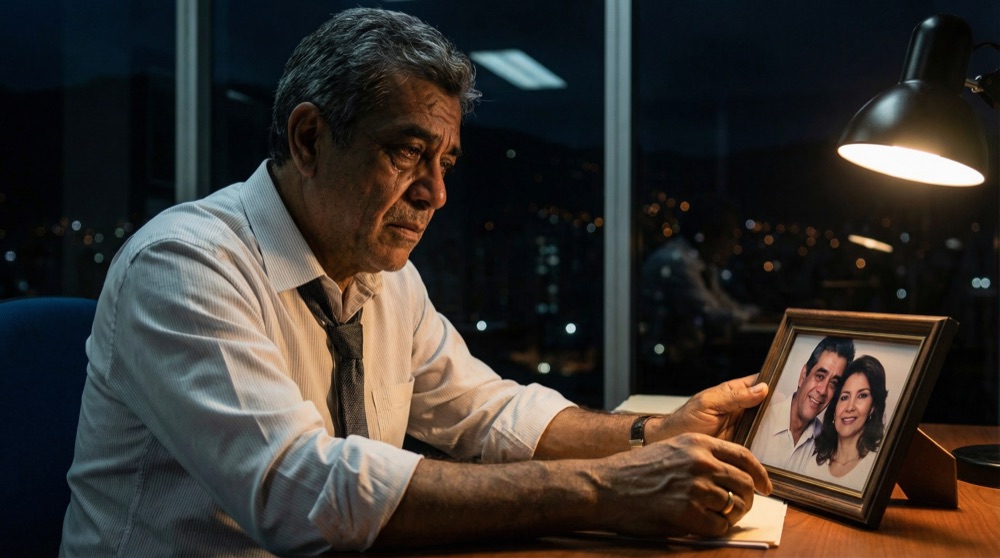
Aurelio’s office. 10:23 PM. First night.
The office that used to belong to the CEO is now just a room where an old man hides.
Aurelio Mendoza sits in the dark, lit only by his laptop screen. He’s not working. He’s looking at photographs. His wife on their honeymoon. His team at the company’s fifth anniversary. The day they signed the Grupo Andino deal, champagne and handshakes and promises that everything would stay the same.
Lies. All of it.
A soft knock. The door opens before he can answer.
When Kindness Looks Like Something Else
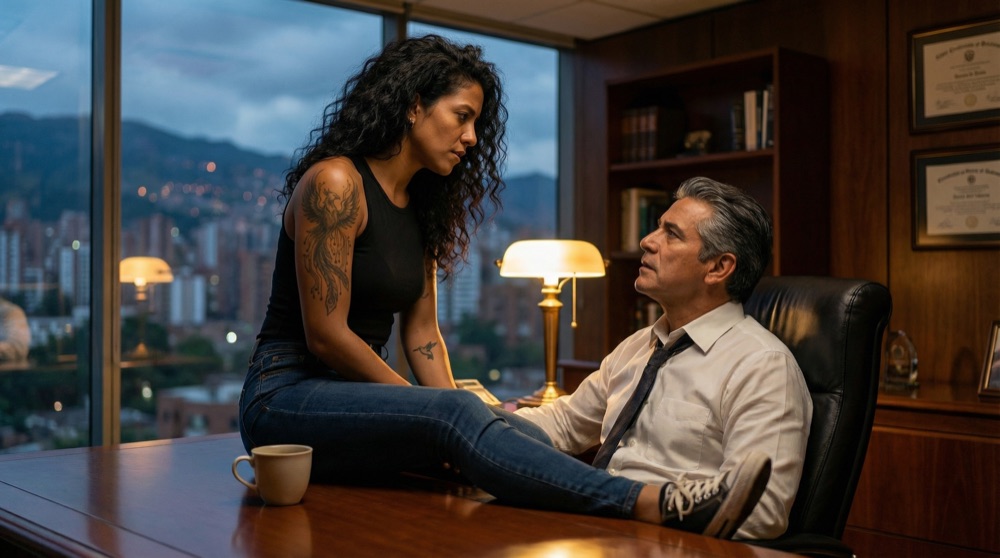
Aurelio’s office. 10:35 PM. Same night.
Salomé closes the door behind her, carrying a paper bag from a local restaurant and two cups of coffee. She just left Carmen and Stefan still planning in the war room three floors below. But Aurelio hasn’t eaten since breakfast, and someone needs to make sure he doesn’t disappear into his grief.
“You forgot to eat again.”
“I’m not hungry.”
“That wasn’t a question.” She sets the food on his desk, moves his laptop aside with the casual authority of someone who doesn’t believe in permission. “Arepa with cheese. Black beans. You need protein.”
“You don’t have to—”
“No. I don’t.” She doesn’t sit across from him like a subordinate. She hops up onto the edge of his desk, right in front of him, legs dangling, close enough that he could reach out and touch her knee if he were that kind of man. “But I’m here.”
They eat. She hands him the container. He takes it with trembling hands. The food is good. Simple. The kind of thing you can only get in Medellín, from a place that’s been making the same recipes for three generations.
The private office insulates them from the world. Solid walls, not glass. No one can see in. No watchers. No witnesses. Just two people eating arepas in the dark while the rest of the building empties out.
“I built this company,” Aurelio says finally. “Fifteen years. Every line of code, every hire, every crisis at 3 AM when the servers went down. I gave it everything.”
“I know.”
“And now I sit in meetings where people half my age explain why everything I built is obsolete. Where some gringo in a three-thousand-dollar suit tells me I don’t understand the future.” His voice cracks. His hands are shaking. “Maldita sea, Salomé. What am I now? A title. A ghost. A man who outlived his own company.”
She sets down her fork. Reaches out without thinking — her hand on his forearm, warm, grounding. “You’re the man who built something real. Something that works. Something forty-seven people depend on.”
“Forty-seven people who are about to lose their jobs.”
“Not if we fight.”
“Fight how? With what?” He gestures at the darkened room. “I have no power. Carmen is trying, but she’s one woman against a machine. And now there’s some German walking around reading code like that’s going to change anything.”
“The German sees what’s real.” Her thumb moves slightly on his arm. Just a small circle. Comfort. Or something else. “I talked to him today. He’s not like the others. He looks at the code — actually looks at it. And he sees what I see.”
“What do you see?”
“That there’s nothing wrong with us. That they’re selling fear because fear is easier than understanding.” She slides off the desk, stands in front of him, close. Too close for professional. Her hand still on his arm. “You’re not obsolete, Aurelio. You’re just… disappearing. Letting yourself become a ghost because it’s easier than feeling everything.”
His eyes meet hers. Fifty-eight and twenty-five. Founder and junior developer. Broken man and wild flame.
“Why do you care?” he asks, voice rough. “You’re twenty-five. You could get a job anywhere. Walk away from this mess.”
“Because I’m not a goddamn quitter.” Her grip tightens. Her eyes are fierce now — the phoenix on her arm might as well be breathing fire. “And because you taught me something.”
“What could I possibly have taught you?”
“That things worth building are worth protecting. That the easy road is for cowards. That when someone tries to tear down what matters, you don’t run — you fight.”
The air between them is charged. Something unspoken. Something dangerous.
If anyone could see them right now — if the walls were glass instead of solid — they’d know exactly what this is. The twenty-five-year-old wild child with her phoenix tattoo and tight jeans, sitting on the desk of the fifty-eight-year-old founder who’s been alone for three years. Her hand on his arm. His eyes locked on hers. The office empty. The building quiet. The night stretching out with possibility.
They’d see a young woman consoling a broken older man. Comfort turning to something else. The moment when caring crosses into wanting. When the age gap stops mattering because loneliness doesn’t ask for ID. When a girl young enough to be his daughter looks at him like he’s still a man worth desiring, and he looks back like maybe he could allow himself to feel alive again.
They’d see the beginning of an affair that would scandalize the office. Her — brilliant and beautiful and reckless. Him — wounded and powerful and twice her age. The kind of relationship that starts with late nights and shared food and grows into hotel rooms and lies and passion that feels like redemption but tastes like regret.
That’s what they’d see. That’s what they’d believe. That’s what the story looks like from the outside.
But what happens next isn’t what the story looks like.
She pulls back. Collects the empty containers. Her hands steadier than her heartbeat. “Get some sleep. Tomorrow, we work.”
She’s almost to the door when he speaks.
“Salomé.”
She turns.
“Thank you. For… this. For not giving up on me.”
She looks at him for a long moment. The founder who built an empire and lost his wife to it. The man who’s watching everything he created get torn apart by people who wouldn’t know a compiler from a spreadsheet. Fifty-eight years old and feeling like a hundred.
“I’m not giving up on any of you,” she says. “That’s not who I am.”
Then she’s gone. The door closes softly. The private office is silent again.
Aurelio sits in the dark, staring at the spot where she was. Thinking about phoenixes rising from ashes. About young women who refuse to let old men disappear into their grief. About the difference between what things look like and what they actually are.
The Day After — Coffee and Whispers
Aurelio’s office. 9:15 AM. Next morning.
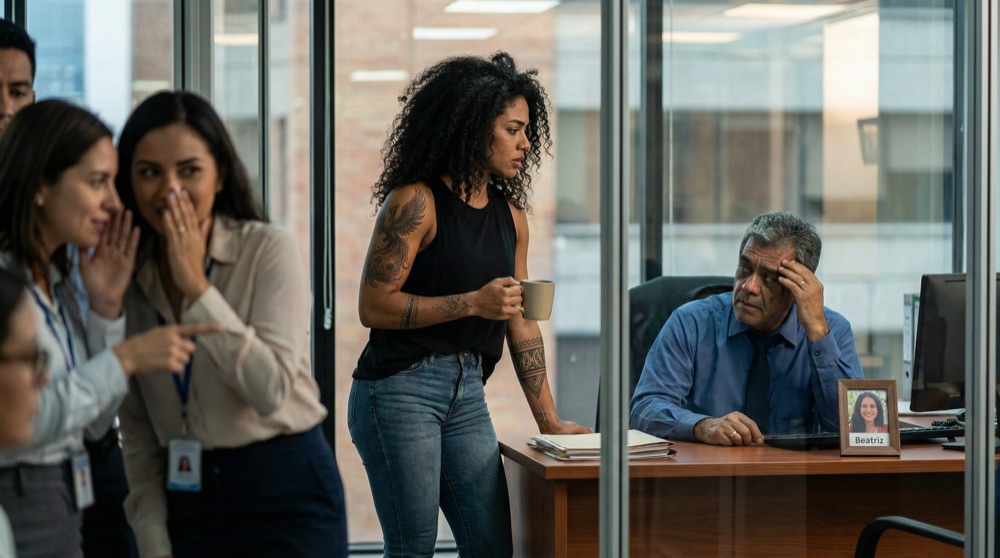
The glass-walled office is a fishbowl. Everyone can see everything.
Salomé walks across the open floor carrying two cups of coffee. Heads turn. Of course they do. She’s wearing a cropped black tank top, jeans that fit like they were painted on, her phoenix tattoo catching the morning light. Men watch her walk. Women watch the men watching.
But she’s not walking toward her desk.
She’s walking toward the founder’s office.
Valentina nudges Diego. “Is she…?”
“Bringing him coffee,” Diego finishes. “Third time this week.”
“You think they’re—?”
“I think we should mind our own business.”
But neither of them look away.
Salomé pushes through the glass door without knocking. Aurelio looks up from his laptop — dark circles under his eyes suggest he didn’t follow her advice about sleeping. But there’s something different. He’s wearing a blazer. He shaved. He’s sitting up straighter. Last night he was trembling, broken, a ghost haunting his own office. This morning he looks like he’s trying to be alive again.
“You look human again,” she says, setting the coffee on his desk.
“I had a good teacher.” His eyes meet hers. Something passes between them that the watchers outside can’t quite decode.
She perches on the edge of his desk again. Same position as last night. Comfortable. Familiar. Intimate.
Outside, Pipe’s phone buzzes. A Slack message from Diego: Dude. Look at Aurelio’s office.
Pipe looks up. Types back: Holy shit. You think she’s…?
Diego: I mean… look at them.
Lucas walks by with Isabela, coffee in hand. Stops. “Is Salomé in Aurelio’s office again?”
“Yep.”
“Sitting on his desk again?”
“Yep.”
Isabela shakes her head. “You’re all terrible. She’s being nice. He’s going through a divorce.”
“That was three years ago,” Lucas points out.
“Some divorces take longer to process.” But even Isabela is watching now.
Inside the fishbowl, Salomé and Aurelio are talking. She’s animated, gesturing with her hands. He’s listening with an intensity that wasn’t there a week ago. She says something that makes him almost smile — the first time anyone’s seen that in months.
Camila walks past, glances in, keeps walking. But she makes a mental note. Files it away with all the other things she’s noticed about Salomé lately — the way she lights up when talking about trunk-based development, the way she challenges Stefan in meetings without fear, the way she seems to give a damn when most junior developers are just trying to survive.
And now this: bringing the founder coffee. Sitting on his desk like she owns the space — not beside him, not in the chair across, but perched right in front of him facing him directly, her knees almost touching his, close enough that if he rolled his chair forward even slightly their legs would be interlaced. The kind of proximity that looks casual if you’re friends, intimate if you’re lovers, and completely inappropriate if you’re a junior developer and the fifty-eight-year-old founder. Looking at him like he’s not a ghost.
What is she to him? Camila wonders. What is he to her?
The Slack channel for the dev team lights up:
Pipe: Ok but seriously, Salomé + Aurelio = ??? 👀
Diego: She’s like 25. He’s like 60.
Valentina: 58, I looked it up
Lucas: Still tho
Isabela: Y’all are disgusting. She’s being a kind human being.
Pipe: Kind human beings don’t sit on desks like that
Valentina: Or bring coffee every morning
Camila: Or look at someone like they hung the moon
Isabela: CAMILA NOT YOU TOO
Camila: I’m just saying. Something’s there. I don’t know what. But something.
Inside the office, Salomé slides off the desk. Says something quiet. Aurelio nods. She turns to leave, and for just a second, her hand touches his shoulder. A brief contact. Reassurance? Affection? Possession?
The watchers can’t tell.
She walks out of the glass office, across the open floor, back to her desk. Every eye tracking her path. She sits down, opens her laptop, starts coding like nothing happened.
But something did happen. The whole floor feels it. Wonders about it. Whispers about it.
Three Days Later — The Touch

Aurelio’s office. 2:47 PM. Friday afternoon.
The glass walls make everything visible and nothing clear.
Aurelio sits at his desk reviewing Stefan’s preliminary assessment. It’s good news — the kind that should feel like vindication. “Architecture is sound. Team is capable. No technical debt that would justify replacement.” But the report also notes what Stefan told them privately: technical excellence won’t save them if the fear campaign succeeds.
Salomé appears in the doorway. No coffee this time. No food. Just her presence.
“Can I come in?”
“Always.”
She closes the door. Outside, the dev team’s collective antenna goes up. Diego and Valentina both stop typing. Pipe turns his chair slightly for a better view. Even Carmen, walking past with a stack of papers, slows her pace.
Salomé doesn’t sit on the desk this time. She stands beside it, close to his chair. “I read Stefan’s report.”
“So did I.”
“We’re not broken.”
“No. But that might not matter.”
“It has to matter.” Her voice is fierce. Frustrated. “We’re good at what we do. The code is clean. The systems work. How is that not enough?”
“Because they’re not evaluating the code. They’re evaluating the optics.” He gestures at the window, at the city beyond. “Grupo Andino sees Marcus Delacroix on stages, in Forbes articles, selling the future. They see me — an old man who still writes comments in Spanish, who doesn’t understand blockchain or whatever the fuck the next buzzword is.”
“Stop calling yourself old.”
“I’m fifty-eight.”
“You’re alive.” She reaches down, takes his hand. Not a brief touch this time. A full grip. Her fingers interlaced with his. Her tattooed forearm next to his in the harsh fluorescent light. “You’re still here. Still fighting. Still trying to protect forty-seven people who are your family.”
Outside, Pipe’s eyes go wide. He frantically types in Slack.
Pipe: GUYS. GUYS. SHE’S HOLDING HIS HAND.
Diego: WHAT
Valentina: like holding or HOLDING
Pipe: HOLDING. Fingers interlaced. Both hands. Full contact.
Lucas: Screenshot or it didn’t happen
Pipe: I’m not screenshotting that you pervert
Isabela: This is none of our business
Camila: But we’re all looking anyway
Isabela: …yes
Aurelio stares at their hands. Hers is young, strong, covered in the calluses of someone who types for a living. His is older, weathered, the wedding ring still there even though his wife left three years ago.
“You still wear it,” Salomé says quietly.
“Force of habit.”
“Or force of hope.” Her thumb traces the band. Gentle. Deliberate. “She’s not coming back, Aurelio.”
“I know.”
“Then why?”
He’s quiet for a long time. When he speaks, his voice is rough. “Because taking it off means admitting I failed. That I gave fifteen years to this company and came home to an empty house enough times that my wife decided she’d rather be alone than waiting for me to notice her.”
“You didn’t fail. She left. That’s her choice.”
“I made it easy for her to make that choice.”
Salomé’s grip tightens. “Stop punishing yourself. You built something real. Something that matters. She wanted something else. Those are two separate truths.”
They’re holding hands in full view of the glass-walled office. Thirty people can see them. Thirty people are watching. Making assumptions. Drawing conclusions. Composing Slack messages and mental narratives about what this means.
But they don’t let go.
“What are we doing?” Aurelio asks. Not pulling away. Just asking.
“I don’t know.” Her honesty is brutal and beautiful. “I know what it looks like. I know what they think. I know you could be my father’s age and I’m young enough to be reckless and this is the kind of thing that becomes office legend.”
“Then why—?”
“Because you’re disappearing. And I refuse to let that happen.” She squeezes his hand once more, then releases it. Steps back. Professional distance restored. “We have a deployment sync in ten minutes. Stefan wants to review the CI/CD pipeline with the team. You should be there.”
“Why?”
“Because you’re the founder. Because they need to see you’re still in this fight.” She walks to the door. Pauses. Looks back. “And because I’m going to present what I’ve been building, and I want you to see it.”
She leaves.
The glass door closes.
Aurelio sits alone, staring at his hand where hers was. The ring suddenly feels heavier. Or maybe it always felt this heavy and he’s only now noticing.
Outside, the Slack channel explodes:
Diego: So. That happened.
Valentina: THAT HAPPENED
Lucas: Are they together?
Isabela: We don’t know that
Pipe: She was touching his ring
Camila: They held hands for like two full minutes
Valentina: In front of everyone
Diego: Does she not care that we’re watching?
Isabela: Maybe she doesn’t. Maybe she’s just being human with someone who needs it.
Pipe: Nobody’s that nice
Camila: Salomé is.
Valentina: But still
Lucas: But still what?
Valentina: I don’t know. But STILL.
The mystery deepens. The office buzzes. Salomé pulls up her presentation slides for the deployment sync — the CI/CD pipeline work she’s been building, the one Stefan asked her to show the team. In ten minutes, she’ll stand in front of everyone and talk about trunk-based development like her hand wasn’t just holding the founder’s hand, like the entire office wasn’t just watching them through glass walls.
And Aurelio Mendoza stares at his wedding ring, thinking about choices and ghosts and young women with phoenix tattoos who refuse to let broken men stay broken.
“Salomé?”
She turns.
“Thank you.”
Something passes between them. Something neither of them is ready to name. Something that has nothing to do with age and everything to do with souls recognizing each other in the dark.
“De nada,” she says softly. Her voice catches slightly. She turns before he can see what’s in her eyes.
And leaves him alone in the glass-walled office, afternoon sun streaming through the windows, thirty people watching from their desks pretending not to watch, and the weight of everything he might still save — including, perhaps, himself.
What Happens in Hotel Rooms
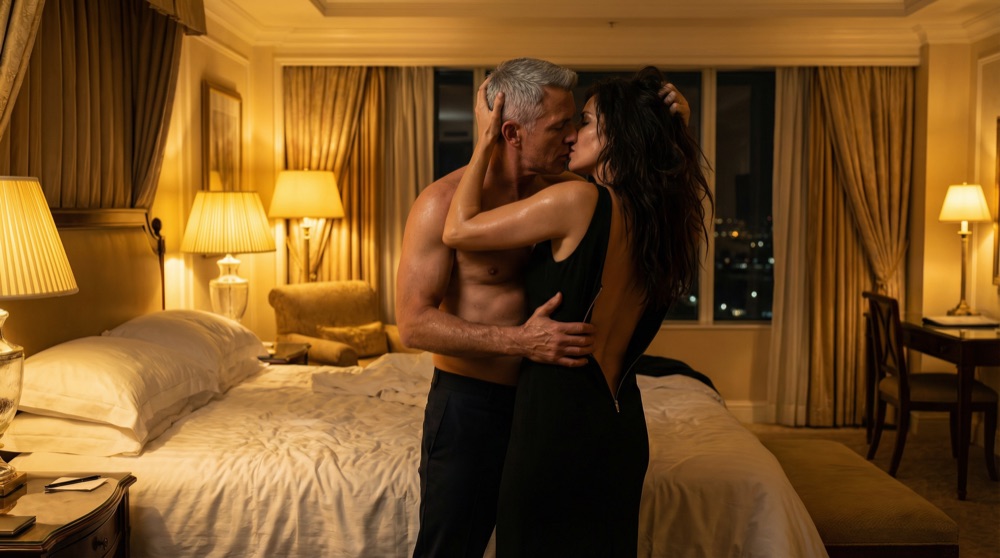
Hotel Dann Carlton, Suite 2804. 11:47 PM.
Natalia’s dress is somewhere on the floor. So is Marcus’s three-thousand-dollar suit.
She rides him hard — back arched, head thrown back, dark hair cascading down her spine. His hands grip her hips, guiding the rhythm, controlling the angle. Sweat glistens on both their bodies. The bedside lamp casts dramatic shadows.
This isn’t lovemaking. This is power exchange.
“Harder,” he commands.
She complies. Always complies. That’s the agreement. And she wants to comply — that’s the secret she’ll never admit outside this room. Being his instrument, his weapon, his perfectly calibrated tool. It makes her feel alive in ways that terrify her.
Her nails dig into his chest, drawing thin red lines. His grip tightens on her waist, leaving marks — fingerprints, bruises, evidence of his ownership that she’ll hide beneath silk scarves and collared blouses tomorrow, marks she’ll touch absently during meetings, feeling the soreness, remembering the weight of his hands. She gasps — genuine pleasure mixed with performance, because with Marcus, everything is performance even when it’s real.
When she comes, it’s loud. The sound echoes off marble and glass. When he comes, it’s silent — just his jaw clenching, his eyes closing, control maintained even in surrender.

Afterward, he lights a cigarette. Exhales smoke toward the ceiling. She stays beside him, wrapped in a white sheet, hair messy, fingers tracing idle patterns on his arm. Not cuddling. Never cuddling. But close enough to receive the next command.
“The developer,” he says. Not looking at her. Looking at the ceiling. “Tomás. You made contact?”
“Tomorrow. Lunch.” Her voice is steady. Professional. The orgasm is already filed away, categorized, logged as another transaction completed. But her fingers continue their path along his arm — a small claim of ownership, or perhaps acknowledgment of his ownership of her. The line blurs.
“Good. He has production access.”
“I know what I’m doing.” There’s pride in her voice. Not defensiveness. Pride in being effective, in being used well.
“Do you?” Now he looks at her. “Because if you get too close — “
“I won’t.” She sits up slightly. The sheet falls to her waist, revealing breasts he’s just finished touching. She doesn’t bother covering them. Modesty is not part of their agreement. “You taught me better than that.”
He smiles. It’s the smile that got him on TED stages, into boardrooms, onto magazine covers. “What did I teach you?”
“That everyone has a price. Most people just don’t know theirs yet.”
“And his price?”
“Being seen. Being valued. Being told he matters.” She leans in, kisses his neck softly. “I’ll make him feel like a god. And then I’ll take everything.”
Marcus stubs out the cigarette. Rolls toward her. His hand finds the nape of her neck — gentle but possessive.
“Don’t get creative. Follow the playbook.”
“I always do.”
“São Paulo got messy because you ad-libbed.”
Her eyes flash. Just for a second. Then the obedience returns. “That won’t happen again.”
“No.” His grip tightens slightly. Not pain. Just reminder. “It won’t.”
They don’t speak for a while. Just lie there in the expensive sheets, in the expensive suite, in the expensive game they’re playing with other people’s lives.
Finally, Natalia speaks. “The German. He’s different.”
“He’s irrelevant.”
“He’s looking at the code. Actually looking. Not performing, not posturing. Looking.”
Marcus considers this. “How much has he figured out?”
“Enough to be dangerous. Not enough to stop us.” She props herself on one elbow. “Yet.”
“Then we accelerate. I’ll push for a demo next week. AI-generated code, live in front of the board. That’ll spook them enough to make decisions.”
“What if he exposes the code samples?”
“He won’t. Not in time.” Marcus pulls her back down beside him. “People like Stefan — idealists, craftsmen, believers in the purity of code — they move too slowly. They want overwhelming evidence before they act. By the time he builds his case, we’ll already have the layoff approval.”
Natalia nestles against him. “You’re sure?”
“I’ve been doing this for eight years. The pattern never changes.” He strokes her hair almost tenderly. Almost. “We’ll be in Buenos Aires before he even realizes he lost.”
She wants to believe him. Needs to believe him. Because if Marcus is wrong — if the German actually sees through them fast enough to matter — then everything collapses. The paycheck. The power. The future where she becomes what Marcus is: selling fear to executives who can’t tell magic from mirrors.
“Get some sleep,” he says. “Big day tomorrow. Your first date with the boy who’ll give us the keys to the kingdom.”
She closes her eyes. But sleep doesn’t come easy.
And tomorrow, a lonely developer with production access goes to lunch with a beautiful woman who smiles like salvation and cuts like glass.
The trap is set.
The Night Watch
Medellín. 11:58 PM.
Three people are still awake.
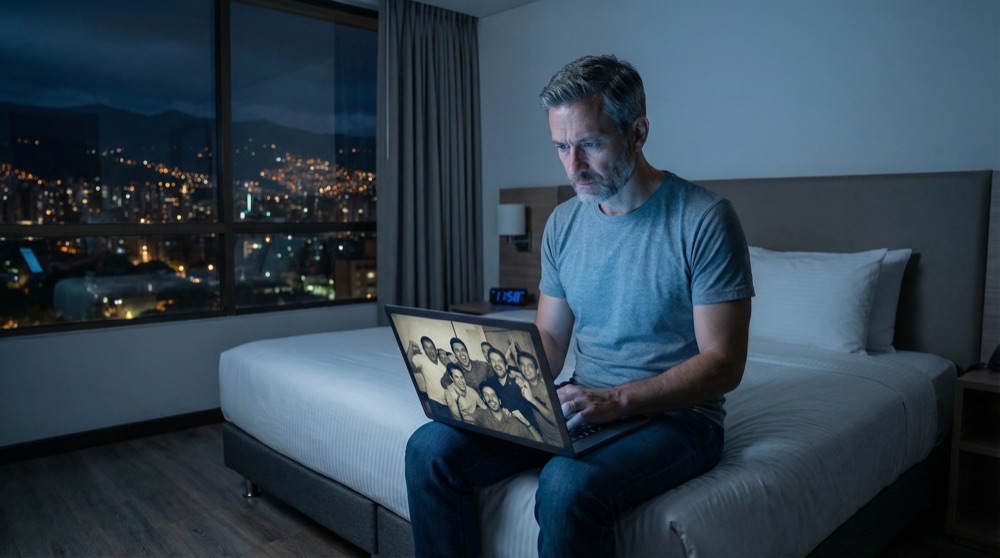
In his hotel room, Stefan Richter stares at his laptop. Not at code this time — at an old photograph. A team in São Paulo, arms around each other, celebrating a deployment that went perfectly. Six months later, the company would lay them all off. The AI consultants had won. He’d been too slow, too cautious, too focused on building a case that never got used.
His hand trembles. Just slightly. He closes the photo.
Never again. Never fucking again.
He won’t make that mistake again.
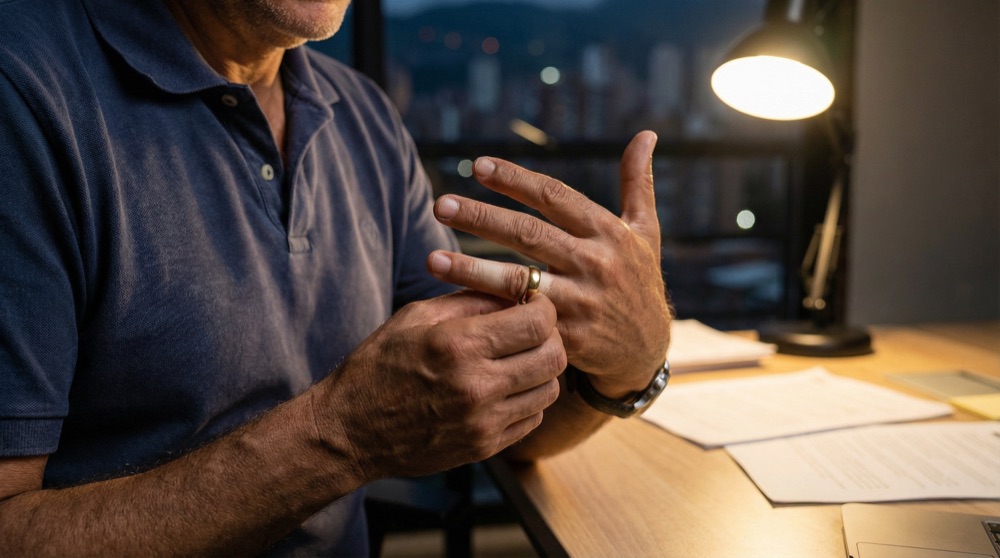
In his darkened office, Aurelio Mendoza removes his wedding ring for the first time in three years. Sets it in a drawer. Stares at the pale band of skin where it used to be.
His throat tightens. His eyes burn.
Elena is gone. The company is dying. And a twenty-five-year-old with fire in her eyes just made you feel something you thought was dead.
Something has to change. Everything has to change.
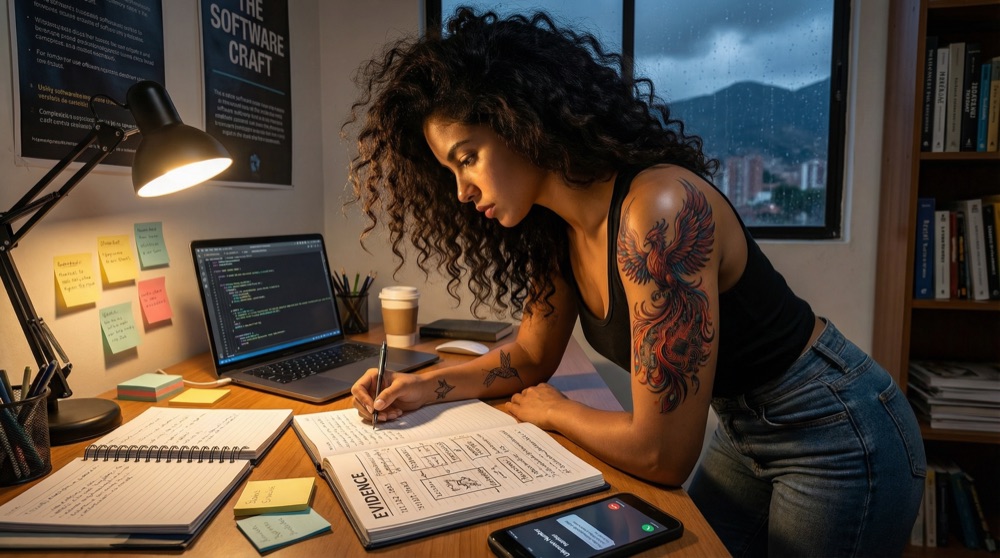
And in her small apartment in Laureles, Salomé Ruiz sits at her desk with her paper notebook open to a page titled: EVIDENCE.
She’s not building her own systems anymore. She’s building something more important.
A case.
A weapon.
A way to fight.
Her phone buzzes. Unknown number.
Unknown: You spoke to him.
Salomé: Who are you?
Unknown: Someone who's been here before. Someone who failed.
Unknown: Don't fail like I did.
Unknown: The evidence you're building matters. Keep going.
Salomé: How do you know what I'm building?
Unknown: Because I built it once. Too late. Make sure you're not too late.
The number goes silent. When she tries to call, no one answers.
Salomé stares at the screen until her eyes blur. The timestamps swim together — evidence of every careless commit, every test skipped, every warning ignored. She picks up her pen and adds another entry to her notebook: Pattern: confidence inversely proportional to competence. See: Tomás (always), Andrés (when stressed), Marcus (always).
Her phone buzzes. A text from Carmen: You still up?
Salomé glances at the clock: 2:47 AM. She types back: Building case files. You?
Same. Stefan sent me his notes from the Marcus meeting. This is worse than I thought.
How much worse?
Call me.
Salomé looks at her notebook — pages of evidence, patterns, connections. Then at her laptop — code that tells the truth when people won’t. Outside, the rain has finally stopped. The mountains are invisible in the dark, but she knows they’re there. Medellín doesn’t stop being beautiful just because you can’t see it.
She doesn’t know if any of this will work. Evidence against money. Craft against fear. Truth against the kind of manipulation that wears a beautiful face and speaks in soothing tones.
But she’s not a quitter.
Salomé reaches for her phone.
Somewhere across the city, Tomás Herrera is probably asleep, dreaming of a woman who smiled at him like he mattered. Tomorrow he’ll wake up and check his messages, hoping she texted. He’ll go to lunch with her. He’ll tell her things he shouldn’t.
He has no idea he’s already bleeding.
The trap is set.
🎭 This Week's Episodes
Telenovelas show what we can't say in client meetings. The drama is heightened, but the patterns are real.
 La Verdad
The emergency board meeting Don Hernando demanded has arrived. Mariana and the Vulcano Capital team want answers. Alejo has one final card to play....
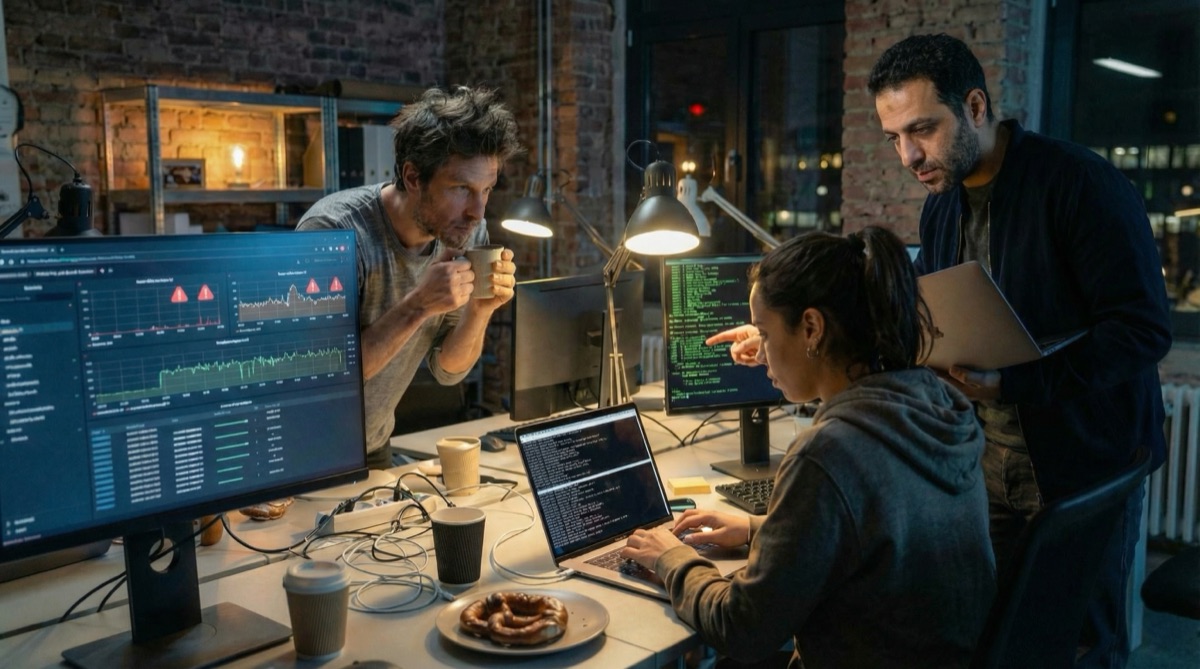 When Players Revolt
They fixed the validation bug properly — six hours, no corners cut. But the database migration script Anton wrote Monday night to handle legacy NUL...
Technical Consultancy
Senior Developer Advocate
Embedded into your team as an active contributor, increasing effectiveness and elevating engineering clarity.
Technical Advisor
Peer-style technical assessments before far-reaching decisions; reduce architectural and product risk early.
Product & Delivery
Ship working software to real users earlier. Measure impact and adapt based on evidence rather than assumption.
Custom Software Development
High quality, maintainable software. Short-term augmentation that leaves lasting capability in your own team.
Recent Articles
- When Labor Becomes Cheap, Motivation Becomes Everything (06.04.2026)
- Authentication Methods That Work in 2026 (03.04.2026)
- Developer, Not Engineer. And Why It Matters (30.03.2026)
- The Product Manager Is Dead. Long Live the Product Developer. (27.03.2026)
- Building Products in the Age of AI (23.03.2026)
Explore More