El Lobo Llega
NexoDigital has just been acquired, and the new owners bring in QuantumMind Solutions to 'transform' the company. For 47 developers, the slick presentation feels like watching their own funeral. Meanwhile, CTO Carmen Torres makes a desperate call to Germany — to a Developer Advocate who doesn't sell anything. He just helps people see what's real.
The Boardroom

NexoDigital, Medellín. Thursday, 9:14 AM.
The boardroom on the eighth floor. Floor-to-ceiling windows overlooking Medellín’s mountains. Polished table reflecting the faces of the condemned.
Marcus Delacroix stands at the head of the table, silver-gray hair perfectly styled, designer glasses catching the light. His smile is perfect. His teeth are too white. His voice carries the confidence of someone who has never written a line of production code in his life.
“Gentlemen, Carmen.” He nods toward the only woman at the table. “What we’re proposing is not disruption for disruption’s sake. It’s evolution. Necessary evolution.”
Don Aurelio Mendoza sits at the far end — the seat he used to occupy as CEO, now demoted to “Strategic Advisor.” He built NexoDigital from nothing in 2009. Taught himself Java, then fumbled through building ugly frontends like every backend guy does, then managed to hire people smarter than him. For fifteen years, he was the captain of this ship.
Now he’s a ghost in his own company.
The acquisition happened six months ago. Grupo Andino, the conglomerate that bought NexoDigital, promised nothing would change. The culture would remain. The team would stay intact.
They lied.
Carmen Lucía Torres, the CTO, sits across from Marcus, her reading glasses pushed up on her head. Her natural curly hair shows strands of gray she stopped hiding years ago. She’s been taking notes, but her pen has stopped moving.
“Forty-seven developers,” she says quietly. “That’s what we’re talking about. Not headcount. Not resources. People.”
“People who will be freed to focus on higher-value work,” Marcus replies smoothly. “AI-assisted development isn’t replacement, Carmen. It’s augmentation.”
“Bullshit.” The word comes from Aurelio. Everyone turns. “I’ve been in this industry long enough to know what ‘augmentation’ means. It means firing thirty developers and telling the remaining seventeen to work twice as hard.”
Marcus’s smile doesn’t waver. “Aurelio, I understand your attachment to the old ways—”
“Don’t patronize me, hijo de puta.”
The room goes silent.
“Aurelio.” Carmen’s voice is gentle but firm. “Let him finish.”
Aurelio looks at her. The woman who’s been his partner for twelve years. The woman who stayed when everyone else left. And he sees it in her eyes: she’s already calculating how to save as many people as she can. She’s already accepted that some will be sacrificed.
He stands. Walks out without another word.
Marcus watches him go. “Change is difficult for some people.”
“He’s the founder,” Carmen says.
“Was the founder. Grupo Andino owns NexoDigital now. And they’ve asked us to optimize your operation.” He clicks his remote. “Which brings me to the all-hands presentation. One hour from now. We’ll introduce the initiative to the full engineering team.”
Forty-Seven Funerals

10:30 AM. The seventh floor.
The conference room has never felt this cold. The air conditioning is set to the same temperature as always — Medellín’s eternal spring rarely demands more — but something has frozen in the room that no thermostat can fix.
Forty-seven developers watch the screen. Some sit in chairs. Others lean against walls, arms crossed. A few have their laptops open, pretending to take notes, actually messaging each other in a private Slack channel.
pipe_gomez Is this actually happening?
tomas_h Shh. They might be monitoring.
camila_dev They're definitely monitoring.
At the front of the room, Marcus gestures with the same practiced precision he used an hour earlier with senior staff. The presentation hasn’t changed. The smile hasn’t changed. Only the audience is different.
“Artificial intelligence,” Marcus Delacroix says, “is not the future. It is the present. And companies that fail to embrace it…” He pauses for effect. “…will not survive to see tomorrow.”
Behind him, a slide shows a graph. Productivity up 300%. Costs down 70%. The numbers are beautiful. The numbers are lies.
“QuantumMind Solutions has helped over forty enterprises across three continents transform their software delivery. We don’t just consult — we revolutionize.”
In the back of the room, Don Aurelio Mendoza watches from the shadows. His eyes are still red from the boardroom confrontation. His fist still aches from the wall. But he came to this meeting because he needs to see their faces — the forty-seven people whose lives are about to be thrown into chaos.
Carmen Lucía Torres sits in the front row. Her reading glasses are pushed up on her head — she’s always losing them. Her natural curly hair shows strands of gray she stopped hiding years ago. She’s taken notes through the entire presentation, but her pen has stopped moving.
She knows what this is. She’s seen it before, in whispered stories from colleagues at other companies. The consultants arrive. The promises flow. The layoffs follow.
Her son asked her last week if she’d still have a job next year. She lied to him too.
The presentation ends. Marcus thanks everyone for their time, promises “exciting developments ahead,” and leaves with the practiced exit of a man who never stays to clean up his own messes.
The room doesn’t move. For a moment, forty-seven people sit in silence, processing what they just heard. Then, like a dam breaking, everyone starts talking at once.
“Hijueputa.” Diego Vargas, one of the senior backend developers, runs his hands through his hair. “They’re going to fire us all, aren’t they?”
“Tranquilo, parce.” Pipe puts a hand on his shoulder. “We don’t know that yet.”
“¿Tranquilo? Did you hear what he said? ‘Optimization opportunities.’ That’s corporate speak for ‘your ass is gone.’” Diego’s voice cracks. “I just bought an apartment, man. Signed the papers three weeks ago. Thirty years of mortgage. Treinta putos años.”
Across the room, Valentina Restrepo is already on her phone, texting furiously. Her eyes are wet.
“My parents,” she says to no one in particular. “They depend on me. My dad had the stroke last year, he can’t work. My mom takes care of him. I send them half my salary every month.” She looks up, mascara starting to run. “¿Qué voy a hacer?”
Lucas Mendoza — no relation to Don Aurelio — stands by the window, staring at the mountains. His girlfriend is three months pregnant. He proposed last week. She said yes. He was going to tell everyone today.
Now he says nothing.
“This is bullshit.” Camila slams her laptop shut. “Complete and utter bullshit. AI can’t do what we do. Have you seen what it produces? Garbage. Absolute garbage that looks right until you actually run it.”
“They don’t care if it works,” Salomé says quietly. Everyone turns to look at her. “They care if it’s cheap. If they can tell the board they reduced headcount by sixty percent, they get their bonuses. Whether the product works is someone else’s problem.”
“Malparidos.” Diego again. “They come here with their fancy suits and their gringo smiles, talking about ‘transformation’ and ‘optimization,’ and we’re supposed to just sit here and take it?”
“What else can we do?” Pipe asks. Not challenging — genuinely asking.
Silence.
Andrés Mejía, the engineering manager, hasn’t said a word. He’s been sitting in the corner, staring at his hands. He’s the one who has to deliver the bad news. He’s the one who will sit in the meetings where names are crossed off lists. He’s the one who will have to look these people in the eye and tell them their jobs are gone.
He used to love this job. Now he just wants to disappear.
“Alright, everyone.” Carmen stands up, her voice cutting through the chaos. “I know you’re scared. I’m scared too. But falling apart in a conference room won’t help anyone. Go back to your desks. Keep working. I’m going to find out what’s really happening and what our options are.”
“Options?” Diego laughs bitterly. “What options? We’re jodidos, Carmen. Completely and utterly jodidos.”
“Maybe.” Carmen meets his eyes. “Or maybe not. I’ve been in this industry a long time, Diego. I’ve seen consultants come and go. Some of them succeed. Many of them fail. And sometimes…” She pauses. “Sometimes the people who are supposed to be replaced turn out to be exactly what the company needs.”
She walks out. One by one, the others follow, shuffling back to their desks like condemned prisoners returning to their cells.
The Weapon
2:07 PM. The engineering floor.
Lunch did nothing to calm anyone’s nerves. If anything, the break made it worse — an hour and a half of conspiracy theories over bandeja paisa and arepas, speculation flowing as freely as the aguapanela. Who will get fired first? How many months of severance? Can you really retrain as a bartender at thirty-four?
The developers are back at their desks, but no one is working. Keyboards sit untouched. Screens show code that no one is reading. The air is thick with whispered conversations and the occasional muffled curse.
Then Marcus appears at the entrance to the floor, and beside him —
Every head turns.

She walks in like she owns the room. Long dark hair, perfectly styled. A silk blouse unbuttoned just enough to be noticeable. Designer heels that click against the floor with each deliberate step. A smile that warms automatically, like a motion-sensor light.
“Everyone,” Marcus announces, “I want you to meet Natalia Vásquez, our AI Integration Specialist. She’ll be embedded with your team over the coming months to understand your systems and identify optimization opportunities. Please give her your full cooperation.”
He leaves. She stays.
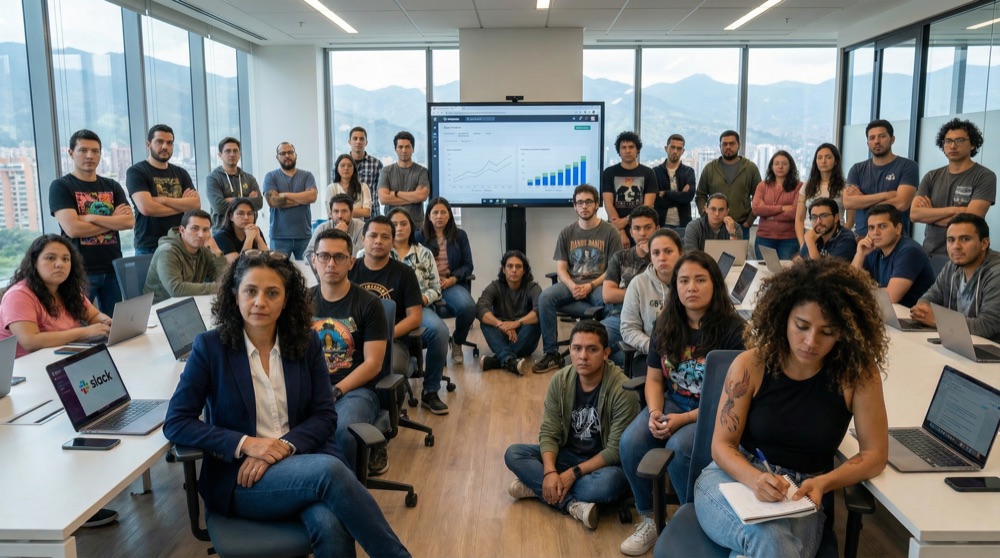
Natalia’s eyes scan the room. She catalogs faces, postures, vulnerabilities. Her gaze lands briefly on a young man two rows back — dark messy hair, glasses, band t-shirt. He’s staring at her like he’s never seen a woman before.
She files him away for later.
“I’m so excited to work with all of you,” she says. Her voice is warm honey. “I know change can be scary. But I promise — I’m here to help.”
In the private Slack channel:
tomas_h Holy shit.
pipe_gomez Focus, kid. Eyes on the screen, not the... you know.
camila_dev That's exactly what they want you to do.
tomas_h What?
camila_dev Stare at her tits instead of thinking about how she's here to destroy your career.
tomas_h That's not...
pipe_gomez She's right, parcero. This is classic misdirection. Send in someone beautiful, everyone gets distracted, nobody asks the hard questions.
salome_r Try using your brain instead of your dick, *pendejo*.
tomas_h You're all paranoid.
salome_r I'm observant. There's a difference.
Tomás Herrera looks away from Natalia, embarrassed. His face is burning. His heart is pounding so loud he’s sure everyone can hear it. Twenty-six years old, a senior developer with full production access, and he’s never had a serious girlfriend. Never even had a casual one. He knows he should be worried about the presentation. He knows this is probably the beginning of the end.
But she looked at him. She actually looked at him. At him.
Don’t be an idiot, he tells himself. She’s a consultant. She looks at everyone.
But his hands are sweating anyway.
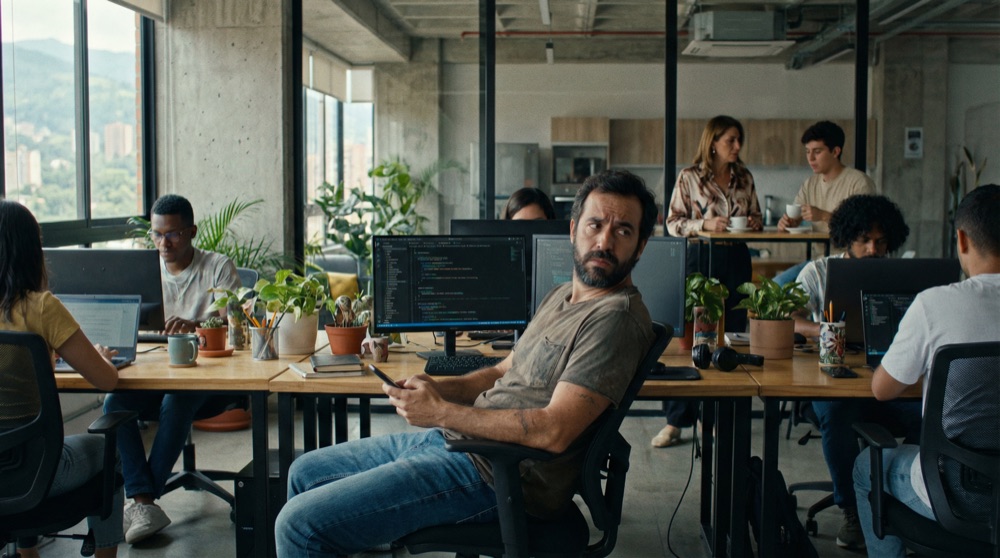
In the front row, Salomé Ruiz — wild curly hair, phoenix tattoo visible on her arm — keeps her eyes on Natalia with cold assessment, not lust. She’s seen beautiful women weaponized before. And unlike half the men in this room, she’s not thinking with her crotch.
She sees one in the mirror every morning. What interests her isn’t the packaging — it’s what QuantumMind is really after.
The Aftermath

6:47 PM. The office is mostly empty.
Most people left hours ago. Some to bars, drowning the day in beer and aguardiente. Others to their families, carrying the weight home with them. A few stayed late, pretending to work, afraid that leaving on time might mark them as expendable.
Don Aurelio stands alone in a conference room by the window overlooking Medellín. The city lights are starting to flicker on as dusk settles over the mountains. Fifteen years ago, he stood at this same window with nothing but an idea and a laptop. Now he has a company worth millions — and no power to save it.
He turns away from the window. Walks out. Takes the stairwell instead of the elevator.
Carmen sees him disappear into the stairwell and follows.
She finds him there, one hand against the concrete wall, staring at nothing.
“Aurelio.”
He doesn’t turn. “Fifteen years, Carmen. I built this company with my hands. Hired every one of those forty-seven people. Watched them grow. And now they bring in these…” He can’t find the word. “These vendedores de humo. Smoke sellers.”
“I know.”
“They’re going to fire them. All of them. The ‘AI transformation’ — it’s just a pretty way of saying replacement.” He finally turns. His eyes are red. “What am I supposed to do? I’m a ‘Strategic Advisor.’ I have no power anymore. Fifteen years, and now I watch some American hijo de puta in a designer suit explain why my people are obsolete?”
His fist hits the wall. Not hard enough to break anything, but hard enough to hurt.

“Mierda.” He looks at his hand. The knuckles are red. “Fifteen goddamn years.”
Carmen takes a breath. “I might know someone who can help.”
“Another consultant?”
“No. A Developer Advocate. From Germany. I worked with him years ago, before NexoDigital. He… he doesn’t sell anything. He just helps people see what’s real.”
“What good is seeing reality when reality is that we’re fucked? Totally, completely jodidos?”
Carmen doesn’t flinch. She’s heard worse. She’s thought worse. “Because sometimes reality isn’t what it looks like from the boardroom. Sometimes the people making decisions are wrong.” She pauses. “And sometimes the only way to fight smoke is with fire.”
Aurelio looks at her for a long moment. The woman who’s been his CTO for twelve years. The woman who stayed when everyone else left. The woman who still believes in something.
“Call him,” he says. “Call your German.”
Carmen walks to her car in the underground parking garage. Sits behind the wheel. Doesn’t start the engine.
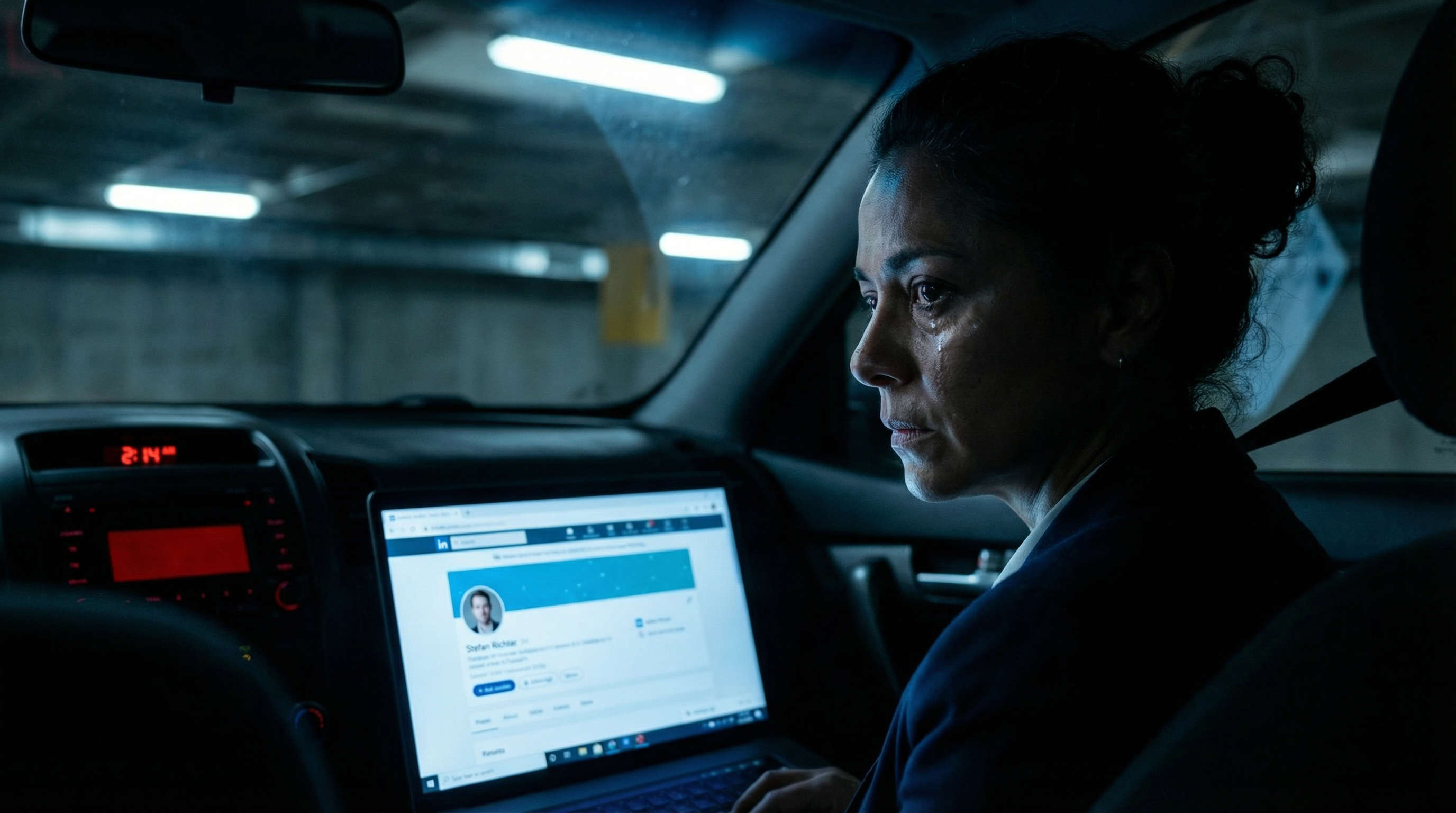
She opens LinkedIn on her phone. Finds Stefan Richter’s profile. The German developer advocate she worked with in Frankfurt six years ago. The man who helped them migrate a fifteen-year-old monolith without losing a single customer.
She stares at his photo. Professional. Kind eyes. The kind of person who listens before he speaks.
Her vision blurs. She wipes her eyes. Dials.
The Call
Berlin, Germany. 11:47 PM.
Stefan Richter sits in his apartment, surrounded by the artifacts of a life spent helping others. Books in four languages. Conference badges spanning two decades. A photo on his desk of a team in São Paulo, smiling — people he couldn’t save.
His phone buzzes. Unknown number. Colombian prefix.
He answers.
“Stefan?” The voice is tired, accented. “It’s Carmen. Carmen Torres. We worked together in—”
“Frankfurt. 2018. The legacy migration.” He remembers. He always remembers. “How are you?”
“Not good.” A pause. “I need help.”
Stefan leans back in his chair. Outside his window, Berlin is quiet. Inside, his instincts are already firing. “Tell me.”
She tells him. The acquisition. The consultants. The promises of AI transformation. The forty-seven developers who are about to become forty-seven casualties of someone else’s quarterly report.
“They’re calling it ‘optimization,’” Carmen says. “But we both know what it is. They’re going to gut my team and replace them with… I don’t know what. Offshore contractors pretending to be AI. Actual AI that produces garbage code. Does it matter? Either way, my people are gone.”
Stefan is silent for a moment. Then: “What’s the consultant’s name?”
“Marcus Delacroix. QuantumMind Solutions. American, I think, but with a French name. Very polished.”
Stefan’s jaw tightens. He knows the name. He’s seen the wreckage Marcus leaves behind.
“I’ll come.”
“You will?” Carmen’s voice breaks slightly. “I can’t promise payment. Grupo Andino controls the budget now, and they—”
“I don’t need payment.” Stefan looks at the photo from São Paulo. “I need to be useful.”
“When can you arrive?”
“I’ll be on a flight tomorrow. Find me somewhere to stay, somewhere the consultants won’t know about. And Carmen?”
“Yes?”
“Don’t tell anyone I’m coming. The element of surprise is the only advantage we’ll have.”
He hangs up. Opens his laptop. Begins researching.
NexoDigital. Grupo Andino. QuantumMind Solutions. Marcus Delacroix.
By 3 AM, he knows enough. By 4 AM, he’s packed. By 6 AM, he’s on his way to the airport.
In his bag: a laptop, a change of clothes, and thirty years of experience watching companies destroy themselves from the inside.
The First Victim
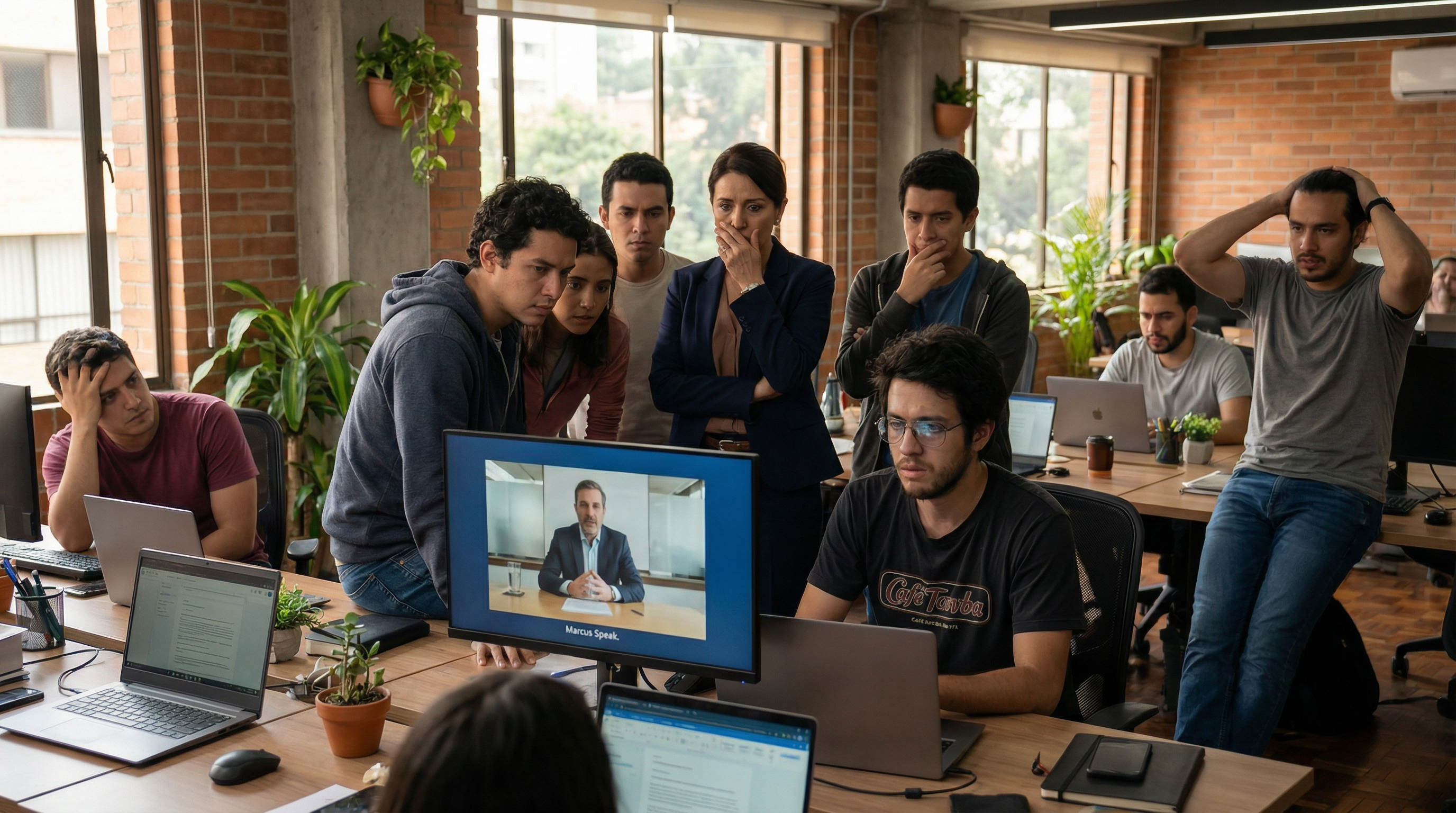
NexoDigital offices. The next morning.
Tomás Herrera arrives early, as always. He likes the quiet hours before everyone else gets in. Time to think. Time to code. Time to be something other than the awkward guy who can’t make eye contact.
The coffee machine in the break room is broken again. He’s trying to fix it — years of debugging software have given him an irrational confidence in debugging hardware — when a voice behind him makes him jump.
“You’re Tomás, right? The senior developer?”
He turns. Natalia is standing in the doorway, holding two cups from the café downstairs.
“I… yes. That’s me.”
She holds out one of the cups. “I noticed the machine was down. Thought you might need this.”
He takes the coffee. Their fingers brush. His heart rate spikes.
“Thank you. You didn’t have to—”
“I wanted to.” She smiles. It’s the kind of smile that makes men forget what they were worried about. “I was hoping you could help me understand the system architecture. Marcus says you’re the one who knows everything.”

“I don’t know everything. I just…” He looks at his coffee, embarrassed. “I’ve been here a while. Since I was twenty-two.”
“Four years. That’s impressive for someone so young.” She takes a sip of her own coffee. “Most people your age don’t stay anywhere that long.”
“I like it here. The team is good. The problems are interesting.”
“And the code?” She tilts her head. “Is it interesting too?”
For the first time, Tomás meets her eyes. Big mistake. His stomach flips. His palms go slick with sweat. He’s already drowning, and some distant part of his brain is screaming that this is a trap, that women like her don’t notice men like him, but the rest of him doesn’t give a damn.
“The code is… complicated. Lots of history. But yeah. It’s interesting.”

“I’d love to see it sometime. If you’re willing to show me.” She touches his arm lightly. “No pressure. I know everyone’s nervous about the changes. But I really am here to help.”
He believes her. God help him, he believes her.
“Sure,” he says. “I can show you whenever you want.”
“How about lunch? We could grab something, and you could walk me through the main systems.”
“Lunch. Yeah. Lunch is good.”
She smiles again. “Perfect. I’ll find you at noon.”
She walks away, heels clicking against the floor. Tomás watches her go, coffee cooling in his hands, his heart hammering against his ribs like it’s trying to escape. His skin is still tingling where she touched his arm.
She noticed me. She actually noticed me.
In the main office, Pipe has been watching through the glass walls. He’s seen this play before. Different actress, same script.
He pulls out his phone and sends a message to Carmen:
pipe_gomez: We have a problem. The new woman is targeting Tomás.
carmen_cto: Targeting how?
pipe_gomez: The usual way. Coffee. Smiles. "Show me the architecture." Touched his arm like he was the most fascinating man she'd ever met.
carmen_cto: Shit. The kid has no defenses.
pipe_gomez: None. He's practically vibrating.
pipe_gomez: He has production access. Full credentials.
carmen_cto: I know.
pipe_gomez: What do we do?
carmen_cto: Nothing yet. Help is coming.
pipe_gomez: What kind of help?
carmen_cto: The German kind.
The Arrival

José María Córdova International Airport. 6:14 PM.
Stefan steps off the plane into the controlled chaos of the Medellín airport. The air is different here — thinner, warmer, alive. Mountains rise in every direction, and the light has a quality he’s never seen in Berlin.
He passes through customs with the practiced ease of a frequent traveler. No checked bags. No complications. Just a man with a laptop and a mission.
In arrivals, a driver holds a sign with his name. Carmen’s work. Discreet.
“Señor Richter?”
“Sí.”
The drive into the city takes an hour. Stefan’s phone had been in airplane mode for the entire flight. As the car descends from the mountains toward Medellín, signal returns. His phone buzzes. Multiple WhatsApp messages from Carmen, sent throughout his travel day.
He reads them in sequence:
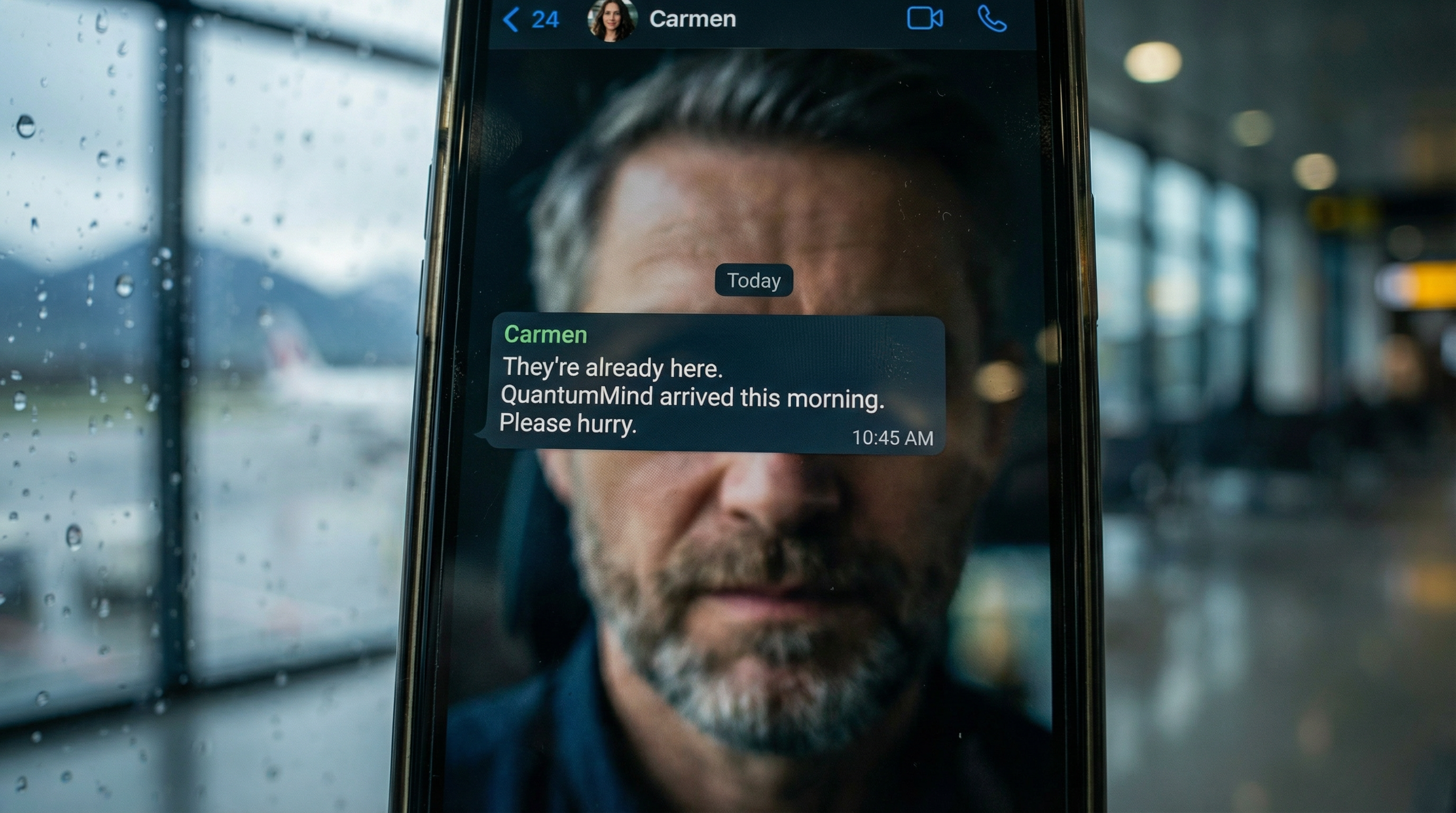
Carmen: [9:47 AM] Marcus just announced a "pilot program" for the AI transformation. Volunteers from the team.
Carmen: [10:15 AM] No one volunteered. They're selecting people anyway. The young ones. The ones with families who can't afford to resist.
Carmen: [1:23 PM] The QuantumMind woman — Natalia Vásquez — had lunch with one of our senior developers. Tomás Herrera. Twenty-six, brilliant, socially awkward. He has full production access.
Carmen: [1:24 PM] He came back from lunch looking like a teenager who just got asked to prom.
Carmen: [2:35 PM] She's been at his desk three times this afternoon. Asking questions. Smiling. Touching his arm. He's completely mesmerized.
Carmen: [2:36 PM] This is how it starts, isn't it?
Stefan stares at the messages. Watches the city lights appear as dusk settles over the mountains. Medellín has transformed since the dark years. Glass towers rise next to colonial churches. The metro system hums with efficiency. This is a city that rebuilt itself from nothing.
He knows something about that.
He types a response:
Stefan: Just landed. On my way to the hotel.
Carmen: Did you see my messages?
Stefan: Yes. Natalia Vásquez — I know her type. This is textbook. How long until she has his credentials?
Carmen: Days. Maybe less if she's good.
Stefan: She's good. I'll be at the office tomorrow. Don't announce me. Just tell them I'm an old colleague visiting from Germany.
The car pulls up to a modest hotel in Laureles. Not the corporate towers of El Poblado where Marcus and Natalia are surely staying. Something quieter. Off the radar.
Stefan checks in under his own name — there’s no point hiding from people who aren’t looking. He unpacks his single bag. Opens his laptop. Connects to the hotel WiFi, then fires up a VPN.
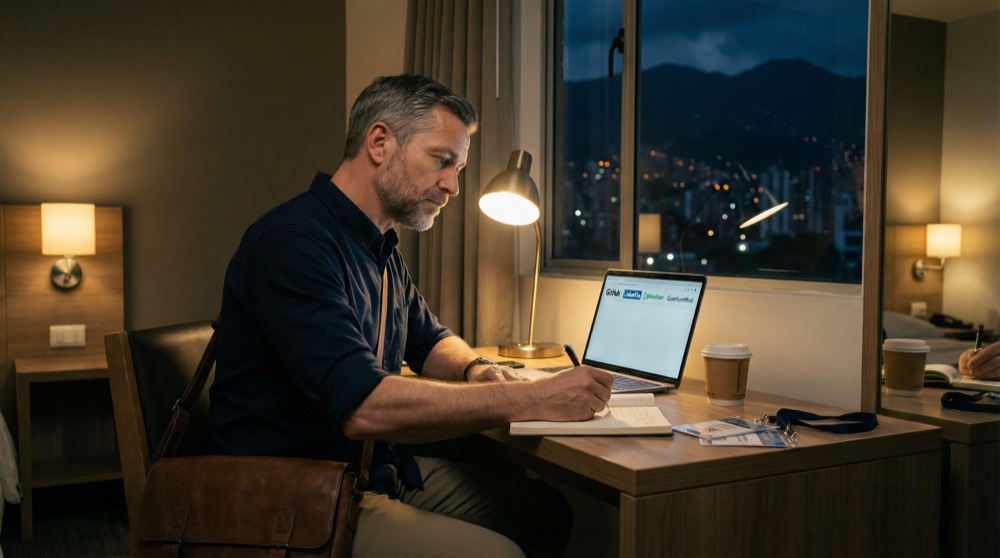
For the next four hours, he reads. NexoDigital’s GitHub repositories — a few open source libraries they maintain for the community. QuantumMind’s marketing materials. LinkedIn profiles of everyone involved. Glassdoor reviews. Reddit threads. Every trace these people have left in the digital world.
He makes notes. Old habits — pen on paper, nothing digital that could be intercepted.
One: NexoDigital’s engineering team is better than they think. Their open source libraries are clean, well-tested, thoughtfully architected. Commit patterns show daily integration, proper branching discipline. The code doesn’t lie — these developers know their craft. Whatever problems exist are organizational, not technical.
Two: QuantumMind’s “AI transformation” has been deployed at seven companies in the last three years. In every case, engineering headcount dropped by 60% or more within eighteen months. In every case, the companies now outsource most of their development to offshore contractors. In every case, the “AI” is a fiction.
Three: Marcus Delacroix left his last company under a cloud. Something about missing data. Something that never quite made the news but lives in the whispered spaces of industry gossip.
Stefan closes his laptop. Looks out the window at the lights of Medellín, glittering like scattered diamonds against the mountain darkness.
Tomorrow, he walks into the lion’s den.
Tonight, he sleeps.
The Silent Observer
NexoDigital. 8:47 PM.
The office is dark except for one desk lamp. Salomé Ruiz sits at her workstation, wild curly hair pulled back in a loose knot, her phoenix tattoo catching the monitor’s glow as she types.
She’s not supposed to be here. Junior developers don’t work late. But Salomé has never cared much about what she’s supposed to do.
Two monitors. Left screen: browser tabs multiplying like evidence. LinkedIn profiles of QuantumMind’s leadership team. Glassdoor reviews from their previous “transformation” projects. Reddit threads where engineers describe what happened after the consultants arrived. Right screen: her IDE, a Python script she’s writing to scrape and analyze QuantumMind’s public materials.
The pattern is consistent: Big promises. Smooth presentations. Then sixty percent of the developers gone within eighteen months. The ones who remain burned out, demoralized, or quietly looking for exits.
She switches focus to her code. The script pulls down QuantumMind’s case studies, extracts the “AI-generated” code samples they showcase, runs static analysis. Something’s off about those samples — they’re too clean, too idiomatic, too human. Real AI output has tells: repetitive patterns, awkward naming, missing edge cases. These samples have none of that.
She opens her paper notebook — the kind that can’t be hacked, can’t be remotely wiped, can’t mysteriously disappear from a server. Page after page of notes. Company names. Timelines. Before-and-after headcounts. Code sample analysis results. Evidence.
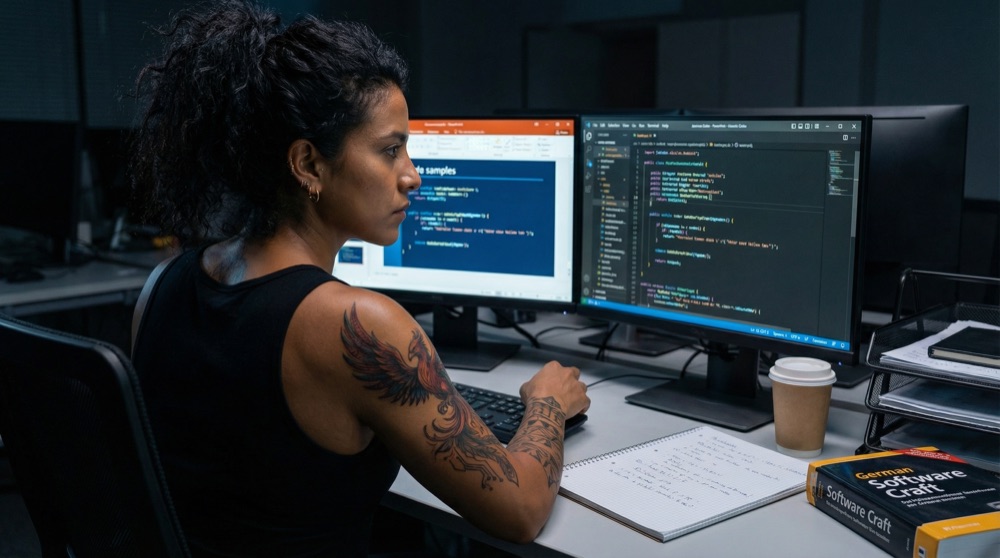
Marcus Delacroix has done this seven times before. Seven companies. Seven engineering teams gutted. Seven portfolios of “AI-driven transformation success” that look impressive in PowerPoint and devastating in human cost.
And she’s the only one building a case against him.
On her desk: the book she’s been reading. A German author — something about software craft, about discipline, about the difference between generating text and building systems. She bought it with money she should have sent home to her mother. The ideas feel like water in a desert.
Salomé knows what she’s found. She just doesn’t know what to do about it yet.
Her phone buzzes. A message from a number she doesn’t recognize. International prefix, but scrambled — routing through multiple countries, hiding its origin.
Unknown: Saw the presentation today. Watched them smile at us while planning our funerals.
Her stomach drops. Us. Not you. Whoever this is, they were there. In the room. Watching.
Or watching remotely. Through NexoDigital’s systems.
She types carefully:
Salomé: Who is this?
Unknown: Someone who failed to stop this before. Same consultant. Same playbook. Same lies about AI transformation.
Unknown: I was too slow gathering evidence. By the time I had proof, it was too late. Families destroyed. Careers ended. A company hollowed out and sold for parts.
Salomé: How do you know about me?
Unknown: Because you're not acting like the others. You stayed late tonight — not working on features, but researching. You're writing code to analyze their samples. You're building a case.
Unknown: I noticed you weren't fooled. You see clearly. That's rare.
Salomé’s hand freezes over her keyboard. They know what she’s doing. They can see her screen. Or they’re inside NexoDigital’s network. Or QuantumMind’s surveillance tools are more invasive than anyone realizes.
Salomé: Are you watching me right now?
Unknown: I'm watching *them* watch you. QuantumMind monitors everything — Slack, email, GitHub commits, even mouse movements. They look for skeptics. You've been flagged.
Unknown: That's why I'm reaching out. You're gathering the right evidence, but you need to be smarter about it. Paper notebooks — good. But your Python script pings their servers directly. They'll notice.
Fear crawls up her spine. She looks at her screen. The script running in her terminal. Pulling down QuantumMind’s case studies, analyzing their code samples.
Leaving traces.
Salomé: What should I do?
Unknown: Route through a VPN. Better yet, use Tor. Archive everything offline. And pay attention to the German consultant arriving tomorrow.
Salomé: How do you know about him?
Unknown: Because I know who called him. And I know why. He wrote the book on your desk — the one about software craft, about discipline over theater. You bought it three months ago. You highlight passages about evidence-based delivery.
Salomé’s eyes snap to the book. The German text. The highlighted sections. The ideas that felt like finding water in a desert.
Salomé: How do you know what's on my desk?
Unknown: I know what matters. He'll see what you see. Maybe more. Learn from him. Trust him.
Unknown: And watch the engineers. QuantumMind always needs inside access. They'll target someone with production credentials. Someone lonely. Someone who won't see it coming.
Salomé: Who?
Unknown: You'll know when you see it. The woman who arrived with Marcus — she's the weapon. Watch who she gets close to.
Unknown: Keep digging. But be careful. QuantumMind destroys people who threaten their business model. The evidence you're gathering matters more than you think.
Unknown: Don't fail like I did.
She types a response. Hits send.
Message failed to deliver. Number no longer active.
The conversation vanishes from her screen — not deleted by her, but remotely wiped. As if it never existed.
Except it did. And whoever sent it knows things they shouldn’t. Sees things they shouldn’t. Has access to systems they shouldn’t.
Someone who failed to stop QuantumMind before. Someone who watched people lose everything — careers, families, futures. Someone who’s hiding in the shadows now, trying to prevent it from happening again.
Someone who knows about the German arriving tomorrow.
Salomé looks at the book. Then at her screen. Then at the dark windows where Medellín’s lights glitter like possibilities.
A German consultant who sees clearly. Who wrote about craft and discipline. Who might understand why she stayed late hunting for proof that everyone else missed.
She closes her vulnerable Python script. Opens a Tor browser. Starts over — this time invisible.
Someone in the shadows is fighting QuantumMind. Someone who lost before.
Tomorrow, maybe she’ll have an ally who can actually win.
Outside, rain begins to fall on Medellín. The mountains disappear into mist. And somewhere in Laureles, in a modest hotel room, Stefan Richter closes his laptop and looks out at the city lights. He knows three things about QuantumMind. He suspects a dozen more. Tomorrow, he’ll find out which suspicions are true.
Forty-seven developers dream of a future that may not exist.
The wolf has arrived.
But so has the shepherd.
🎭 This Week's Episodes
Telenovelas show what we can't say in client meetings. The drama is heightened, but the patterns are real.
 La Verdad
The emergency board meeting Don Hernando demanded has arrived. Mariana and the Vulcano Capital team want answers. Alejo has one final card to play....
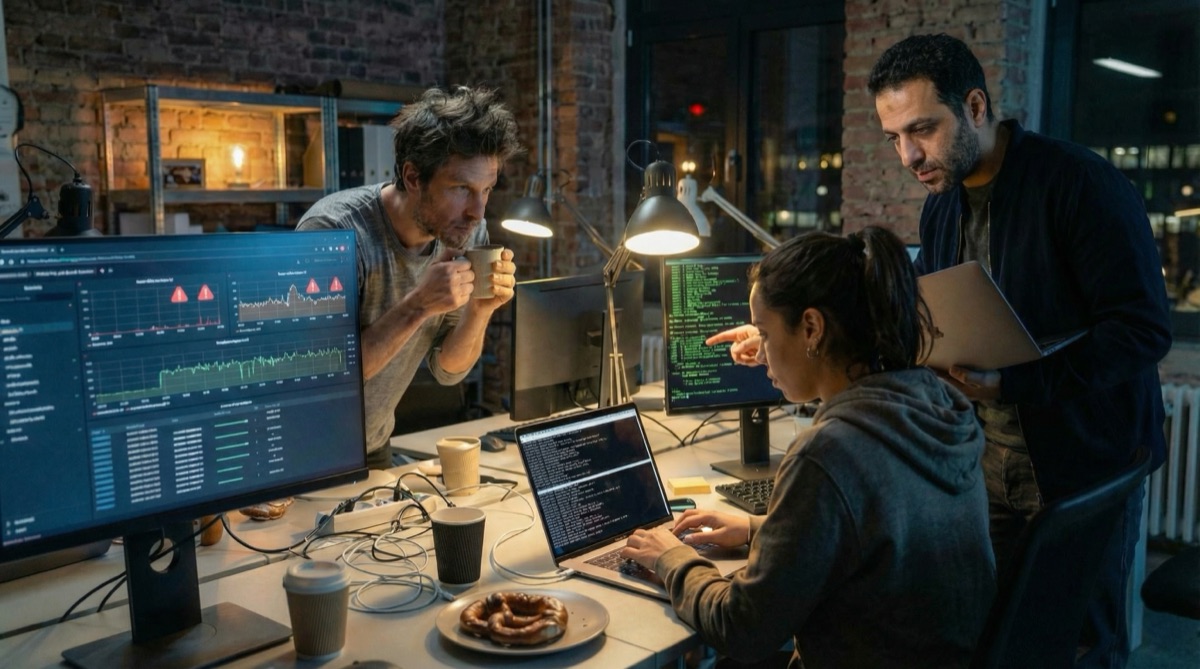 When Players Revolt
They fixed the validation bug properly — six hours, no corners cut. But the database migration script Anton wrote Monday night to handle legacy NUL...
Technical Consultancy
Senior Developer Advocate
Embedded into your team as an active contributor, increasing effectiveness and elevating engineering clarity.
Technical Advisor
Peer-style technical assessments before far-reaching decisions; reduce architectural and product risk early.
Product & Delivery
Ship working software to real users earlier. Measure impact and adapt based on evidence rather than assumption.
Custom Software Development
High quality, maintainable software. Short-term augmentation that leaves lasting capability in your own team.
Recent Articles
- When Labor Becomes Cheap, Motivation Becomes Everything (06.04.2026)
- Authentication Methods That Work in 2026 (03.04.2026)
- Developer, Not Engineer. And Why It Matters (30.03.2026)
- The Product Manager Is Dead. Long Live the Product Developer. (27.03.2026)
- Building Products in the Age of AI (23.03.2026)
Explore More