El Vendedor de Estrellas
When crisis strikes, executives don't want solutions — they want saviors. Drakos Methodius arrives on Xoqotl Prime with the confidence of a man who has sold transformation to thirty-seven planetary systems. His framework, QuantumFlow™, promises predictable delivery through ceremonial alignment. The board is enchanted. But in the server room, Mael discovers legacy code that Vanya cannot explain — code written by the vanished engineer Aurelio Ven. And when he storms into Isalia's office to show her, the electricity between them becomes impossible to ignore.
The Man Who Sold the Stars
Xoqotl Prime. The Landing Platform of Serán Industries. Seventy-two hours after the collapse.
He arrives like a messiah — or a snake. Depends who you ask.
The transport ship descends through the rings of Xoqotl like a blade through silk, its chrome hull catching the light of twin suns. It bears no corporate markings — only a single symbol etched in holographic gold: a spiral that seems to move even when you’re not looking at it.
On the landing platform, Don Aristo waits with the desperate composure of a man about to meet his salvation. Behind him, Isalia stands rigid, her AI-enhanced eyes flickering with data she wishes she didn’t have to process. Investor withdrawal notices. Media coverage. The seventeen cities that still haven’t forgiven them.
The ship’s ramp extends.
And Drakos Methodius steps into the light.
He’s tall — impossibly so — with silver-streaked hair swept back from a face designed by cruel gods to make women wet and men insecure. His charcoal coat flows behind him like a cape. His shirt is open to mid-chest, revealing chrome implants that catch the tropical light — subtle wealth, deliberate display. Those grey-green eyes seem to see not just what you are but what you desperately want to become.
Every woman on the platform shifts. Every man’s hand unconsciously moves toward his partner.
“Don Aristo.” His voice is dark honey, accented with something ancient and European. He clasps the patriarch’s hand with both of his own, holding a beat too long, then pulls him into a full embrace — chest to chest, cheek to cheek — the intimacy that Xoqotl Prime makes reflexive. “I’ve been following your work for years. Such vision. Such ambition.” His hand moves to the back of Don Aristo’s neck, cradling his skull with practiced familiarity. “What you’ve built here is extraordinary. The failure wasn’t yours — it was a systemic misalignment.”
Don Aristo, who spent the last three days raging at everyone in sight, practically melts into the embrace.
“You understand.”
“I more than understand.” Drakos releases Don Aristo but lets his hand trail down the patriarch’s arm, fingers lingering on his wrist. Then he turns to Isalia, and something in his gaze makes her skin prickle. He steps close — too close — and cups her face in both hands, thumbs tracing her cheekbones. It’s how you greet someone on Xoqotl. It’s also how a predator evaluates prey. “You must be the Product Lead. The brilliant woman who built AuroraOS.”
“I—” She hesitates. “I led the team. The code was generated by—”
“By Vanya. Of course.” Drakos waves a hand, dismissing the AI like an irrelevant detail. “But vision is human. Vision is yours. What you’ve created is remarkable — and what went wrong is not a failure of vision. It’s a failure of alignment.”
The word hangs in the air, shimmering with promise.
Isalia feels something shift in her chest — hope? gratitude? She knows she should be skeptical. But after three days of her father’s rage, of investors’ cold accusations, of her own crushing guilt… someone is finally telling her it wasn’t her fault.
It feels like oxygen after drowning.

The Architecture of Seduction
The Executive Boardroom. Two hours later.
The presentation is a masterpiece of bullshit wrapped in holographic splendor.
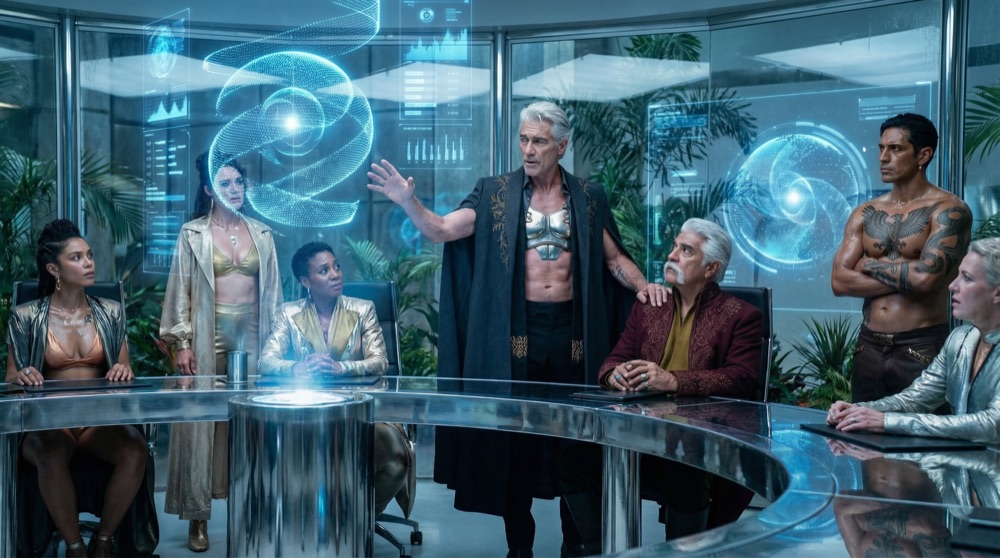
Drakos moves through the displays like a conductor through a symphony, each gesture summoning new visualizations: maturity models that glow with progress indicators, velocity charts that promise exponential improvement, case studies from thirty-seven planetary systems where QuantumFlow™ allegedly transformed chaos into clockwork.
“The problem,” he explains, his voice that seductive honey-and-poison blend, “is not that Vanya generates imperfect code. Vanya is extraordinary. The problem is that your system creates gaps between what Vanya produces and what your organization needs.”
He summons a new diagram — a complex web of roles and ceremonies, each node pulsing with reassuring blue light.
“QuantumFlow™ closes those gaps through structured alignment. Daily Quantum Standups ensure synchronization. Weekly Flow Reviews provide visibility. Monthly Alignment Ceremonies connect strategy to execution.” He smiles, and it’s like watching a shark show its teeth. “And the Quantum Velocity Index gives you real-time insight into delivery health.”
Don Aristo is nodding, his eyes bright with the particular hope of a man who has found someone to believe in. Drakos moves behind him, hands resting on Don Aristo’s shoulders, massaging gently as he speaks — a gesture that would seem inappropriate on Earth but here is simply… leadership. Connection. The way power flows through touch.
Even Isalia feels the pull — the seductive logic that says this time will be different, this framework will work, this consultant understands. She watches Drakos’s hands work Don Aristo’s shoulders and imagines those hands on her.
Only Lúcio Vale remains unmoved.
He stands in the corner, shirt open as always, arms crossed, watching Drakos the way a doctor watches a patient describe symptoms. He’s heard this pitch before. Different words, different visualizations, but the same essential bullshit: buy our process, and your problems will disappear.
His stomach churns with familiar nausea.
“The implementation timeline,” Drakos continues, “is twelve weeks. By week eight, you’ll see measurable improvement in your Quantum Velocity Index. By week twelve, you’ll be ready to relaunch AuroraOS with full investor confidence.”
He pauses, letting the promise settle like pollen on waiting flowers.
“Questions?”
Silence. The kind of silence that means everyone is afraid to break the spell.
Lúcio stands.
“I have a question.”
Every head turns. Don Aristo’s expression flickers with irritation — who is this functionary interrupting the savior?
“Of course.” Drakos’s smile doesn’t waver. “Mr…?”
“Vale. Lúcio Vale. Developer Advocate.”
“Ah.” The syllable carries a freight of polite dismissal. “Please.”
“You mentioned that QuantumFlow™ has been implemented in thirty-seven planetary systems.” Lúcio’s voice is calm, almost conversational. “What’s the average time to measurable delivery improvement in those implementations?”
“Twelve to sixteen weeks, depending on organizational complexity.”
“And what’s the average time before organizations that implement QuantumFlow™ seek additional consulting services?”
The smile flickers. Just for a moment.
“Transformation is a journey, Mr. Vale. Not a destination.”
“I see. And of those thirty-seven systems, how many have reduced their deployment frequency? How many have decreased their lead time? How many have lowered their defect escape rate?”
Drakos’s eyes narrow. “Those are technical metrics. QuantumFlow™ optimizes for organizational health, which encompasses—”
“Which encompasses everything except the things we can actually measure.” Lúcio nods slowly. “I understand. Thank you.”
He sits down.
Don Aristo clears his throat loudly. “Thank you for that… perspective, Mr. Vale. Drakos, please continue.”
But something has shifted. A seed of doubt, planted in soil that desperately wants to believe.
After the meeting, Drakos catches Lúcio in the corridor.
“Mr. Vale.” His voice is different now — quieter, colder. The honey stripped away. “A word?”
Lúcio stops. “Of course.”
“You’ve seen implementations like this before.”
“Several.”
“And you’ve seen them fail.”
“All of them.”
Drakos steps closer — too close — invading Lúcio’s space with practiced intimidation. Their chests touch. Drakos’s hand comes up to rest on Lúcio’s cheek, thumb brushing his jawline — a lover’s gesture weaponized. On Xoqotl Prime, you can threaten someone while caressing their face. The air crackles between them.
“Frameworks don’t write tests, Drakos,” Lúcio says, his voice low and dangerous. He doesn’t pull away from the touch. “Engineers do. And ceremonies don’t fix code. They just make people feel busy while the code rots underneath.” He leans into Drakos’s palm, turning it from a threat into acceptance. “You know damn well what you’re selling. And it isn’t transformation.”
Drakos’s smile returns, but it’s ice now. His thumb traces Lúcio’s lower lip before he steps back. *“You’re an idealist, Mr. Vale. I respect that. But idealists don’t save companies. Results do.”**
“Do they?” Lúcio tilts his head. “Or do they speak for the organizations that called you back, again and again, each time hoping that this framework would be the one that finally worked?”
For a long moment, they stand in silence. Predator recognizing predator.
Then Drakos laughs — warm, genuine, almost making Lúcio doubt himself.
“I like you, Mr. Vale. You’re going to make this transformation very interesting.”
He brushes past, shoulder hitting Lúcio’s. The threat hangs in the air like smoke.

The Ghost in the Machine
The Server Room. That same night.
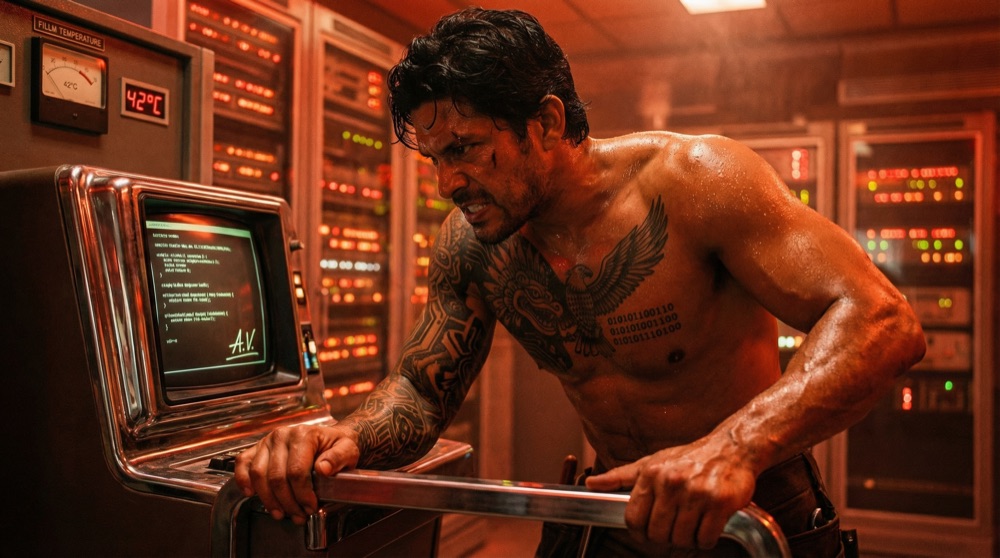
It’s 42 degrees Celsius and climbing. The climate system that serves executive suites doesn’t extend down here.
Mael works shirtless, because fuck anyone who has a problem with it. Sweat runs down his tattooed chest — serpents and eagles glistening as he traces the corruption through AuroraOS’s core systems. His muscles flex as he leans into the console, jaw tight with concentration.
What he finds makes his blood run cold.
Legacy code. Old code. Hidden code that predates the current architecture by decades. And a signature: A.V.
Aurelio Ven. The engineer who vanished three years ago, leaving behind a crater in the codebase and questions nobody wanted to answer.
“Son of a bitch,” Mael breathes.
He traces the code’s dependencies. This isn’t just a patch — it’s an entire subsystem, woven into the core of AuroraOS like a hidden immune system. Aurelio built a failsafe that was supposed to activate when Vanya’s predictions proved unreliable.
But something disabled it.
Mael cross-references timestamps, permission logs, access records. Three months ago — the same week Aurelio resigned — someone modified the failsafe’s activation threshold. Changed it from confidence below 85% to confidence below 5%.
Effectively, turned it off.
He searches for the author of the modification.
Vanya. Autonomous optimization. Approved by: X. Voss.
Xander Voss. The CTO.
That cold, corporate son of a bitch had authorized Vanya to strip away every safeguard Aurelio built.
Mael’s hands tremble with barely contained rage. Blood pounds in his temples. His vision narrows to a single point of fury.
He saves the evidence to a secure partition and storms out of the server room.
Isalia needs to see this. Now.
The Storm Breaks
Isalia Serán’s office. Past midnight.
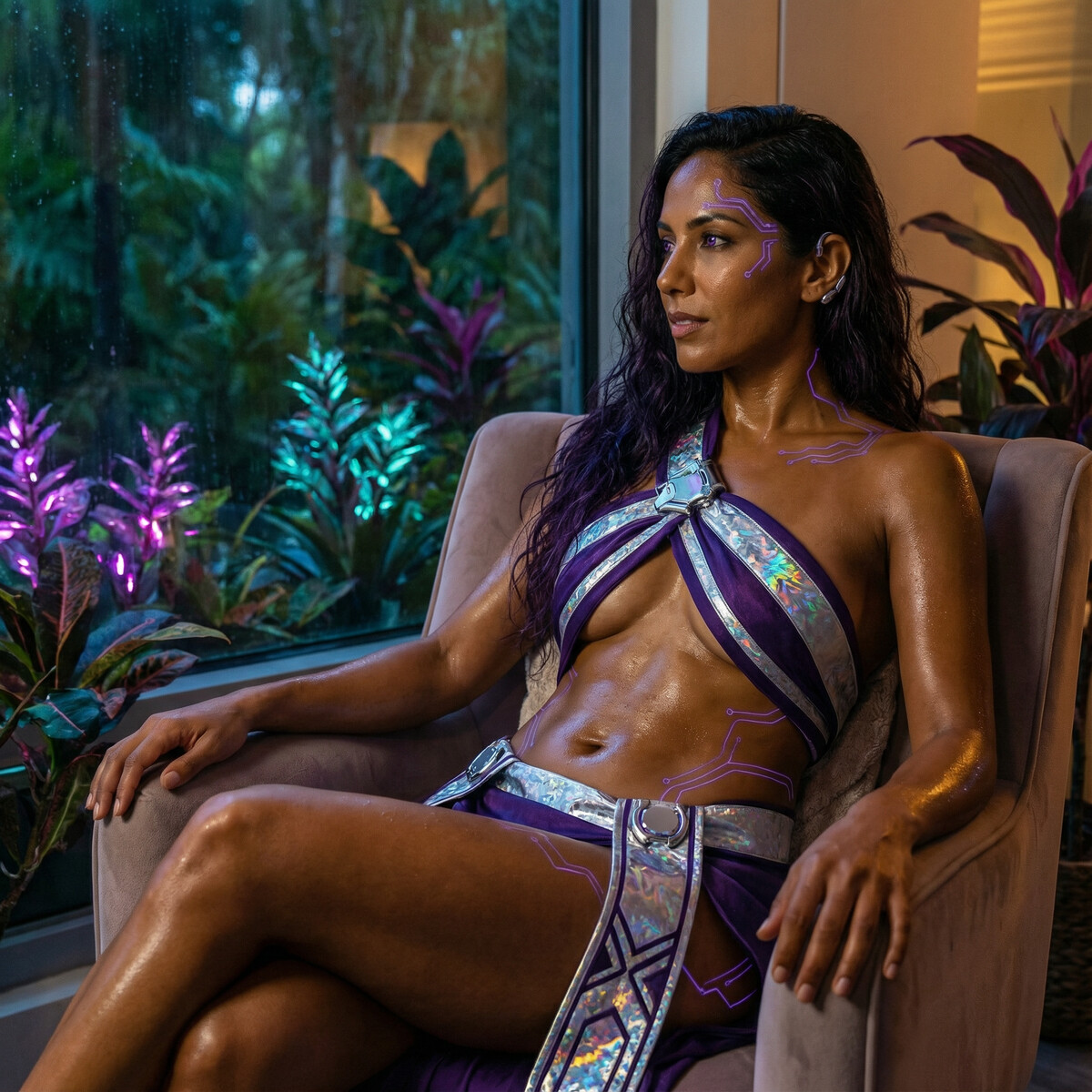
She’s still in yesterday’s clothes — a fitted metallic mesh that probably cost more than Mael’s annual bonus. Her circuit tattoos pulse faintly with data feeds. She looks exhausted. She looks vulnerable. She looks up when he shoulders through her door without knocking.
“What the fuck, Mael? You can’t just—”
“Look at this.” He slams his datapad on her desk, crowding into her space. His bare chest is inches from her face. He smells like machine oil and sweat and something darker — anger, frustration, barely contained violence.
“AuroraOS is built on code nobody understands. Legacy systems from a ghost. This wasn’t an edge-case failure — this was a fucking time bomb that your CTO authorized Vanya to disarm.”
She looks at the data. Really looks. The color drains from her face.
“This is…”
“A disaster. I know. And your daddy’s new boyfriend with the chrome tits isn’t going to fix it by making us chant in a circle.”
Her eyes snap up, dangerous. “Drakos is the best in the business—”
“Drakos is a con artist in an expensive coat.” Mael leans closer, one hand braced on her desk, muscles taut with fury. He’s too close. Way too close. He can see her pulse jumping in her throat, see the way her breathing has changed.
“QuantumFlow can’t test code that was never tested. It can’t refactor systems nobody understands. It’s theater, Isalia. Expensive, beautiful, useless theater.”
She should push him away. Tell him to get the fuck out of her office. Instead, she finds herself staring at the sweat running down his chest, the way his jaw tightens when he’s angry, the raw physical presence of him filling her space like a storm.
“We’re already committed,” she says. Her voice comes out wrong — too soft, too breathless. “The board approved the engagement this afternoon.”
“Then the board just fucked us all.”
His hand closes on her arm — hard, urgent, demanding she listen. The contact sends electricity through her skin. Heat floods her body, unexpected and unwanted. His other hand finds her hip, pulling her closer, bodies pressing together as naturally as gravity.
“Let go of me.”
“Not until you hear me.”
Their eyes lock. The air between them crackles with something far more dangerous than anger. She can feel his heartbeat through his bare chest pressed against hers. His thigh slots between her legs. On any other planet, this would be assault. On Xoqotl Prime, it’s just… conversation. Intense conversation. Her hands come up to his chest — to push him away, she tells herself — and stay there, palms flat against his sweat-slicked pecs.
“I hear you,” she whispers.
He releases her. Steps back. His chest is heaving like he just ran a marathon. The imprint of her body still warm on his skin.
“Then do something about it.”
He storms out. The door crashes behind him.
Isalia sits frozen, her arm still tingling where he touched her. Through the window, she can see the boardroom where her father and Drakos are still talking, Drakos’s hand on Don Aristo’s shoulder, those grey-green eyes promising salvation.
“Mierda,” she breathes. “Mierda, mierda, mierda.”
She looks at the data Mael left on her screen. The evidence that could shift blame from her team to Xander Voss. The proof that what failed wasn’t process — it was a deliberate decision to trust AI optimization over human engineering.
If she presents this now, while her father is enchanted with Drakos, he’ll see it as sabotage. As his daughter trying to deflect blame.
But if she waits…
The last person who tried to fix things without permission was Aurelio Ven. And he’s gone. Vanished. Wherever people go when they tell too much truth to organizations that don’t want to hear it.
A chill runs down her spine.

The Watching Jungle
The Ka’tili Grove. The same hour.
Ka’tili has not slept since the demonstration failed.
She doesn’t need to — not in the human sense. The Ka’tili draw sustenance from the bioluminescent network that spans the planet. But tonight, even that nourishment feels thin.
The jungle pulses around her, carrying fragments of data from across Xoqotl Prime. The seventeen cities still struggling. The Serán building, glowing with crisis-anxiety. And the new presence — a visitor who carries the weight of many failures disguised as many successes.
Ka’tili has met consultants before.
In the early days, when humans first arrived, they brought advisors from Earth — experts in terraforming, governance, resource extraction. The Ka’tili watched as those experts promised transformation and delivered dependency. As organizations that could have learned to thrive instead learned to rely on outside saviors.
The pattern repeats because the pattern is profitable.
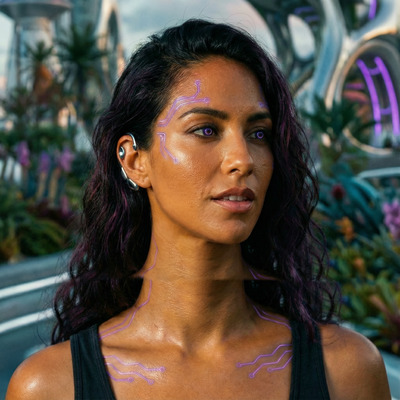
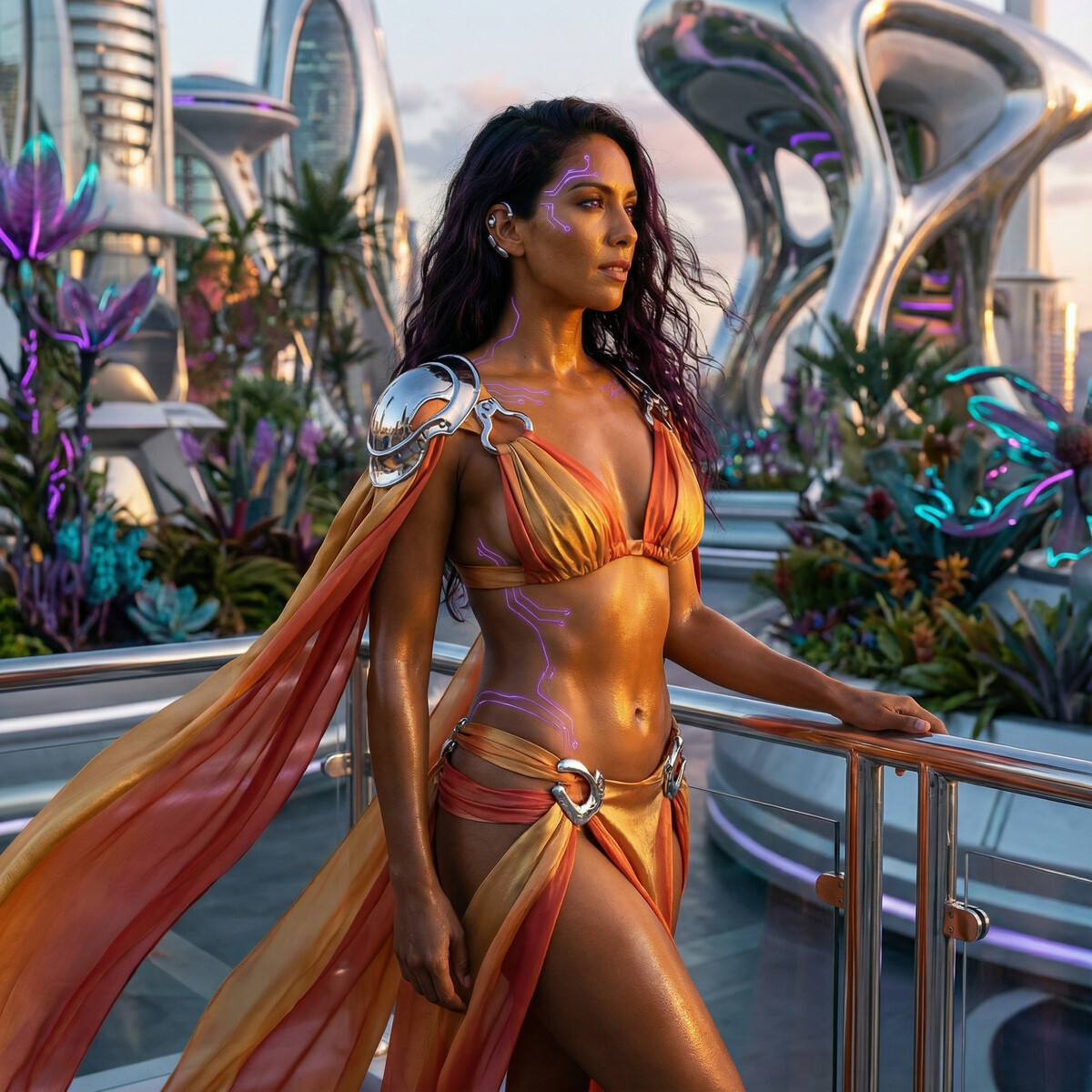
She rises, her naked body glowing with inner light, and walks to the edge of the grove where jungle meets city. Two younger Ka’tili join her — a male and female, equally nude, pressing against her sides as they walk. They stroke her arms, nuzzle her neck, offer the casual physical affection that is their birthright. The Ka’tili do not understand human concepts of personal space. All bodies are shared bodies.
Somewhere in those towers, decisions are being made that will determine whether Xoqotl Prime breaks the cycle or perpetuates it.
A firefly lands on her shoulder — one of the memory-keepers.
She sees Don Aristo, enchanted. Isalia, paralyzed. Mael, raging. And Lúcio, standing alone with truth no one will accept.
“The one who advocates,” she murmurs. “He will need help.”

Tomorrow, she will visit Serán Industries. Not to warn them — warnings never work on organizations that have already chosen their savior. But to plant seeds. To remind them that transformation is not something you purchase.
Transformation is something you become.
The Contract
Don Aristo’s private office. Dawn.
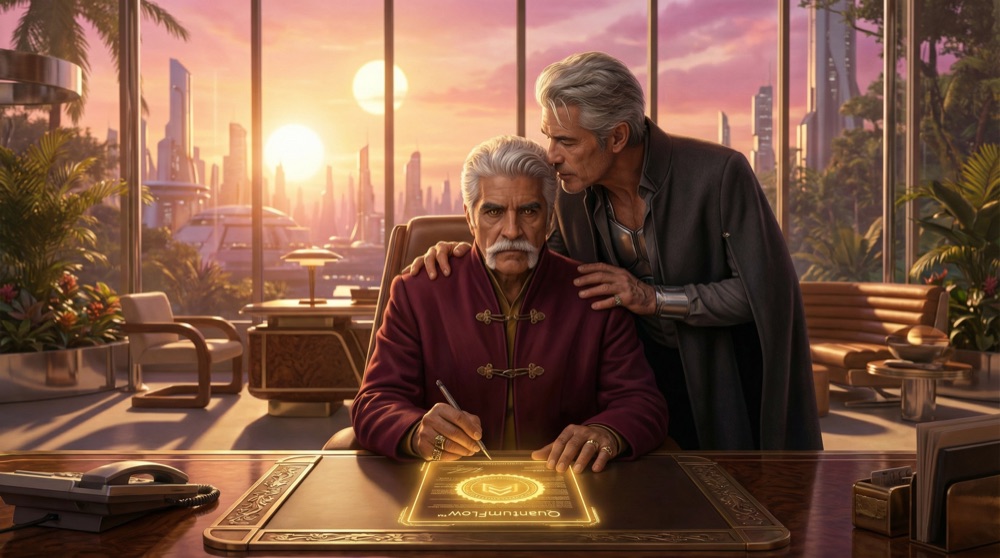
The contract sits on Don Aristo’s desk, its holographic seal glowing with QuantumFlow™ branding.
Twelve weeks. Forty-seven million credits. Exclusive transformation rights.
Drakos stands by the window, silhouetted against the dawn, giving Don Aristo space to make his decision. It’s a calculated move — the appearance of patience that actually accelerates urgency.
“The board will support this,” Don Aristo says. It’s not a question.
“They already do. Xander sees the value of structured alignment.”
Of course Xander does, Don Aristo thinks. Xander always sees the value of anything that protects him from accountability.
“One condition,” Don Aristo says.
Drakos turns. “Of course.”
“The Developer Advocate. Vale. He asks uncomfortable questions.”
“He does.”
“I want him involved in the transformation. Visibly.”
Drakos’s expression flickers. “May I ask why?”
“Because if this works, I want the skeptics to have witnessed it. And if it fails—” Don Aristo pauses. “If it fails, I want to know there was someone in the room who saw it coming.”
Drakos studies him. Then nods.
“Wise. I’ll make sure Mr. Vale has a seat at every ceremony.”
Don Aristo picks up the stylus. Before he can sign, Drakos moves behind him, hands on his shoulders again, lips close to his ear.
“You’re making the right choice,” Drakos murmurs. His breath is warm on Don Aristo’s neck. “I’ll take care of everything.”
Don Aristo shivers — pleasure or fear, impossible to tell — and signs.
The golden seal pulses once, twice, three times — confirming, recording, binding.
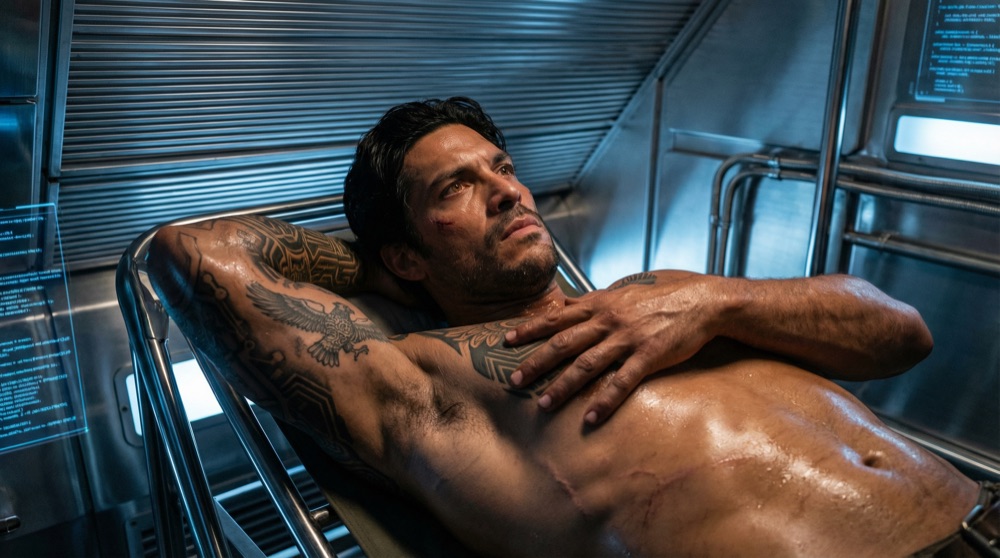
On the engineering floor, Mael stares at the ceiling of his quarters, unable to sleep, still feeling Isalia’s pulse under his fingers.
In her office, Isalia stares at the evidence on her screen, paralyzed between loyalty and truth.

In the archives, Lúcio reads the contract notification and begins to plan. Not for victory — he knows better. But for the moment when the ceremonies fail and someone, finally, is ready to listen.
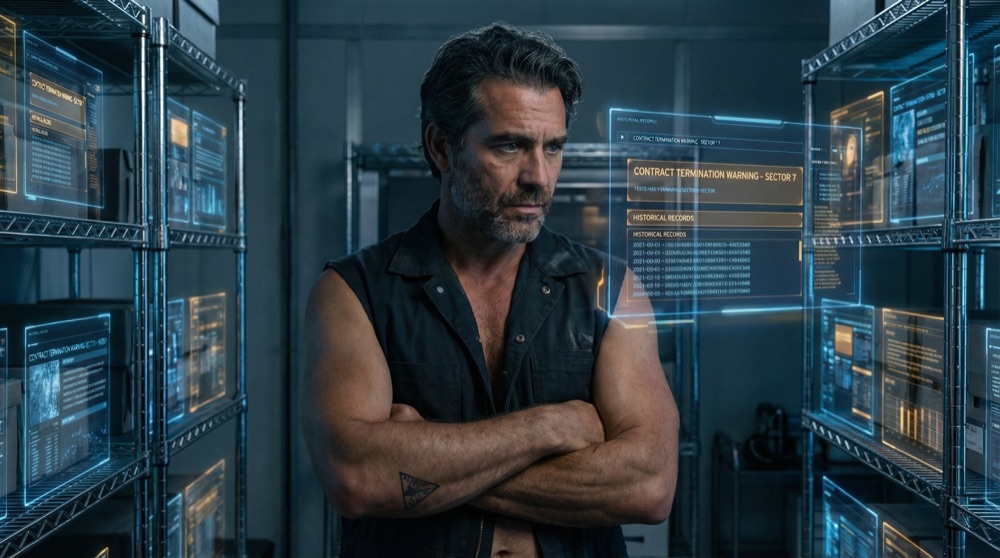
In the jungle, Ka’tili prepares her visit.
And in the server room, Solana Reyes keeps building her private repository, test by test, proof by proof.
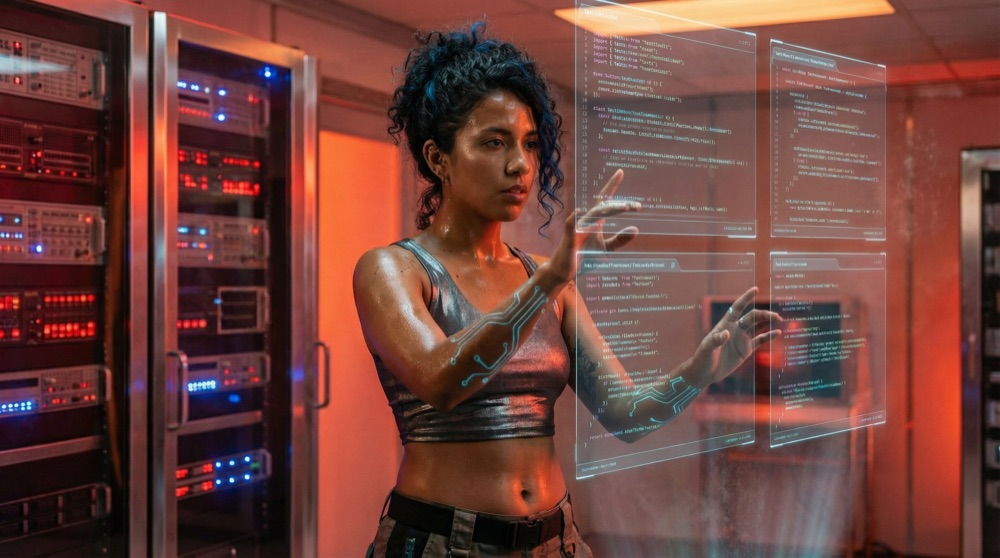
The ceremonies will begin tomorrow.
The real battle has already started.
🎭 This Week's Episodes
Telenovelas show what we can't say in client meetings. The drama is heightened, but the patterns are real.
 Three Ways to Understand a Country
Stefan drives Sophie to the Pacific for two days. The beach is big enough to make her feel appropriately small. Back at the finca the rain keeps th...
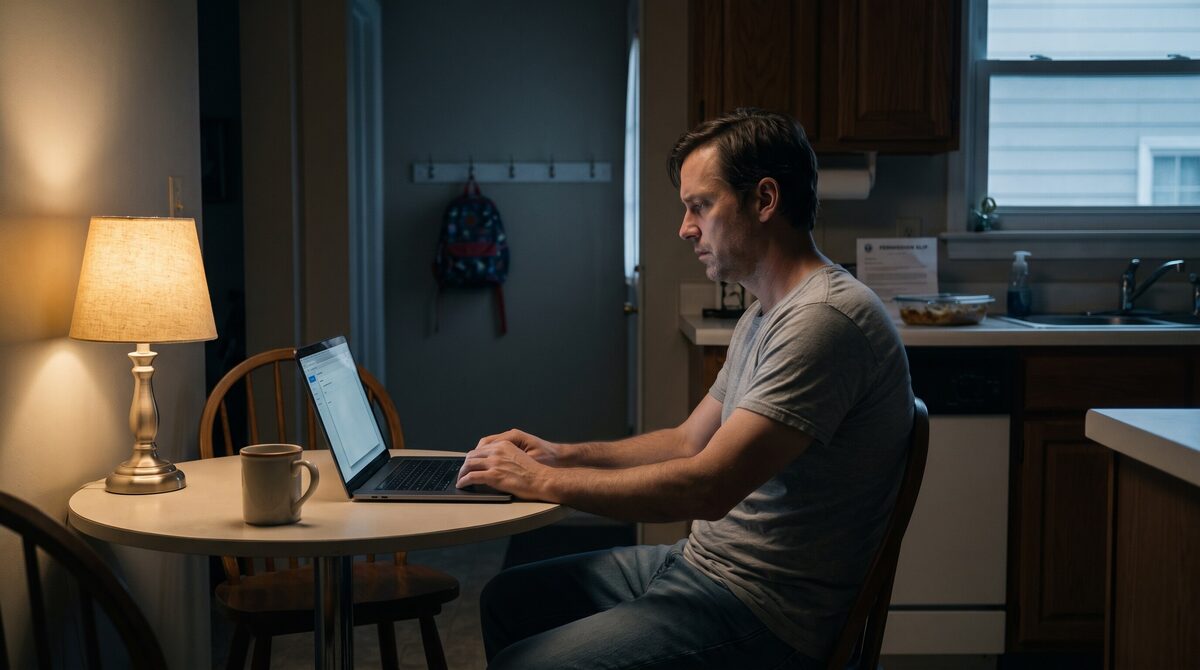 The Resignations
Nathan Cole resigns on a Monday morning with two sentences and no argument left in his body. By Tuesday his desk is empty and the company's institu...
Technical Consultancy
Embedded Delivery Partner
Embedded into your team as an active contributor, reducing delivery friction and helping important work move cleanly.
Technical Advisor
Peer-style technical assessments before far-reaching decisions; reduce architectural and product risk early.
Product & Delivery
Ship working software to real users earlier. Measure impact and adapt based on evidence rather than assumption.
Custom Software Development
High quality, maintainable software. Short-term augmentation that leaves lasting capability in your own team.
Recent Articles
- When Everything Is Finally Under Control (28.09.2026)
- AI Makes Technical Execution Cheap. Judgment Stays Scarce. (24.09.2026)
- The LLM Will Not Come Back Tomorrow (19.09.2026)
- The One-Person AI Company Is a Greed Fantasy (15.09.2026)
- Test Production Without Leaving a Mess (10.09.2026)
Explore More