Arrival
Stefan Richter arrives in São Paulo with a 90-day contract to fix delivery at AutoConnect Brasil. He finds 90 developers, 18 months of chaos, and a car entertainment system that barely works. The radio plays music. Everything else crashes. As Klaus Hartmann digs into catastrophic financials, Stefan sits down to code with Júlia Nascimento — and discovers the one thing that might save them all: someone still remembers how to write a test first.
The City That Never Sleeps Quietly
São Paulo. January 2020.

The humidity hit Stefan Richter like a wall the moment he stepped out of Guarulhos International Airport. Berlin in January meant gray skies and frozen breath. São Paulo meant something else entirely — a wet heat that clung to his skin, carried on air thick with exhaust, grilled meat, and the electric hum of twelve million people all awake at once.
His hotel room on Avenida Paulista offered a view of the city’s contradictions: glass towers pressed against brutalist concrete, tropical green fighting through every crack, favelas climbing the distant hills like warnings no one wanted to read. Stefan stood at the window in his underwear, jet-lagged and wide awake at 3am, watching the lights pulse.
He’d read the brief on the flight. AutoConnect Brasil. Ninety-plus developers. Eighteen months of development. One product that should have shipped a year ago.
BergMotor AG — the German automotive giant with a factory in São Bernardo do Campo — had contracted AutoConnect to build the infotainment system for their budget car line. Radio. Navigation. Climate control integration. Vehicle diagnostics. All speaking to the car’s CAN bus, all working seamlessly.
The radio worked.
Nothing else did.
His phone buzzed. A message from Leo Ferreira, the developer who’d recommended him:
Leo Landing okay? Get some sleep. Tomorrow is going to be long.
Stefan typed back:
Stefan Sleep is for the dead. What am I walking into?
The response came immediately:
Leo Exactly what you're afraid of.
Leo But there are good people here. Adriana. Júlia. Rafa. They haven't given up yet.
Leo They just need someone to show them there's a way out.
Stefan looked back at the city. Somewhere out there, ninety developers were writing code that wouldn’t ship. Somewhere, a German financial controller named Klaus Hartmann was reviewing spreadsheets that didn’t add up. And somewhere, a CEO named Bernardo Souza was sleeping soundly, confident that consultants would save him.
Stefan had written a book called Engineering Over Process. He’d spoken at conferences across three continents. He’d helped teams in Berlin, Barcelona, Buenos Aires.
But he’d never fixed a team this broken.
He pulled out his laptop and opened the AutoConnect codebase for the hundredth time since the contract was signed. Feature branches everywhere. Some dating back eight months. A test coverage report showing 12% for the navigation module. Zero percent for climate control.
Tomorrow, he would meet them. Tomorrow, he would start coding alongside them. Tomorrow, he would find out if there was anything left to save.
Tonight, he just watched the city breathe and wondered what he was really running from.
His daughter Emma was asleep in Berlin. His wife — his soon-to-be-ex-wife — was probably awake, staring at the ceiling of their apartment, wondering where it all went wrong.
Stefan knew where. He just couldn’t fix it.
Maybe São Paulo would be different. Maybe he could save something here.
The city offered no promises. It just kept humming.
The Bridge
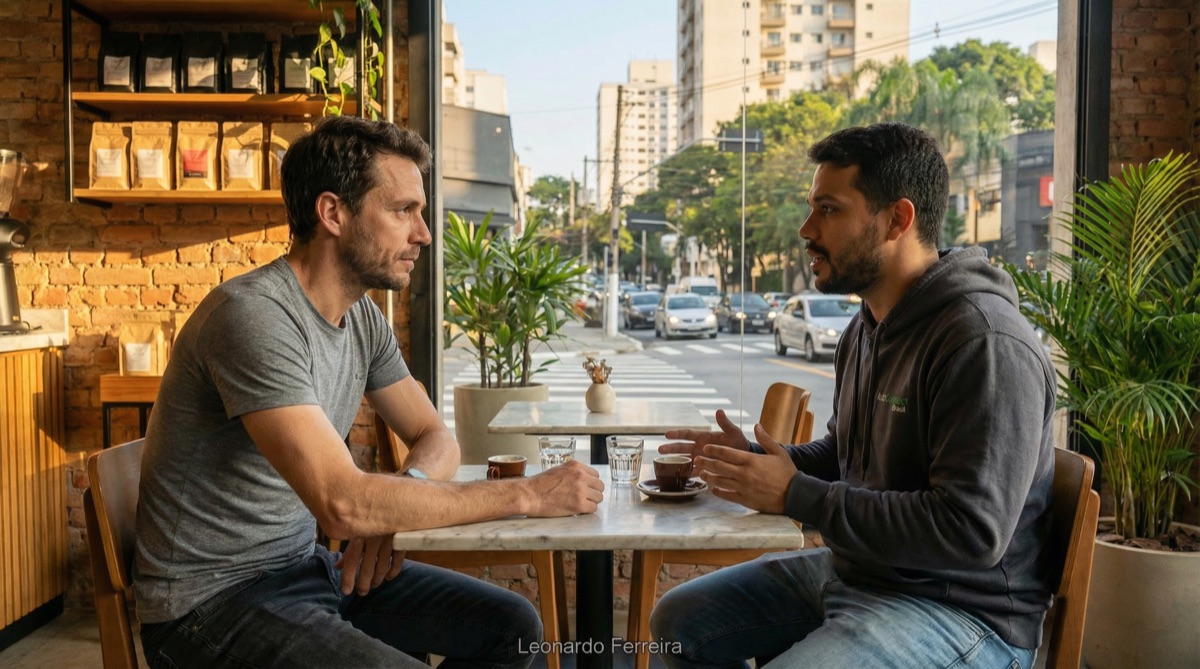
Leo Ferreira was waiting at a café two blocks from the AutoConnect office, a small espresso cup already empty in front of him. He stood as Stefan approached — lean, relaxed, dressed in the Valley-casual uniform of hoodie and sneakers that looked slightly wrong against São Paulo’s more formal business district.
“You look like shit,” Leo said cheerfully.
“Twelve hours in economy will do that.” Stefan took a seat. The waiter appeared instantly. “Café, por favor. Strong.”
“It’s Brazil. All the coffee is strong.” Leo studied him. “You read the codebase.”
“Couldn’t stop.”
“And?”
Stefan rubbed his eyes. “Feature branches from eight months ago. Test coverage that would make a bootcamp graduate cry. A navigation module that looks like it was designed by someone who hates drivers.”
“That’s navigation. You should see climate control.”
“I did. There’s nothing to see.”
Leo nodded. “Now you understand why I called you.”
The coffee arrived — thick, dark, almost syrupy. Stefan drank half of it in one gulp and felt his nervous system realign.
“Tell me about the people,” he said.
Leo leaned back. “Adriana Costa. Engineering lead. Brilliant. Still codes every day. Knows the automotive embedded systems better than anyone alive. She’s been fighting this battle for three years. The executives ignore her.”
“Why?”
“Because she tells the truth, and the truth is inconvenient.” Leo shrugged. “She’s your natural ally. If you can convince her you’re not another consultant with slides.”
“I don’t do slides.”
“I know. That’s why I recommended you.” Leo’s expression grew serious. “But Stefan — she’s seen consultants before. Germans, Americans, everyone with frameworks and promises. They all left. Things got worse. She doesn’t trust outsiders.”
“I’m not here to consult. I’m here to code.”
“Prove it. That’s the only thing that will convince her.”
Stefan nodded. “Who else?”
“Júlia Nascimento. Backend developer. Young, talented, frustrated. She’s on the climate control team — the one with zero tests. She knows it’s broken. She just doesn’t know how to fix it.” Leo paused. “She’s also… magnetic. Be careful.”
Stefan raised an eyebrow.
“I’m serious.” Leo’s voice dropped. “She’s young. You’re not. You’re also running from something in Germany — don’t think I didn’t notice. Júlia is not the answer to whatever question you’re avoiding.”
“I’m not here for—”
“I know. Just… be careful.” Leo finished his coffee. “Then there’s Rafa Lima. Junior developer, embedded systems. Self-taught, brilliant, terrified. He found something in the project budgets that scared him. He told Adriana. She told Helena — my aunt, the board member who hired you.”
“What did he find?”
“That’s the thing. Nobody will tell me. Helena just said the financial situation was ‘complicated’ and that BergMotor was ‘concerned.’” Leo shook his head. “That’s why Klaus Hartmann is here. The German controller. Sent from Stuttgart to figure out where the money went.”
Stefan processed this. Financial irregularities. A missing story. Developers who’d found something they shouldn’t.
“What about the CEO? Bernardo something?”
Leo’s face hardened. “Bernardo Souza. CFO, actually, but he runs everything. Don’t trust him. Don’t trust anyone he introduces to you. And don’t let him convince you that the problem is the developers.”
“Is it?”
“Christ, no.” Leo leaned forward, intense now. “Stefan, these people are good. They’re not bad developers. They’re sabotaged developers. The process, the politics, the impossible deadlines — it’s all designed to make them fail. And every time they fail, Bernardo brings in another consultant, another framework, another magic solution that costs money and changes nothing.”
“Why would he want them to fail?”
Leo hesitated. “I don’t know. But my aunt Helena is asking the same question. That’s the real reason you’re here. Not just to fix delivery. To find out what’s really going on.”
Stefan finished his coffee. The caffeine was hitting now, sharpening the edges of a picture he didn’t fully understand yet.
“Take me to them,” he said.
The Floor

AutoConnect Brasil occupied floors eight through twelve of a mid-rise tower on Avenida Paulista. The lobby was all glass and chrome, designed to impress investors. The development floor was something else entirely.
Open plan. Low cubicle walls. Developers hunched over monitors with the posture of people who hadn’t looked up in months. Whiteboards everywhere, covered in diagrams that looked more like crime scene evidence than architecture. Post-it notes fading in the tropical sun that poured through floor-to-ceiling windows.
Stefan noticed the divisions immediately. In the corner by the windows — natural light, plants that were actually alive — a cluster of desks with people who talked to each other, laughed occasionally, had whiteboards showing actual test cases. The radio team.
In the middle of the floor — cramped, no windows, fluorescent lights buzzing — two larger groups that didn’t talk to each other at all. Navigation. Climate control. Their whiteboards showed blocked tasks, crossed-out items, and someone had drawn a stick figure hanging from a noose labeled “CAN bus.”
Leo led him past the clusters toward a glass-walled office in the back corner. Inside, a woman in her late thirties was reviewing code on a large monitor, her expression the concentrated fury of someone who’d just found a bug that should have been caught months ago.
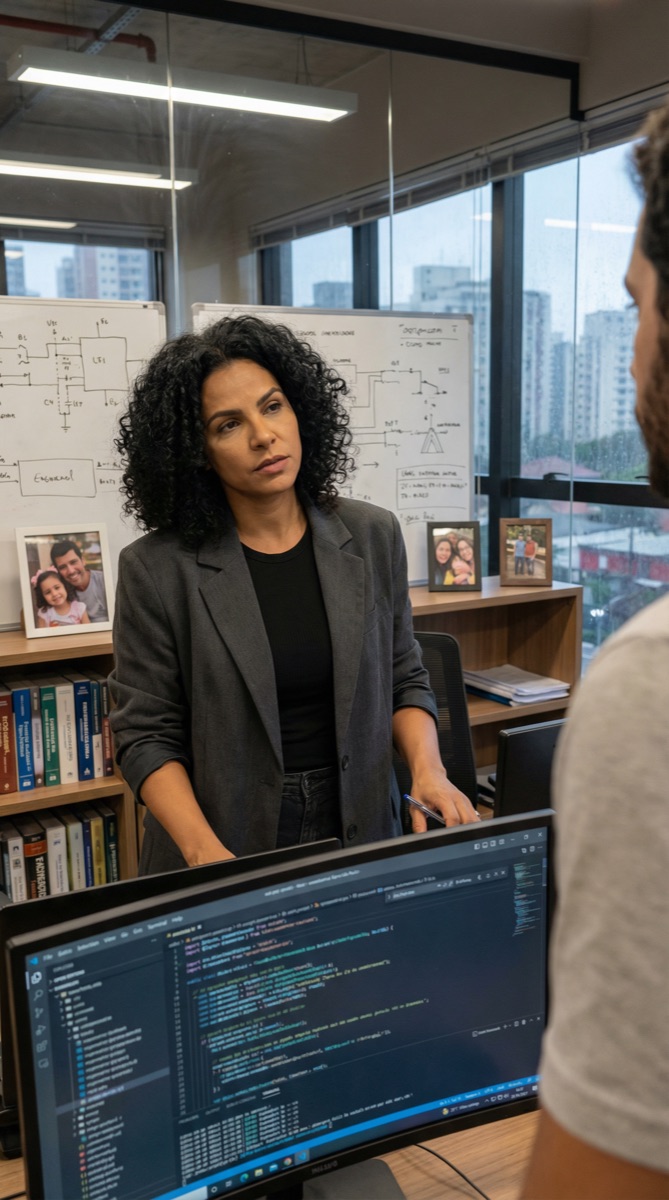
“Adriana.” Leo knocked on the doorframe. “This is Stefan Richter.”
She didn’t look up. “The German who wrote the book.”
“That’s me.”
“Helena sent you.”
“She hired me. Leo recommended me.”
Now she looked up. Brown skin, natural curls she’d stopped trying to control, eyes that assessed him like a compiler checking for syntax errors.
“Show me your hands.”
Stefan blinked. Then he understood. He held them out, palms up.
Adriana studied them. Calluses on the fingertips. Short nails. The slight tension of someone who spent eight hours a day at a keyboard.
“You actually code,” she said. Not a question.
“Every day.”
“Good.” She stood, came around the desk. “Because the last three consultants Helena sent had soft hands and PowerPoint presentations. They talked about ‘process transformation’ and ‘agile maturity’ and left us with another framework to ignore.”
“I don’t do frameworks.”
“What do you do?”
Stefan gestured at the floor behind him. “I sit with developers. I code with them. I figure out why things are broken. And then I fix them. Or help them fix them.”
Adriana’s expression didn’t change, but something shifted behind her eyes. A door opening, just a crack.
“Navigation team.” She pointed at the middle section. “They’ve been trying to get CAN bus integration working for six months. The temperature sensor read works — finally — but everything else crashes. They have no tests. No deployment pipeline. Nothing.”
“Where do you want me to start?”
“Climate control.” She pointed at the other cluster. “They’re worse. No tests at all. The lead developer quit two months ago. Júlia’s trying to hold it together, but she’s drowning.”
Stefan looked at the climate control area. A young woman with natural curls and bright earrings was staring at her monitor, jaw clenched, hands moving over the keyboard with the frustrated energy of someone who kept trying the same thing hoping for different results.
“That’s Júlia?”
“That’s Júlia.” Adriana’s voice softened slightly. “She’s good. She just doesn’t know it yet.”
“Then let’s start there.”
Adriana studied him for another long moment. Then she nodded once — sharp, decisive.
“Don’t disappoint me, German.”
The Numbers Man

Klaus Hartmann had been in São Paulo for three days, and he’d spent most of them in a conference room on the fifteenth floor, surrounded by spreadsheets that made his stomach hurt.
The tie was too tight. It was always too tight in this humidity. He loosened it slightly — a concession to Brazil that felt like surrender.
The numbers were catastrophic.
Ninety-two developers. Eighteen months of development. Total expenditure: eight million euros and climbing. And what did BergMotor have to show for it?
A radio that played music. Volume control that worked. Bluetooth pairing that usually succeeded.
Nothing else.
Klaus had seen cost overruns before. He’d seen projects fail. But this was something else. This was money disappearing into a black hole, and the people responsible kept asking for more.
His phone buzzed. A message from Stuttgart:
Dr. Hoffmann Board meets Friday. They want answers. Can we salvage this or do we pull the contract?
Klaus looked at the spreadsheets again. At the burn rate. At the projections.
He typed back:
Klaus Too early to tell. Investigating.
A lie. He could already tell. But he wasn’t ready to say it out loud.
There was a knock on the glass door. A man his own age — tall, lean, German features, dressed too casually for a business meeting — stood in the doorway.
“Klaus Hartmann? I’m Stefan Richter.”
Klaus stood, shook hands. “The Developer Advocate. Helena mentioned you.”
“She hired me to fix delivery. Leo tells me you’re here about the money.”
“I’m here to understand where the money went.” Klaus gestured at the spreadsheets. “So far, understanding is… elusive.”
Stefan stepped into the room, glanced at the numbers on the screen. His expression tightened.
“Eighteen months. Ninety developers. And the only thing that works is the radio?”
“You’ve seen the product?”
“I’ve seen the code.” Stefan shook his head. “Test coverage at twelve percent on navigation. Zero on climate control. Feature branches dating back eight months. No CI/CD pipeline. No automated deployment.”
Klaus stared at him. “In eighteen months, they haven’t built a deployment pipeline?”
“They haven’t built tests. The pipeline is the least of their problems.”
Klaus sat back down heavily. “How is this possible? I’ve reviewed the budgets. They have everything — developers, tools, infrastructure. Where is the money going?”
“That,” Stefan said, “is a very good question.”
They looked at each other. Two Germans in a foreign city, looking at the same disaster from opposite ends of the telescope.
“I’m here to fix the engineering,” Stefan said. “But if you find something… financial… I’d want to know.”
Klaus nodded slowly. “And if I find something, I’d want someone who understands the technical side to explain what I’m seeing.”
“Then we understand each other.”
Klaus pulled out his leather notebook — old-fashioned, but he didn’t trust electronic notes for sensitive things.
“There’s something I don’t understand,” he said. “The cost reports show significant spending on ‘external consulting’ — separate from you. Someone called QuantumMind Solutions. Do you know them?”
Stefan’s expression went cold. “I know the type.”
“They’re supposed to arrive next week. ‘Agile transformation specialists,’ according to the contracts.” Klaus flipped through his notes. “The fees are… substantial.”
“Who authorized it?”
“The CFO. Bernardo Souza.”
Stefan was silent for a long moment. Then he said, very quietly: “That’s interesting.”
“Why?”
“Because the developers are already doing agile. Or trying to. They don’t need transformation specialists.” Stefan moved toward the door. “They need someone to stop sabotaging them.”
He paused at the doorway. “Find out more about QuantumMind. Who they are. What they’re really selling. And who’s paying for it.”
“You think there’s something wrong?”
Stefan looked back at him with the eyes of a man who’d seen too many companies destroyed by the wrong kind of help.
“I think,” he said, “that we’re both here because someone is hiding something. The question is what.”
The First Test

Júlia Nascimento had been staring at the same function for two hours.
sendTemperatureCommand(). Thirty-seven lines of spaghetti that was supposed to send a temperature change request to the vehicle’s CAN bus and update the UI accordingly. It didn’t work. It had never worked. And she had no idea why.
The documentation was wrong. The previous developer’s notes were wrong. The CAN bus specification she’d found online was for a different model year. Everything was wrong, and she was alone, and she was starting to understand why the last lead had quit.
“Mind if I sit?”
She looked up. A man was standing beside her desk — tall, lean, German accent, dressed more casually than anyone she’d seen in the executive area. He had the look of someone who actually touched keyboards.
“Who are you?”
“Stefan Richter. Helena hired me to help with delivery.”
“Another consultant.” Her voice was flat.
“No.” He pulled up a chair. “I’m a developer. I wrote a book once, which was a mistake, and now people think I’m smart. But mostly I just write code.”
Despite herself, Júlia’s lips twitched. “What’s the book about?”
“Why process doesn’t matter if you don’t have engineering practices.” He nodded at her screen. “Can I see what you’re working on?”
She hesitated. Then shrugged. What did she have to lose?
“Climate control integration. Temperature commands to the CAN bus. It’s supposed to work but it doesn’t, and I’ve been staring at it for two hours, and I don’t know—” Her voice cracked slightly. She stopped.
Stefan leaned in, studying the code. His expression was thoughtful, not judgmental.
“Where are the tests?”
“There aren’t any.”
“For this function?”
“For anything. The whole module.”
Stefan nodded slowly, as if this confirmed something he’d already suspected.
“Okay,” he said. “Let’s write one.”
“A test?”
“The first one. Right now.” He pulled up a chair beside her. “What should this function do? In plain words.”
Júlia blinked. “It should… take a temperature value, send it to the CAN bus, wait for acknowledgment, and update the UI to show the new setting.”
“Good. That’s four things. Four tests. Let’s start with the first one.” He reached for her keyboard, then stopped. “May I?”
She nodded.
His fingers moved with the casual speed of someone who’d written millions of lines. He opened a new file, typed a test framework setup, and then paused.
“Your turn. Write the test. What does success look like?”

Júlia stared at the empty test function. She’d never written a test first. She’d always written the code, then — if there was time, which there never was — written a test afterward that confirmed the code did whatever the code already did.
This was different. This was describing what should happen before it existed.
She started typing:
def test_send_temperature_command_transmits_to_can_bus():
    # Given a valid temperature value
    temp_value = 22  # Celsius

    # When we send the command
    result = send_temperature_command(temp_value)

    # Then the CAN bus should receive the message
    assert can_bus.last_message.type == 'CLIMATE_TEMP'
    assert can_bus.last_message.value == temp_value
Stefan read it over her shoulder. “Good. Run it.”
She ran it. It failed. Of course it failed — she hadn’t implemented anything yet.
“Now make it pass.”
Twenty minutes later, with Stefan asking questions instead of giving answers, Júlia had refactored sendTemperatureCommand() into something she actually understood. The test passed. She ran it again. Still passed.
“One down,” Stefan said. “Three to go.”
Júlia stared at the green checkmark on her screen. Such a small thing. A single test passing. But it felt like the first solid ground she’d stood on in months.
“How do you know this?” she asked. “This… test-first thing?”
“I learned it the hard way. Years of writing code that broke in production. Years of debugging at 3am. Eventually I figured out that writing the test first was just a way of thinking clearly before I touched the keyboard.” He shrugged. “It’s not magic. It’s just discipline.”
“The other teams don’t do this.”
“I know. That’s why nothing works.”
Júlia looked at him — really looked. He was older than her by at least ten years. German, obviously. Wedding ring on his finger, but something in his eyes suggested the marriage wasn’t happy.
He looked tired. And sad. And like someone who’d come a very long way to sit next to a stranger and help her write a test.
“Why are you here?” she asked. “Really?”
Stefan was silent for a moment. Then he said: “Because Leo asked. Because Helena is paying me. And because…” He paused. “Because I needed to be somewhere that wasn’t Berlin.”
“What’s wrong with Berlin?”
“Everything.” He smiled, but it didn’t reach his eyes. “But that’s not your problem. Your problem is this—” he gestured at the screen “—and I can help with this.”
Júlia nodded slowly. “Will you come back tomorrow?”
“I’ll be here every day. That’s what embedded advocacy means. I don’t sit in meetings. I sit with developers. I write code. I help you get better at getting things done.”
“That’s…” She searched for the word. “That’s different.”
“I know.” Stefan stood. “Get the other three tests written. I’ll check in tomorrow.”
He started to walk away. Then turned back.
“Júlia?”
“Yes?”
“You’re good. You’re better than you know. The problem isn’t you. The problem is the system you’re trapped in.” His voice was quiet, intense. “I’m going to try to change the system. But it might not work. So keep learning. Keep writing tests. And if everything falls apart… you’ll still have the skills.”
He walked away before she could respond.
Júlia sat alone at her desk, the green test result glowing on her screen, and felt something she hadn’t felt in months.
Hope.
The Daily Standup (A Disaster)
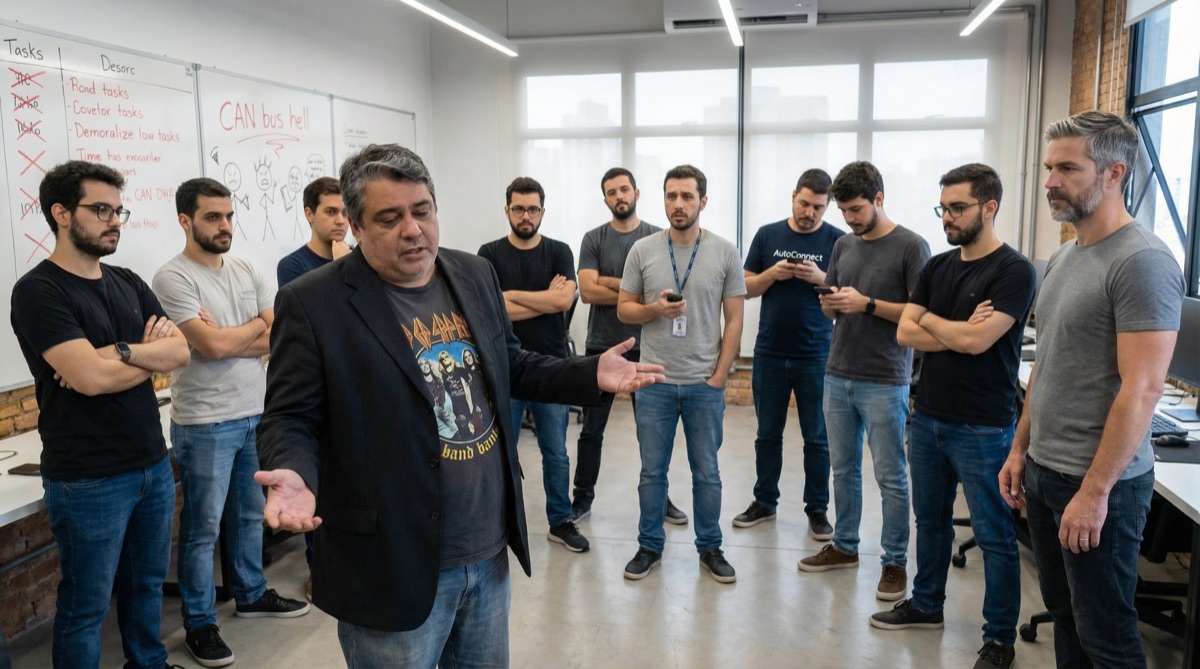
The next morning, Stefan attended his first daily standup.
It was a disaster.
Twelve developers stood in a reluctant circle near the navigation team’s whiteboards. A scrum master — or someone who’d been given that title — held a timer and a notebook. The energy in the room was somewhere between funeral and hostage situation.
“Let’s start,” the scrum master said. “Navigation team. Felipe, you first.”
Felipe — a heavyset man in his forties, clearly the senior developer — shrugged. “Same as yesterday. Waiting for the CAN bus specification from BergMotor. Emailed them three times. No response.”
“Can you do anything else?”
“What would you suggest?”
Silence.
“Next. Marcela?”
A young woman with tired eyes: “Blocked. My feature branch has conflicts with Felipe’s branch. We tried to merge yesterday. Build broke. We’re still fixing it.”
“How long will that take?”
“I don’t know. Maybe a week.”
Stefan kept his expression neutral, but internally he was cataloging: Long-lived feature branches. No integration. No tests to catch merge conflicts early. No CI to fail fast.
The standup continued. Blocked. Blocked. Waiting for approval. Blocked. Waiting for Diego — whoever Diego was — to finish something he’d started three months ago.
When it was finally over, Stefan approached Felipe.
“Can I ask you something?”
Felipe looked at him with the wary suspicion of a man who’d seen too many consultants. “You’re the German.”
“Stefan Richter.”
“I know who you are. Leo mentioned you.” Felipe’s voice softened slightly. “You wrote the book.”
“For my sins.”
Despite himself, Felipe smiled. “What do you want to know?”
“Why feature branches? Why not trunk-based development?”
Felipe stared at him like he’d suggested they all work naked. “Trunk-based? You mean everyone commits to main? Every day?”
“Every hour, ideally.”
“That’s insane. We’d break the build constantly.”
“Do you have automated tests?”
Felipe’s silence was answer enough.
“There it is.” Stefan gestured at the whiteboard full of blocked tasks. “You’re working in isolation for weeks, then trying to merge. Of course everything breaks. The longer you’re separated, the harder integration becomes.”
“So what’s the solution?”
“Tests first. Continuous integration. Small commits, frequent merges. It’s not magic — it’s just discipline.” Stefan paused. “But it requires everyone to change at once. You can’t do it alone.”
Felipe’s expression shifted. For a moment, Stefan saw the developer he’d been twenty years ago — curious, skilled, not yet beaten down by process.
“I used to work like that,” Felipe said quietly. “When I started. Before all the…” He gestured vaguely at the room, the whiteboards, the standup that had accomplished nothing. “This.”
“Would you try again? If someone showed you how?”
Felipe looked at him for a long moment. Then he said: “Ask me again next week. After I see if you’re serious.”
He walked away.
Stefan made a note in his phone: Felipe Gómez. Skeptical but salvageable. Needs proof.
Helena’s Warning

Dr. Helena Ferreira had been in software for forty years. She’d written code when punch cards were normal. She’d survived the PC revolution, the internet bubble, the mobile explosion. Now, at fifty-eight, she sat on boards and watched younger people make the same mistakes she’d made decades ago.
Stefan found her in the executive floor conference room, reviewing documents with the focused intensity of someone who’d learned that reading the fine print was the only way to survive.
“Stefan.” She didn’t stand. “Sit.”
He sat.
“I’ve been watching the floor cameras,” she said. “You sat with Júlia for three hours yesterday. Wrote code together.”
“That’s why you hired me.”
“Most consultants wouldn’t touch a keyboard on their first day. Or their last.” Her eyes were sharp. “Leo was right about you.”
“Leo exaggerates.”
“Leo has good taste.” She leaned back. “What’s your initial assessment?”
Stefan considered how much truth she could handle. Decided: all of it.
“The developers are good. The systems are broken. They’re working in isolation because no one taught them how to work together. They have no tests because no one showed them why tests matter. They’re failing because the organization is designed to make them fail.”
Helena nodded slowly. “And can you fix it?”
“I can try. I can teach them practices that work. TDD, CI/CD, trunk-based development.” He paused. “But none of that matters if the organization won’t change.”
“Meaning?”
“Meaning the technical problems are symptoms. The disease is somewhere else.” He met her eyes. “Klaus Hartmann is digging into the financials. He’s found something.”
Helena’s expression didn’t change, but Stefan saw her shoulders tighten slightly.
“I know,” she said. “I’ve seen Klaus’s preliminary reports.”
“And?”
“And nothing I can prove. Yet.” Helena stood, moved to the window. São Paulo sprawled beneath them — glass and concrete and twelve million people trying to make a living. “Bernardo Souza has been CFO here for five years. In that time, development costs have tripled while output has halved. He always has explanations. New initiatives. Transformation programs. External consultants.”
“QuantumMind Solutions.”
Helena’s back stiffened. “You’ve heard of them.”
“Klaus mentioned them. They’re arriving next week.”
“Yes.” Helena turned. “Stefan, I hired you because Leo trusts you. And I trust Leo. But I need to warn you about something.”
“Go ahead.”
“Bernardo didn’t want you here. He wanted QuantumMind. He told the board that real transformation requires ‘proper expertise’ — his words — and that a single consultant with a book was not sufficient.”
“But you overruled him.”
“I convinced the board to try both approaches. QuantumMind for ‘governance and process.’ You for ‘engineering practices.’” Her voice was bitter. “It was the only way to get you in the door.”
Stefan processed this. He was here because Helena had fought for him against a CFO who didn’t want him. A CFO who preferred expensive consultants with frameworks.
A CFO who might be hiding something.
“What do you want me to do?” he asked.
“Do what you came to do. Teach the developers. Fix the practices. Show them there’s another way.” She paused. “And watch. Listen. If Bernardo is doing something wrong, the evidence will be in the details. The budgets. The contracts. The decisions that don’t make sense.”
“You want me to investigate.”
“I want you to pay attention. There’s a difference.” Helena returned to her desk. “Be careful, Stefan. Bernardo is charming. And he’s dangerous. Don’t underestimate him.”
“I won’t.”
She studied him for a long moment. “One more thing.”
“Yes?”
“Júlia Nascimento.” Helena’s voice was gentle but firm. “She’s young. She’s talented. And she’s vulnerable right now — her lead quit, her team is failing, she’s alone.”
Stefan felt his face heat slightly. “I’m here to help her write tests.”
“I know. Keep it that way.” Helena’s eyes held his. “I saw the way she looked at you on the floor cameras. She’s looking for a hero. Don’t be that. Be a teacher. Anything else will destroy you both.”
Stefan nodded, not trusting himself to speak.
“Good.” Helena turned back to her documents. “Now go. You have ninety days. Make them count.”
The End of Day One
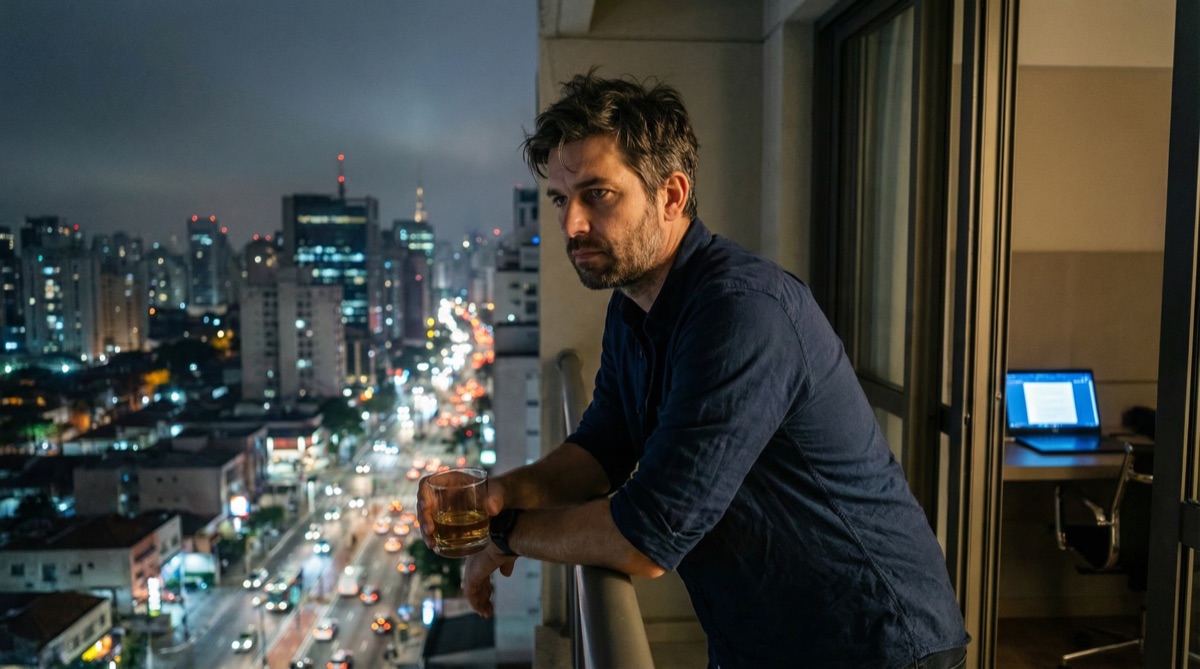
The hotel bar was nearly empty at midnight. Stefan sat alone with a whiskey he wasn’t drinking, watching the ice melt.
His phone buzzed. Klaus Hartmann:
Klaus These numbers are catastrophic. Ninety developers, eighteen months, eight million euros. They should have shipped three products by now. They have one half-working radio.
Klaus I have to report this to Stuttgart. They're going to want answers.
Stefan And what will you tell them?
Klaus That someone is lying to us. I just can't prove who yet.
Stefan put down the phone. Picked up the whiskey. Put it down again.
His mind kept going back to Júlia. The way her face had lit up when the first test passed. The hope in her eyes — fragile, desperate, looking for someone to believe in.
Don’t be a hero, Helena had said.
He wasn’t trying to be a hero. He was trying to teach a developer how to write tests. That was all.
But he knew himself well enough to recognize the warning signs. The pull toward someone young and bright and uncomplicated. The escape from the mess waiting for him in Berlin. The temptation to be someone’s answer when he couldn’t answer his own questions.
Emma was seven. She was growing up without him. His wife — his ex-wife, essentially — had stopped calling. The apartment in Prenzlauer Berg was full of his books but empty of his presence.
He’d come to São Paulo to fix a team. Maybe to prove his book wasn’t just theory. Maybe to find out if he still believed in what he taught.
What he hadn’t expected was to find a reason to stay.
His phone buzzed again. Leo:
Leo First day done. How do you feel?
Stefan Like I'm standing at the edge of something. Not sure if I'm saving them or joining them in the fall.
Leo That's the job, amigo. Welcome to São Paulo.
Stefan finished the whiskey in one swallow. The burn felt appropriate.
Tomorrow, he would teach more developers. He would write more tests. He would watch Klaus dig through numbers and Helena watch Bernardo and QuantumMind prepare their arrival.
Tomorrow, the real work would begin.
Tonight, he just sat with the weight of ninety developers’ hopes and his own unanswered questions, and watched the city breathe.
🎭 This Week's Episodes
Telenovelas show what we can't say in client meetings. The drama is heightened, but the patterns are real.
 La Verdad
The emergency board meeting Don Hernando demanded has arrived. Mariana and the Vulcano Capital team want answers. Alejo has one final card to play....
 When Players Revolt
They fixed the validation bug properly — six hours, no corners cut. But the database migration script Anton wrote Monday night to handle legacy NUL...
Technical Consultancy
Senior Developer Advocate
Embedded into your team as an active contributor, increasing effectiveness and elevating engineering clarity.
Technical Advisor
Peer-style technical assessments before far-reaching decisions; reduce architectural and product risk early.
Product & Delivery
Ship working software to real users earlier. Measure impact and adapt based on evidence rather than assumption.
Custom Software Development
High quality, maintainable software. Short-term augmentation that leaves lasting capability in your own team.
Recent Articles
- When Labor Becomes Cheap, Motivation Becomes Everything (06.04.2026)
- Authentication Methods That Work in 2026 (03.04.2026)
- Developer, Not Engineer. And Why It Matters (30.03.2026)
- The Product Manager Is Dead. Long Live the Product Developer. (27.03.2026)
- Building Products in the Age of AI (23.03.2026)
Explore More