El Juicio
Bruno presents his evidence of sabotage to the board, demanding the developers be fired and Stefan expelled. But Stefan has prepared his own presentation: actual metrics showing deploy frequency, bug rates, and user satisfaction under the real pipeline versus Bruno's framework theater. Don Rodrigo must make an impossible choice. Then Patricio shocks everyone by standing with the developers. Luciana threatens to expose everything. And Rafa — quiet, bitter Rafa — delivers the numbers that can't be denied.
The Summons

The email arrived at 6:47 AM.
Valentina saw it first, her phone buzzing on Diego’s nightstand. She was still half-asleep, warm under his arm, pretending the world outside didn’t exist for a few more minutes.
Then she read the subject line.
EMERGENCY BOARD MEETING — MANDATORY ATTENDANCE — ALL SENIOR STAFF
“Shit.” She sat up so fast the covers flew off. “Diego. Diego, wake up.”
He groaned, reached for her. “Five more minutes…”
“Bruno called a board meeting.” Her voice was shaking. “In an hour. He’s going to do it. He’s going to burn us all.”
Diego’s eyes snapped open. All the softness vanished from his face.
“Get dressed,” he said, already swinging his legs out of bed. “I’ll call Stefan.”
The team gathered in the break room at 7:30. No one had slept. Coffee cups trembled in hands that couldn’t stay still.
Héctor looked like a man awaiting execution. Thirty days sober, but this morning he wanted a drink more than he wanted to breathe.
Mando put a hand on his shoulder. “Whatever happens, brother. We stand together.”
“What if standing together means we all fall?” Héctor’s voice cracked. “What if this is the end?”
“Then we fall with dignity.” Mando’s jaw was set. “That’s more than Bruno will ever have.”
Rafa sat apart from the others, his laptop open, fingers flying across the keyboard. He hadn’t looked up since he arrived.
Mari found Valentina by the window. “How bad is this?”
“Bad.” Vale couldn’t sugarcoat it. “Bruno’s had a logging hook on the deployment pipeline for two weeks. He knows about the shadow builds. He knows about the doctored metrics. Every commit, every fake test result — he has everything he needs to destroy us.”
“Then why does Stefan look so calm?”
Valentina turned. Stefan had just walked in, dressed in his best suit, carrying a leather briefcase she’d never seen before. He looked like a man walking into battle — not running from one.
“Because Stefan’s been preparing for this since day one,” she said slowly. “He knew this moment would come.”
Stefan met her eyes across the room and nodded once.
Trust me, that nod said.
She wasn’t sure she had a choice.
The Accusation
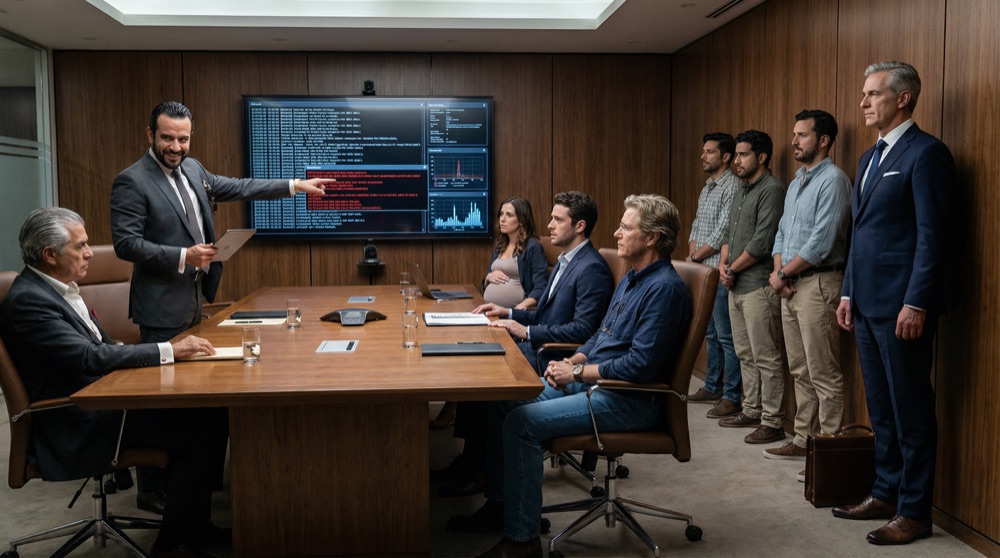
The boardroom felt like a courtroom.
Don Rodrigo sat at the head of the table, his face unreadable. To his left, Don Aurelio Vega — the rancher, the partner, the deciding vote. His weathered face showed nothing but skepticism for everything that involved screens and keyboards.
Patricio sat beside Luciana, who kept one hand possessively on his arm. Her other hand rested on her barely visible belly.
The development team lined the wall like defendants awaiting sentence. Stefan stood slightly apart, that leather briefcase at his feet.
Bruno commanded the room from the presentation screen, his tablet in hand, his smile razor-sharp.
“Gentlemen. Ladies.” He let the words hang. “I wish I could be here with good news. I wish I could tell you that the transformation is succeeding, that LogiMex is on track to become the world-class organization we promised.”
He clicked to the first slide.
“Instead, I’m here to report criminal sabotage.”
The word landed like a bomb.
“Sabotage,” Bruno repeated, savoring it. “Deliberate, organized sabotage of the transformation process by members of your own development team.”
He clicked again. Server logs filled the screen.
“For the past three weeks, a shadow deployment pipeline has been operating outside my framework. Code has been deployed to production without proper review cycles, without approval processes, without any of the controls that ensure quality and compliance.”
Another click. Names appeared.
Valentina Reyes. Diego Ramírez. Armando Guerrero. Rafael Ortega. Héctor Villanueva.
“These individuals have systematically undermined the transformation. They’ve filed false compliance reports while operating their own rogue infrastructure. And they’ve been aided and abetted —” his eyes found Stefan — “by the very consultant brought in to help them.”
Don Aurelio leaned forward. “You’re saying they lied? To the board?”
“I’m saying they committed fraud, Don Aurelio.” Bruno’s voice dripped with righteous fury. “They took your money, they ignored your directives, and they built their own little kingdom in the shadows. The question isn’t whether they’re guilty. The evidence is irrefutable. The question is what you’re going to do about it.”
He clicked one final time.
RECOMMENDATION: IMMEDIATE TERMINATION — ALL NAMED PARTIES
Valentina felt Diego’s hand find hers, grip tight enough to hurt. Her heart was slamming so hard she could barely hear.
Don Rodrigo’s face was stone. He hadn’t looked at any of them.
This is it, she thought. This is how it ends.
Then Stefan stepped forward.
“May I respond?”
The Defense
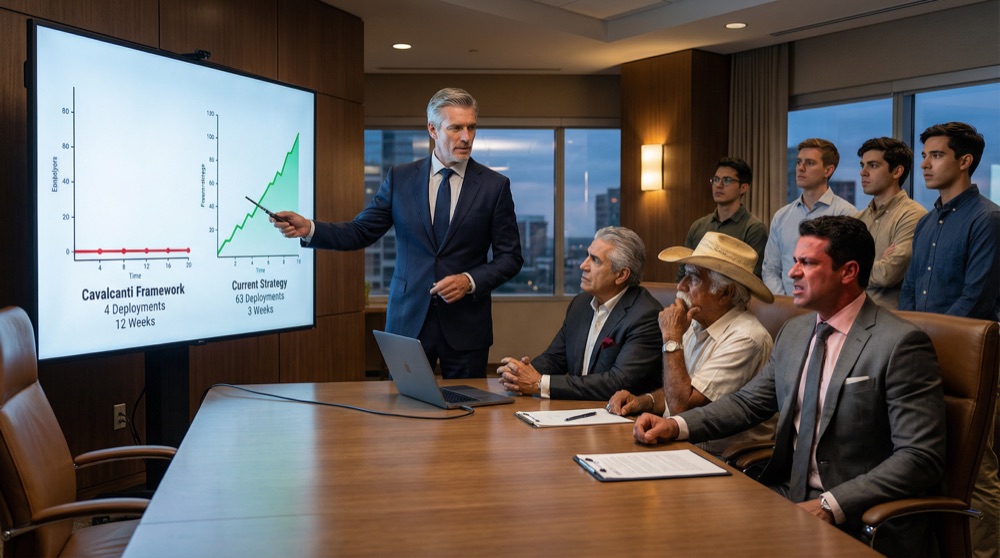
Bruno’s smile tightened. “By all means. Explain yourself.”
Stefan walked to the front of the room with the calm of a surgeon entering an operating theater. He connected his laptop. The screen changed.
“Mr. Cavalcanti is correct about one thing,” Stefan said. “There has been a parallel pipeline operating for the past three weeks. I built it. These developers operated it. And yes — we filed reports that satisfied the framework requirements while the real work happened elsewhere.”
Whispers rippled through the room. Don Aurelio’s face darkened.
“But here’s what Mr. Cavalcanti didn’t show you.”
Stefan clicked.
Two graphs appeared side by side.
“On the left: deployment frequency under the Cavalcanti Framework. Four deployments in twelve weeks. Each one preceded by forty-seven hours of approval meetings, compliance documentation, and status reports.”
He pointed to the right graph.
“On the right: deployment frequency under the parallel pipeline. Sixty-three deployments in three weeks. Same codebase. Same developers. Same systems.”
Don Aurelio squinted. “How is that possible?”
“Because the framework isn’t designed to enable delivery, Don Aurelio. It’s designed to appear to enable delivery while actually preventing it.” Stefan’s voice was ice-cold now. “Every hour your developers spent filling out compliance forms was an hour they didn’t spend writing code. Every approval meeting was a day of delay. Every status report was a lie dressed up as accountability.”
Bruno stepped forward. “This is absurd. You’re admitting to sabotage and then claiming—”
“I’m not finished.” Stefan didn’t raise his voice. He didn’t need to. “Let’s look at outcomes.”
Another click.
“Bug rates. Under the framework: fourteen critical defects introduced, eleven of which made it to production. Under the parallel pipeline: two defects introduced, zero reached production.”
Click.
“User satisfaction. Customer complaint tickets. Framework period: up 340%. Parallel pipeline period: down to baseline.”
Click.
“Actual revenue impact. During the framework period, LogiMex lost two major clients citing ‘system instability’ and ‘poor response times.’ During the parallel pipeline period, we recovered one and signed two new contracts.”
Stefan turned to face the board directly.
“The framework failed. Not because the developers sabotaged it — because it was designed to fail. Mr. Cavalcanti’s methodology creates dependency on consultants, justifies extended engagements, and produces beautiful reports while delivering nothing of value. It’s not transformation. It’s parasitism.”
Bruno’s face had gone red. “You arrogant fucking—”
“Bruno.” Don Rodrigo’s voice cut through like a blade. “Sit down.”
The Brazilian hesitated, his jaw working, his hands clenched into fists at his sides. For a moment, it looked like he might explode.
Then he sat.
“Continue, Herr Richter,” Don Rodrigo said quietly.
Stefan nodded. “I have one more thing to show you.”
He clicked.
A spreadsheet appeared. Dense with numbers. Every eye in the room went to Rafa, who had finally looked up from his laptop, something fierce and hungry in his expression.
“This analysis was prepared by Rafael Ortega,” Stefan said. “He’s been with LogiMex for twenty years. His specialty is data. And the data he’s compiled tells a story that cannot be argued with.”
He turned to Rafa.
“Tell them.”
The Numbers
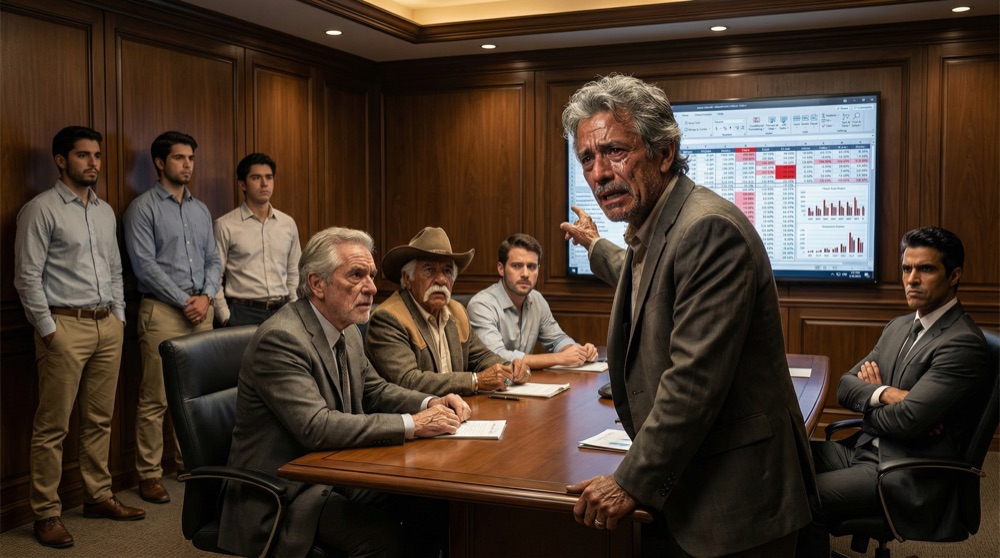
Rafa rose slowly. His hands were trembling, but his voice was steady.
“I didn’t want to do this,” he said. “I didn’t want to care anymore. After my son died, I stopped giving a damn about anything. Including this company.”
He walked to the screen.
“But then I watched what was happening. I watched good people get fired for being ten minutes late on a report. I watched my friends break down crying in the server room because some Brazilian pendejo told them their life’s work was garbage.”
Bruno shifted in his seat. “This is unprofessional—”
“Shut your mouth.” Rafa’s voice cracked like a whip. “You don’t get to speak. Not now. You’ve spoken enough for twelve weeks.”
Silence.
Rafa pointed to the spreadsheet.
“These are the numbers. Every hour logged. Every task completed. Every deployment, every bug, every customer interaction. I’ve been tracking it since day one, because that’s what I do. I track data. My son —” his voice caught. “My son taught me that numbers don’t lie. People lie. Consultants lie. But numbers just are.”
He traced a line on the screen.
“The Cavalcanti Framework added 312% overhead to every development task. Not productivity. Overhead. For every hour of actual coding, developers spent three hours on compliance theater.”
Another line.
“Staff turnover tripled. Two resignations, four terminations. Six people gone in three months. Institutional knowledge that took years to build, destroyed in weeks.”
His finger found a final number.
“Net productivity change under the framework: negative forty-seven percent. We were doing worse than before Bruno arrived. The only thing that improved was the number of reports we produced.”
He turned to Don Aurelio, the rancher, who understood cattle and land and honest work.
“Don Aurelio. You run a ranch. If someone came to you and said, ‘I’ll help you raise more cattle,’ and then all your cattle died while he filed beautiful reports about cattle management best practices — would you keep paying him?”
Don Aurelio’s weathered face cracked into something that might have been a smile. “I’d run him off my land with a shotgun.”
“Then you understand exactly what’s happening here.”
Rafa sat down. The room was silent.
The Betrayal

Don Rodrigo turned to his nephew.
“Patricio. You recommended Mr. Cavalcanti. You championed this framework. What do you have to say?”
Every eye in the room shifted to Patricio.
Luciana’s hand tightened on his arm. Her nails dug in like claws. Her eyes blazed with warning: Don’t you dare. Don’t you fucking dare.
Patricio felt the weight of everything pressing down on him. The gambling debts. The secret lover. The child on the way. All the compromises, all the lies, all the desperate scrambling to appear worthy of a legacy he’d never earned.
He thought of his uncle, weeping on the hospital bed. What does forgiveness feel like?
Like dying and coming back to life.
“I was wrong.”
The words came out before he could stop them.
Luciana’s grip turned to ice. “Patricio—”
“No.” He pulled his arm free and stood. “No, Luciana. I’m done.”
He looked at Don Rodrigo. At the developers lining the wall. At Bruno, whose face was cycling through shock and fury and calculation.
“I brought Bruno here because I thought I needed something to prove,” Patricio said. “Something to show I was worthy of this company. Something world-class.” He laughed bitterly. “What a stupid fucking word that is. World-class. I’ve been chasing it my whole life and I never stopped to ask what it meant.”
He walked to the window, his back to the room.
“I knew the framework was failing. I knew three weeks ago when I found the shadow pipeline. I could have reported it. I could have given Bruno what he needed to destroy everyone in this room.”
He turned.
“I didn’t. Because for the first time in my miserable life, I watched people who actually believed in something work their asses off to save it. Not for money. Not for status. Because they loved this company. Because they loved each other.”
His voice cracked.
“I don’t know what that feels like. I never have. My whole life has been about looking good and avoiding failure. But these people—” he gestured at the developers — “they risked everything. They could lose their jobs, their reputations, everything. And they did it anyway. Because they’re not cowards.”
He looked at Bruno.
“I am. I’ve been a coward my whole life. But not today.” His jaw set. “Today I’m telling you — all of you — that these developers saved this company while Bruno was busy destroying it. And if you fire them, you might as well fire me too. Because I’d rather be unemployed than be the kind of man who lets good people burn for his own career.”
The silence was absolute.
Then Luciana stood. Her face was white with fury, her eyes burning with something between rage and terror.
“If you do this,” she said quietly, “I’ll tell everyone about the debts. The gambling. The money you stole from company accounts to cover your losses.”
Patricio turned to her slowly.
“Then tell them.”
“What?”
“Tell them, Luciana. Tell everyone. Go ahead.” He spread his arms. “I’m done hiding. I’m done pretending. If I’m going to burn, I might as well burn clean.”
Luciana’s mouth opened and closed. No words came.
Don Rodrigo rose.
“Sit down, Luciana.” His voice was ice. “We’ll discuss Patricio’s financial issues later. Right now, we’re discussing the future of this company.”
She sat.
And for the first time in his life, Patricio felt something shift inside him. Something that might have been the beginning of self-respect.
The Veterans Stand
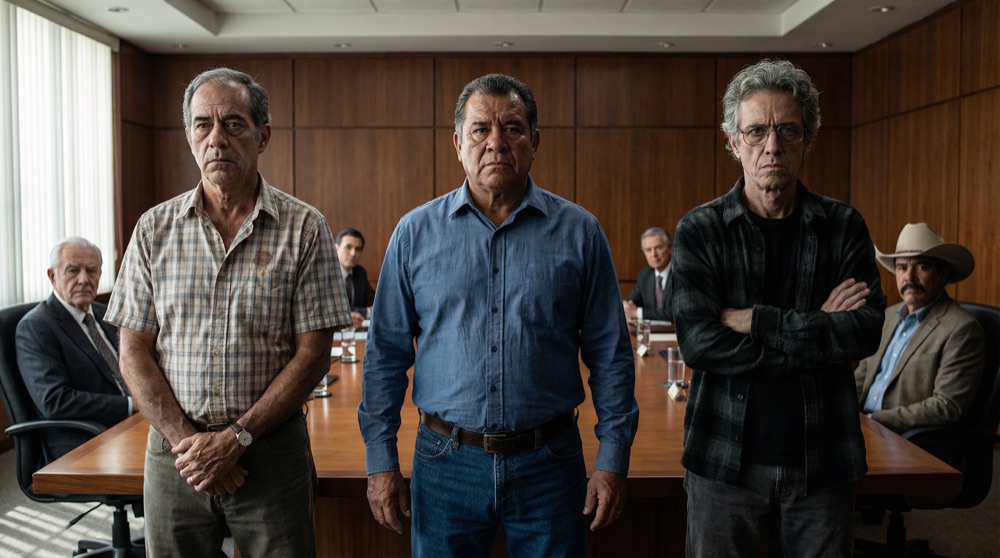
Héctor stood.
For thirty days, he’d fought the bottle. For thirty days, he’d woken up trembling, craving, bargaining with himself just to make it through one more hour. But he’d made it. One day at a time. One moment at a time.
And now, standing in this boardroom with everything on the line, he felt something he hadn’t felt in years.
Clarity.
“My name is Héctor Villanueva,” he said. “I’ve worked for LogiMex for twenty-five years. I built the first version of the system that runs this company. I was here when Don Rodrigo was working out of a garage. I was here when Esperanza — God rest her soul — was alive and bringing us coffee at midnight.”
His voice grew stronger.
“I watched this company grow. I watched it struggle. I watched good people come and go. And I’ve never — not once — seen anything as destructive as the past three months.”
He pointed at Bruno.
“This man doesn’t care about LogiMex. He doesn’t care about software. He doesn’t care about any of us. He cares about one thing: his fee. His billable hours. His next engagement. We’re not a company to him. We’re a carcass he’s feeding on.”
Mando stood beside him. Then Rafa. The three veterans, shoulder to shoulder, facing the board like soldiers.
“We are this company,” Héctor said. “We’ve been here when no one else believed. We’ll be here when everyone else is gone. Fire us if you want. Call us saboteurs. Call us traitors. But know this —” his eyes found Don Rodrigo’s — “every line of code we wrote was for you. Every night we stayed late. Every weekend we missed with our families. It was all for this company. For this family.”
He spread his arms to include everyone — Valentina, Diego, Camila, Mari, Sebastián, Stefan.
“All of us. Old guard and new blood. We fought for LogiMex. And we’ll keep fighting, whether you believe us or not.”
He sat down.
Don Aurelio turned to Don Rodrigo.
“Well, compadre? What do you say?”
The Judgment
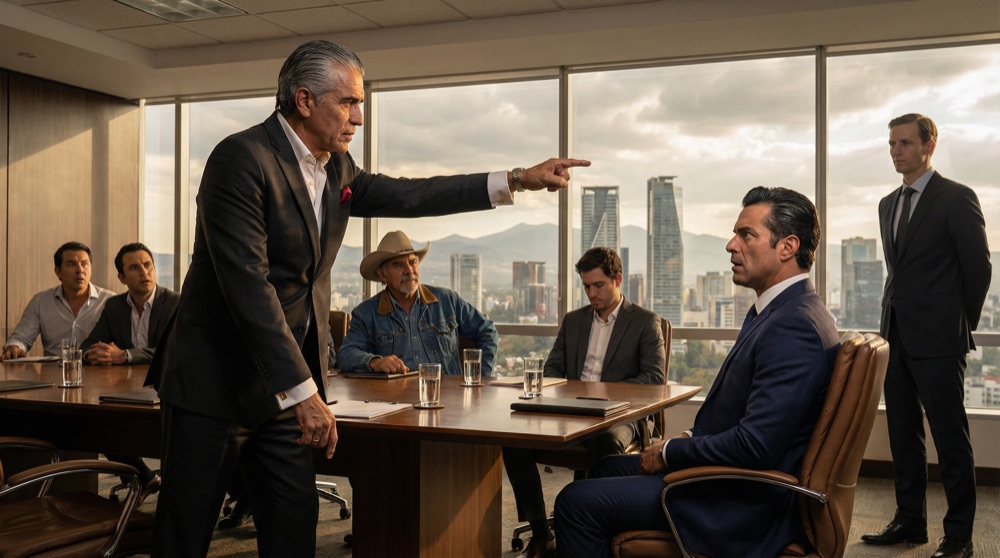
Don Rodrigo walked slowly to the window. The Mexico City skyline stretched before him, smog and sunlight and twenty million souls hustling through another day.
“I built this company with my wife,” he said quietly. “Esperanza and I started with nothing. A dream and a second-hand computer and enough stubbornness to ignore everyone who said we’d fail.”
He turned.
“When she died, I thought the company would die too. Part of me wanted it to. But it didn’t. Because of them.” He nodded toward the developers. “They kept it alive. Not me. Not Patricio. Not any board member or consultant. Them.”
He walked toward Bruno, who sat rigidly in his chair, his face a mask of fury and calculation.
“Mr. Cavalcanti. Bruno.” Don Rodrigo stopped in front of him. “I invited you into my house. I trusted you with my legacy. And you —” his voice hardened — “you tried to burn it down for profit.”
“The framework—”
“The framework is garbage.” The words came out flat and final. “The metrics don’t lie. The outcomes don’t lie. You came here selling certainty, and you delivered chaos. You promised transformation, and you gave us destruction.”
He extended his hand toward the door.
“It’s time for you to leave, Bruno. Your services are no longer required.”
Bruno stood slowly. His jaw was tight, his eyes blazing with barely contained rage.
“You’ll regret this,” he said, his voice low and dangerous. “All of you. I have connections. I have influence. I can make sure no one in Latin America ever hires another LogiMex developer again.”
“Then do it.” Valentina’s voice cut through the silence. She stepped forward, her chin high, her eyes fierce. “Burn our reputations. Blacklist us. Do your worst. We survived you. We’ll survive whatever comes next.”
Bruno’s eyes met hers. Something flickered there — rage, yes, but also something that might have been respect.
Then it was gone.
“Goodbye, LogiMex,” he said. “Enjoy your little victory. It won’t last.”
He walked out.
The door closed behind him.
And the room erupted.
The Aftermath

Tears. Hugs. Laughter that bordered on hysteria.
Mari grabbed Valentina and held her so tight neither could breathe. “We did it. Dios mío, Vale, we actually fucking did it.”
Diego lifted Camila off her feet and spun her around. Sebastián was crying openly, not even trying to hide it. Mando and Héctor clasped hands, forearm to forearm, the way warriors do.
Rafa stood apart, his laptop still open, watching the celebration with something almost like a smile on his weathered face. When Valentina approached him, he looked up.
“Thank you,” she said. “Those numbers — they saved us.”
“Numbers don’t save anyone.” His voice was gruff, but his eyes were wet. “People save people. The numbers just tell the story.”
Stefan shook Don Rodrigo’s hand. “It was an honor, Don Rodrigo.”
“The honor is mine, Herr Richter.” Don Rodrigo held the handshake. “You saw something in my people that I’d forgotten to look for. You reminded me what this company was supposed to be.”
“They reminded themselves. I just gave them permission.”
Don Aurelio approached, his boots heavy on the boardroom floor. He looked at the celebrating developers, then at Stefan, then at Don Rodrigo.
“I didn’t understand half of what just happened,” he admitted. “All that talk about pipelines and frameworks and deployment frequencies. Might as well have been speaking Chinese.”
Don Rodrigo smiled. “And yet?”
“And yet.” The rancher’s weathered face softened. “I understand loyalty. I understand people who work hard for something they believe in. And I understand a snake when I see one.” He nodded toward the door Bruno had left through. “That one was a snake.”
“He was.”
“Then I’m glad he’s gone.” Don Aurelio stuck out his hand. “We’re good, compadre. Whatever you need from me — you’ve got it.”
They shook.
In the corner, Patricio stood alone. Luciana had left without a word, her face white with fury and calculation. He knew she’d make good on her threats. He knew the debts would come out. He knew everything was about to get much, much harder.
But for the first time in his life, he didn’t care.
Valentina approached him. “That was brave. What you did.”
“It was the least I could do.” He couldn’t quite meet her eyes. “After everything I put everyone through.”
“It’s a start.” She hesitated, then put her hand on his arm. “That’s all any of us can do. Start.”
He looked at her hand, then at her face. Something in his chest unclenched.
“Thank you,” he said quietly. “For not hating me.”
“Ask me again tomorrow,” she said, and smiled. “Today, I’m just grateful we’re all still here.”
The Call

The celebration was still going when Valentina’s phone rang.
She pulled it out, saw the number, and felt her heart stop.
The hospital.
She stepped away from Diego, from the laughter and the tears, pressing the phone to her ear with shaking hands.
“¿Bueno?”
Her mother’s voice. Weak. Thready. But alive.
“Mija… mi amor…”
“Mamá.” Valentina’s voice cracked. “Mamá, what’s wrong? Are you okay? What’s happening?”
“I need you to come.” Her mother coughed. “I need you to come now. There’s something… something I have to tell you. Before…”
She didn’t finish the sentence. She didn’t need to.
“I’m coming.” Valentina was already moving, grabbing her bag, pushing through the celebrating crowd. “I’m coming right now. Just — just hold on. Please, Mamá. Please hold on.”
Diego saw her face and all the joy drained from his own.
“Vale? What—”
“It’s my mother.” The words came out strangled. “I have to go. I have to go now.”
He didn’t hesitate. “I’ll drive.”
They ran.
Behind them, the celebration continued for a few more minutes before someone noticed they were gone. Before the reality settled in that every victory comes with a price, and the bill always comes due.
Stefan watched them leave, his own phone in his hand. On the screen, a message from Berlin. From his daughter’s doctor.
Another call to make. Another bill to pay.
He put the phone away.
Later, he told himself. Handle one crisis at a time.
But he knew, as he watched Valentina and Diego disappear through the door, that the crises never really stopped. They just changed shape.
🎭 This Week's Episodes
Telenovelas show what we can't say in client meetings. The drama is heightened, but the patterns are real.
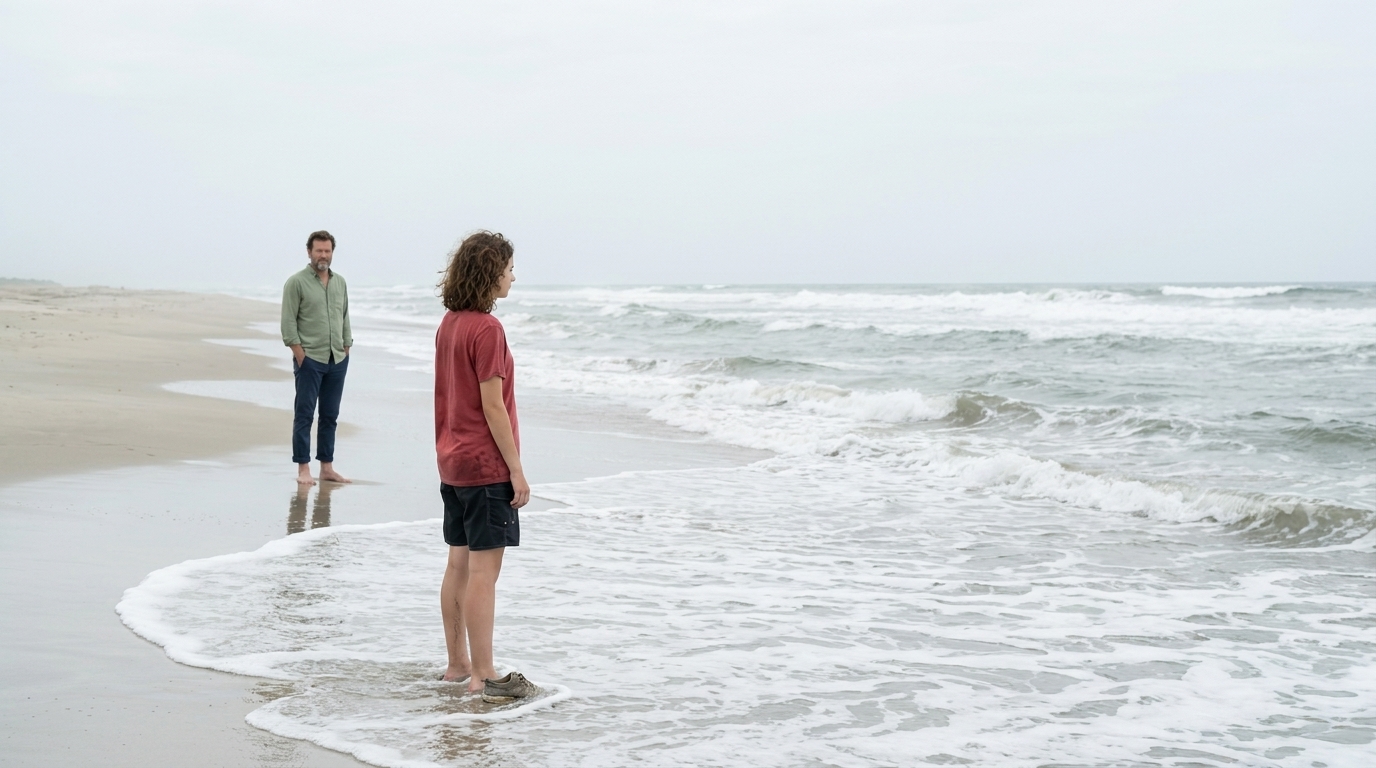 Three Ways to Understand a Country
Stefan drives Sophie to the Pacific for two days. The beach is big enough to make her feel appropriately small. Back at the finca the rain keeps th...
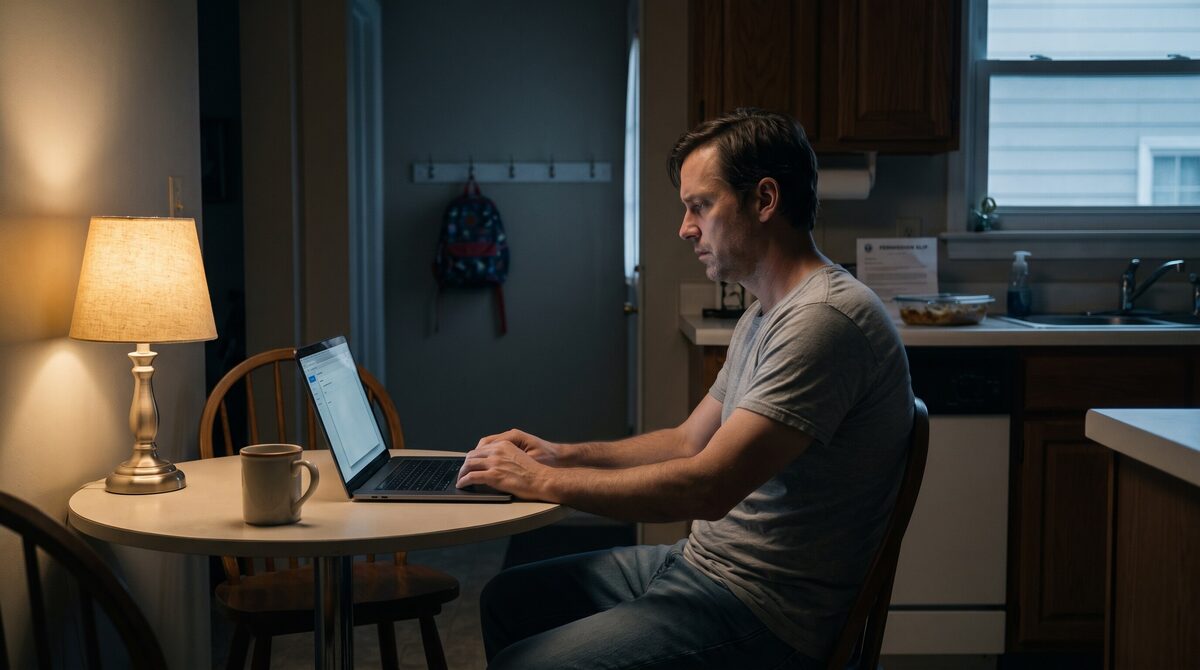 The Resignations
Nathan Cole resigns on a Monday morning with two sentences and no argument left in his body. By Tuesday his desk is empty and the company's institu...
Technical Consultancy
Embedded Delivery Partner
Embedded into your team as an active contributor, reducing delivery friction and helping important work move cleanly.
Technical Advisor
Peer-style technical assessments before far-reaching decisions; reduce architectural and product risk early.
Product & Delivery
Ship working software to real users earlier. Measure impact and adapt based on evidence rather than assumption.
Custom Software Development
High quality, maintainable software. Short-term augmentation that leaves lasting capability in your own team.
Recent Articles
- When Everything Is Finally Under Control (28.09.2026)
- AI Makes Technical Execution Cheap. Judgment Stays Scarce. (24.09.2026)
- The LLM Will Not Come Back Tomorrow (19.09.2026)
- The One-Person AI Company Is a Greed Fantasy (15.09.2026)
- Test Production Without Leaving a Mess (10.09.2026)
Explore More