Desde Cero
The recovery is underway. Pair programming fills the office. Tests turn green. Deployments happen daily. But transformation breeds resistance, and a senior developer named Hernán refuses to accept that his twenty years of experience mean less than Camila's tests. When a bank integration deadline threatens everything, the old ways and new ways must finally collide. Someone will have to change — or leave.
The New Rhythm
FinPulso office. Six weeks later. Monday, 9:15 AM.
The office sounds different now.
Gone is the oppressive silence of fear, the whispered complaints, the frantic clatter of last-minute emergencies. In its place: conversation. Keyboards clicking in rhythm. Occasional laughter from the pair programming stations.
Camila walks the floor with her notebook, checking in with each team. It still feels strange — being the one people look to for answers. But six weeks of daily standups, weekly retrospectives, and relentless focus on working software have built something that slides alone never could.
Confidence.

Diego and Pipe are at one station, an unlikely pair that has become FinPulso’s most productive. Diego’s instinct for clean architecture combined with Pipe’s encyclopedic knowledge of the legacy systems — they’ve migrated three major modules in five weeks, each one deployed without incident.
“The reconciliation module goes live today,” Diego announces as Camila approaches. “Final tests passed at 7 AM.”
“Pipe stayed until midnight fixing that date calculation bug,” Camila notes.
“The bug was mine,” Pipe admits gruffly. “From 2019. Left it in because I was too busy fighting fires to fix it properly.” He shrugs. “Now I’ve fixed it. Better late than never.”
Sebastián appears with coffee for everyone — another change. The co-founder who once hid in his office now spends mornings moving between teams, learning what they’re building, asking questions instead of demanding status reports.
“Stefan’s arriving from Panama this afternoon,” Sebastián says. “He wants to review the bank integration before Thursday’s deadline.”
“We’ll be ready,” Camila says.
But from the corner of the office, someone is watching. Listening. Not joining.
Hernán Mendoza, senior developer, twenty years in the industry, and FinPulso’s most persistent problem.
The Resistance
11:00 AM.
Hernán has been at FinPulso since the beginning — one of the original three developers hired when the company was just an idea and a seed round. He’s survived every crisis, every deadline, every leadership change.
He has no intention of changing now.
“Pair programming is for people who can’t think for themselves,” he announces to no one in particular, though his voice carries across the open floor like a slap.
Camila pauses at his desk. Her jaw tightens. “Something wrong, Hernán?”
“Wrong? No. Just observing the fucking circus.” He gestures at the pair programming stations with barely disguised contempt. “Two developers doing the work of one. Two salaries for half the output. Very efficient.” His lips curl. “Did they teach you that at whatever bootcamp you crawled out of?”
“The research shows—”
“Research.” Hernán’s laugh is bitter. “I’ve been writing production code since you were in primary school. I don’t need research to tell me how to do my job.”
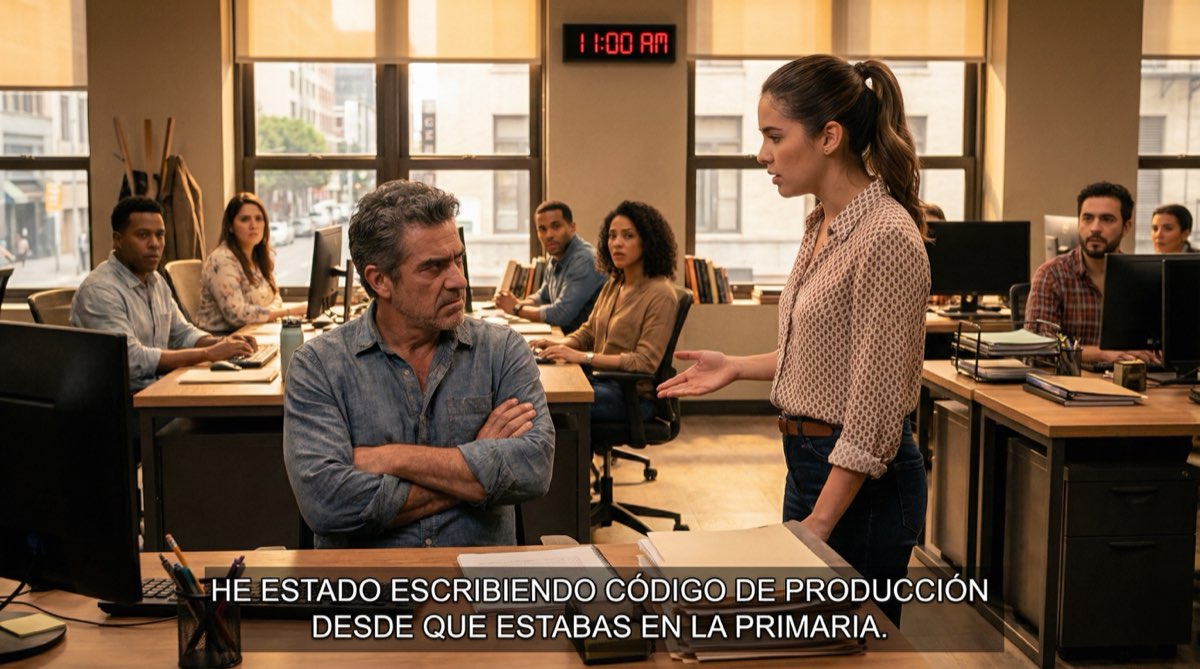
Other developers are watching now. This confrontation has been building for weeks — Hernán’s snide comments, his refusal to attend retrospectives, his solo commits that bypass the team review process.
“The bank integration module,” Camila says carefully. “You’re the only one who hasn’t contributed code this sprint.”
“Because I’m working on it properly. Not rushing to check boxes on your little board.”
“The integration is due Thursday. We need to test—”
“It will be ready when it’s ready.” Hernán turns back to his screen. “I’ve delivered more integrations than anyone in this company. I don’t need a junior developer telling me how to manage my time.”
Camila’s hands tighten on her notebook. She could push. Could escalate. Could invoke her new authority.
Instead, she walks away.
Diego catches her eye as she passes. Want me to talk to him? his look asks.
She shakes her head. Not yet.
The Arrival
2:30 PM.
Stefan emerges from the elevator with his worn leather bag and the unhurried manner of someone who has seen enough crises to recognize real problems from manufactured ones.
He finds Camila in the small conference room, staring at a whiteboard covered in integration diagrams.
“You look worried,” he says.
“Hernán Mendoza.” Camila doesn’t turn around. “He’s been here since the beginning. Knows the banking APIs better than anyone. And he’s refusing to work with the team.”
“Refusing how?”
“Solo commits. No code reviews. Won’t pair. Won’t attend standups.” She finally faces him. “The bank integration he’s building — I have no idea if it works. He won’t show anyone.”
Stefan sets down his bag. “What have you tried?”
“Talking to him. Multiple times. He sees me as a junior developer who got lucky. Twenty years of experience versus two years. From his perspective, I’m an insult to everything he’s built.”
“And from yours?”
Camila considers. “From mine… he’s a risk. A single point of failure. We’re supposed to be eliminating those, and instead we’ve built our most critical deadline around someone who won’t collaborate.”
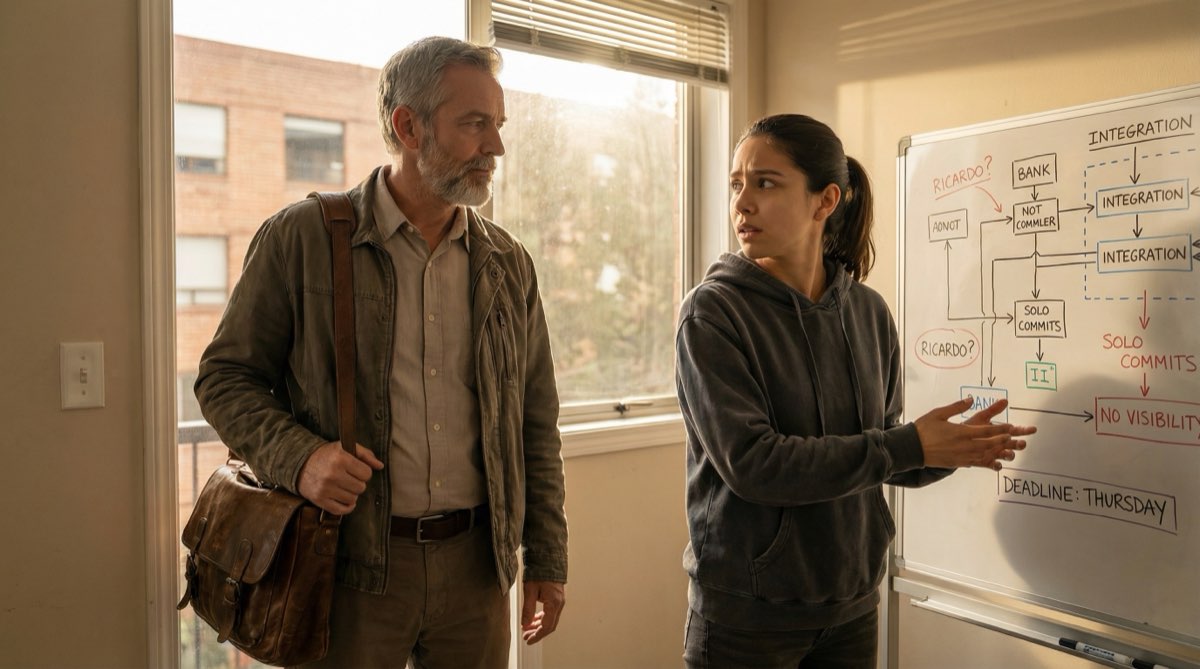
Stefan walks to the window. Outside, Bogotá’s afternoon traffic crawls through the streets of Chapinero. He’s quiet for a long moment.
“In my experience,” he says finally, “there are three kinds of resistance to change. Fear, pride, and principle.”
“Which one is Hernán?”
“That’s what you need to find out. Fear can be addressed with safety. Pride can be addressed with respect. But principle…” He turns back to her. “If someone genuinely believes the old way is better, you have to let them prove it. Or fail trying.”
“And if they fail on Thursday? With the bank integration?”
“Then you’ll have learned something important. About Hernán, about your process, about what this team is really made of.”
Camila doesn’t like the answer. But she’s learning that Stefan’s answers aren’t meant to be comfortable. They’re meant to be true.
The Visit
5:00 PM.
Hernán is still at his desk when the office begins to empty. He’s the last of the old guard — the developers who remember when FinPulso was a dream and a garage, before investors and consultants and junior developers who think they know better.
He doesn’t hear Stefan approach.
“Mind if I sit?”
Hernán looks up, startled. Stefan is already pulling over a chair, settling in with the ease of someone who has nowhere else to be.
“The German,” Hernán says. “Heard you were coming.”
“Stefan Richter. We haven’t been formally introduced.”
“I know who you are. The consultant who’s supposed to fix us.” Hernán’s voice is flat. “How’s that going?”
“I don’t fix companies. I help teams see what they’re capable of.” Stefan gestures at Hernán’s screen, filled with dense Java code. “That’s the bank integration?”
“Part of it.”
“May I?”
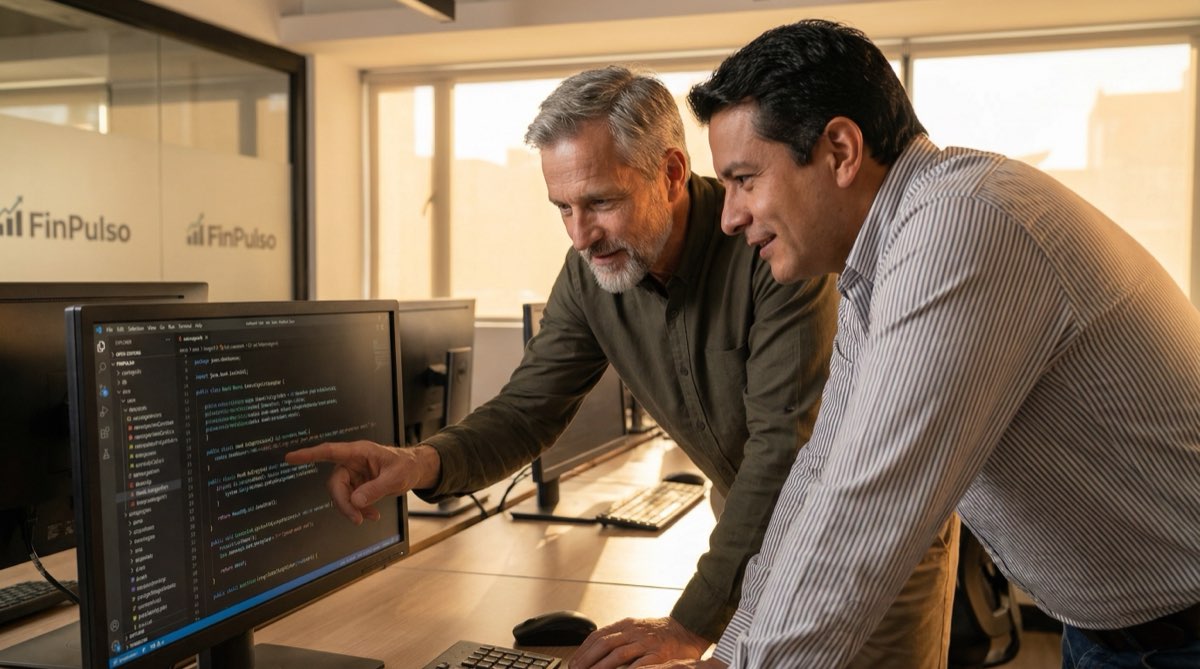
Hernán hesitates, then scrolls through the file. Stefan reads in silence, occasionally nodding.
“The transaction batching logic,” Stefan says after a few minutes. “You’re handling the edge case where the bank returns a partial acknowledgment. I’ve seen that problem break systems at scale.”
Hernán blinks. “You… recognize it?”
“I worked on a similar integration in Germany, fifteen years ago. Before the APIs were standardized. We had to handle twelve different response formats from twelve different banks.” Stefan smiles faintly. “I spent three months on that project. It taught me more about defensive programming than any book.”
The silence that follows is different. Less hostile.
“Nobody here understands this code,” Hernán says finally. “They want me to pair program with developers who’ve never seen a bank API. Who think everything can be solved with unit tests and continuous deployment.”
“Can’t it?”
“Some things require experience. Intuition. The kind of knowledge you only get from twenty years of watching systems fail in ways the documentation never mentions.”
Stefan nods slowly. “You’re right.”
Hernán looks at him sharply. He wasn’t expecting agreement.
“The question,” Stefan continues, “is whether that knowledge dies with you. Or whether you find a way to pass it on.”
The Choice
Wednesday. One day before deadline.
The integration is not ready.
Camila discovers this at the morning standup, when Hernán — forced to attend by direct order from Sebastián — admits that he’s hit a problem with the authentication flow.
“The bank changed their certificate requirements last week,” he says. “Didn’t announce it. I’ve been debugging for three days.”
“Why didn’t you ask for help?” Diego asks.
“Because—” Hernán stops. Because he doesn’t trust anyone else. Because asking for help feels like weakness. Because twenty years of being the expert have made it impossible to be the learner.
The room waits.
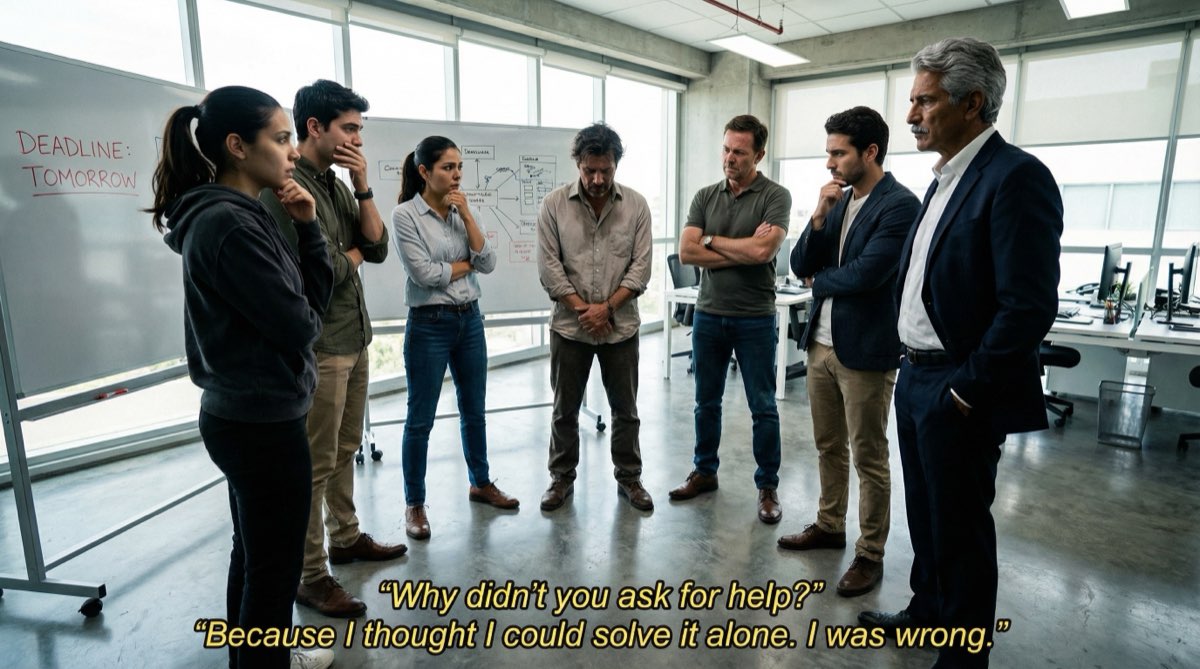
“Because I thought I could solve it alone.” The words come out ragged, torn from somewhere deep. Hernán’s face is flushed, his eyes bright with something that might be shame. “I was wrong.” He swallows hard. “Jesus Christ, I was so fucking wrong.”
The room is silent. No one has ever heard Hernán admit anything.
Camila makes a decision.
“Diego, Pipe — you’re pairing with Hernán today. Full focus on the authentication issue.” She turns to the rest of the team. “Everyone else, continue on the deployment pipeline. We need to be able to push the fix the moment it’s ready.”
“And if we can’t fix it by Thursday?” Sebastián asks.
“Then we tell the bank the truth. We’re delayed, and we explain why.” Camila’s voice is steady. “But we don’t hide. We don’t pretend. We show them what we’re doing to solve the problem.”
Don Hernando has appeared at the edge of the standup circle. He’s been attending these meetings for three weeks now — listening, learning, staying silent.
He catches Camila’s eye and nods. Just once. But it’s enough.
The Night
Wednesday, 11 PM.
The office is dark except for three monitors at the pair programming station. Hernán, Diego, and Pipe — an unlikely alliance — have been working for fourteen hours straight.
Camila brings coffee. Stefan brings sandwiches from the arepa shop downstairs. Neither speaks. The developers are in the zone — that state of flow where the problem is everything and the world falls away.
“The bank’s certificate chain is incomplete,” Diego says. “They’re not sending the intermediate certificate.”
“Which is why our validation fails,” Pipe adds. “But only in production. The test environment uses a different chain.”
“So we need to bundle the intermediate certificate ourselves.” Hernán is already typing. “It’s not pretty, but it’s what we did at Bancolombia in 2008.”

Stefan watches from across the room. He’s seen this before — the moment when individual ego dissolves into collective purpose. When the code becomes more important than credit.
It doesn’t always happen. But when it does, it’s why he keeps doing this work.
At 2:47 AM, Diego pushes a commit. The test suite runs: 847 tests, 847 passing. The deployment pipeline triggers automatically.
At 2:51 AM, the bank integration goes live.
At 2:52 AM, the first transaction processes successfully.
Hernán stares at the screen. He hasn’t shipped code this fast in years. Maybe ever.
“It works,” he says, as if he can’t quite believe it.
“It works,” Diego confirms.
“How did we—” Hernán stops. He knows how. He just didn’t expect it. “Thank you. Both of you.”
Pipe shrugs. “De nada. Now go home and sleep. You look worse than I do.”
The Morning
Thursday, 8 AM.
The bank confirms: twenty-three transactions processed overnight, zero errors. The integration is stable. The deadline is met.
Sebastián calls an impromptu all-hands meeting. Not to celebrate — that will come later — but to acknowledge what happened.
“Last night, three developers solved a problem that had stumped one of them for days,” he says. “They did it by working together. By trusting each other. By admitting what they didn’t know and combining what they did.”
Hernán stands at the edge of the group. His expression is complicated — pride, embarrassment, something that might be the beginning of change.
“I’ve been at this company since the beginning,” Hernán says. The room goes quiet. “I’ve survived because I knew things no one else knew. That was my value. My security.”
He pauses.
“But last night… I realized that knowing things doesn’t matter if you can’t share them. And that the people I dismissed as too inexperienced—” he looks at Camila, then Diego, “—they know things I don’t. Different things. Important things.”
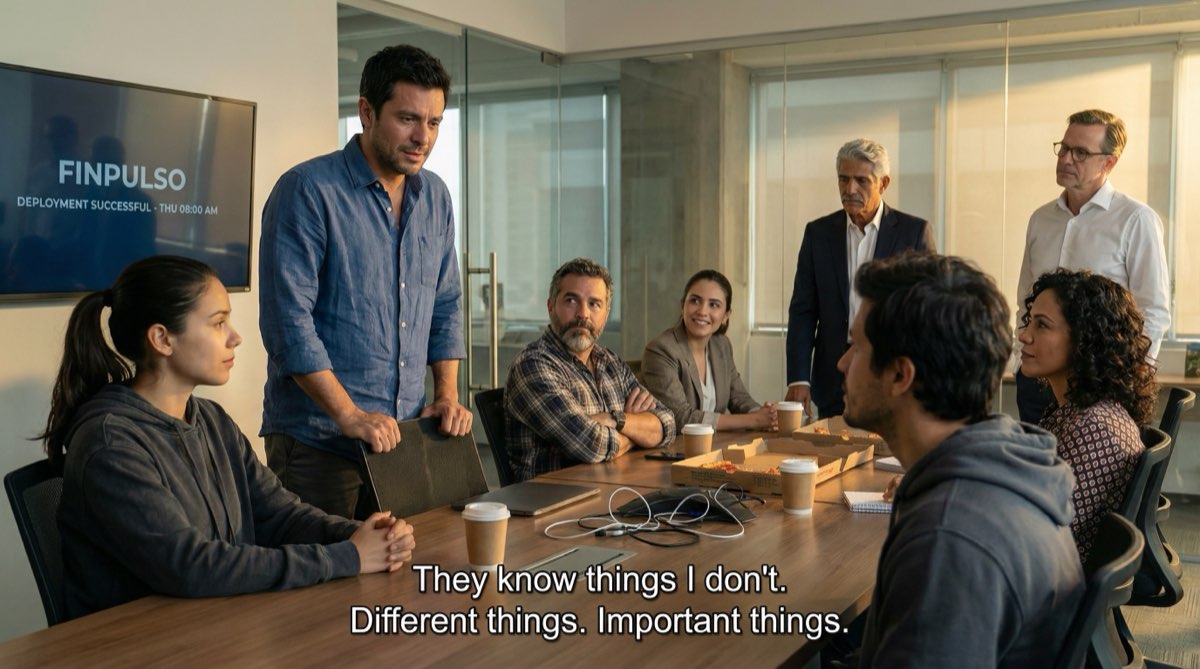
He turns to Camila.
“I’ve been unfair to you. You earned your position. I was too proud to see it.” He extends his hand. “I’d like to try again. If you’ll have me.”
Camila takes his hand. “Welcome to the team. Finally.”
The room exhales. Someone claps. Then someone else. And then the whole office is applauding — not for the integration, but for something harder to achieve.
A change of heart.
The Shadow
Somewhere across Bogotá. Thursday, 10 AM.
Alejo’s apartment has a view of the city he used to own. Now he watches from exile, tracking FinPulso’s progress through carefully cultivated sources.
His phone buzzes. A message from a number he knows well.
Unknown The bank integration went live. No issues. The German was there all night.
Alejo And the team?
Unknown Functioning. Better than expected. They're actually starting to trust each other.
Alejo That's a problem.
Unknown What do you want me to do?
Alejo Nothing yet. Keep watching. Report everything.
Unknown The next milestone is the merchant onboarding system. Two weeks.
Alejo I know. That's when we move.
He sets down the phone and pours himself a coffee. The first phase of his plan required FinPulso to succeed — just enough to attract attention, to prove the concept has value.
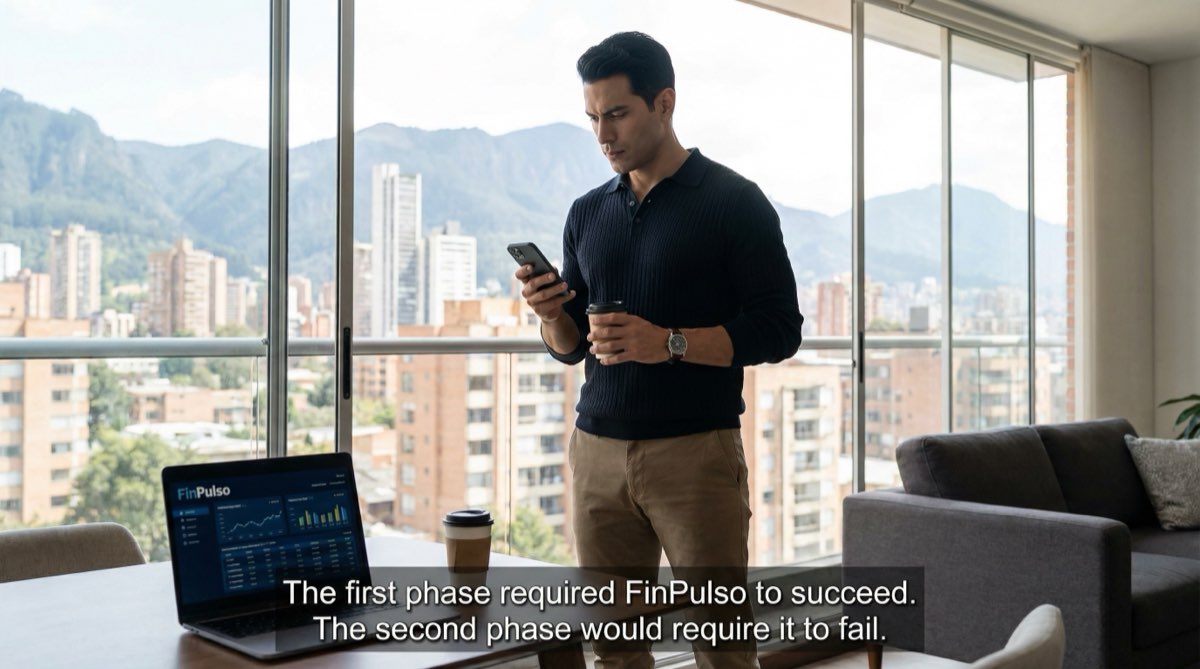
The second phase requires it to fail. At exactly the right moment. In exactly the right way.
And thanks to his informant, he’ll know precisely when to strike.
The First Deployment Celebration
Friday, 6 PM.
The tradition started three weeks ago: every successful deployment gets a small celebration. Nothing elaborate — just a moment to acknowledge that software shipped, that it worked, that the team made something real.
Today’s celebration is bigger. Not just the bank integration, but the hundredth successful deployment since Project Fénix went live.
Don Hernando has ordered champagne. Real champagne, not the local sparkling wine. He raises his glass.
“One hundred deployments,” he says. “In six weeks. Without a single production incident.” He shakes his head slowly. “When Stefan first arrived, I thought he was selling me a fantasy. Deploying every day? Impossible. Dangerous. Reckless.”

He pauses.
“I was wrong. About a lot of things. I’m learning — slowly — that the people closest to the work understand it best. And that my job is not to tell them what to do, but to remove the obstacles that prevent them from doing it well.”
Sebastián catches Isabella’s eye across the room. She smiles — the first real smile he’s seen from her in months. Something unspoken passes between them. A question, perhaps. Or the beginning of an answer.
Camila finds Stefan by the window.
“You’re leaving tomorrow?” she asks.
“For a few weeks. Another engagement.” He sets down his champagne. “But I’ll be back for the next milestone. You don’t need me for the daily work anymore.”
“I don’t need you.” She pauses. “But the team is better when you’re here. I’m better.”
“That’s your confidence speaking. It doesn’t come from me. It comes from proving, every day, that you can do difficult things.”

Camila wants to say something more. To acknowledge whatever this is between them — respect, affection, something she can’t quite name. But Stefan has always kept a careful distance. And she knows, somewhere beneath the wanting, that the distance is necessary.
“Thank you,” she says instead. “For everything you’ve taught me.”
“You taught yourself. I just asked the right questions.” Stefan finishes his champagne. “Take care of this team. They’re worth it.”
The Discovery
Saturday, 7 AM.
Camila arrives early, as always. The office is empty. She likes these quiet hours before the team arrives — time to think, to plan, to review the metrics that tell the real story of how the company is doing.
She opens her laptop. Checks the deployment dashboard. Scans the error logs.
Then she sees something that makes her freeze.
An access log entry from 3 AM. Someone connected to the production database from an IP address she doesn’t recognize. The session lasted fourteen minutes. No changes were made — but someone was reading. Looking.
At transaction data. Customer records. The bank integration she just shipped.

Camila traces the IP. It routes through a VPN — untraceable. But the access credentials belong to someone on the team. Someone who has been here from the beginning.
Someone she trusted.
Her phone buzzes. A message from Diego.
Diego You at the office?
Camila Yes.
Diego Don't touch anything. I'm on my way. I found something too.
She stares at the screen. At the name attached to the access log.
Her heart sinks.
The Revelation
Saturday, 8:30 AM.
Diego arrives running. He has his laptop open before he reaches Camila’s desk.
“Look at this.” He pulls up a chain of commits from the past six weeks. “Someone’s been adding logging to the payment modules. Very subtle. Easy to miss in code review.”
“What kind of logging?”
“Transaction summaries. Amounts. Timestamps. Customer identifiers.” Diego’s face is grim. “It’s not storing them in our system. It’s sending them to an external endpoint. The same IP you found.”
Camila’s hand shakes as she scrolls through the code. The commits are small, innocuous-looking. The kind that slip through when everyone is focused on shipping features.
“Who wrote these?”
Diego doesn’t answer. He pulls up the commit history.
The author is clear. The timestamps are clear.
The betrayal is clear.
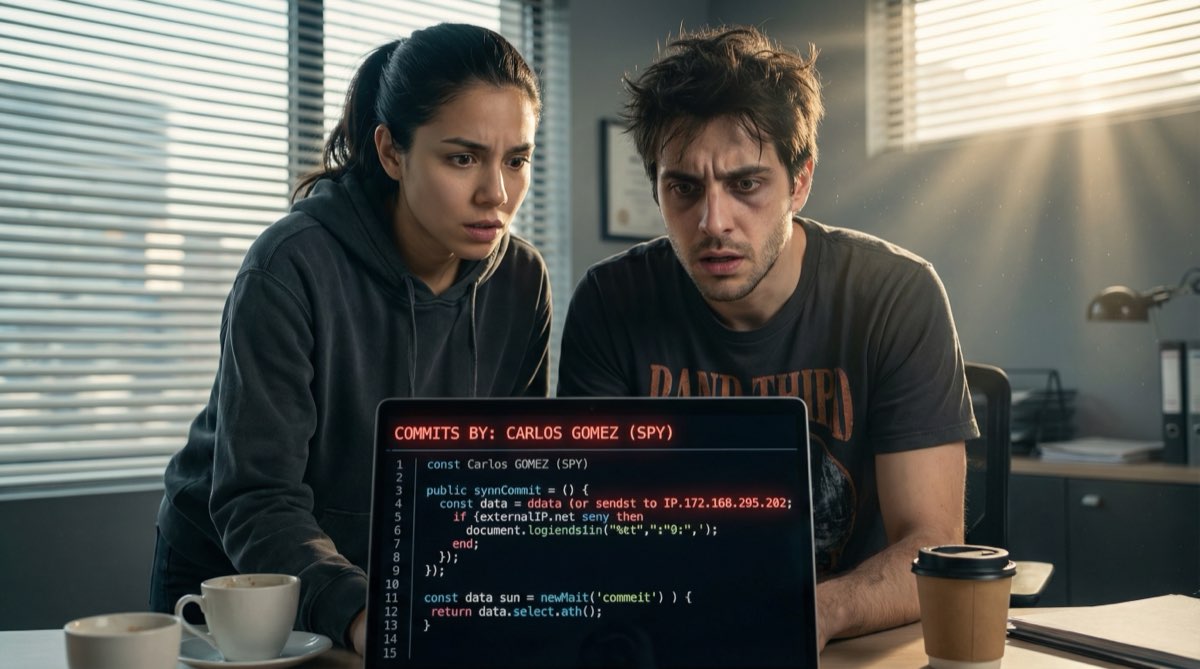
“We need to tell Don Hernando,” Diego says.
“And Stefan. Before he leaves.”
“And what about—” Diego can’t say the name. Neither can Camila.
But they both know who it is.
Someone who has been at every standup. Every retrospective. Every celebration. Someone who has seen the recovery from the inside — and reported every detail to the man who wants to destroy it.
The sun rises over Bogotá, bright and indifferent. Inside the FinPulso office, Camila picks up her phone.
Some conversations can’t wait until Monday.
🎭 This Week's Episodes
Telenovelas show what we can't say in client meetings. The drama is heightened, but the patterns are real.
 Three Ways to Understand a Country
Stefan drives Sophie to the Pacific for two days. The beach is big enough to make her feel appropriately small. Back at the finca the rain keeps th...
 The Resignations
Nathan Cole resigns on a Monday morning with two sentences and no argument left in his body. By Tuesday his desk is empty and the company's institu...
Technical Consultancy
Embedded Delivery Partner
Embedded into your team as an active contributor, reducing delivery friction and helping important work move cleanly.
Technical Advisor
Peer-style technical assessments before far-reaching decisions; reduce architectural and product risk early.
Product & Delivery
Ship working software to real users earlier. Measure impact and adapt based on evidence rather than assumption.
Custom Software Development
High quality, maintainable software. Short-term augmentation that leaves lasting capability in your own team.
Recent Articles
- When Everything Is Finally Under Control (28.09.2026)
- AI Makes Technical Execution Cheap. Judgment Stays Scarce. (24.09.2026)
- The LLM Will Not Come Back Tomorrow (19.09.2026)
- The One-Person AI Company Is a Greed Fantasy (15.09.2026)
- Test Production Without Leaving a Mess (10.09.2026)
Explore More