Collapse
Year-end arrives with the force of something everyone has been preparing not to name. A critical COBOL tax-calculation path fails on an undocumented edge case, and the failure exposes the final truth of Whitaker Payroll's decline: the people who knew how to repair the old machine are gone, and the people remaining know only how to route fear through meetings. Caleb Turner and Marcus Doyle do what frightened competent people always do first. They try to work the problem. Linda Pritchard, Sharon Mills, and Donna Reeves know what the outputs should look like, but descriptive knowledge cannot patch a batch. The offshore team can document damage but not correct COBOL they cannot compile. As wrong W-2s reach clients and the IRS, phones erupt, penalties trigger, lawsuits threaten, and cash begins leaving the company faster than language can contain it. By Thursday evening, behind a closed door with outside counsel, Graham Whitaker and Derek Lawson finally hear the plain version: they cannot deliver the service, they cannot fix the defect, and every additional day of operation increases liability. On Friday afternoon Graham reads a short prepared statement, Derek follows him out, and fifty lives are pushed over the edge by people who still, even then, want to think of themselves as having preserved order.
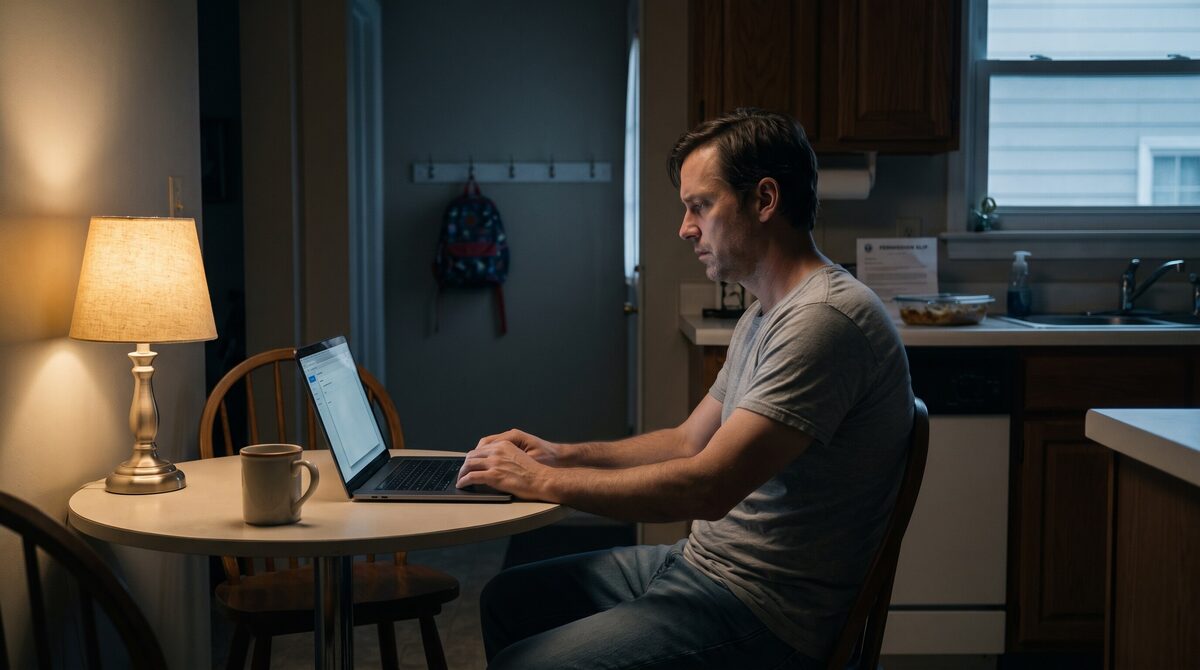
Tuesday, 02:17 — The Edge Case
[Image: Whitaker Payroll development room in the middle of the night. Caleb Turner and Marcus Doyle are under harsh fluorescent spill from a single overhead strip, both in hoodies or half-zipped jackets over wrinkled work clothes. A monitor shows a COBOL batch log full of red errors and a printed W-2 sample with highlighted mismatched withholding amounts. Coffee cups, stale takeout boxes, and Nathan’s old notebook are spread across the desk. Through the window, the parking lot is dark and slick with winter damp. 2°C outside.]
The batch failed at 2:17 in the morning on a line no one in the room could safely touch.
That was the first fact.
The second was worse.
The failure did not announce itself as apocalypse. It announced itself in the dry, unfriendly language of a system that had spent fifty years assuming somebody nearby still knew what it meant.
Marcus’s phone vibrated on the nightstand. He was awake before his eyes opened. That was what the last six months had done to his body. It had trained him to rise into dread faster than consciousness.
By the time he reached the office twenty-six minutes later, Caleb was already there in a hoodie under his winter coat, standing too close to the monitor as if proximity alone might produce understanding.
The batch log showed the same paragraph name three times.
TX-WITHHOLD-CALC
Then an edge-case branch Marcus had seen referenced once in Nathan’s plain-text year-end checklist and nowhere else.
A municipal withholding path for a mixed-jurisdiction client in Ohio whose employees worked across city boundaries and had a reciprocity rule layered over an old local exception that had probably been correct because Thomas Whitaker had typed it into COBOL in 1994 and then never had to explain it again.
Now the exception had surfaced in the one week of the year when errors became visible at federal scale.
Caleb held a printed output sheet in both hands.
The paper shook slightly, not dramatically, just enough to tell the truth his face was trying not to.
“These numbers are wrong,” he said.
Marcus set his bag down beside Nathan’s old notebook and leaned over the screen.
Wrong by enough to matter.
Wrong in the way that would travel.
Wrong on tax forms, which meant wrong not only to employees but to employers, accountants, regulators, and eventually to the IRS itself.
He felt his stomach tighten with the deep mechanical certainty of a body recognizing the shape of a disaster before the mind had finished naming it.
“Can we rerun the prior output against the sample client?” Caleb asked.
Marcus already knew what the comparison would show.
They ran it anyway because panic still prefers ritual at first. Ritual lets you postpone the sentence that changes the room.
The prior run and the current run differed on federal withholding, state withholding, and two municipal lines.
Not by pennies.
By enough that any payroll department comparing current W-2 output to quarterly filings would call before breakfast.
Caleb pressed both palms against the edge of the desk and lowered his head for a second.
He was twenty-eight years old. Four months earlier he had been excited by feature flags, test harnesses, and the feeling that software could finally become a profession instead of a haunted maintenance ritual. Now he was standing in a fluorescent room at two in the morning, staring at a failure he had no legal, technical, or emotional authority to repair.
“We need the COBOL source,” he said.
Marcus almost answered with something gentler.
Then he stopped himself. Gentle lies had gotten them here too.
“We have the source,” he said. “We don’t have a way to compile it.”
The files existed. That was not the same thing as having a working system. The Micro Focus build path lived on one aging machine with the right license, the right ancient configuration, the right mapped drives, the right environment variables, and all the accumulated invisible assumptions Nathan had learned not to disturb. If they changed COBOL now, they had no trustworthy way to turn that text back into a safe executable batch without risking a second failure layered on top of the first.
The sentence landed between them with the cold finality of weather.
They both looked, by reflex, at Nathan’s old desk.
Empty still. Monitor dark. Chair pushed in.
The offshore team could not help with this. Priya could map contradictions. Aamir could document flows. Bilal could tell them professionally that the VB6 environment remained unstable and the runtime assumptions were unsafe. None of that changed the current fact: the one piece of code that now mattered most lived in a language no one remaining could write and inside a toolchain no one remaining could trust.
Marcus opened Nathan’s notebook.
There it was, half a page down in cramped handwriting:
Check mixed-jurisdiction muni override before W-2 generation. Old Cleveland Heights reciprocity patch still ugly. Don’t trust Donna’s packet.
Caleb stared.
“That can’t be all,” he said.
It was not really a question.
Marcus looked at the line again and felt grief arrive in a form he had not expected: not grief for Nathan as a person exactly, though that was in it, but grief for the existence of somebody who could once turn a sentence like that into an action and no longer sat in the building doing so.
“It’s all that’s left,” he said.
The phones would not start ringing for another few hours.
For a few more minutes, the room still belonged only to them and the error.
That was almost merciful.
Tuesday, 09:48 — The People Who Know But Can’t Repair
[Image: Conference room under bright morning light. Linda Pritchard, Sharon Mills, and Donna Reeves sit together with binders, highlighters, and printed W-2 samples marked in red. Caleb Turner stands at the whiteboard with a batch-flow diagram; Marcus Doyle sits beside an open laptop showing the failed output. Derek Lawson is at the head of the table with a tablet, trying to hold the meeting inside process. Graham Whitaker stands near the window, pale and tense in a blazer. 8°C outside.]
By nine forty-eight the problem had become social.
That was when it began to resemble a Whitaker problem in the full institutional sense.
Linda, Sharon, and Donna sat with the printed W-2s spread before them like women studying pathology slides from a disease they had long suspected was possible but had never believed would become their responsibility in public.
Linda put on her reading glasses and traced a highlighted figure with one finger.
“This one is wrong,” she said.
Nobody in the room argued.
That was the horror. After months of equivocation, the numbers had finally become so visible that even the old defensive choreography could not plausibly recast them as interpretation.
Sharon swallowed and looked at Marcus.
“On the old run,” she said carefully, “the municipal carryover should have been zeroed before federal recalculation. It used to do that when the Cleveland Heights exception fired.”
Used to do that.
Marcus felt the phrase hit him with almost comic violence. The room still spoke as if memory itself were a repair tool.
“Can you show us where?” he asked.
Sharon looked down at the page.
Donna answered instead, voice small but still dressed in procedural competence.
“Not in the code,” she said. “In the behavior. We know what it should do.”
Descriptive, not reparative.
Nathan had known that distinction for years. Marcus felt it now like a blade sliding between ribs.
Caleb stood at the whiteboard with a marker in his hand and the posture of someone trying not to move too fast because speed might turn panic visible.
“We can identify the output mismatch,” he said. “We can identify the likely area. We cannot safely patch a COBOL tax path without the build environment and somebody who knows what secondary logic it touches.”
Derek lifted one hand.
The gesture was small and polite and entirely unbearable.
“Let’s stay solution-oriented,” he said.
Caleb stared at him.
The kid in him wanted to laugh. The adult in him wanted to hit something. The professional in him chose the middle path that Whitaker had forced into him over the last months: speak plainly enough to remain truthful, calmly enough not to be reclassified as unstable.
“The solution-oriented version is the same sentence,” he said. “We can’t repair this in-house.”
Graham was standing by the window with one hand in his pocket and the other pressing lightly against the frame, as if the office itself were the only thing still holding an outline around him.
He had slept badly and dressed carefully. That was becoming his pattern. If inner life frayed, outer surfaces tightened.
“Can the contractors help?” he asked.
Marcus heard, beneath the question, something more wounded: Please let the thing I approved still count as prudence.
He answered before Caleb could.
“Not on the COBOL path. They can help isolate effects. They can’t repair the batch.”
Linda looked stricken then, and because her stricken face made her look older, Graham instinctively turned toward her rather than toward the programmers. That, too, had always been part of the pattern. The people who looked most endangered by truth attracted his mercy fastest, even when the truth itself had arrived through others.
“Is there any manual workaround?” he asked her.
Linda inhaled slowly.
“For a handful of clients, maybe. Not at this volume. Not at year-end.”
Donna pressed both lips together and adjusted the alignment of the papers in front of her. Sharon folded her hands over her notepad as if physically stillness might prevent collapse from spreading through the table.
All three women had spent months surviving through defensiveness, deferral, and the hope that one more packet might keep the burden of explicit judgment from landing fully on them. Now the burden had arrived anyway, and it was arriving in the one form they had never been able to convert into safety: irreversible output.
Derek looked at his tablet.
“Let’s identify impacted clients and contain communications until we know more.”
Contain communications.
Marcus wrote the phrase down in the margin of his notebook and immediately hated himself for doing it, because writing it down felt too much like participating in the grammar that had gotten them here.
But documenting the institutional language of your own wreckage was one of the few surviving pleasures available to the trapped.
The first client voicemail arrived before the meeting ended.
Then a second.
Then support forwarded an email with the subject line URGENT: W-2 FIGURES DO NOT MATCH QUARTERLY TOTALS.
The room changed.
Not outwardly at first.
Nobody shouted. Nobody stood up so fast a chair fell over. Whitaker Payroll had been culturally optimized against scenes.
Instead the fear arrived in bodies.
Graham’s jaw hardened until the muscle at the side of his face began to tick. Derek started scrolling too fast through the tablet, as if speed might summon control. Sharon’s hand went to the chain of her glasses. Donna’s shoulders rounded inward. Linda stopped annotating the printout and simply stared at it.
Caleb looked at Marcus and understood that the event had now escaped the room.
That was the point where technical problems became institutional events. Not when the system failed, but when the failure acquired witnesses.
Wednesday, 13:06 — The Sound of Simultaneous Discovery
[Image: Open office in full daytime chaos. Support staff on phones, sales people standing in clusters, printed W-2s and client emails spread across desks. Marcus Doyle sits at a workstation with headset off, overwhelmed by multiple monitors full of logs and tickets. Caleb Turner stands near a whiteboard dense with red arrows and client names. Linda, Sharon, and Donna are at a nearby table comparing forms and binders. Derek Lawson strides through the room with a tablet while Graham appears at a doorway, pale and visibly shaken. 7°C outside, overcast light.]
By Wednesday afternoon, the phones had taken over the building.
They did not ring like ordinary work. Ordinary work rings one line at a time, with spaces for triage and routing and the fiction that the next problem can wait its turn.
This was simultaneous discovery.
Clients calling from Akron, Dayton, Parma, Canton. Payroll managers who had opened sample W-2s and felt their professional instincts flare before they even knew the exact numbers. Accountants who had compared withholding totals and found that the forms Whitaker had generated no longer reconciled cleanly with prior filings. HR directors whose voices began polite, then became very cold.
Support could not absorb it.
That department had spent years solving the kinds of problems companies liked to call customer issues and developers liked to call symptoms. Password resets. Export confusion. Printing glitches. Data-entry questions. Nobody in support had been hired to tell fifty-six-year-old payroll managers that the company’s year-end tax forms might be materially wrong.
The support floor now sounded like a storm made of courtesy.
“I understand your concern.”
“We’re escalating that internally.”
“We are actively reviewing the issue.”
“I understand your concern.”
The repetition itself became horrifying. A whole room of decent people reciting linguistic sandbags while the river kept rising. One support rep had gone pale enough that her makeup ended at her jawline like a mask. Another kept one hand flat against her headset as if holding it in place could keep her voice from shaking. A man from client services was sweating through the collar of his shirt and blinking too often, the way people do when tears are close enough to feel insulting.
Marcus sat at his desk with three monitors open and felt as if his brain had been split into incompatible jobs.
On one screen: batch logs.
On another: the growing impact spreadsheet.
On the third: contractor messages from Priya and Aamir asking for updated examples, rule descriptions, and any change history that might explain when the error path had diverged.
He could feel sweat collecting under his arms despite the cold building. Every few minutes he became aware of his jaw and realized he had been clenching it hard enough to ache. Just get through the next ten minutes, he told himself. Then, when ten minutes passed and the phones only multiplied: Just get through the next one.
They were still trying to help.
That was the bleak dignity of it.
The offshore team had been hired under false assumptions and dropped into a system no one had adequately described, yet they were still behaving like professionals. Asking specific questions. Building tables. Cross-referencing documents. Trying to limit damage in the only ways available to people denied the one kind of access that mattered.
Caleb was at the whiteboard writing client names in red and drawing arrows between known impacts.
Lake County Plastics.
North Shore Dental.
Brennan Logistics.
Union Municipal Transit.
The names multiplied until the board looked less like a list than contagion mapping.
“We’re over two hundred impacted forms already,” he said.
He kept his handwriting blocky and deliberate because anything cleaner would have required steadier hands than he had. The back of his neck was damp. He could feel the whiteboard marker slipping slightly in his fingers. Do not let them see you panic, he thought. If you panic, they’ll call it panic instead of math.
Marcus didn’t answer because he had just opened an email from a client controller attaching three screenshots and a one-line message that achieved fury by refusing any decorative language at all.
Explain immediately whether these filings are valid.
That was the kind of sentence institutions dreaded most. Not emotional. Not profane. Just clean enough to leave no place for performance.
Derek moved through the room with the strange, overcomposed energy of a man whose internal model of professionalism was now colliding with events too fast for choreography. He stopped at Marcus’s desk.
“How many confirmed clients?” he asked.
Marcus gave the number.
Derek’s eyes shifted once toward the support floor.
“We need tighter categorization,” he said. “Confirmed impact, suspected impact, optics-only.”
Marcus looked up.
“Optics-only?”
Derek heard himself and pressed forward anyway, because people under pressure often commit hardest to the vocabulary they should abandon.
“Client perception issues that may not map to actual numerical harm. We need clean buckets.”
Marcus thought: The numbers are wrong and he still wants a taxonomy that protects his nerves.
He did not say it.
He couldn’t afford the luxury Nathan had once tried to model. Nathan had lost a marriage, then a job, then the illusion that truth bought anything in this building except punishment.
So Marcus answered in the clipped professional dialect of the trapped.
“I’ll separate confirmed numeric discrepancies from unverified complaints,” he said.
Derek nodded, grateful for compliance, and moved on.
Marcus watched him go and had the fleeting, vicious thought that Derek still believed a cleaner spreadsheet might save them. Then the thought curdled immediately into envy. To still be rearranging categories this late required a kind of insulation Marcus no longer possessed.
At the table near the windows, Linda, Sharon, and Donna compared forms with increasing desperation.
“This line should inherit the adjusted local amount,” Sharon said.
“Only if the employee code was flagged before batch close,” Donna replied.
Linda’s reading glasses had slid low on her nose. She kept pushing them back up with a finger that would not stay steady. Sharon’s voice was holding, but only just; the strain sat in it like a crack under paint. Donna looked as if she might cry and was furious at her own face for considering it.
Linda looked between them and said what the room had needed months ago and what was now almost worthless because saying it no longer came early enough to save anything.
“We should have never let Nathan leave.”
Nobody answered her.
Not because anyone disagreed.
Because agreement had become a kind of mourning and there was no slack left in the day for mourning.
At 2:14 p.m. the first threat of legal action arrived by email.
At 2:37 p.m. a client with twelve hundred employees said they were suspending all further processing and evaluating immediate transition to another provider.
At 3:05 p.m. support forwarded a call log noting that two clients had already contacted their outside counsel.
The room didn’t explode.
It compressed.
Everyone moved faster inside smaller emotional space. People straightened their backs, lowered their voices, spoke more politely, as if posture itself might keep the building from understanding what was already happening inside it. Fear moved under the professionalism like floodwater under a floor. You could feel the boards softening even while everyone kept pretending to stand on something solid.
That was how collapse often looked from the inside. Not flames. Increased professionalism at impossible speed.
Thursday, 18:42 — The First Expensive Truth
[Image: Executive conference room after dark, door closed. Graham Whitaker sits at the end of the table, tie loosened, face gray with exhaustion. Derek Lawson sits beside him with a laptop and a thin stack of client notices he no longer knows how to control. Across from them sits a corporate lawyer in a dark suit, hands flat on the table, expression calm and unsparing. The room is too bright, coffee cups everywhere, winter dark outside the windows.]
By Thursday evening, forty percent of the customer base had either given notice, threatened departure, or frozen processing pending written assurances nobody at Whitaker Payroll could honestly provide.
The emergency meeting began at 6:42 p.m.
No programmers were invited.
No packets were requested.
The room held only Graham, Derek, and the outside lawyer.
That alone told the truth of the moment. The problem had moved above diagnosis and below ceremony, into the narrow private chamber where institutions finally ask what they should have asked months earlier and do so only because the price of not asking has become impossible to carry.
The lawyer was a woman in her late fifties with close-cropped silver hair and the tired, depthless calm of someone whose career had consisted largely of telling executives the price of their own lagging honesty.
She listened for twelve minutes while Derek summarized the situation in the most defensible sequence he could construct.
Unexpected year-end discrepancy.
Legacy calculation path.
External support engaged.
Customer concern elevated.
Potential regulatory exposure.
He kept his voice level. He kept his notes in order. He kept his hands still except for one finger pressing too hard against the edge of the laptop.
Inside, panic was already running.
Keep it coherent, he thought. Keep it inside a sequence. If it still sounds like management, maybe it is still manageable.
Graham sat beside him in a loosened tie and felt the same terror in a different dialect.
This cannot be the meeting where they tell me the company is over, he thought. Not like this. Not after all the times it almost was and wasn’t. Not by a woman who has been in the room less than an hour.
The lawyer let Derek finish. Then she rested both hands on the table and asked the only question that mattered.
“Can you currently produce correct forms?”
Silence.
Graham looked at Derek.
Derek looked at the dark screen of his own laptop for half a beat, as if one more glance at the shape of his materials might produce a version of reality that was less terminal.
The lawyer waited.
That was what made her unbearable. She did not rescue powerful men from their own pauses. She let silence remove their camouflage for her.
“Not with confidence,” Derek said finally.
The lawyer nodded once.
“Can you correct the underlying defect internally?”
Another silence.
Longer this time.
Graham felt sweat gather under his shirt despite the cold room. He could feel it at his ribs, in the small of his back, under the arms of the white shirt he had chosen that morning because it made him look like a man still inhabiting order. Derek’s mouth had gone dry enough that swallowing hurt. Neither man wanted to answer because both already knew the answer and could feel, with the clarity of people standing at the lip of their own judgment, what would happen once it was spoken aloud.
This was the bill coming due. Not for the batch failure alone. For Ethan. For Nathan. For every meeting where the right sentence had been recoded into a safer one. For every time fear had dressed itself as governance and called that prudence.
This is it, Graham thought, with a streak of self-pity so naked it almost made him nauseous. This is where they decide what kind of man I was.
No, Derek thought, almost at the same instant. This is where they decide what I did to him, and what I did to all of us.
“No,” Graham said.
He said it more quietly than he intended.
The lawyer looked directly at Graham.
“You cannot deliver the service,” she said. “You have no one who can fix this. Every day you continue operating, you increase your liability. You need to cease operations now.”
The sentence changed the air in the room.
Not because it revealed something nobody knew.
Because it priced it.
That was the one conversion Whitaker Payroll had not yet attempted: truth into immediate cost.
Graham felt, for one awful second, the temptation to ask if there was a more managed option. A partial shutdown. A phased communication plan. A stabilization window. Some form of retreat that would let the company die elegantly instead of correctly. The thought came to him with such humiliating speed that some intact part of him recognized it as the same instinct that had ruined them all year: not to fix reality, but to negotiate the feeling of it.
He saw Derek wanting the same thing, and the recognition was ugly, almost intimate. There you are, he thought. There I am. Exactly as advertised.
The lawyer saw it too.
“No,” she said, before either man spoke. “This is past the stage where language changes the exposure.”
Derek looked down at his hands.
They were still.
That was new.
All month his body had leaked anxiety through pen clicks, rapid note-taking, microscopic flares of nostril and jaw. Now the anxiety had gone too large for motion. He looked like a man who had finally reached the size of event his talent for administrative poise had never been built to survive.
Graham leaned back in the chair that had once belonged to his father and understood, maybe for the first and only time with true adult clarity, that inheritance was not stewardship and that taste was not judgment and that years of speaking carefully could still culminate in a room where a stranger told you, without anger, that your company was over.
He did not cry.
He did not apologize.
He asked the question people like him ask when moral reality has already been translated into operational necessity and all that remains is scheduling.
“How do we do it?”
The lawyer told him.
Short statement. Immediate cessation. No promises. Written follow-up through counsel. Lock the building over the weekend. Preserve records. Notify insurer. Notify payroll provider. Notify everyone necessary to protect whatever fragment of legal order remained.
Order.
Even now the word survived.
When the meeting ended, Derek closed the laptop. The lawyer gathered nothing because she had brought almost nothing. Graham stayed seated after the others stood.
Derek asked if he was all right.
It was a ridiculous question. That was why he asked it.
Graham looked at the dark window and saw only his own reflection.
“No,” he said.
It was the most truthful sentence he had spoken in months.
Friday, 15:00 — Effective Immediately
[Image: All-hands meeting in the Whitaker Payroll office. Employees stand and sit in tense silence among cubicles and folding chairs. Graham Whitaker stands at the front holding a single sheet of paper, pale and rigid in a dark blazer. Derek Lawson stands slightly behind him, face shut down. Support staff, sales staff, Linda, Sharon, Donna, Marcus, Caleb, and other employees look stunned, confused, or already afraid. Harsh office light, winter afternoon dim beyond the windows.]
At 2:52 p.m. the all-hands calendar invite hit inboxes across the company.
Mandatory. Conference area. 3:00 p.m.
No agenda.
Support assumed it was the W-2 crisis.
Sales assumed it was client messaging.
A few people — the ones with the oldest institutional instincts — understood immediately and then spent eight minutes refusing their own understanding because some knowledge still feels superstitious until another person says it aloud.
By three o’clock the conference area was full.
Fifty employees in an office designed for routine, not endings.
Winter coats slung over chair backs. Coffee cups half-finished. A support rep still wearing a headset around her neck because she had not had time to take it off before coming down. Donna clutching a packet she would never use again. Linda standing beside Sharon with both hands wrapped around a notebook. Caleb and Marcus near the back, not sitting, because the programmers had spent enough of the year learning that bad news rarely improved in chairs.
Graham stood at the front holding one sheet of paper.
He had chosen a dark blazer and a white shirt, which was exactly the kind of choice men like Graham make when trying to dress responsibility onto themselves after the fact. Derek stood half a step behind him with both hands clasped in front of his body so tightly that the knuckles had gone pale.
The room quieted with the strange collective obedience that institutions can still command at the moment of their own disappearance.
Graham looked down at the paper.
His voice, when it came, was steady enough to insult the people listening.
“Effective immediately, Whitaker Payroll will cease operations. Today is your final day of employment. Further information regarding pay, benefits, and next steps will be provided through follow-up communication.”
That was all.
He had practiced the sentences enough to remove the tremor and not enough to make them human.
The room broke open before the last syllable had time to settle.
Not at Graham first.
At reality.
At the air.
At each other.
“No.”
“What does that mean?”
“My calls are still queued.”
“Did he say final day?”
“What happens to December payroll?”
“What about insurance?”
“No, no, no.”
The support rep with the headset around her neck started crying openly, wiping at one eye with the heel of her hand and getting mascara on her knuckles. Someone near the folding chairs swore, loudly and without shame. A chair went over. A sales rep knocked a coffee cup off the edge of a table and didn’t even look down when it hit the carpet. People turned toward one another before they turned toward the front, because for the first few seconds nobody’s mind could accept that the man who had just ended their employment might already be leaving.
That was what saved Graham and Derek. The shock had no direction yet.
He did not even try to own the room after that. He glanced once toward the side corridor behind the conference area, and Derek saw it and moved first.
It was not brave enough to be called flight.
It was smaller than that. Meaner. The fast, practiced retreat of men who had already calculated that if they started moving before the crowd found its target, they could get out clean.
Derek touched Graham’s elbow and steered him through the side door near the copy room, into the little back hallway employees used to reach the service exit and loading area. They moved quickly enough to be shameful and quietly enough to be effective. By the time the first voices sharpened into the right question — Where the fuck are they going? — the two of them were already past the rear door and out into the winter air.
Then the room found its focus.
“Hey!”
“Get back here!”
“You don’t get to just leave.”
Someone lunged toward the front too late. Someone else ran to the side window by the copier bank, slapped a hand against the glass, and shouted with the raw, astonished fury of a person who has just seen contempt take physical form.
“They’re in the car leaving!”
That made everything worse.
The chaos acquired direction. People surged toward the side hall, toward the windows, toward the front, not because they believed they could stop the departure now but because the sight of it — Graham and Derek already halfway to the car while the room was still breaking — stripped the last administrative fiction off the moment. They had not merely delivered catastrophe. They had fled it.
That was the final Whitaker act: administrative withdrawal as conflict style, now performed at a near-run.
The room stayed full because people do not immediately know how to disperse around the end of their employment.
Someone started crying quietly near the printer station. Two support reps began talking over each other about client callbacks still queued. Sharon sat down abruptly in the nearest chair as if her knees had decided before the rest of her. Donna kept holding the packet. Linda stared at the doorway Graham had used and said, almost conversationally, “Tom would have never left a room like that.”
Marcus heard her and felt, simultaneously, contempt and pity and an exhausted recognition that even now everyone was still reaching for the nearest available story that protected them from the full size of the present.
Caleb looked at him.
Neither said anything.
There was nothing to say that would improve the fact that by Monday the building would be locked and Beth’s insurance clock would already be running.
A sales rep asked aloud whether severance had been mentioned.
Nobody answered.
In the far corner, someone was already opening job sites on their phone.
That, too, belonged to the collapse.
The moment after disbelief when labor begins trying to save itself one person at a time.
Monday, 08:11 — Locked Doors
[Image: Outside the Whitaker Payroll building on a gray winter Monday morning. A small cluster of former employees in coats stand in the parking lot facing dark windows and locked glass doors. Caleb Turner stands with a messenger bag and hands in pockets, stunned but upright. Marcus Doyle stands nearby, pale and hollow-eyed, staring at the building. A few others hold coffee cups, phones, or tote bags, unsure whether to leave. No lights inside. Frost on the edges of parked cars. 1°C outside.]
Some people still came in Monday.
Not because they had not heard Graham.
Because catastrophe often remains theoretical until a door refuses your badge.
Caleb got there at 8:03 with his backpack over one shoulder and a half-finished coffee cooling too quickly in the cold. He had spent the weekend in a state that resembled action from the outside — updating his resume, sending messages, reading job listings until the verbs blurred — but from the inside had felt more like waiting for impact to travel from one part of the body to the rest.
Marcus arrived three minutes later.
He had barely slept. Beth had lain awake beside him long after midnight, both of them pretending not to count forward through deductible dates, COBRA notices, refill windows, and mortgage timing. The silence between them had not been a lack of love. It had been love encountering arithmetic.
When he saw the dark windows, something in his face simply stopped arranging itself.
The front door did not unlock.
The lobby lights were off.
The sign by reception still said WHITAKER PAYROLL in brushed metal letters that now looked like props left behind after a show closed early.
A support rep named Melissa — not Ryan’s Melissa, a different one, older, with two teenagers and a husband recently laid off from a machine shop — tugged her badge against the reader twice before she seemed willing to believe the red light meant what it meant.
“No,” she said quietly.
Not to anyone in particular.
Just to the morning.
Within ten minutes a dozen people had gathered in the parking lot.
Coats zipped. Bags over shoulders. Phones out. No message from Graham beyond the legal follow-up sent Saturday afternoon. No one answering reception. No one answering Derek. Voicemail on every line that mattered.
The building behind the glass looked already posthumous. Desks visible but uninhabited. Chairs tucked in. Fluorescent strips dead. A workplace reverting instantly into real estate.
Caleb stared at the door and thought about the first day Ethan had shown him a failing test. About how thrilling it had felt to discover that software could be interrogated honestly. About how quickly Whitaker had taught him the opposite lesson: that the technical truth and the organizational truth could occupy the same room and only one of them would get to keep its job.
Marcus was not looking at the building anymore.
He was looking at his phone.
Insurance portal bookmarked.
COBRA FAQ open.
No actual numbers yet, just the architecture of ruin warming up.
He thought of Beth’s pill organizer on the kitchen counter. Monday, Tuesday, Wednesday. Little white compartments holding chemistry in place while human institutions fell apart around it.
Around them, people began making calls.
One woman called her husband and said, very evenly, “It’s locked.”
A man from sales kept saying, “This has to be temporary,” with decreasing conviction each time. Linda arrived late, saw the cluster, and stopped walking before she reached the sidewalk. Sharon put a hand over her mouth. Donna never got out of the car for nearly a full minute.
No one looked like a villain.
That was the final obscenity of it.
Just ordinary people in winter coats, in a parking lot in Ohio, discovering that years of deferred judgment had turned into unemployment all at once.
By eight thirty the group had thinned.
People left in ones and twos because there was nothing else to do and because standing in front of a locked building too long begins to feel like asking a corpse to revise its paperwork.
Caleb stayed until Marcus turned away first.
Not out of hope.
Out of witness.
The batches had stopped running forever.
Not with an explosion.
Not with sparks.
Just by being left behind by the people who had once known what to do when they broke.
The building stood there in the gray light holding all the hardware, all the paper, all the residual vocabulary of order.
None of it could process payroll now.
None of it could pay for medicine.
None of it could undo the fact that truth had been visible much earlier and had simply cost less, back then, to ignore.
🎭 This Week's Episodes
Telenovelas show what we can't say in client meetings. The drama is heightened, but the patterns are real.
 Three Ways to Understand a Country
Stefan drives Sophie to the Pacific for two days. The beach is big enough to make her feel appropriately small. Back at the finca the rain keeps th...
 The Resignations
Nathan Cole resigns on a Monday morning with two sentences and no argument left in his body. By Tuesday his desk is empty and the company's institu...
Technical Consultancy
Embedded Delivery Partner
Embedded into your team as an active contributor, reducing delivery friction and helping important work move cleanly.
Technical Advisor
Peer-style technical assessments before far-reaching decisions; reduce architectural and product risk early.
Product & Delivery
Ship working software to real users earlier. Measure impact and adapt based on evidence rather than assumption.
Custom Software Development
High quality, maintainable software. Short-term augmentation that leaves lasting capability in your own team.
Recent Articles
- When Everything Is Finally Under Control (28.09.2026)
- AI Makes Technical Execution Cheap. Judgment Stays Scarce. (24.09.2026)
- The LLM Will Not Come Back Tomorrow (19.09.2026)
- The One-Person AI Company Is a Greed Fantasy (15.09.2026)
- Test Production Without Leaving a Mess (10.09.2026)