What Valentina Knows
Valentina takes Sophie out alone — no Stefan — on the forest trails above the finca. The horses walk. Valentina has been Stefan's closest friend in Panama since before Sophie ever visited, and she has watched him try to be a father across twelve thousand kilometres for years. She asks Sophie a question Sophie has been avoiding: whether the story she arrived with is the whole story.
Valentina has known Stefan for seven years. She is allowed to ask things Sophie’s mother cannot.
Two Riders
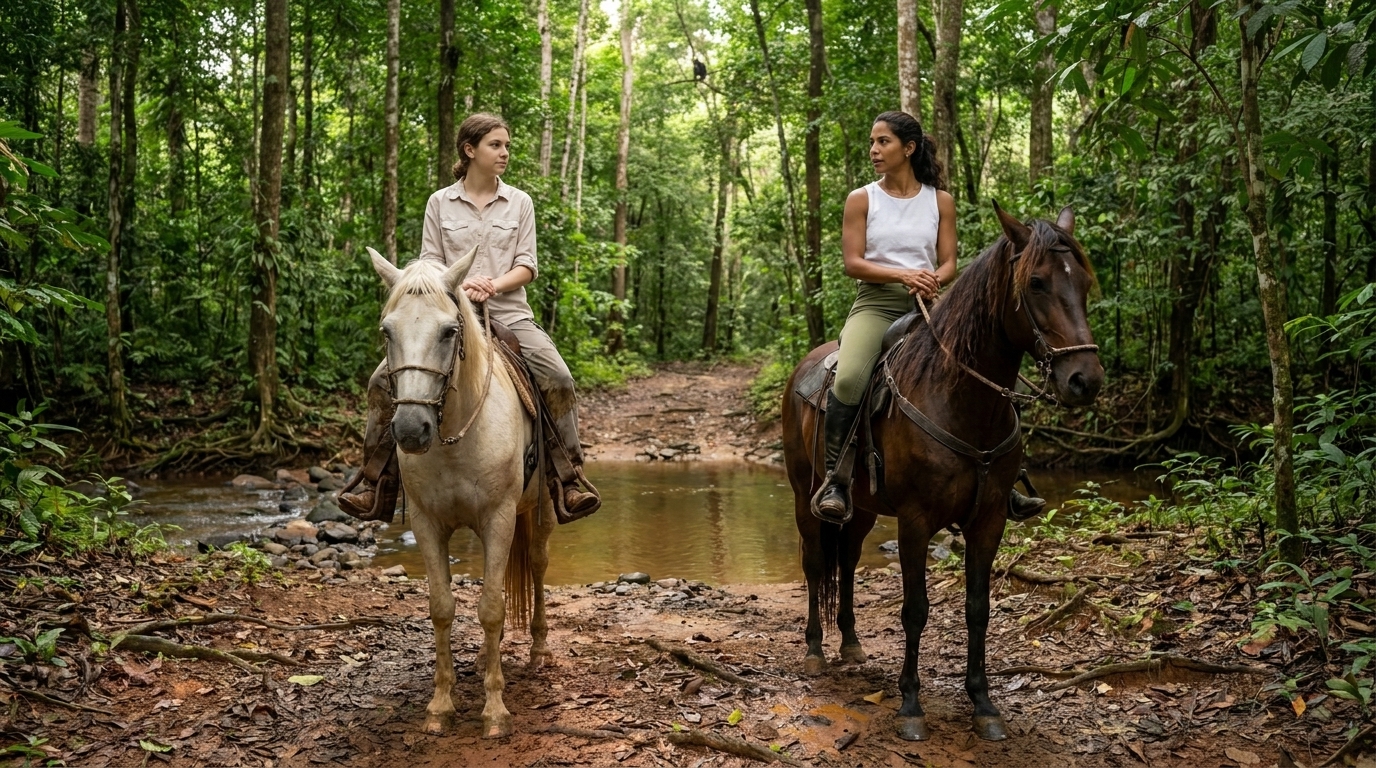
Papa had a call. One of those calls that appears in his diary in red, that he mentions three days in advance and treats as immovable. He apologized to Valentina. She waved it off before he finished the sentence.
“I’ll take Sophie,” she said.
He looked at me. I shrugged. I had learned to shrug in Panama the way the country itself seemed to shrug — not indifferently, but with a kind of confidence that things would resolve.
We left at seven before the heat settled in. Two horses, two riders, no itinerary. Valentina knew every trail above the finca — she had ridden them since she was nine, she said, first on a pony that her father called “the furniture” because it never moved unless pushed. Now she rode the bay, Cielo, who had more brio than Reina but a more skeptical temperament, and who needed to decide for himself that each new section of trail was worth proceeding into.
“He’s an intellectual,” Valentina said. “He needs to understand why.”
“That sounds exhausting.”
“It is. But when he decides to go, he goes completely.” She looked at me sideways. “Some personalities are like that.”
I did not ask which personalities she meant.
We rode for half an hour in comfortable silence. The forest here was older than the lower trails — taller canopy, less undergrowth, the light coming down in shafts that moved when the canopy moved. Howler monkeys somewhere, deep and slow. A stream crossing where both horses drank without being asked.
I had stopped feeling like a visitor on horseback somewhere around the fourth or fifth day of riding. Now I just felt like someone riding a horse in a forest. This was, I understood, a significant development.
What She Doesn’t Ask Directly
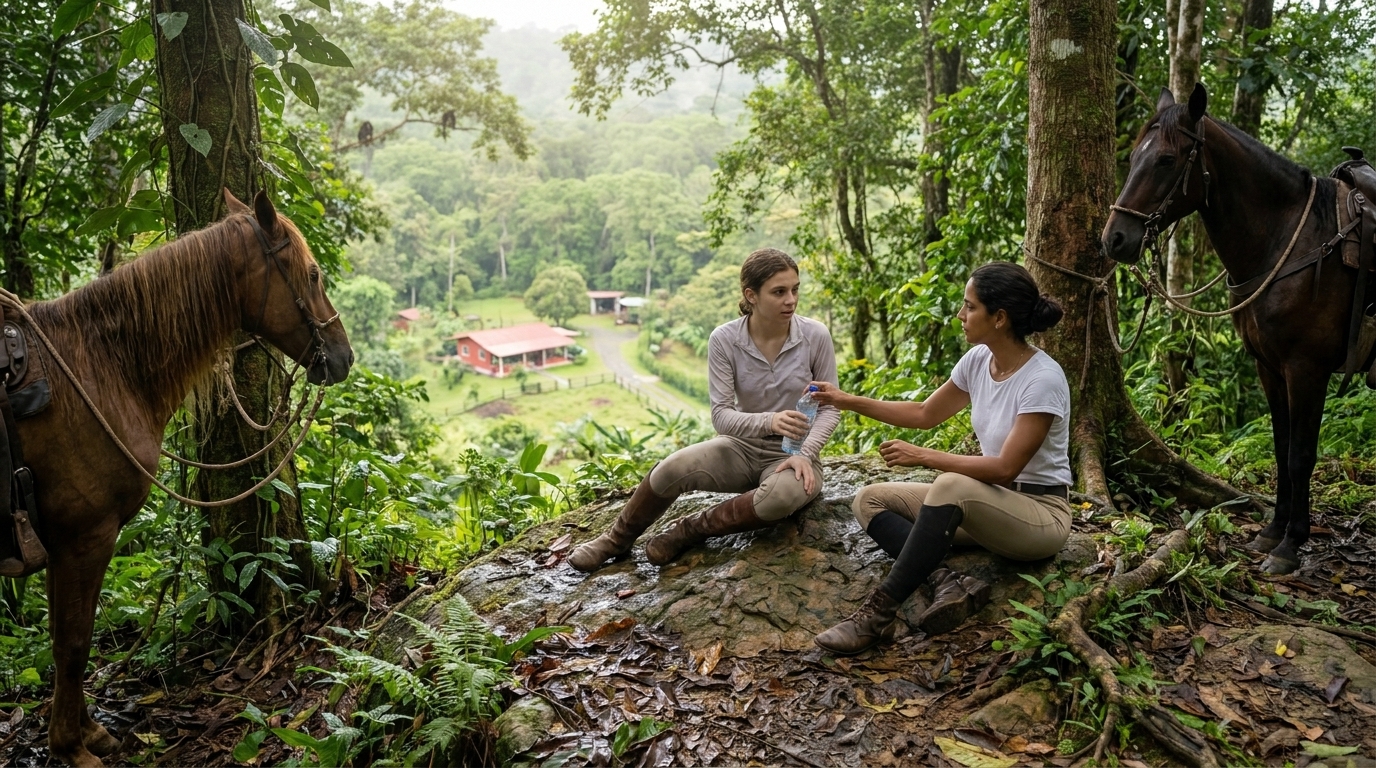
We stopped at a place where the trail widened onto a flat rock shelf with a gap in the canopy. Below, the valley. The finca was visible — the red roof, the paddock fence, the track running down to the main road. From up here it looked small and deliberate, like something built with intention.
Valentina handed me a water bottle.
“Your father talks about you,” she said.
I wasn’t prepared for that.
“What does he say?”
“That you are very serious. That the distance was hard on you — both of you, him included.” She said it plainly. “That he has spent a long time trying to be present across twelve thousand kilometres, which is not the same as being present but is not nothing.”
I looked at the finca roof.
“He told you that.”
“He tells me a lot of things. We’ve had time.” A pause. “I’m not trying to make you uncomfortable. I’m saying — he knows more about what happened than you might think he knows. He just doesn’t say it.”
I thought about the three days of rain. The recursion problem. The glass of water on the terrace without comment.
“Why are you telling me this?”
She considered the question seriously, which I had come to understand was how Valentina operated — she didn’t deflect, she just thought before she answered.
“Because you’ve been trying to figure out what his life here is,” she said. “And I think you’ve mostly figured it out. But there’s a part you’re doing the math on and not saying.”
I kept looking at the valley.
“And?”
“And I think you’ve been watching me with your father and reading it through a lens that doesn’t quite fit here.”
I looked at her.
“What lens?”
She turned the water bottle in her hands. “When I come to the finca — when I bring food, when I stay to talk, when I ask how he is and mean it — you see that as something specific. Something with a meaning attached.” She paused. “Where you are from, warmth between adults is measured out carefully. You give it when you have decided it is appropriate. You hold back until you are sure of what it means.”
I didn’t say anything.
“Here it is different,” she said. “Here warmth is — it is just how you are in the world. You are simpática, or you are not. It is not a signal. It is not an invitation. It is not a down payment on something else. It is how you move through a room, how you greet someone, how you show that you understand they are a person and you are a person and that matters. My mother is the same with your father. Esteban is the same with your father. Mateo is the same with everyone. It is the water we swim in.”
She looked at me.
“I am not making a case for anything,” she said. “I am telling you what I actually am. I am your father’s friend. I have been his friend for years, across a lot of rainy weeks and difficult breeding seasons and the particular loneliness of being a person far from where they started. That is a real thing. It does not need to be more than that to be real.”
I thought about the dinner at her parents’ house. Doña Carmen’s warmth, the way she had taken my hands. Don Ricardo explaining pasture grass to my father as though this was information worth exchanging between equals. The whole table operating at a register I had read as performance, or as something socially coded that I hadn’t cracked.
I had not cracked it. I had just applied the wrong key.
“I kept thinking,” I said slowly, “that everyone here was too — “
“Too friendly,” Valentina said. Not unkindly.
“Yes.”
“And that it must mean something.”
“Yes.”
She smiled. Not the big laugh from the first day. Something quieter, more personal. “It does mean something. It means you are welcome. It means you are seen. It means that when something happens to your family — when your mother is sick, when your father is far away — someone will show up. With food. With time. Without being asked.” She paused. “That is not nothing. In fact, from what I understand of where you come from, it is quite a lot.”
“And I thought it would be better if you heard it from me directly than if you spent the next ten days being careful about it.”
What She Does Ask Directly
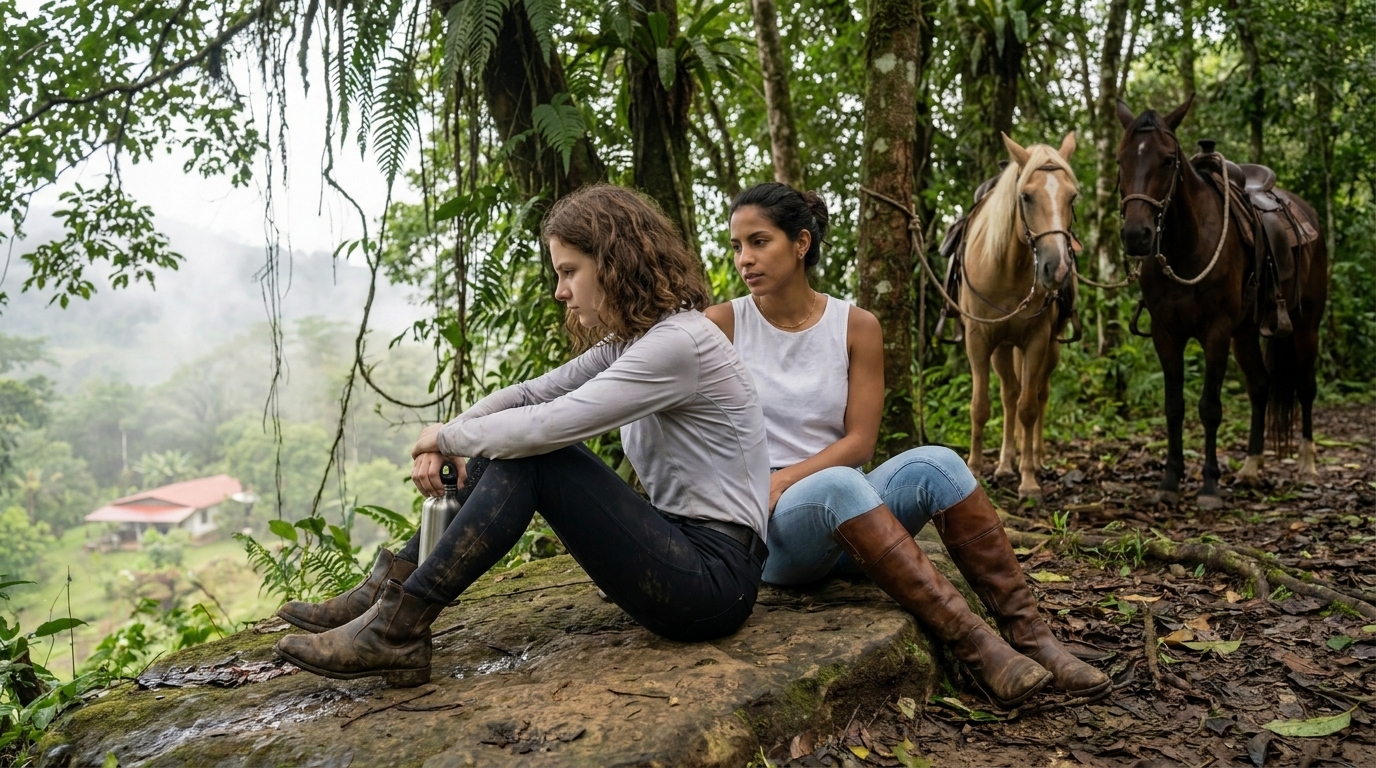
“Can I ask you something,” Valentina said. It was not quite a question.
“Yes.”
“The story you came here with — the one about why your father left, why he stayed away, why Panama instead of Berlin — whose version is that?”
I looked at the valley.
“My mother’s,” I said.
“And have you asked him for his?”
A long pause. The howlers called somewhere below us.
“Not really,” I said.
She didn’t say anything. She didn’t need to. Valentina was someone who understood that some silences were doing work and should be left alone.
“He doesn’t talk about it,” I said, which was true but also, I recognized as I said it, convenient.
“No. He doesn’t.” She looked at the valley. “He has been here seven years. I have known him almost that long. We have ridden these trails, worked the same breeding seasons, sat through the same rainy weeks when there is nothing to do but talk. He talks about you. He talks about your mother carefully, which is how you talk about someone you don’t want to speak badly of. He has never explained himself to me. I’m telling you this because — “ She paused. “Because I think you are smart enough to understand that there are at least two accounts of any story, and you have only heard one.”
I thought about my mother in Berlin, who had packed my bag with me, who had driven me to the airport, who had texted me the day I landed to say she was glad I’d come. She and Papa had stood together in a hospital corridor in April while the doctors talked. That had not been nothing either. They had figured out how to be in the same room when it mattered. I was the one who hadn’t asked him anything.
“I’m asking whether you’ve let him tell you his side,” Valentina said.
We sat with that. The howlers called again.
“No,” I said. “I haven’t.”
She nodded. Just once. Then she handed me the water bottle again.
I had not managed to say that to anyone before. It sat differently outside my head than it had inside it — smaller, maybe. Or just more precise. A thing with edges instead of weather.
Reina
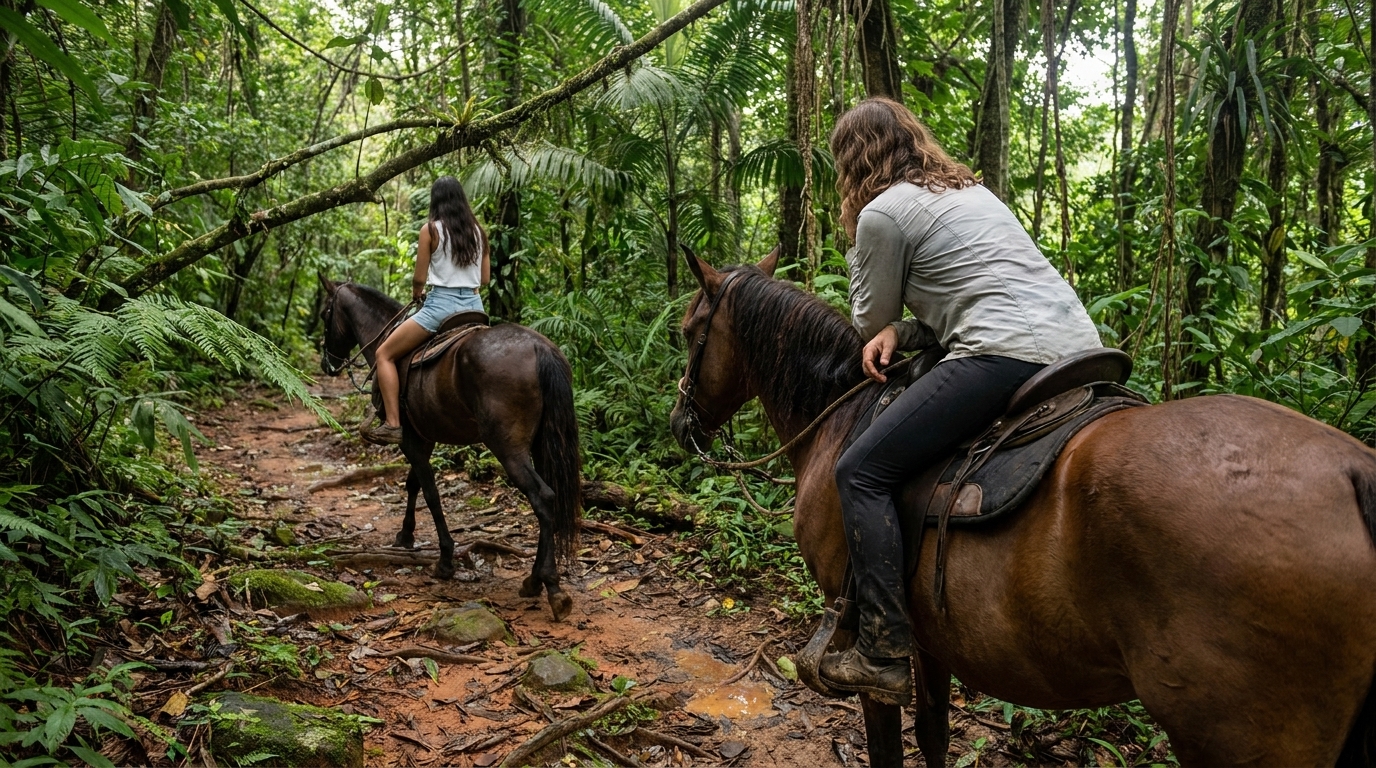
We rode back mostly in silence, which was a different silence than the one on the way up.
At some point Valentina moved ahead — Cielo had opinions about a section of trail that he communicated through a series of small sideways movements, and she needed her attention — and I rode behind on Reina, who had no opinions about anything except where the grass was and whether the girth was too tight.
I put my forearms on Reina’s neck and let the reins go loose.
She kept walking. She knew the way back.
I thought about what Valentina had said: present across twelve thousand kilometres. The birthday calls on the right day. April in the hospital corridor, the flight from Mexico City that he didn’t finish explaining and didn’t need to. The Brötchen from the bakery. The invitation to Panama, offered every year, accepted this year because I finally understood I wanted to go — and because in the hospital corridor, when I asked him, he didn’t hesitate.
He had been trying. I had been receiving it without asking what it cost him.
Reina picked her way carefully over the stream crossing. I felt her balance shift under me, the precise adjustments of a horse that knew exactly what she was doing and didn’t need help. I had learned, in the past three weeks, to sit quietly when Reina knew what she was doing. To not interfere with competence you don’t match.
That seemed applicable to more than horses.
That Evening
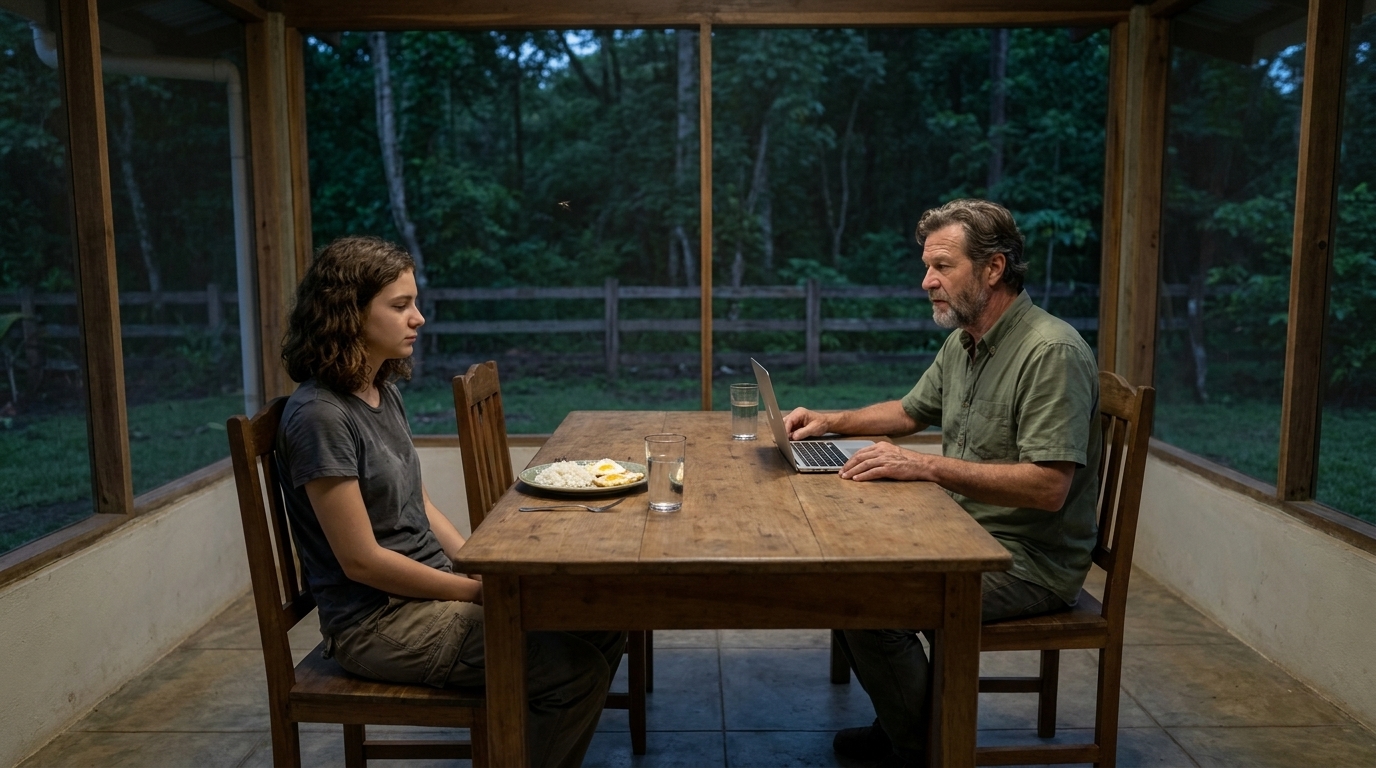
Papa had finished his call by the time we got back. He was at the outdoor table with his laptop, a glass of water, some kind of work that could wait. He looked up when we came through the gate.
“Good ride?”
“Yes,” I said.
He looked at me for a moment in the way he had — the way I’d noticed over the past weeks, the waiting-to-see-if-there’s-more way — and then looked back at his screen when there wasn’t.
Rosa had left food. Papa heated it. We ate on the terrace because we always ate on the terrace when the rain wasn’t coming.
I thought about asking him directly. I thought about what Valentina had said: better if you heard it from me than if you spent the next ten days being careful about it. She had said ten days. I had eleven left.
I didn’t ask. Not because I was afraid of the answer — I had the answer, more or less — but because I wasn’t sure yet what I wanted to do with it. Some information you need time to grow around before you can handle it cleanly. I had learned that about jagua. The pattern develops in the dark.
“The trail above the ridge,” I said. “Does it go all the way to the other valley?”
He looked up, mildly surprised at the question. “It does. You need a full day. Mateo has done it.”
“Can we do it before I leave?”
He considered. “Yes. I think so.” A pause. “I’d like that.”
“Good,” I said.
The potoo screamed. I didn’t startle. Neither did he. We sat there in the kind of quiet that is not silence — the forest at dusk, the horses settling, the insects starting — and ate Rosa’s food, and I thought: this is also something I didn’t have three weeks ago.
The capacity to sit with my father without needing anything to be different.
I didn’t write that. I thought it was worth keeping exactly as it was.
🎭 This Week's Episodes
Telenovelas show what we can't say in client meetings. The drama is heightened, but the patterns are real.
 Three Ways to Understand a Country
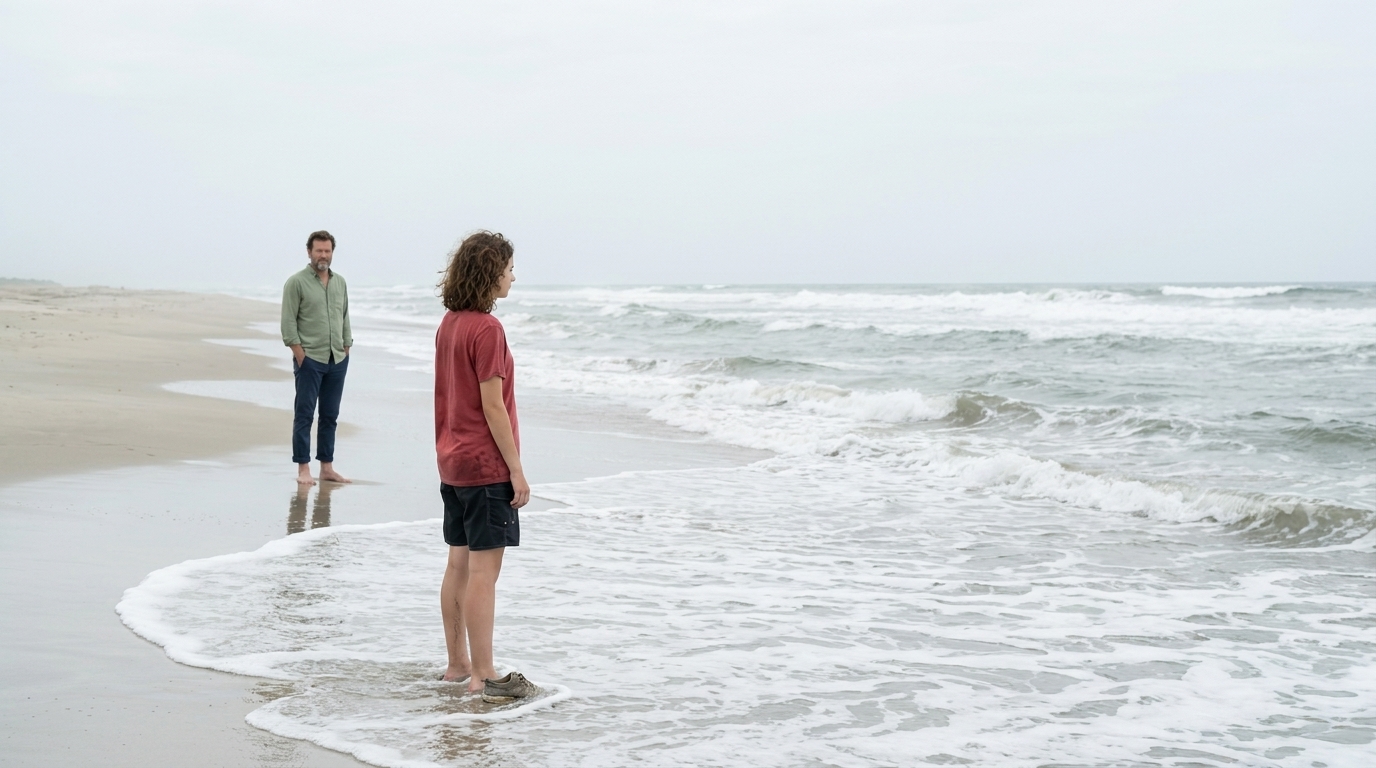
Stefan drives Sophie to the Pacific for two days. The beach is big enough to make her feel appropriately small. Back at the finca the rain keeps th...
 The Resignations
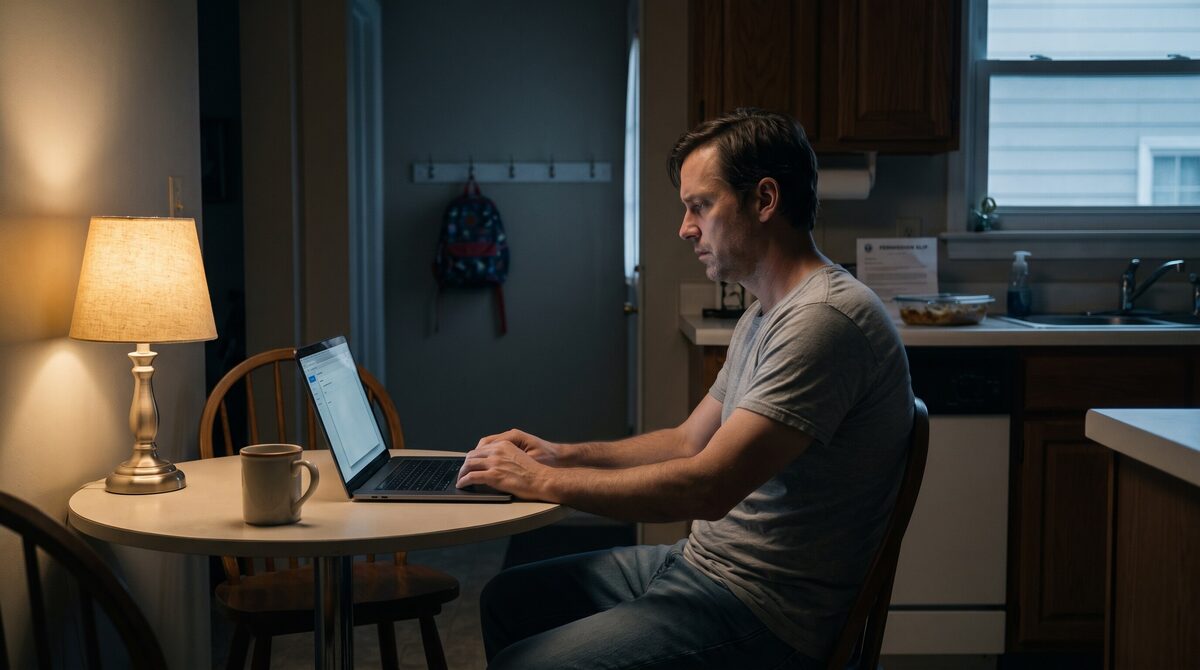
Nathan Cole resigns on a Monday morning with two sentences and no argument left in his body. By Tuesday his desk is empty and the company's institu...
Technical Consultancy
Embedded Delivery Partner
Embedded into your team as an active contributor, reducing delivery friction and helping important work move cleanly.
Technical Advisor
Peer-style technical assessments before far-reaching decisions; reduce architectural and product risk early.
Product & Delivery
Ship working software to real users earlier. Measure impact and adapt based on evidence rather than assumption.
Custom Software Development
High quality, maintainable software. Short-term augmentation that leaves lasting capability in your own team.
Recent Articles
- When Everything Is Finally Under Control (28.09.2026)
- AI Makes Technical Execution Cheap. Judgment Stays Scarce. (24.09.2026)
- The LLM Will Not Come Back Tomorrow (19.09.2026)
- The One-Person AI Company Is a Greed Fantasy (15.09.2026)
- Test Production Without Leaving a Mess (10.09.2026)