The Scattered — Part Two
After Whitaker Payroll shuts its doors, the damage keeps distributing itself unevenly. Some former employees find new work quickly. Others discover that decades of loyalty, office competence, and obsolete specialization do not translate into a future. Linda Pritchard, Sharon Mills, and Donna Reeves send out resumes full of Whitaker-specific process language and institutional memory and receive almost nothing back. To survive the humiliation, they settle on a more merciful explanation: AI did this, the market did this, time did this. Anything but the harder truth that they helped defend the very system that stranded them. Around them, former support staff, sales people, and administrators try to turn shock into rent payments, childcare, and smaller jobs with thinner dignity. Graham Whitaker, meanwhile, converts the company into real-estate disposal, reduced acquisitions, and an upscale bar conversation with Preston Hale in which blame remains everyone else's burden. The final contrast belongs to Ethan Carter, far from Ohio, building a business on his own terms under a wide Wyoming sky. He does not need revenge. He simply kept moving while the people who mistook control for stewardship learned too late that institutions can disappear faster than the stories built to protect them.
Tuesday, 09:36 — The Shorter Lines
[Image: County workforce center or unemployment office in northeast Ohio. Former Whitaker employees stand in a quiet queue with folders, coffee cups, and tired winter coats. Melissa from support, a sales rep in a worn suit, and a client-services manager sit with forms and phones. Fluorescent light, beige walls, vending machines, a television mounted in the corner with captions on. Cold January morning, 0°C.]
The first weeks after a company dies produce a strange democracy.
Everyone has paperwork.
Everyone takes a number.
Everyone begins speaking in the same bureaucratic dialect whether they used to sell, support, document, reconcile, charm donors, quote account growth, or fix printers no one thanked them for fixing.
At the county workforce center, Whitaker Payroll kept reappearing in fragments.
Melissa from support sat three chairs down from an account manager named Rob Fenton, both of them pretending not to notice how humiliating it felt to encounter former coworkers under fluorescent lights where nobody’s title mattered and everyone’s winter coat looked a little cheaper than it had at the office.
Melissa had worked phones for eleven years. She knew client birthdays, payroll cycles, and which callers needed five extra seconds of silence before they could hear an answer. None of those skills had names that improved a resume.
Rob had spent a decade telling clients Whitaker was stable. Reliable. Built on relationships. He had believed those sentences while saying them. That was what now made them burn.
Melissa filled out unemployment forms with the efficient pen pressure of a woman trying to remain useful somewhere, even if usefulness had been reduced to legibility.
Her husband, Dean, was driving part-time for an auto parts distributor after the machine shop closed. Their oldest son’s braces still had fourteen payments left. Their daughter needed new glasses. Every financial obligation in her life had the rudeness of continuing to believe in the future.
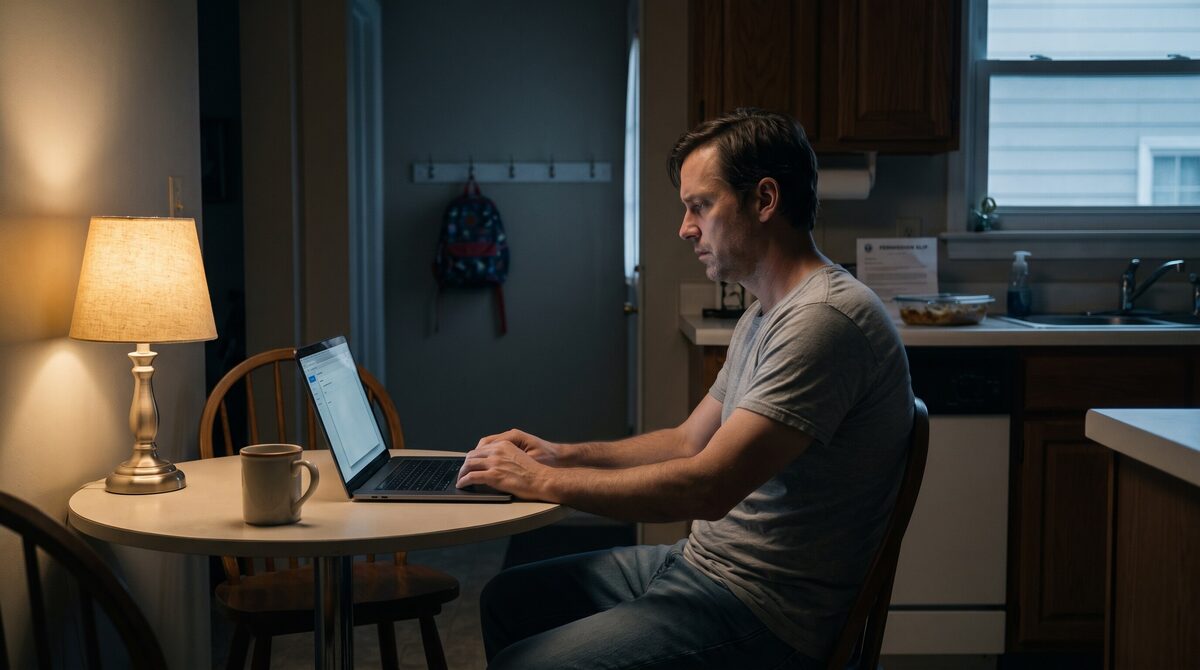
Rob kept refreshing his email between fields.
He had already applied to twelve sales roles, all of them requiring cold confidence and CRM fluency and the kind of self-presentation that only works when you do not currently feel like a man who sold certainty for a company that shut its doors on a Friday and locked them by Monday.
“You hear from anybody?” Melissa asked, not looking at him.
The question had the casual shape coworkers use when trying not to make sympathy too visible.
Rob shook his head.
“A recruiter called,” he said. “Wanted to know why I left.”
Melissa’s mouth tilted once.
“How’d you answer that one?”
He gave a short laugh with no amusement in it.
“Tried three versions. None of them sounded employable.”
She nodded.
That problem belonged to all of them now. How to describe catastrophe without becoming contaminated by it. How to tell the truth in a labor market that heard too much truth as a personality risk.
Across the room, Teresa Morrow from client services was arguing gently with a benefits representative about continuation paperwork. Teresa was forty-eight, divorced, raising a grandson because her daughter was in rehab. She had never attended a single executive meeting in her life. She had never heard Preston Hale’s name until the collapse story began circulating afterward in second-hand fragments. She knew only that she had spent fifteen years making panicked small-business owners feel less alone on payroll mornings and that now she was standing in a beige office asking whether the insurance extension would cover her grandson’s asthma medication.
“I’m not disputing the date,” she said. “I’m asking if there’s any gap in pediatric coverage if the paperwork arrives after the deadline.”
Her voice remained level.
That was the discipline of people who had spent careers solving other people’s panic without ever being paid enough to indulge their own.
The representative explained the process in a voice practiced to resist contagion. Teresa listened, nodded, wrote things down, and looked, from a distance, composed.
Up close, Melissa could see the muscle in Teresa’s jaw jumping.
That was what aftermath looked like for the non-technical side of Whitaker.
Not insight.
Administration.
Not dramatic speeches about structural failure.
Forms. Deadlines. co-pays. Interview clothes that still fit. Calls to landlords. Quiet calculations made in parked cars before going back inside to tell children what would happen next in a tone that suggested adults remained in charge of the sequence.
When Melissa’s number was called, she stood, smoothed the front of her coat, and carried her folder to the desk with the reflexive professionalism of a woman who had spent too many years believing good demeanor could keep institutions from embarrassing themselves.
Sometimes it helped.
Just not at Whitaker.
Month Two — Skills That Expired Quietly
[Image: Public library computer area in winter afternoon. Linda Pritchard, Sharon Mills, and Donna Reeves sit at separate terminals with printed resumes, reading glasses, and notebooks. Their coats are draped over chair backs. On the screens: job boards, rejected applications, and old resume bullets mentioning payroll exception review, requirements packets, and office process work. Snow light through large windows, 3°C.]
Linda, Sharon, and Donna discovered unemployment in the humiliating way specialists often do: not as sudden hunger, at first, but as delayed irrelevance.
For the first two weeks they had told themselves some version of the same story.
The market was probably slow.
People were just returning from holiday.
Employers needed time to review applicants properly.
Surely there had to be companies somewhere that still valued women who knew payroll edge cases, quarter-close rituals, exception histories, and the dense lived texture of practical office work.
Surely history itself still counted as skill.
Then the applications began returning silence at scale.
At the public library in Parma, Linda sat at terminal fourteen with her reading glasses halfway down her nose and looked at the screen as if looking harder might restore a category the labor market had retired without telling her.
Resume:
Payroll exception review.
Quarter-close reconciliation.
Requirements packets.
Output review.
Cross-department coordination.
Each line described real work she had done for decades.
Each line now looked, in digital light, like the biography of a profession that had died privately before the company ever did.
Donna was two terminals down, rewriting summary bullets for the third time in a week. She kept trying to replace old words with newer ones, the way people repaint old cabinets when they cannot afford to change the house.
Business analyst became operations specialist.
Payroll exception review became issue resolution.
Requirements packets became process documentation.
The new phrases improved tone without changing outcome.
No callbacks.
Sharon had gotten one interview for a payroll coordinator role at a regional manufacturer. The hiring manager had been thirty-two years old, friendly, and visibly confused by the section of Sharon’s resume that listed “payroll exception review” under specialized experience.
“So was that development work?” he had asked.
Sharon had smiled carefully.
“Not exactly. More reviewing outputs, catching odd cases, knowing which rules to escalate.”
He had nodded in the polite way younger professionals nod when they are trying not to reveal that your expertise sounds to them like a museum label.
She had not heard back.
At the library Linda clicked open another rejection email and felt the old defensive story begin warming itself again.
It was not, in her mind, exactly dishonesty.
More like a human immune response.
“It’s AI,” Donna said suddenly, in a low furious voice not intended for the room but audible enough for the other two. “Everything is AI now. They’re filtering people out before a human even sees them.”
Linda did not answer immediately.
The sentence offered relief too quickly. That was why it was tempting.
If AI was doing this, then the market’s rejection of them was mechanical and therefore impersonal. No need to think about the years spent protecting obsolete skill boundaries. No need to revisit the way Ethan’s tests had made their uncertainties visible. No need to admit that what frightened them back then had not been merely replacement but exposure: the possibility that their expertise was narrower, older, and less portable than they had built their dignity around.
Sharon took off her glasses and folded them carefully.
“AI is part of it,” she said.
She needed it to be part of it. Needed the sentence to retain enough truth to remain habitable.
Donna turned toward her.
“You don’t think so?”
Sharon looked down at the printed resume in her lap.
Her hands were still elegant hands, thin-fingered, competent hands, hands that had spent years annotating outputs and catching exceptions other people missed. She had never thought of those hands as old. Now every job posting seemed written for someone faster, broader, cheaper, and already fluent in tools she had only heard named in rooms where younger people spoke too quickly.
“I think,” she said slowly, “that the world moved and we kept calling that stability.”
Linda heard the sentence and felt something in herself recoil.
Not because it was false.
Because it came too close to the version of the story from which no dignity could be extracted.
“That’s not fair,” she said. “We did what the company needed.”
The words arrived with more force than she intended.
A teenager at the printer glanced over and then away.
Donna’s face tightened in immediate alliance. That was how the three of them still held each other up: through small mutual rescues from the worst available interpretation.
“We kept it running,” Donna said.
And there it was again. The sentence that had been partly true for years and insufficiently true for longer. They had helped keep it running, yes. They had also helped keep it frozen. The difference between stewardship and stasis was exactly the kind of nuance a frightened career cannot afford once the paychecks stop.
Sharon put her glasses back on.
“I know,” she said.
What she meant was: I need that to remain true enough to survive on.
By closing time, all three women had submitted more applications.
No new messages arrived.
Outside, the parking lot was crusted with dirty snow. Linda stood beside her car a moment longer than necessary and looked at the library windows reflecting late afternoon back at her.
She was fifty-one years old, too young to retire, too old to reinvent cleanly, and carrying a version of the story in which what happened to Whitaker still had to be caused by everything except the possibility that her own fear had once mistaken itself for prudence.
She got in the car and drove home to a husband who had started asking practical questions about savings in the careful tone men use when they know practicality itself can sound like blame.
Month Three — Smaller Work
[Image: Split scene showing three former Whitaker employees in different new settings. Melissa at the front desk of a dental office wearing scrubs under a cardigan; Teresa in the back office of a regional trucking company sorting invoices; Rob alone in his apartment on a late-night video interview. All three spaces feel lower-status, more fragile, and more immediate than the old office. Winter gray outside.]
Not everybody fell equally.
That was its own cruelty.
Melissa found work first because offices always need somebody who can sound calm on the phone.
The dental practice in Fairview Park paid six dollars less per hour than Whitaker had, offered thinner benefits, and made her wear black scrubs beneath a cardigan that still smelled faintly new after three washes. The dentist called the team a family in the first interview, which Melissa would once have taken as reassurance and now heard as a labor warning dressed in crochet.
Still, she took the job.
She answered appointment calls, verified insurance, and watched her paycheck shrink into a narrower version of adulthood.
At lunch she sat in her car eating yogurt from the cup with a plastic spoon and calculating whether her son’s braces could be refinanced into any of the existing debt without making the monthly burden look obscene enough to scare Dean.
When people asked how she was doing, she gave the Ohio answer.
“Hanging in there.”
What she meant was: The world did not end. It simply got smaller and more expensive.
Teresa took a back-office job at a regional trucking company because her grandson still needed asthma medication and the hiring manager liked that she knew how to talk to upset people without sounding frightened herself. The work was invoices now, not clients. Freight discrepancies, fuel surcharges, billing adjustments. The office was louder and less polished than Whitaker, but the owner, a woman in her sixties with practical shoes and no interest in euphemism, said on Teresa’s second day, “If something’s broken here, you tell me. I don’t pay people to decorate disasters.”
Teresa nearly cried at the sentence.
Not because it was beautiful.
Because it was plain.
She went into the bathroom, dabbed under her eyes with a paper towel, and returned to her desk with the embarrassed gratitude of someone discovering that honesty at work did not always have to cost a job.
Rob took longer.
Sales work required confidence, and confidence becomes physically difficult when your last company turned itself into a cautionary tale and left you holding the pitch deck vocabulary like evidence.
He interviewed over Zoom in a tie and gym shorts from his one-bedroom apartment, ring light reflected in the dark television behind him. Recruiters kept asking about quotas and client retention and what happened at Whitaker.
He learned to say, “The company experienced an abrupt closure during a critical operational period,” which sounded grave without sounding radioactive.
He got close twice. Final round once. No offer.
Each rejection made him a little more ornate in the next interview, as if better phrasing might compensate for the contamination of recent history.
By month three he was considering a territory rep role selling office equipment to school districts, a job he would have mocked privately during the Whitaker years for its dead-end smell.
Now dead-end smelled a lot like rent.
At night he poured one bourbon into a rocks glass and told himself he was being measured, not lonely.
That was how self-respect survived middle age sometimes. Not by denying decline, but by insisting every compromise still had posture.
Among the former employees, texts continued for a while. Job leads. COBRA complaints. Rumors about client lawsuits. Who had heard from Sharon. Who had seen Graham downtown. Then the thread thinned, as all threads do once people realize shared catastrophe does not actually create shared futures.
One by one, each person’s damage individualized.
That was the second death of the company.
Not when operations ceased.
When the old coworkers stopped being a collective story and became separate monthly obligations again.
Late Winter — Liquidation Tone
[Image: Graham Whitaker in the mostly emptied lobby of the old Whitaker Payroll building with a commercial real-estate broker. Framed art has been removed, a few pieces of office furniture remain, and the brushed-metal company sign is gone or leaning against a wall. Graham wears an expensive coat and scarf that now hang a little too loosely on him, trying to inhabit the space as transaction rather than ruin. Pale afternoon light, 4°C.]
Graham sold the building in stages before he sold it legally.
First he removed the art.
Not all at once. That would have felt vulgar even to him. Just a few pieces per week from the conference room and lobby, as if curation rather than collapse explained the blank rectangles left behind on the walls.
Then he stopped going in unless the broker required it.
Then he began speaking of the property as a holding rather than a headquarters.
This, too, was grief translated into the dialect wealth finds easiest to survive inside.
Elsewhere, former employees were learning what medication cost without coverage, what rent sounded like when paid late, what it felt like to sit under library fluorescents and discover the market had no use for the only expertise they had. Graham, by contrast, was measuring corridor width and parking ratios.
That was part of the obscenity too. Harm did not distribute itself according to blame. It distributed itself according to insulation.
On a gray Thursday in late winter he walked the empty lobby with a commercial broker named Artie Levin, who wore polished shoes and talked in square footage. Graham appreciated him immediately for this. Square footage had none of the moral residue of memory.
“For this corridor width and parking ratio,” Artie said, “you’ve got good options. Medical admin, insurance, maybe light professional services if the next owner wants to rework the interior.”
Graham nodded and looked at the wall where the company sign had hung for years.
He felt, fleetingly, the urge to say something about legacy. His father. The generations of payroll. The people. The weight of what had happened here.
Instead he asked about comps in the area.
That was how he had learned to protect himself by now. Convert narrative into asset class before feeling had time to become accusation.
Artie flipped through his folder.
“Market’s not terrible if pricing is realistic,” he said.
Realistic.
Graham almost laughed.
The whole last year of Whitaker Payroll had been a war between realism and the need to remain the kind of man who never appeared panicked. Realism had finally won only after lawyers put a dollar amount on denial.
Since the shutdown he had reduced his art acquisitions, stepped back from two museum committees, and started declining invitations with the phrase taking some private time. People in his world heard that and supplied tasteful meanings. Grief. Burnout. A family matter. Nobody asked whether fifty employees and a failed payroll company had broken something more vulgar in him than sadness.
At home, the separate bedrooms were old news, old enough by now to feel less like a fresh wound than a household fact. Whatever softness had once justified the arrangement was long gone. What was fading now was the polished outer version of the marriage, the one that had once survived on arm touches, donor smiles, and her instinct for keeping a room from smelling weakness. She no longer appeared automatically at gallery openings. She had begun replying to invitations on her own, not theirs. When people asked after Graham, she gave them the dry social version of weather. “He’s had a difficult season.” Then she let the silence sit where a loyal wife’s softening sentence used to go.
He felt that withdrawal more sharply than the closed bedroom door. The missing public cover was harder to forgive because it left him exposed to the possibility that other people might begin seeing him as he now sometimes saw himself at 3 a.m.: thinned out, ridiculous, and too late.
Because polite society, like Whitaker, preferred the kind version of silence.
Standing in the emptied lobby, Graham still did not experience himself as the villain.
That was the remarkable durability of self-regard.
He experienced himself as a man who had inherited something impossible, trusted the wrong processes under pressure, and then done the adult thing when reality became untenable.
The fact that his wrongness had destroyed lives rarely reached him in continuous form. It came in flashes. A support rep crying at the Friday meeting. Marcus’s face in the parking lot. Nathan’s exhaustion. Then the flashes receded, and the more survivable narrative returned.
I did what I could.
The company was already too old.
The technical people were impossible.
The market changed.
The consultants were too late.
Artie was saying something about tenant improvement allowances.
Graham made himself listen.
The building would become something else soon enough.
Real estate was useful that way. It let the dead change category.
Friday, 19:11 — Nobody’s Fault In Particular
[Image: Upscale hotel bar in Cleveland at night. Graham Whitaker and Preston Hale sit in low leather chairs with whiskey and small plates on a polished table. The room is warm, expensive, and acoustically soft. Graham looks older and thinner in a tailored coat; Preston remains immaculate, watchful, and coldly self-possessed. Outside the windows, city lights blur against winter darkness.]
Preston chose the bar carefully.
Quiet enough for absolution.
Expensive enough that failure, if discussed in the right tone, could still sound like complexity.
He had no real interest in Graham’s pain except as material. A man in visible decline, still solvent, still socially placed, still desperate not to become the villain of his own story, was exactly the kind of client Preston understood best.
Graham arrived five minutes late, apologized automatically, and sat down with the posture of a man trying to preserve good breeding one rung below catastrophe.
Preston lifted two fingers toward the server.
“Red or whiskey?” he asked.
“Whiskey.”
The answer surprised Graham slightly. Wine still belonged to the older version of him, the one who believed curation and control were adjacent arts. Whiskey felt more medicinal now.
For a while they talked around the thing itself.
The market.
Board politics.
A museum director Preston found tiresome.
A mutual acquaintance’s second marriage.
Only after the drinks arrived did Preston say, in the measured tone of a man offering emotional architecture disguised as analysis, “You know, there are situations no amount of leadership can recover if the people closest to the work refuse institutional discipline.”
Graham felt his shoulders lower by a fraction.
That was all it took now. A sentence pointing blame away from the softest internal place.
“Nathan made it impossible by the end,” he said.
There it was.
Not entirely a lie.
That was why it still worked.
Nathan had, in fact, become impossible for men who needed truth delivered through deference. Ethan had been impossible even earlier. Caleb impossible in the final weeks. The programmers’ greatest sin at Whitaker had never been incompetence. It had been forcing reality into rooms that depended on delayed naming for their emotional order.
Preston folded one leg over the other.
“Some technical people derive identity from indispensability,” he said. “When you challenge that, they convert structure into oppression. It’s very common.”
He said it with the smooth chill of someone discussing market weather. Nathan’s exhaustion, Ethan’s warnings, the programmers’ anger, the support floor’s fear, the people in parking lots doing benefit math with shaking hands: Preston handled all of it the same way. As material. As language. Never as harm.
Graham nodded slowly.
He wanted to believe this because the alternative still smelled like personal failure.
“And the offshore people underperformed,” he said.
Preston made a small sympathetic face, the kind that preserved the speaker’s dignity while agreeing that unnamed others had disappointed the situation.
It was not sympathy. It was product.
“Execution variance is always possible,” he said. “Especially when the internal environment is already emotionally contaminated.”
Emotionally contaminated.
Graham repeated the phrase inwardly and felt its usefulness immediately. The company had not been destroyed by his inability to distinguish politeness from judgment, or by Derek’s addiction to administrative smoothing, or by the SMEs’ fear, or by his own need to protect his father’s ghost from operational truth.
It had been emotionally contaminated.
What a merciful phrase.
It blamed the weather inside people without ever forcing one person to own the window left open.
“I still think,” Graham said, “if Nathan had been less… oppositional… if Ethan hadn’t made everything feel like an indictment…”
He did not finish.
Preston did it for him.
“You might have had more room to stabilize.”
Yes.
That sounded right.
Not true exactly. But true enough to let the evening continue.
Across the room, a couple in their thirties laughed over oysters. A television above the bar played muted basketball highlights. The city carried on with the impolite indifference cities reserve for private moral failure.
Graham took a drink.
He thought, briefly, of the Friday all-hands and the way the room had looked at him after the statement. Then Preston asked about Wyoming real-estate prices because he’d heard something about Ethan through a mutual contact in the developer-conference circuit.
Graham’s mouth tightened.
“He landed fine, apparently,” he said.
Preston gave a little shrug.
“Some people are professionally nomadic. They don’t carry institutions the same way.”
Which was another way of saying: men like Ethan escape because they lack loyalty, not because they read the room correctly sooner.
Graham accepted that too.
By the second drink, the conversation had produced what both men came for: a version of the past in which everyone involved had been reasonable, the programmers had been temperamental, and the collapse belonged chiefly to unfortunate complexity plus unfortunate personalities plus unfortunate timing.
No villains.
No guilty men in a bar.
Just one man in shambles and another one neat enough to feed on it.
Just two cultivated adults maintaining each other’s ability to keep sleeping.
Spring — Wyoming
[Image: Wide Wyoming ranch landscape at golden hour. Ethan Carter stands near a fenced pasture in work boots, jeans, and a weathered jacket, one hand resting on a gate. Horses graze beyond him. In the distance: low buildings, open land, immense sky. A laptop or tablet on a nearby post or tailgate shows a SaaS dashboard with calm growth charts. The scene feels spacious, unsentimental, and earned.]
In Wyoming the sky was large enough to make Ohio office tragedies look, if not small, then properly regional.
Ethan stood by the paddock fence in a denim jacket and work boots with dry spring wind moving over the grass and through the manes of two horses who cared nothing about payroll cycles, governance language, or the sociology of frightened middle managers.
He had a SaaS company now.
Not huge.
Not mythic.
Just real.
Recurring revenue. Customers in three states. A dashboard that reflected ordinary business truths instead of institutional theater. Code deployed by people who understood the code. Problems stated plainly. No one at the center needing politeness to survive an accurate sentence.
The laptop on the tailgate of the truck showed the week’s metrics.
MRR up.
Churn low.
Support queue normal.
A feature request from a customer in Cheyenne flagged for next sprint.
Ethan closed the laptop and looked out over the pasture.
He did not feel revenge.
That was too theatrical and too dependent on staying emotionally leased to Ohio.
He felt distance.
He felt the specific quiet available to people who had once been punished for competence and then kept building anyway, somewhere the punishment no longer defined the room.
A friend from Denver had texted him that morning with a link to a trade publication note about Whitaker’s dissolution finally clearing the last filings.
Wild story, the friend had written.
Ethan had looked at the message, felt the old narrative offer itself — the satisfying one in which he became the man proven right by collapse — and let it pass.
Being right had not paid for Nathan’s marriage.
Being right had not saved Marcus’s house.
Being right had not changed the fact that Linda, Sharon, and Donna had been frightened women trapped inside obsolete usefulness and had turned that fear into defense because defense still looked, from the inside, like duty.
Moral clarity was not the same thing as moral victory.
He knew that now.
One of the horses lifted its head and walked toward the fence. Ethan reached out and scratched along the jawline the way the animal liked, firm enough to count as contact, not ownership.
The horse leaned in and then away.
On the porch of the ranch house behind him, a wind chime hit one uncertain note and then another.
The company in Ohio was gone. The batches had stopped forever. The people left behind were scattered into smaller jobs, damaged marriages, practical recoveries, and explanations they could bear.
Ethan was not haunted in the same way.
That, too, was part of the contrast.
He had portable skills and had used them.
He had not stayed to be noble inside someone else’s refusal.
He had left when the room proved it needed distortion more than truth.
Now the land opened in every direction and the work on his laptop belonged to the same life as the horses in the field.
No one had to call that alignment maturity.
It simply was.
🎭 This Week's Episodes
Telenovelas show what we can't say in client meetings. The drama is heightened, but the patterns are real.
 Three Ways to Understand a Country
Stefan drives Sophie to the Pacific for two days. The beach is big enough to make her feel appropriately small. Back at the finca the rain keeps th...
 The Resignations
Nathan Cole resigns on a Monday morning with two sentences and no argument left in his body. By Tuesday his desk is empty and the company's institu...
Technical Consultancy
Embedded Delivery Partner
Embedded into your team as an active contributor, reducing delivery friction and helping important work move cleanly.
Technical Advisor
Peer-style technical assessments before far-reaching decisions; reduce architectural and product risk early.
Product & Delivery
Ship working software to real users earlier. Measure impact and adapt based on evidence rather than assumption.
Custom Software Development
High quality, maintainable software. Short-term augmentation that leaves lasting capability in your own team.
Recent Articles
- When Everything Is Finally Under Control (28.09.2026)
- AI Makes Technical Execution Cheap. Judgment Stays Scarce. (24.09.2026)
- The LLM Will Not Come Back Tomorrow (19.09.2026)
- The One-Person AI Company Is a Greed Fantasy (15.09.2026)
- Test Production Without Leaving a Mess (10.09.2026)